When you were little did you ever jump rope, or if you were a little boy like me did you at least watch the little girls as they jumped rope? If you did then you are familiar with the shape that the rope takes as it’s being twirled around. You remember how it sort of has a hill shape when the rope is above the jumper’s head and the exact opposite valley shape when it’s coming down and she has to jump over it.
There’s a lot of Physics in this simple child’s activity. Whether up or down the shape the rope takes is one half of a sine wave. (Credit: Reddit)
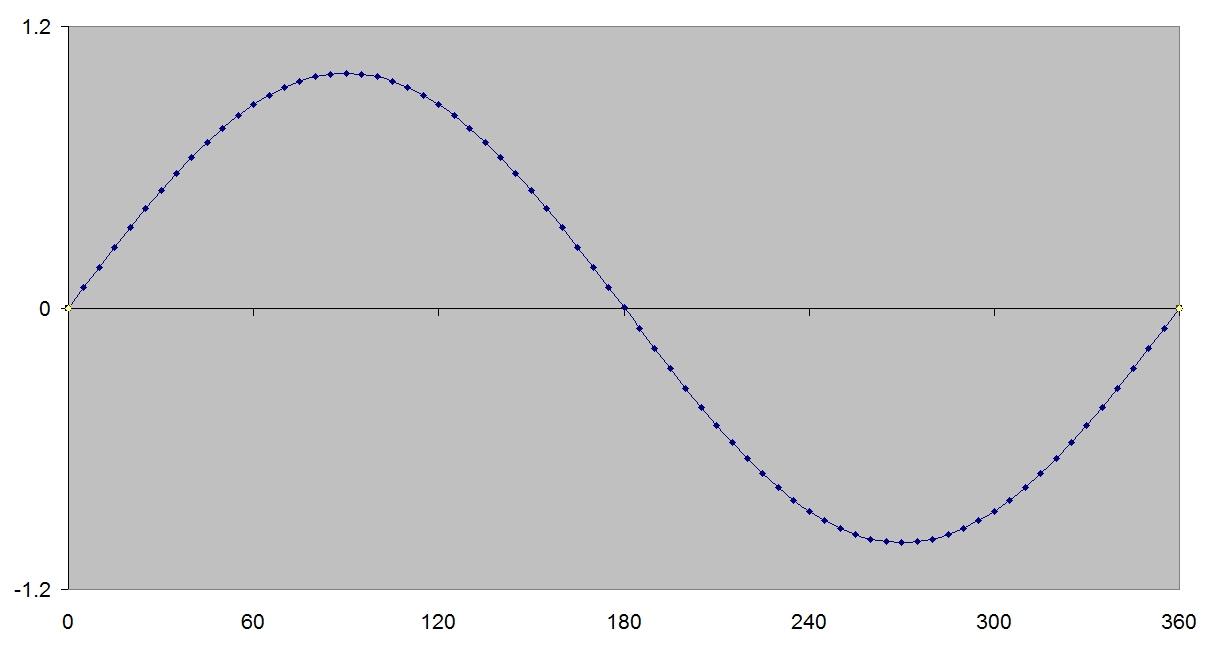
Later on, in high school, you may have learned in your math class that the shape the rope takes is that of the trigonometric function known as the Sine of an angle, Sin (θ). Or more properly a jump rope is half of a sine wave, the positive half on the up stroke and the negative half on the down.
As a function of angle, here in degrees, a sine wave is generated. Here the right half is a jump rope on the up swing while the left half is a jump rope on the down swing. (Credit: R. A. Lawler)
Now that half a wave phenomenon is an important point, because if you take a jump rope and twirl it really fast you can actually get a shape that is two-half waves, one up one down which of course makes a full sine wave. Even faster and you get three halves or 1½ waves, and so on. When I taught freshman physics I would always take a jump rope to class when we started to study waves and by tying one end to a door knob and twirling the other as fast as I could I usually managed to get six half or three full waves.
With practice it is relatively easy to get a rope to produce multiple ups and downs. This guy is actually doing that with two ropes at once. (Credit: Men’s Journal)
No matter how hard you try however, you will never get 2/3 of a wave, or 1¼ waves or something like π waves. Only integer multiples of ½ of a wave are allowed, ½, 1, 1½, 2, 2½, 3 and so on. In physics these special values have been given the name Eigenvalues, which is German for characteristic values.
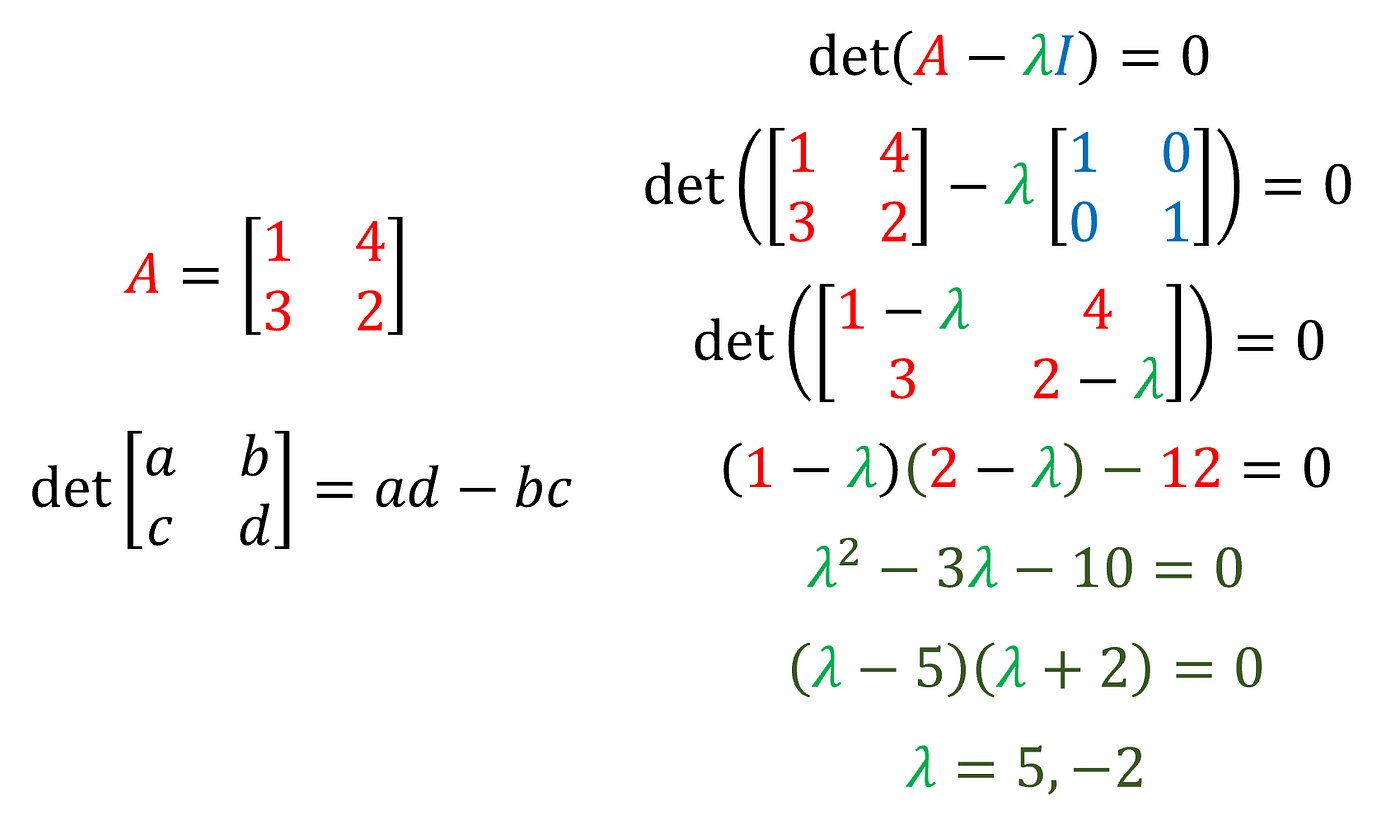
In pure mathematics eigenvalues are defined as the unique solutions to a set of equations whose coefficients are arranged as a matrix. The eigenvalues in this problem are the values 5 and -2. (Credit: Towards Data Science)
Eigenvalues are a fundamental attribute of every musical instrument. For example when you pluck a guitar string you get a shape very much like a jump rope, a half wave vibrating up and down and the speed of that vibration is the frequency of the sound that you hear. In a similar way the eigenvalue of an single organ pipe can be calculated so that it will sound the right note.
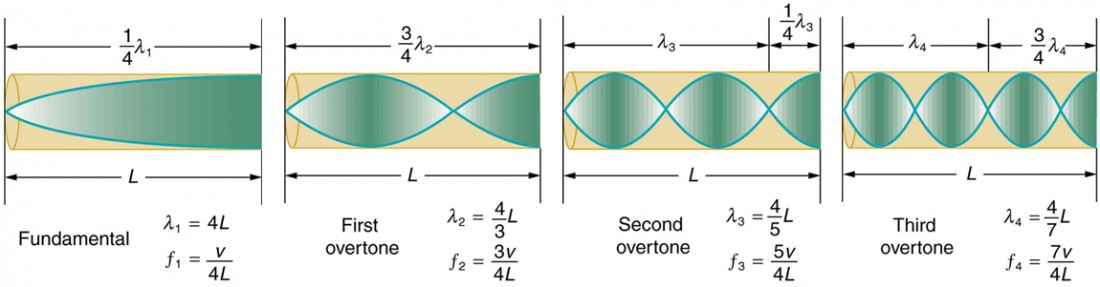
The eigenvalues for the sound produced by a tube closed at one end, an organ pipe. Also known in acoustics as the resonant frequencies of the tube. Musically these frequencies are the fundamental note of the organ pipe and its overtones. (Credit: Lumen Learning)
If you want to try a simple experiment take a 16oz. bottle of soda and drink about half of it. Then, holding the bottle upright so the soda doesn’t spill out, blow across the opening at the top, what you’ll hear is a fairly high pitched note. Now drink about another quarter of the soda so you still have about a quarter of it left and repeat blowing across the opening. Notice how the note is different; it’s a lower note. Finally finish your drink and repeat blowing across the opening; the note will sound even lower, deeper.
If you get several bottles with different levels of liquid in them you can even construct your own musical instrument. (Credit: Quora)
It’s the size of the air chamber in the bottle, along with its shape, that determines the frequency or the note you hear. The larger the chamber the larger the fundamental eigenvalue and therefore the lower the note.
Organ pipes come in a variety of sizes because the larger the volume of the pipe the lower the frequency, the lower the tone. (Credit: Diaqnoz.Az)
All musical instruments make use of this eigenvalue phenomenon and being able to calculate the eigenvalues of an instrument is important in being able to design one. Now the examples I’ve talked about so far, the jump rope, guitar string, organ pipe and even the soda bottle are all basically one dimensional systems. Even for the soda bottle it’s the longest dimension that primarily determines the fundamental frequency.
For stringed instruments, like this guitar, it’s the tension that the string is under, as well as its length that determines the frequency of the sound it produces, its tone. (Credit: Artist Guitars)
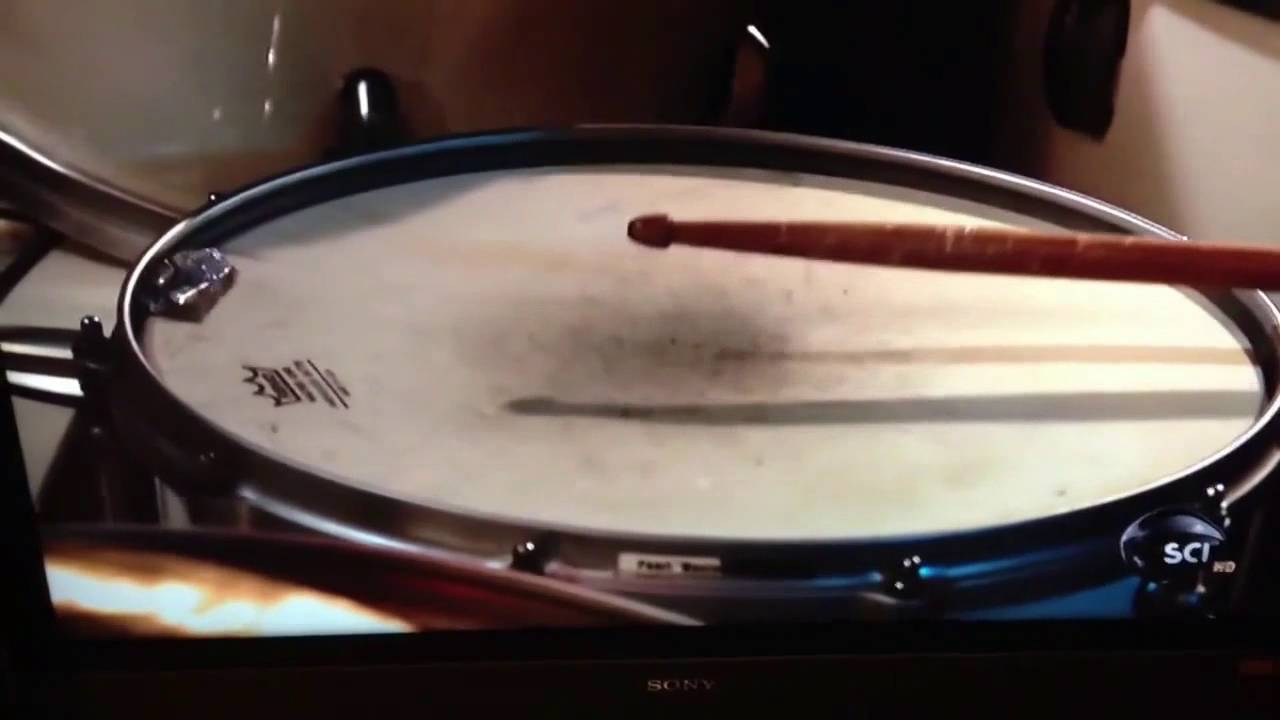
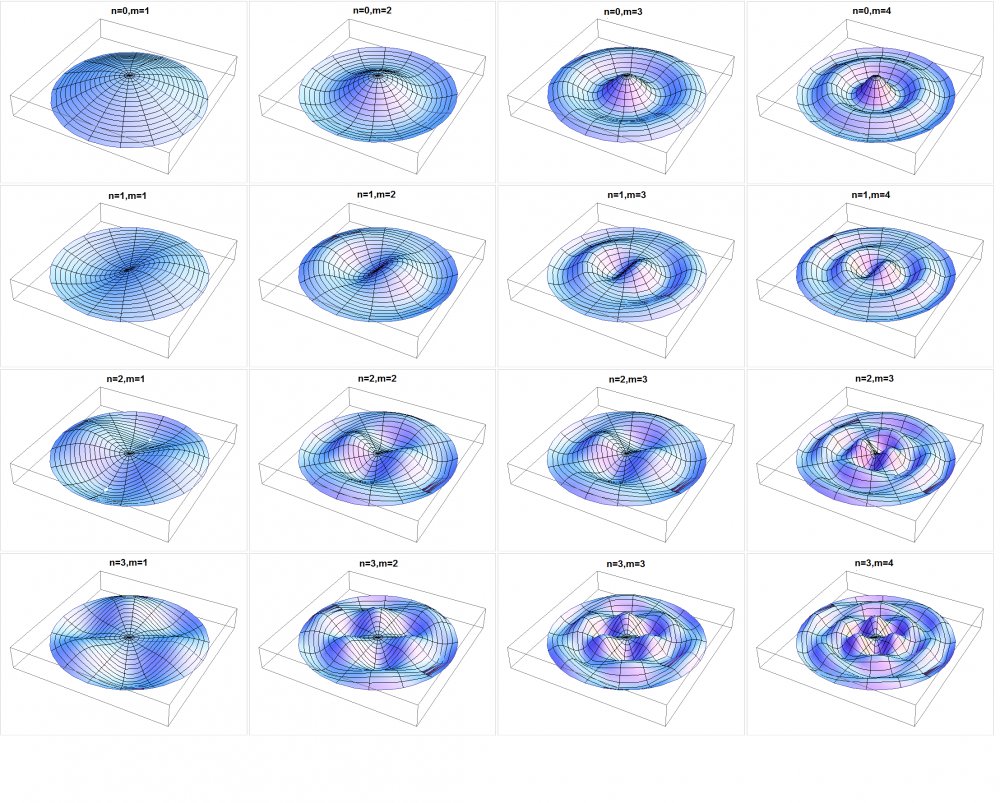
There are two dimensional instruments as well, the best known of which are drums, that flat sheet of animal skin stretched across the round drum base is what vibrates to create a sound. Now a two dimensional problem like the disk of a drum is quite a bit more difficult to calculate than the one dimensional one, orders of magnitude more difficult in fact. You can actually get a two dimensional disk to vibrate in different ways by striking it in different places. Striking a drum head in the center causes it to vibrate something like a jump rope, if you looked at a cross section at least. Striking the drum head off center however can cause one side to go down while the other side goes up in a fashion unlike any one dimensional wave.
At first glance a drum skin may look like a pretty simple instrument. (Credit: YouTube)But actually the vibration eigenvalues, the variety of ways that a drum skin can vibrate are very complex, requiring some very difficult mathematics. (Credit: thairghs.com)
Back in 1954 a mathematician named George Pólya stated a conjecture where you could calculate the shape of a two dimensional surface from the frequency of the sounds it gave off. Pólya succeeded himself in proving his conjecture for a two dimensional surface that is made up of shapes that tile together, see my post of 22 April 2023 for more information on geometries that tile. Round disks, like a drum head, however do not tile and Pólya never managed to prove his idea for disks.
Mathematician George Polya was another one of the European scientists who fled to the United States during the Nazi era giving us the advantage of his brilliance. (Credit: Wikipedia)
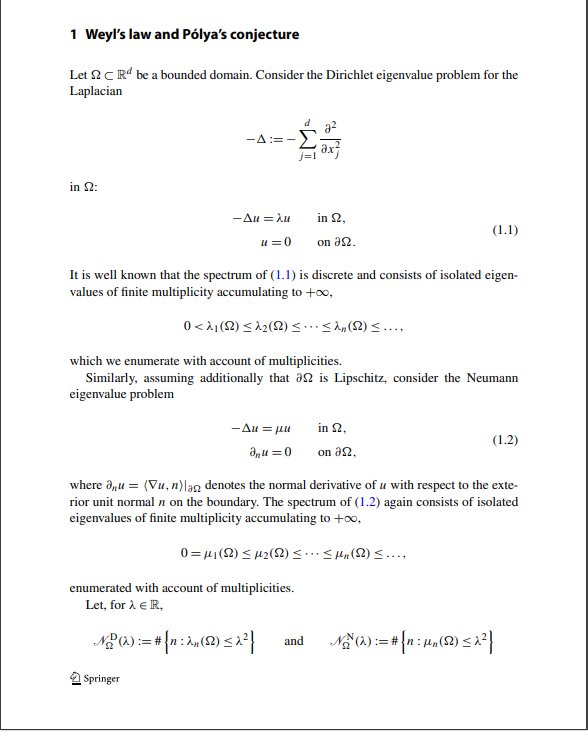
Now an international team of mathematicians, Nikolay Filonov from Steklov Institute of Mathematics in St. Petersburg Russia, Michael Levitin of the University of Reading in the UK, Losif Polterovich from the University of Montreal in Canada and David Sher of DuPaul University in the US, have succeeded in proving Pólya’s conjecture for disks. Their proof has been published in the journal Inventiones Mathematicae and while that proof may be an abstract piece of mathematical analysis it could also lead to practical applications in many fields, not just music.
Just the first of 41 pages of complex mathematics needed to prove Polya’s conjecture. (Credit: Filonov et al)
Eigenvalues are a factor wherever waves occur, acoustics, hydrodynamics, electronics and perhaps most famously in quantum mechanics. So any advance in our understanding of eigenvalues is a step forward in our understanding of the world around us.
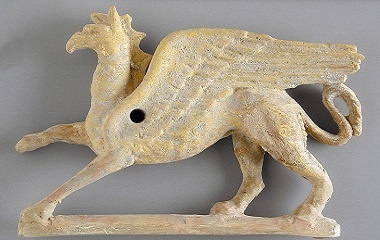
We know from historical records that human beings have been finding the remains of large unknown animals for thousands of years. The ancient philosophers who mentioned such fossils usually described them as coming from mythical creatures like giants or dragons or griffons. The idea that these bones belonged to animals that had gone extinct is actually a very new one; even Thomas Jefferson wrote that God would not allow a species to go extinct.
A carved Griffon from ancient Greece. Early humans imagined many such fantastic creatures but how many were actually inspired by the fossil remains of Dinosaurs? (Credit: Mythology.net)
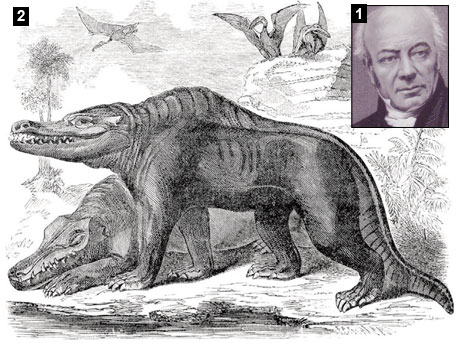
It wasn’t until the early 19th century that scientists began to really study these fossils in earnest and realized that some of these creatures, trilobites for example, simply no longer existed anywhere on Earth. So the science of paleontology began. One of the major factors that led to this revolution were the unearthing of some bones that belonged to very large reptiles in Oxfordshire England by the Reverend William Buckland a professor at Oxford and literally the first person to be officially called a Professor of Geology.
The Reverend William Buckland was the world’s first “official” geologist creating that title for his position at Oxford University. (Credit: Simple Wikipedia)
Buckland knew that the bones he’d discovered belonged to reptiles not mammals not only because of their anatomical shape but also because the bones of cold-blooded reptiles are denser, not like the bones of mammals that have many more blood vessels flowing through them. Buckland estimated the size of his creature at as much as forty feet. (Notice I’m using Imperial units here because we’re talking about an early 19th century English scientist.)
The first dinosaur to be described was Megalosaurus here pictured as William Buckland imagined it looked. (Credit: Down to Earth)
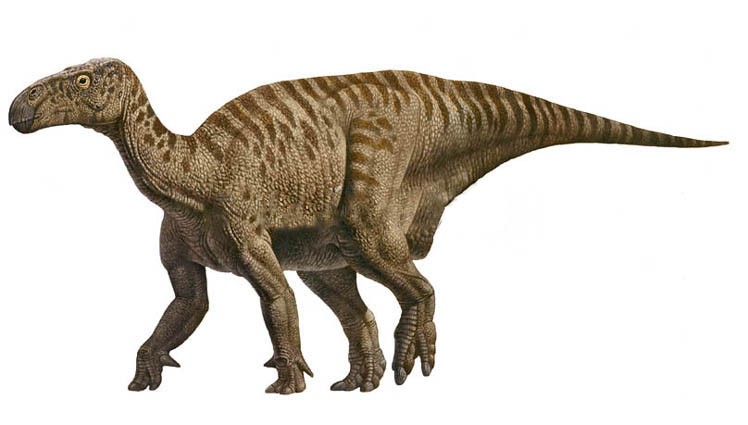
It was just two hundred years ago; in 1824 that Buckland published his results naming his creature Megalosaurus, which literally means ‘big lizard’. A year later Buckland would describe a second reptile, almost as big as Megalsaurus, which he named Iguanodon because its bones reminded him of those of an iguana, only much larger. It wasn’t until 1841 and the discovery of several other large extinct reptiles however that it was decided to group these animals together under the name Dinosaur, meaning ‘Terrible Lizard’.
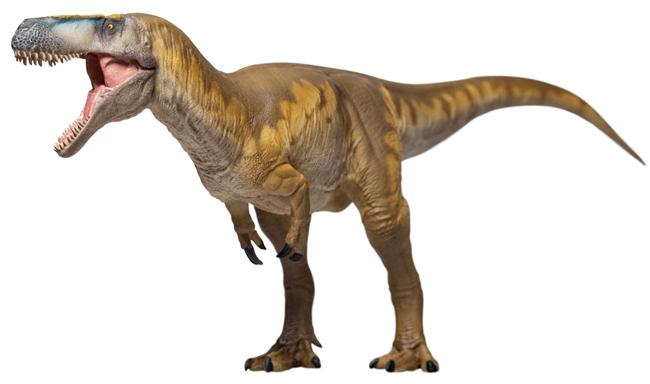
Megalosaurus as modern paleontology has revealed it, a two legged predator more like a T rex than the four legged lizard William Buckland thought it was. (Credit: Everything Dinosaur Blog)
Now Buckland had only a few dozen bones to study and of course since these were the first dinosaurs to be analyzed he only had living reptiles to compare them to. He did correctly guess that Megalosaurus was a meat eater while Iguanodon was an herbivore, but he also pictured both as clumsy overgrown lizards walking on all fours and probably amphibious in nature.
Buckland also named the second dinosaur species, Iguanodon because its teeth reminded him of the teeth of the modern lizards. Here is a modern illustration of one. (Credit: The Dinosaur Database)
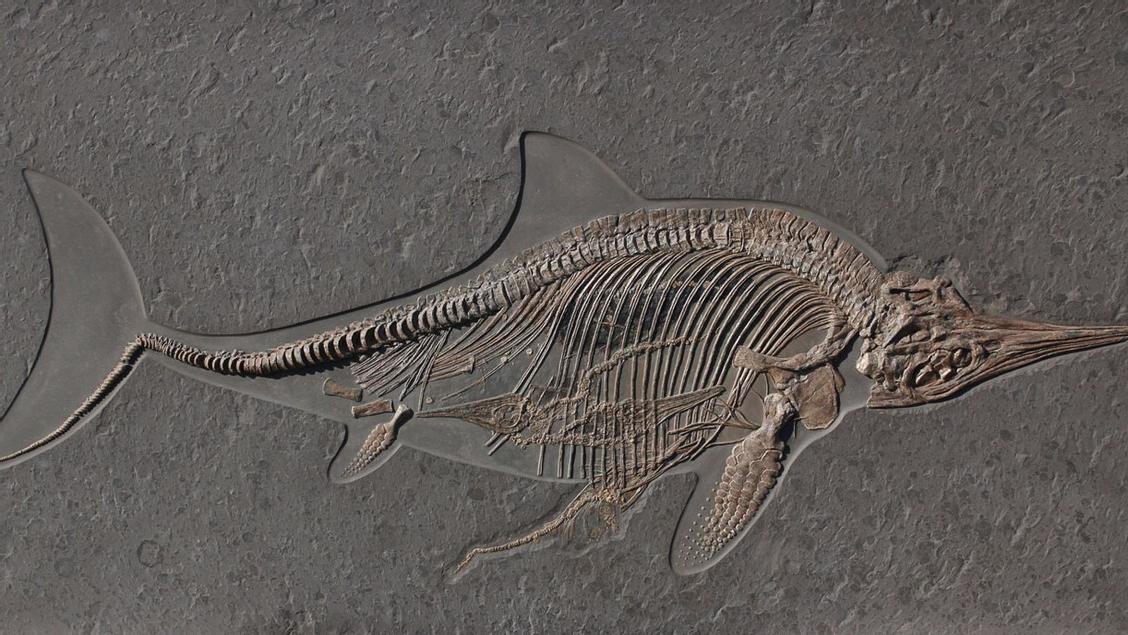
Soon after the discovery of those first dinosaurs other kinds of extinct reptiles, like the Ichthyosaur (fish lizard) and the pterosaurs that had leathery wings that enabled them to fly. These creatures were also described by comparing them to living reptiles with Ichthyosaurs being depicted as something like a crocodile while it was assumed that at best the pterosaurs could only glide with their wings. All in all the creatures who lived during the ‘Age of the Reptiles’ the Mesozoic era were thought to be slow moving, slow witted, spending at least some of their time in the water and basically just big versions of monitor lizards and crocodiles.
At the same time that the first Dinosaurs were being discovered fish like reptiles were also unearthed and named Ichthyosaurs. Here’s one that died at the very moment of giving birth! (Credit: Central Washington University)
It’s taken a long time to correct those early impressions and in many ways of course we’re still learning about the many wondrous creatures of the Mesozoic Era. One of the biggest discoveries came from right across the Delaware River from where I live. In 1858 a farmer named John Estaugh Hopkins in Haddonfield, New Jersey dug up some large bones from a marl pit on his land. Hopkins showed the bones to a friend William Parker Foulke who then dug out many more bones.
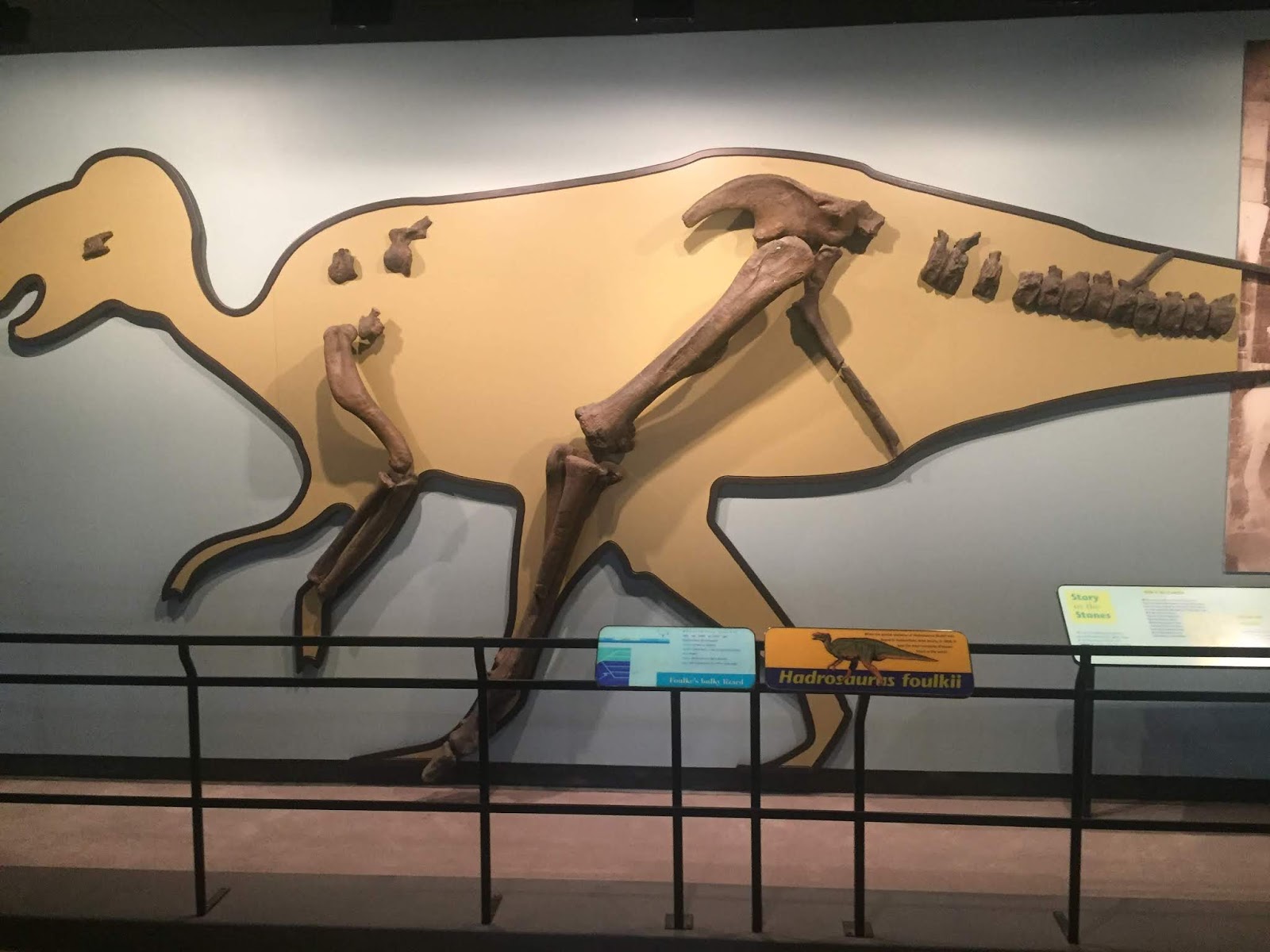
The bones of Hadrosaurus foulkii at the Academy of Natural Science. At the time of its discovery this was the most complete skeleton of a dinosaur ever found but even with these few bones Joseph Leidy was able to demonstrate that some dinosaurs walked on two legs. (Credit: Prehistoric Beast of the Week)
Foulke contacted the geologist Joseph Leidy at the Academy of Natural Sciences in Philadelphia who brought the bones to the Academy for study. Eventually Leidy had more than seventy bones and teeth fragments of the animal, by far the most complete dinosaur skeleton at that time and when published the animal was named Hadrosaurus foulkii. The completeness of the skeleton, including rather compete forelimbs and hindlimbs, enabled Leidy to make the astounding assertion that H foulkii walked on two legs. Then, 1858 H foulkii became the first full dinosaur skeleton to be mounted and publicly displayed at the Academy, where I have seen it many times.
The Academy of Natural Sciences in Philadelphia, the oldest scientific institute in the US. (Credit: The Academy of Natural Sciences of Drexel University)
Before long it was realized that many species of dinosaur were two legged. Famous examples include Tyrannosaurus rex and other meat eaters along with the plant eating ‘Duck Billed’ dinosaurs like H foulkii. Even Buckland’s original dinosaurs Megalosaurus and Iguanodon are now accepted as being two legged.
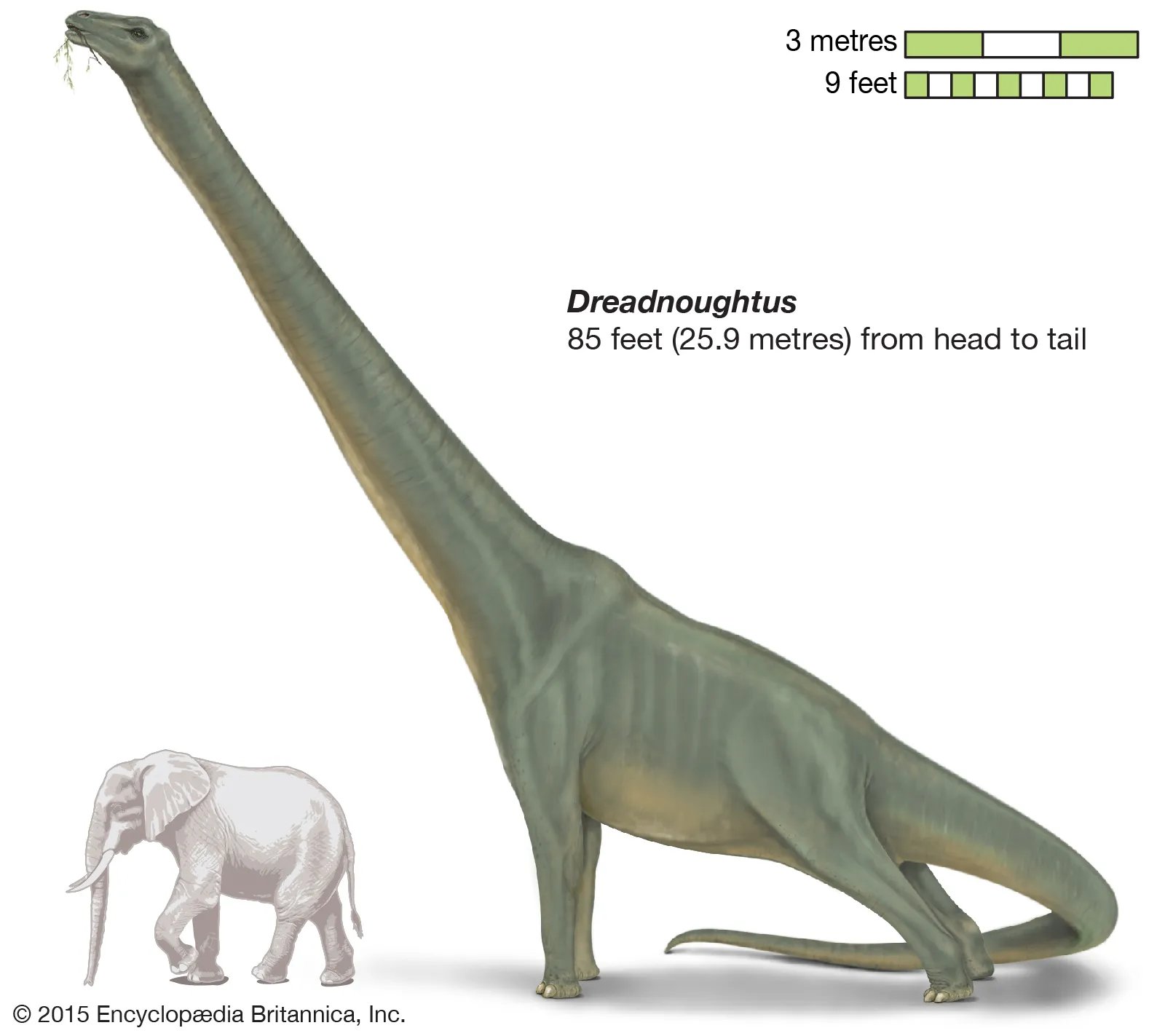
Not all dinosaurs are two legged. In fact the largest animals to ever walk on land were the enormous sauropod dinosaurs. (Credit: Encyclopedia Britannica)
Not all dinosaurs are two legged however. Along with the horned dinosaurs like the Triceratops and the armored Stegosaurus and Ankylosaurus there were the Sauropod dinosaurs, some of which were among the largest animals to have ever lived. Despite the growing variety of species however the dinosaurs were still thought of as cold-blooded reptiles, slow moving, solitary in nature and probably monochrome in colour.
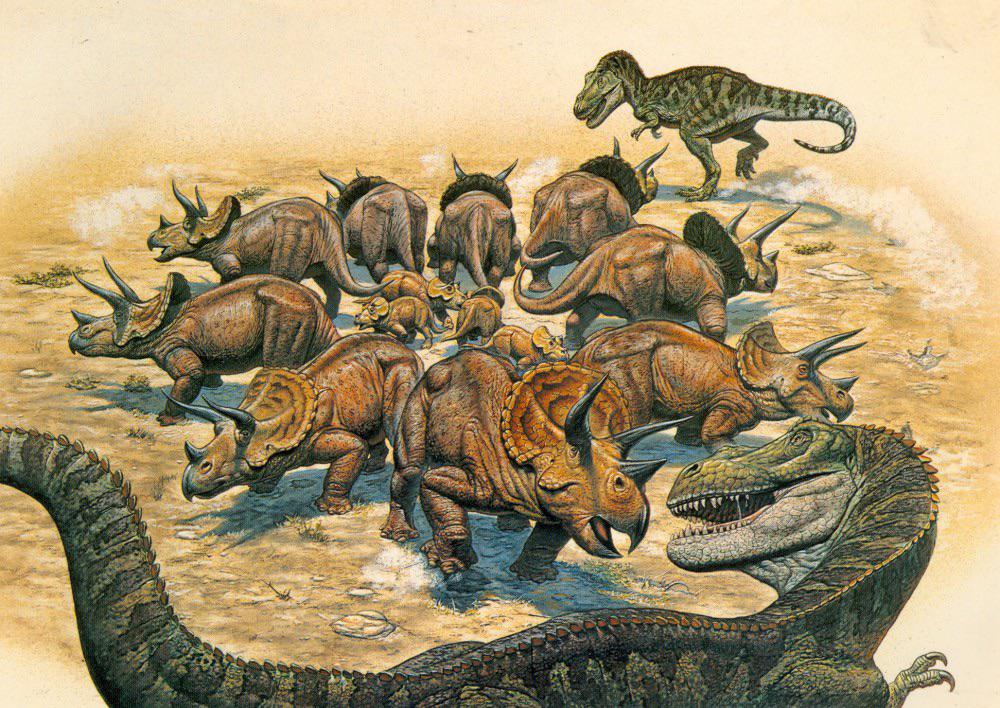
Well get your triceratops in a circle! Today we even consider the possibility that some species of dinosaurs lived in herds and worked together as a group for protection. (Credit: Reddit)
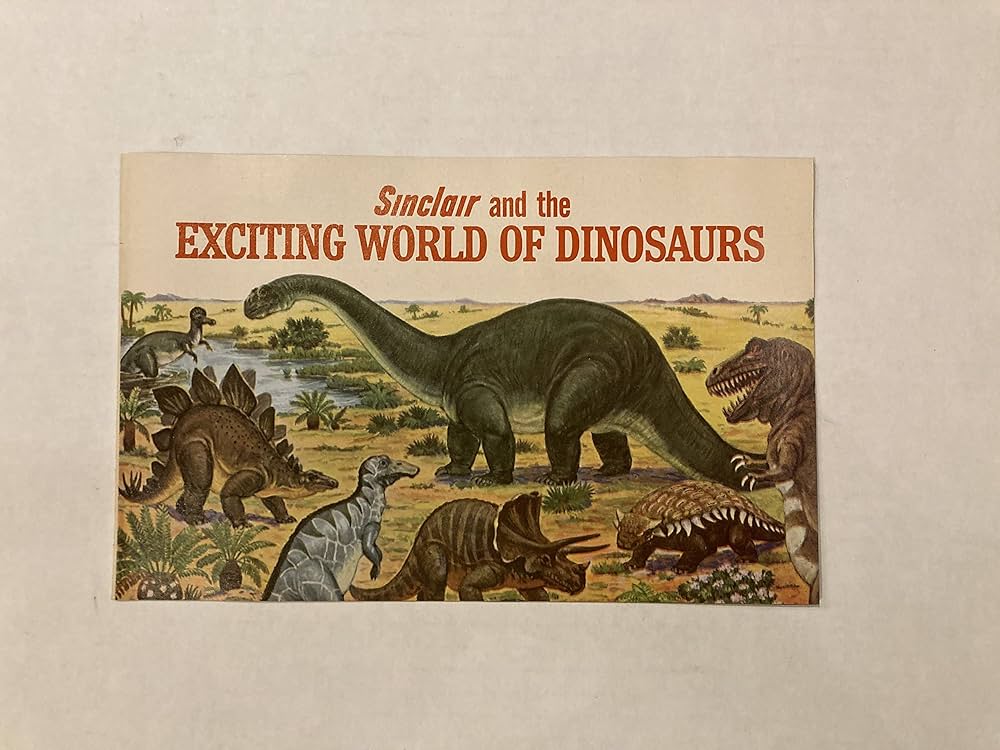
This view persisted right into the 1960s. It’s how I first learned about dinosaurs. In the decades that followed a series of fossil sites changed much of our view of how some dinosaurs lived. A dinosaur graveyard in Alberta Canada that contained scores of dead Triceratops showed that some species must have lived in large herds and therefore must have possessed some social behavior. At the same time the nests of a species of duck billed dinosaur called Maiasaur were unearthed that showed evidence that the babies were being cared for by the parents, Maiasaur means ‘Good Mother Lizard’. Some paleontologists then even considered the possibility that some dinosaurs were warm-blooded. In fact some now maintain that the dinosaurs haven’t really gone extinct, they argue that our modern birds should be reclassified as dinosaurs.
When I was a boy one of my favourite possessions was the book on dinosaurs given out by Sinclair Oil Company for the 1964 World’s Fair in NYC. (Credit: Amazon.com)
So we’ve come a long way. From dinosaurs being just big reptiles to them being a fascinating group with a tremendous variety of different lifestyles and behaviors. We should celebrate the dinosaurs therefore; after all they ruled our planet for 150+ million years, far longer than we have. Remember, if it weren’t for that asteroid they’d probably still be here, and we wouldn’t!
On the 8th of April 2024 North America was treated to one of the most spectacular astronomical events as a total eclipse of the Sun raced across Mexico, 13 of the United States along with the Maritime Provinces of Canada. I started my planning for the eclipse last year and decided that Texas had the best chance of good weather in April. When it comes to eclipses it’s all about the weather and getting your arrangements made early!
Thanks to the Internet booking a hotel months in advance is easy now. That’s means if you want to witness an eclipse all you have to worry about is the weather. (Credit: Newsweek)
The town in Texas I choose is known as Greenville, just about 50 kilometers to the east of Dallas which was scheduled to see four minutes and five seconds of totality, weather permitting. Anyway, by last Thanksgiving I had my flight planned and motel booked for the event. All I needed was clear skies.
Shout out to Greenville, Texas. You did a great job of welcoming eclipse viewers like me! (Credit: YouTube)
Now I saw my first total eclipse in Sweetwater Tennessee back in 2017. Like Sweetwater, Greenville made quite a few preparations for the crowd of people that could be expected to arrive to see the eclipse. See my post of 24 August 2017 for my report on that eclipse. However, whereas Sweetwater had closed off their main street and a small park for the eclipse, Greenville set up for this year’s eclipse in a large Sports Park just outside of the town where there was plenty of room for parking and a nice big area for food and other vendors to set up. The town even hired a DJ to provide music in the hours before the eclipse and went to the trouble of erecting about 30 picnic tables. Everything was ready we just needed good weather.
Part of the arrangements that the town of Greenville made for the people who came to see the eclipse. (Credit: R. A. Lawler)
The day before the eclipse was mostly sunny as I did some fossil hunting at the Ladonia Fossil Park along the Sulfur River and when 1PM arrived I remember thinking, “if only tomorrow at this time is this clear!” It wasn’t. The morning of the eclipse dawned with a thick layer of clouds blanketing the sky and we anxiously checked the weather forecasts to see if there was any hope of the sky clearing for the time of totality at 1:42 PM. According to the forecasts there was hope of some clearing by noon, partly sunny to mostly sunny depending on which weather report you read.
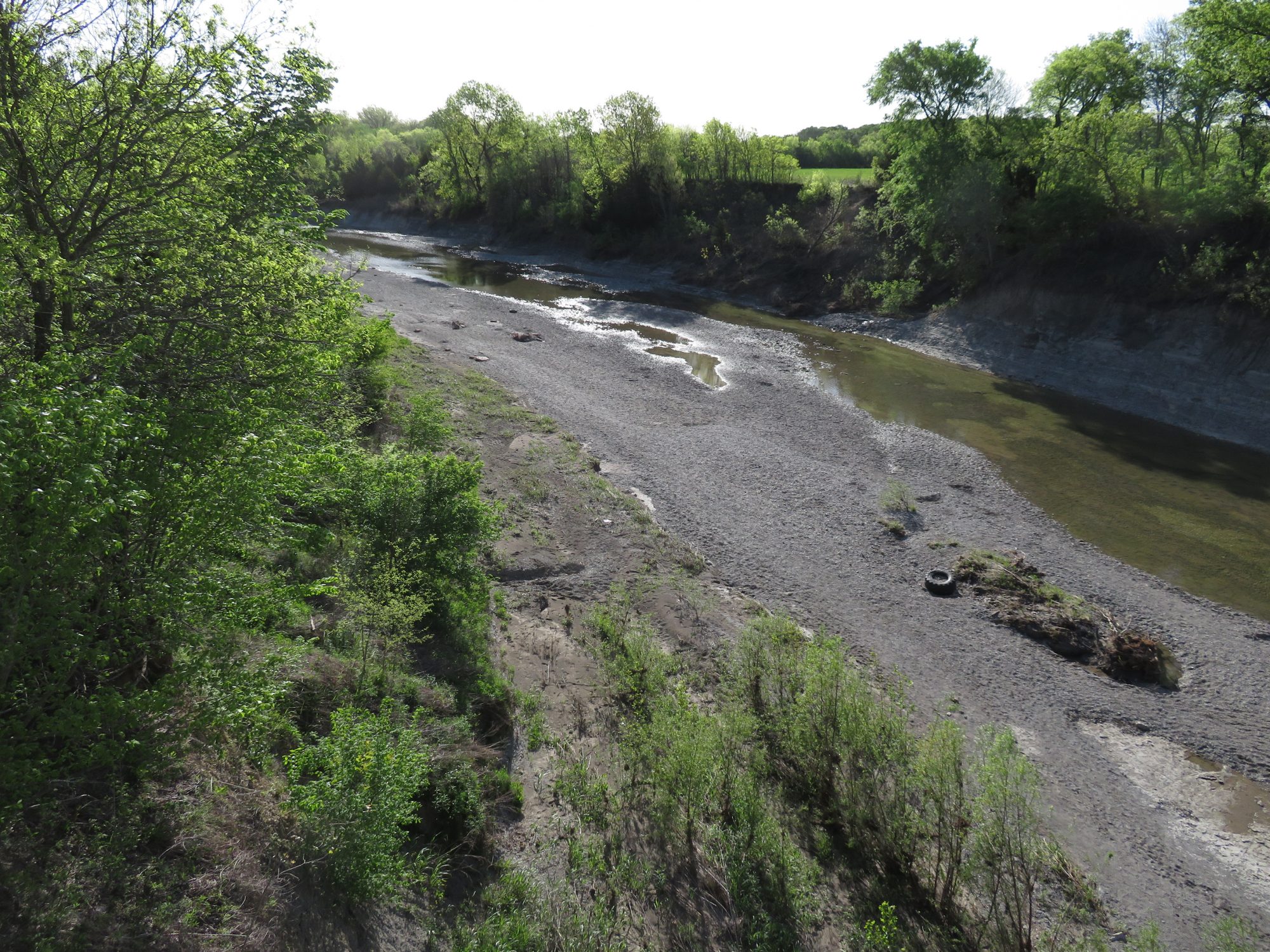
The banks of the Sulfur River just outside of Ladonia, Texas is a little site set apart for fossil hunters. The fossils here are marine specimens from the late Cretaceous period. (Credit: E. M. Lawler)
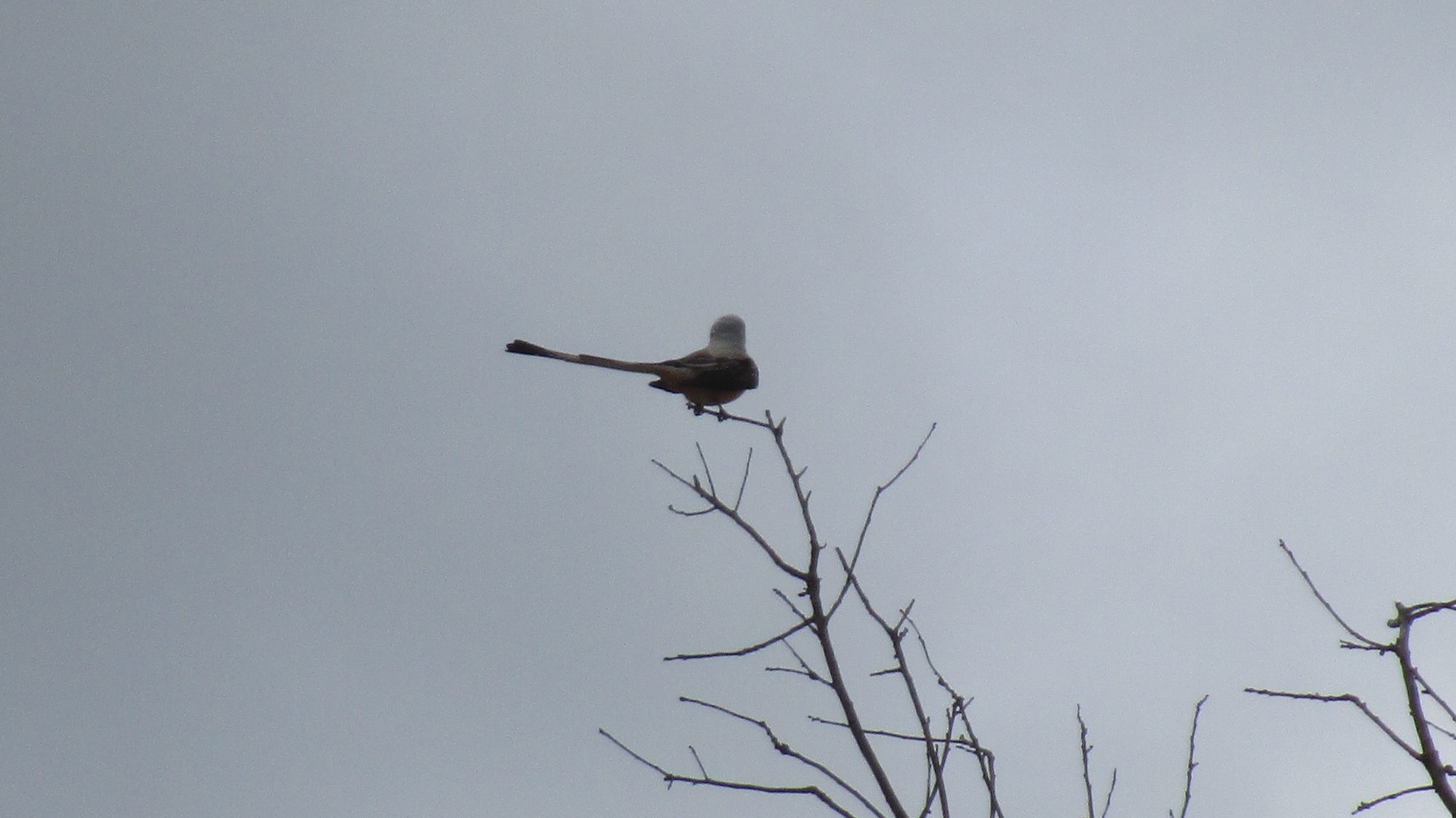
Anyway we were the very first to arrive at the parking lot at about 8 O’clock so we got the best spot to park in. None of the vendor’s opened until 10 O’clock however so we had two hours to wait. As we waited my sister spotted a couple of Scissor-tailed flycatchers which kept her busy trying to get some good pictures of them while my brother and I just worried about the cloud cover.
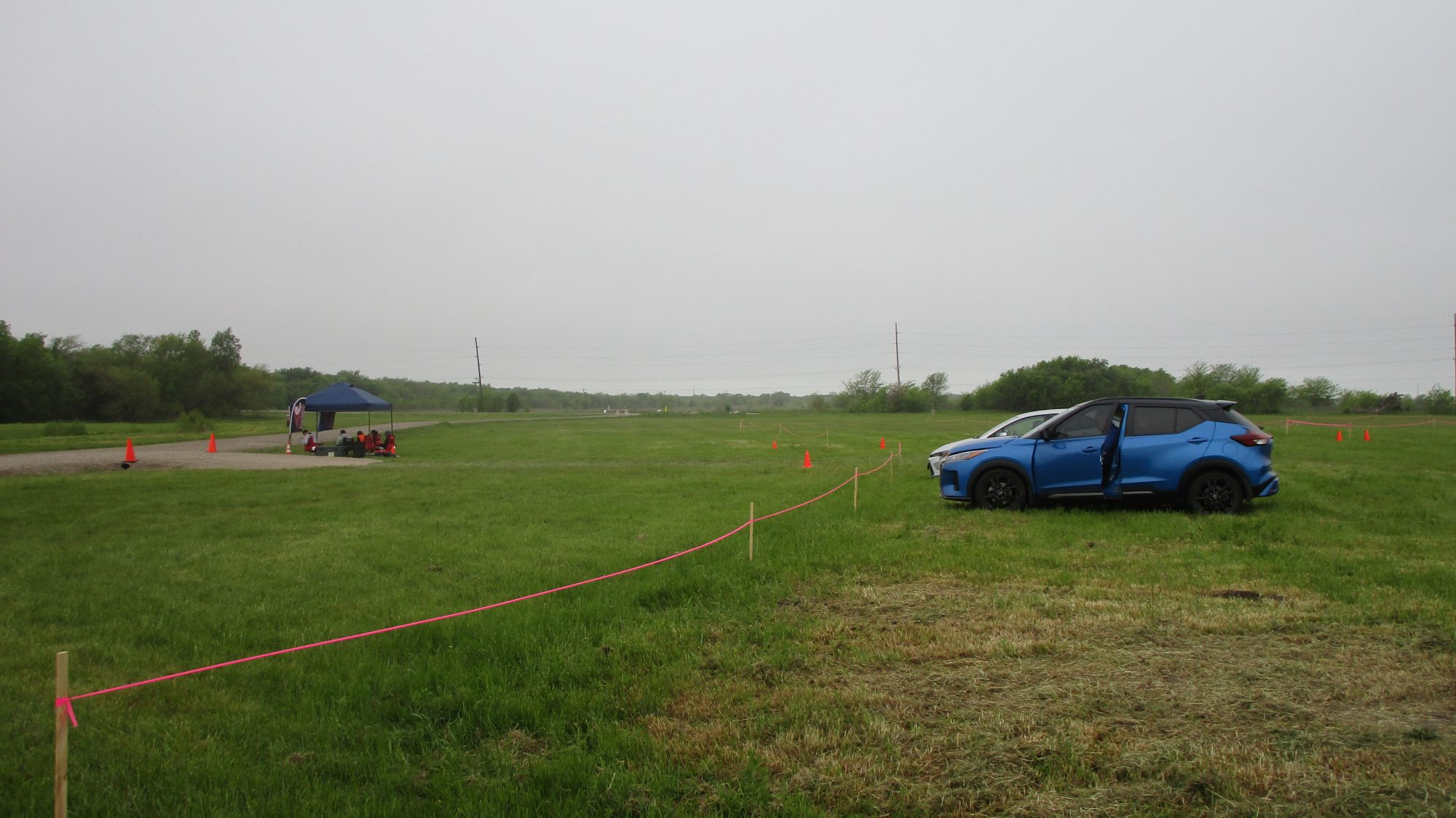
We were the first in the blue rent-a-car. The silver car behind us came in just after us. (Credit: R. A. Lawler)The pair of Scissor-tailed Flycatchers flying around the site Greenville had set aside of eclipse viewing provided some entertainment in the hours before the eclipse started. Notice the thick cloud cover behind the bird! (Credit: T. G. Lawler)
By 10 O’clock you could see that the clouds were thinning even though they still covered the sky. By 11 there were a few small breaks and around 11:30 the Sun finally started appearing in and out of the clouds so that we could actually use the eclipse glasses and the eclipse binoculars I bought.
That’s me with the binoculars with my brother Tom in the blue shirt. My sister Ellen took the picture. (Credit: E. M. Lawler)
The partial eclipse started at just about noon and with the thin wispy clouds you often didn’t need the eclipse glasses because the clouds cut out just enough light so it didn’t hurt your eyes. As we watched the sky cleared more and more although the clouds never completely dissipated.
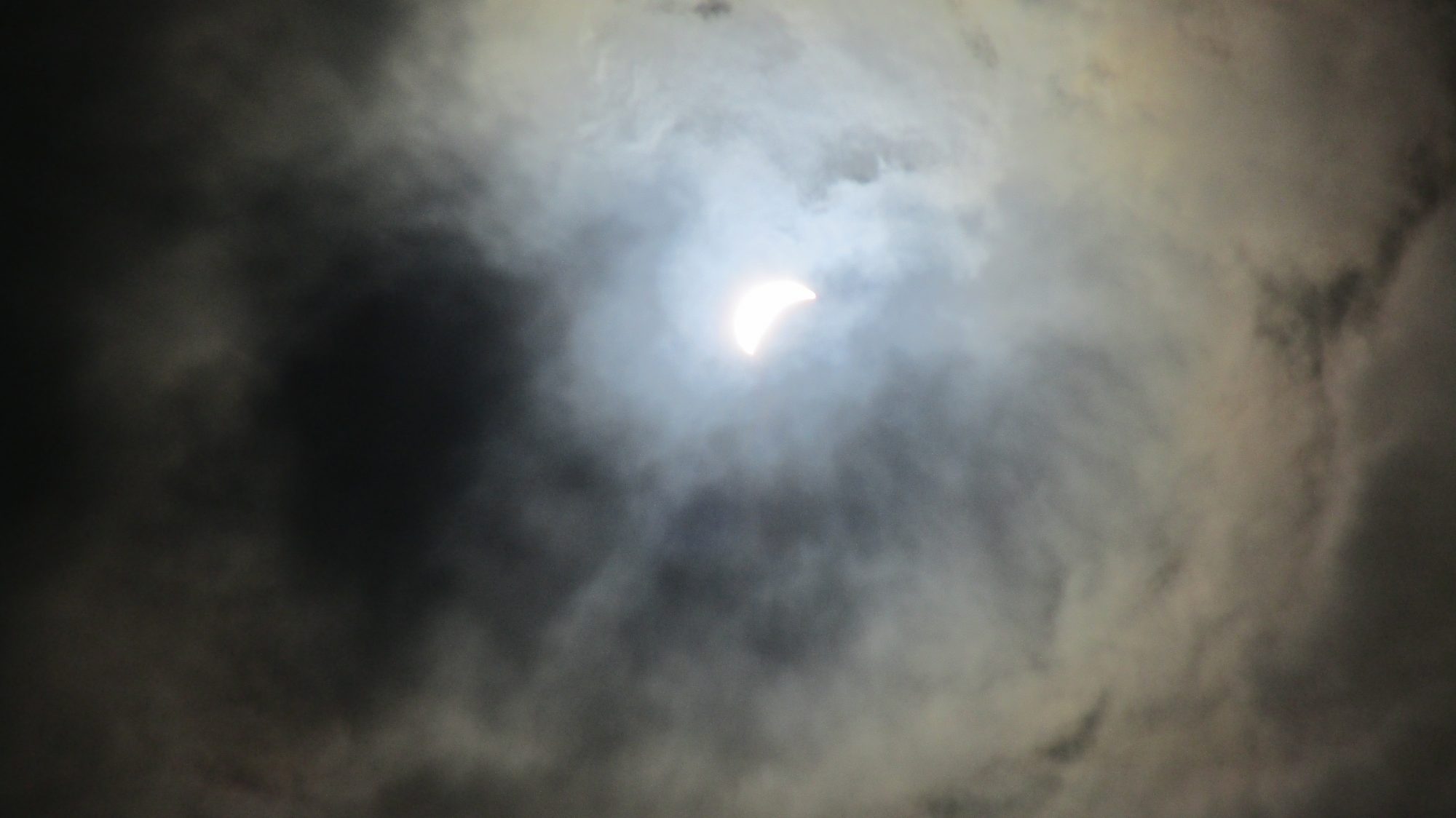
During first half of the partial eclipse the clouds were still so thick you didn’t need any protection to view the Sun. (Credit: R. A. Lawler)
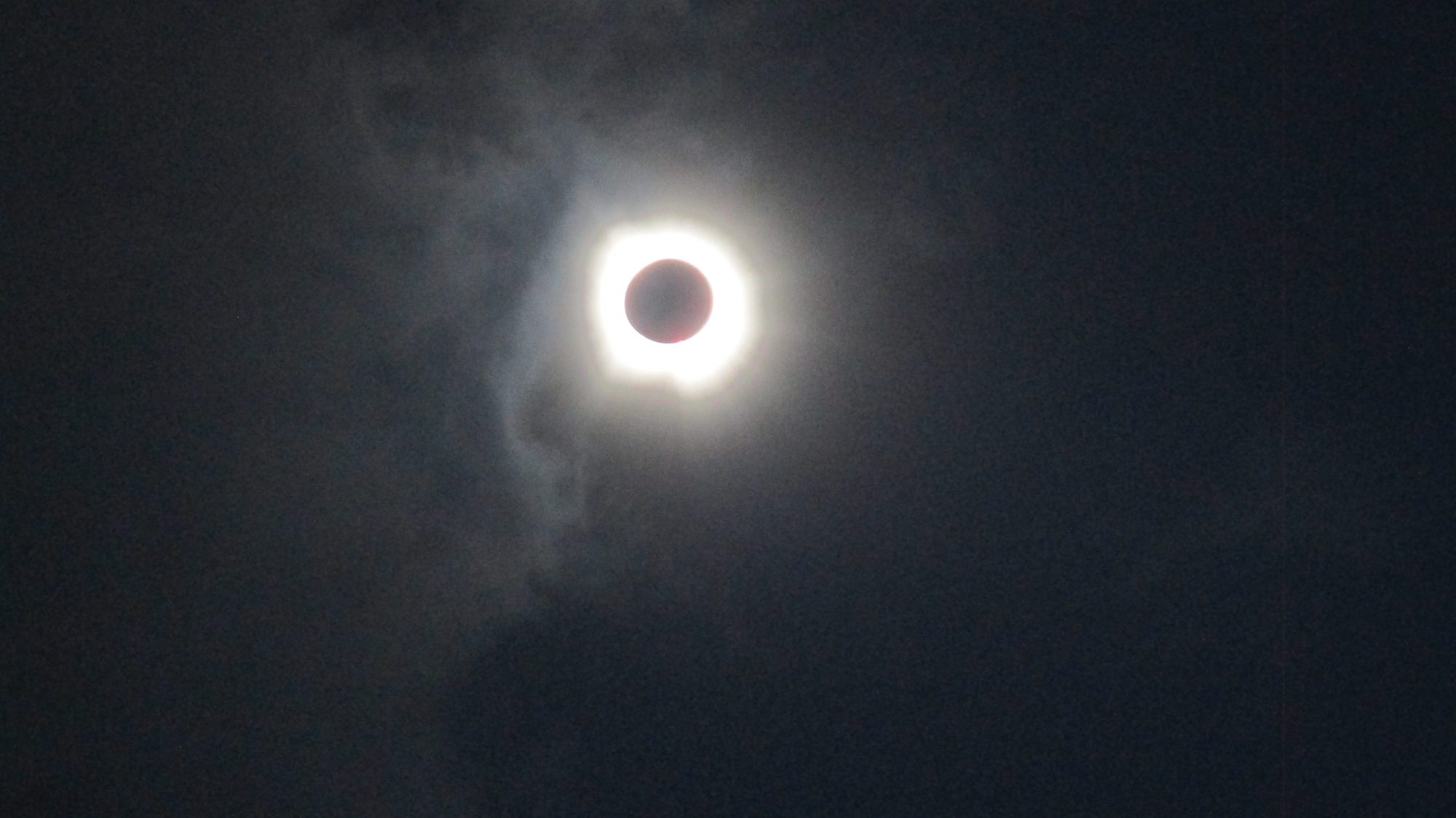
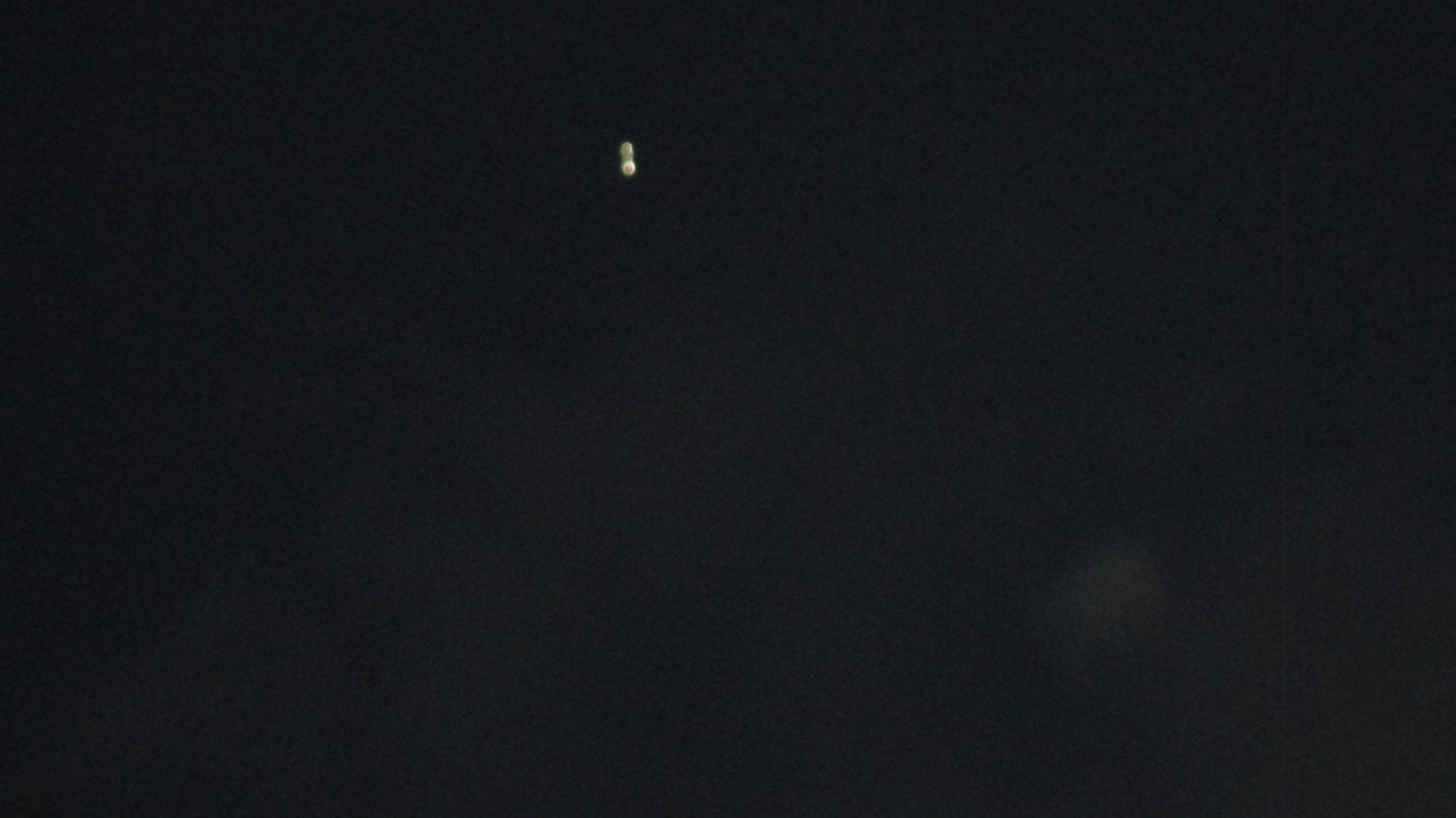
When totality came at 1:42 PM there were still a few thin clouds that passed in front some of the time but despite them we were able to see the entire four minutes and five seconds of totality. In fact the light of the corona passing though the clouds made the eclipse look quite spectacular, although it probably made any real scientific measurements impossible. By the way the skies around the eclipse also cleared enough for me to see both the planet Venus and, for a few seconds Jupiter.
Totality! The slight hint of red just round the black circle are actually solar flares that were occurring during the eclipse. This year is solar maximum after all! (Credit: T. G. Lawler) A quick, and not very steady image of the planet Venus during totality. Jupiter was also visible for just a couple of seconds but if the sky had been clearer Mercury, Mars and Saturn could also have been seen! (Credit: T. G. Lawler)
Since our motel was only a few kilometers away we stayed after totality and watched most of the partial eclipse that followed. Most of the crowd left immediately however, as did the vendors so around 2:30 we also packed up our stuff and headed back to our motel. Even as we were leaving the skies were beginning to darken again and that night around 8:30 a severe thunderstorm with heavy hail rained down as we relaxed in our room.
Up to quarter sized hail rained down on large portions of northern Texas just hours after the eclipse. So I get really lucky! (Credit: HailPoint.com)
So I feel I got lucky, I got to see my second eclipse despite some bad weather. With two total eclipses along with a transit of Venus and a transit of Mercury the two big items remaining in my astronomical bucket list now are the Northern Lights and a really good Occultation by the Moon. If I ever see either of them I’ll be sure to let you know!
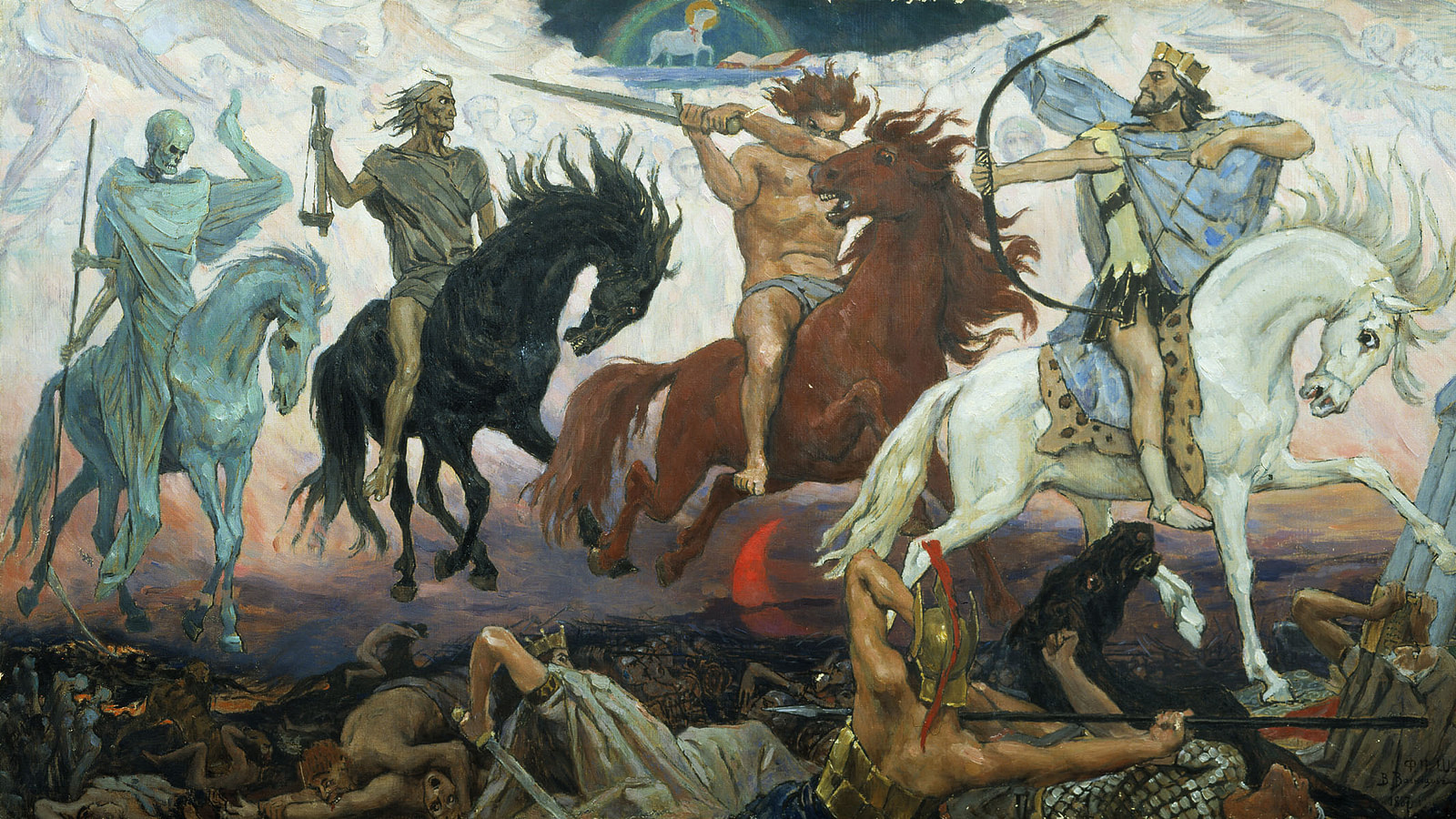
Apocalyptic disasters that destroy all but a small handful of human beings have been written ever since the flood story in the Lay of Gilgamesh, from which the flood story in the Bible was derived. Such catastrophe epics became even more popular after the invention of nuclear weapons when humanity gained the ability to cause our own destruction. Whether by an act of God or by our own technology apocalypses are a definite genre in SF.
The Four Horsemen of the Apocalypse. Why are so many people actually anxious for the ‘End of the World’ to come. Do they really think that they’re going to be better off somehow?????? (Credit: World History Encyclopedia)
‘The Ark’ by Christopher Coates is such an end of the world story. Astronomers have discovered a comet that will approach Earth in three years. It’s not going to hit us, but it will pass very close and its tail is extremely radioactive. Material from that tail will go into orbit around our planet, slowly seeping into the atmosphere for twenty years, killing every living thing on the surface. So ‘The Ark’ is an Act of God type of apocalypse. I have quite a few problems with this ‘radioactive comet’ scenario but I’ll save them for later.
Cover Art for ‘The Ark’ by Christopher Coates. (Credit: Amazon)Author Christopher Coates. I think he’s the one on the left. (Credit: Next Chapter)
By a sheer coincidence I started reading ‘The Ark’ at the same time as the 60th anniversary of the Stanley Kubrick movie ‘Doctor Strangelove’. You may recall how, at the end of that movie a Soviet ‘Doomsday Device’ is going to blanket the entire world with enough radioactive fallout to kill every living thing.
It was just a coincidence that I rewatched the movie ‘Doctor Strangelove’ as I was started to read ‘The Ark’ but the idea of people surviving radiation by going into mine shafts is a big part of both. (Credit: American Cinematheque)
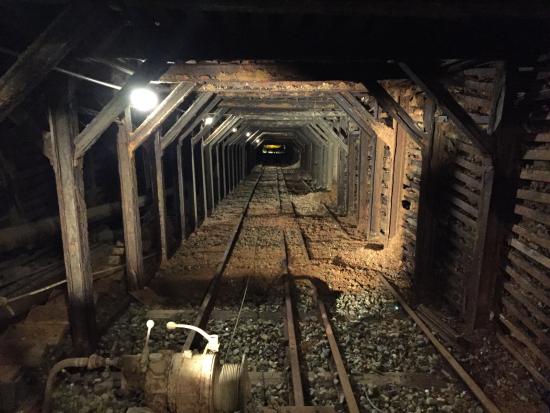
“Mister President,” Strangelove announces as the doomsday device is triggered. “I would not rule out the possibility of preserving a nucleus of human specimens.” His plan is to set up living quarters for a few thousand people deep underground in mine shafts until the radiation is gone. I have to wonder if author Christopher Coates got his theme from Strangelove because that’s pretty much the plan in ‘The Ark’.
Yes, the United States does have a lot of mine shaft space but it’s not exactly the kind of place I’d like to spend the next hundred years or so! (Credit: Tripadvisor)
Of course in the novel the plan is a great deal more detailed and it also includes the idea of human hibernation, in fact a good deal of the story concerns the development of hibernation technology. So 10,000 carefully selected people, experts in various fields that will be required in order to rebuild civilization are buried beneath the Rocky Mountains, along with a lot of equipment in a great big sleep chamber. At the same time smaller groups of people will try to survive for twenty years in mine shafts throughout the country.
Look, somebody’s already written a book with all the knowledge we need to rebuild civilization! So I guess we’re all ready then! (Credit: Bug Out Bag Builder)
I have several problems with ‘The Ark’ and I’ll start with the radioactive comet that triggers the whole thing. Intense radioactivity implies short-lived radioactivity. The intense radioactive element Radium is extremely scarce just because it is so radioactive. After a few billion years in the Oort cloud at the outskirts of our Solar System no comet is going to be extremely radioactive. Still, O’k for the sake of the story I’ll let that pass, suspension of disbelief after all. But then add in the bit about the radioactive material going into orbit and slowly seeping into our atmosphere. Finally, although US astronomers and NASA scientists realize the danger three years before the comet gets here no other country ever figures it out. In fact the rest of the world is pretty much ignored, only Americans are going to survive this apocalypse, we don’t even let the Brits or Canadians in on the end of the world.
The element Radium is extremely radioactive. That’s why it doesn’t last long! The idea of a comet that’s been out in the Oort cloud for billions of years being intensely radioactive at least needs some sort of explanation! (Credit: YouTube)
Still, suspension of disbelief for the sake of the story, that’s where the second problem comes in because the story in ‘The Ark’ is really pretty dry. There’s no conflict to speak of and the few plot twists don’t generate much suspense. In fact the whole novel reads more like a manual for surviving an apocalypse than a story about one.
‘The Ark’ has little personal conflict or actual fighting so there’s about as much drama in it as there is in a survival manual! (Credit: Karate Mart)
I’m not saying that ‘the Ark’ is a bad novel, it is a quick read and pretty much kept my attention. It certainly needs more work however. At least it could have a plausible reason for why the comet is so radioactive and add in some international intrigue to introduce some degree of conflict, some suspense. Finally the novel ends just as the rebuilding process has begun which makes me wonder if a sequel is already in the works.
In ‘The Ark’ the United States never even tells its closest allies about the radioactive comet! That’s a bit implausible and a little Foreign Intrigue over that fact might have made the story a bit more exciting! (Credit: Wikipedia)
So if you’ve got a few hours to spare for an interesting, if not exactly perfect end of the world novel you might enjoy ‘The Ark’ by Christopher Coates.
Anyone who is familiar with physics today knows that the mysteries being studied are pretty esoteric in nature. Things like Black Holes, Dark Energy, Marjorana Particles, Quantum Gravity; these are the subjects that occupy the physics community nowadays. The behaviors of everyday objects in our everyday world, those problems were all solved by Galileo and Newton, weren’t they?
Physics today has a reputation for being all about objects and situations far beyond normal human life. But that’s not quite true! (Credit: Pinterest)
Well, not quite. Turns out there are still a few problems; usually dealing with a large number of objects under special circumstances that physicists have never really been able to solve rigourously. Today I’d like to discuss two of these problems, one of which has finally been solved and another whose solution remains elusive.
The first problem, the one that has recently been solved is a familiar one to anyone who has shopped for fruits or vegetables. Greengrocers wanting to display their tomatoes or apples or other nice round fruit commonly do so by spreading them out on an inclined plane, see image below:
In your local supermarket the grocer wants to arrange his vegetables so as to fit as many as possible into as small an area as possible in order to sell more! (Credit: iStock)
Now, if you look closely at the peaches, plums, apples and oranges in the image you’ll see that by stacking them in tightly the fruits all form a nice hexagonal array. The question is, when a customer takes a single fruit out of the display what are the chances of them causing a collapse or avalanche of the entire array. Or to put it another way, how many fruits can be taken out of such an array before a collapse occurs.
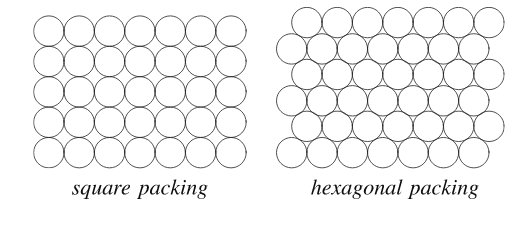
Square packing may be simplest, but Hexagonal packing can fits more in. 35 for square versus 42 for hexagonal in the same space! (Credit: R. A. Lawler)
Seems simple enough doesn’t it, but remember there are a lot of different particles, different individual fruits that is, and each and every fruit exerts a force on every other fruit. That’s right even the mass of the orange on the upper right exerts a force on the orange at the bottom left and, keeping in mind Newton’s third law that “For every action there is an equal and opposite reaction” that means that the orange at the bottom left exerts a force on the orange at the top right. Oh, and let’s not forget that the angle at which the oranges are stacked is certainly going to be a factor.
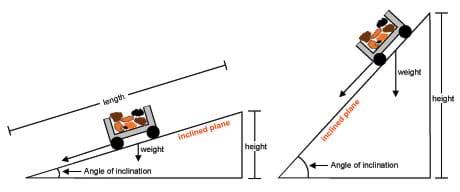
We all know from experience how the steeper an incline the more unstable the system becomes. (Credit: Teach Engineering)
So you see the whole mess gets really complicated really quickly which is why physicists have hated problems like this throughout the 18th, 19th and even the 20th century. That’s why the solution had to wait until the 21st century and the development of supercomputers. That’s right the physicists who solved the problem did so but running a vast number of numerical simulations, they let the computer do the arithmetic.
The latest Supercomputers can perform as much arithmetic in a few seconds as the entire human race did before the age of computers! (Credit: Data Center Knowledge)
The physicists, Eduardo Rojas, Hector Alarcon, Vincente Salinas, Gustavo Castillo and Pablo Gutierrez all hail from three universities in Chile, the Universidad de Autofagasta, Universidad Autonoma de Chile and the Universidad de O’Higgins. For their simulations they considered identical spherical balls each with a diameter of 4cm and a mass of 2.93 gm, basically tennis balls. Altogether the team ran simulations with 90 balls with 6 rows alternating between 7 and 8 balls each. They then scaled up that basic array to arrays of 372, 846, 1512 and 2370 balls.
The researchers used tennis balls as being representative of all of the different objects that can be stacked. (Credit: Pinterest)
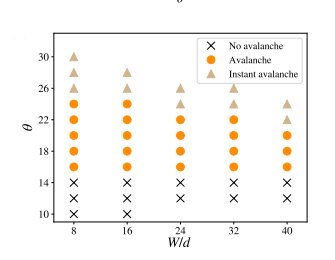
The first thing the physicists found was that for very low angles an avalanche may never occur, obviously if the angle is zero you could lift out every ball with no collapse occurring. Conversely for a very high angle removing even a single ball can cause an avalanche. The interesting results came, as I’m sure you guessed, from medium angles. After numerous simulations were run the researchers found that avalanches typically occurred after 10% of the balls were removed and that the original number of balls in the array had only a small effect on that percentage.
The ability to stack tennis balls or vegetables heavily depends on the angle of incline. For angles below 10 degrees the stacking is very stable while for angles greater than 22 degrees removing just a single object can cause an avalanche. (Credit: Eduardo Rojas et al)
So the next time you’re in the local supermarket and you reach for that one perfect apple in a big display, rest assured that you probably won’t cause all of the apples to go tumbling onto the floor. Unless of course several other customers have already plucked out their apples.
We’ve even made a game out of stacking identical objects higher and higher until they fall. Again the physics is fairly simple but the amount of calculations that need to be done in each specific case is so large no one can do them. (Credit: Shutterstock)
The other everyday physics problem is one that will also have a familiar feel about it. Imagine a large container that is only partially filled with a variety of mixed nuts, some small like peanuts or almonds, some large like walnuts and hazelnuts. Now you want to have all of your nuts nicely distributed so that anyone who wants a peanut just has to reach in and take one off the top while anyone who wants a hazelnut can do the same. So you put a lid on your container and give it a good shake for a minute or so to get all the nuts scrambled together.
Doesn’t it often seem as though in a container of mixed nuts the larger nuts all wind up on top? (Credit: Melchoir)
Problem is that when you open the container what you find is that the top layer is completely made up of the big walnuts and hazelnuts with all of the smaller nuts down at the bottom. And it’s not the shape of the objects that causes the effect, you can do the same experiment with BBs and marbles, the smaller BBs will go to the bottom while the larger marbles end up on top.
The same phenominon can be observed in a box of raisin bran cereal with all of the raisins rising to the top so your last few bowls are all bran and no raisins! (Credit: Willis Lam)
On the one hand it doesn’t make sense, you’d think that the larger, heavier objects would be able to force their way to the bottom. But at the same time maybe the small sized objects are able to squeeze their way between the bigger objects so that they end up on the bottom.
Squeezing through a crowd is not a lot of fun. So do the big guys have the advantage with their heft or do the little guys find more openings that they can take advantage of? (Credit: Medium)
The plain fact is that the smaller objects do go to the bottom but we really don’t know how. Again the problem seems simple enough in detail but when you consider dozens or even hundreds of objects the amount of arithmetic quickly becomes a nightmare. Like with the fruit avalanche problem above the ‘Hazelnut Problem’ as it’s often call, or more formally Granular Convection, will hopefully one day be solved by thousands of simulations carried out on a supercomputer.
So why does shaking cause the larger objects in a container to rise to the top? Actually nobody knows for certain! (Credit: Limor S. Spector)
There you have it, two ‘classic’ problems in physics that neither involve field theory, nor particles traveling near the speed of light or getting too close to a black hole. Two ordinary problems in everyday life. One of which took hundreds of years to solve while the other remains unsolved.
I assume by now everyone out there has heard about the Solar Eclipse that is going to occur on April the eighth. That day the Moon will cross in front of the Sun completely blocking out the Sun’s light in the middle of the day. The celestial event will draw a line of totality across the North American continent traversing Mexico before passing through 13 states of the US with the show finally ending in the maritime provinces of Canada.
The path of totality, yellow band, for the Eclipse of April 8th, 2024. Weather permitting it’s going to be quite a show. (Credit: Space.com)
I’ve had my eclipse plans made for sometime now. I’ve got plane tickets and hotel reservations in a small town in Texas just to the east of Dallas. I won’t have to move an inch to see a full four minutes of totality, weather permitting that is. That’s always the big question with any rare astronomical event, whether it’s an eclipse or a transit or an occultation, will the weather be good enough so that you can see? So wish me luck and I’ll tell you all about it when I get back. (See my post of 24 August 2017 about the eclipse of 2017.)
Getting close to Totality back in August of 2017. (Credit: R. A. Lawler)
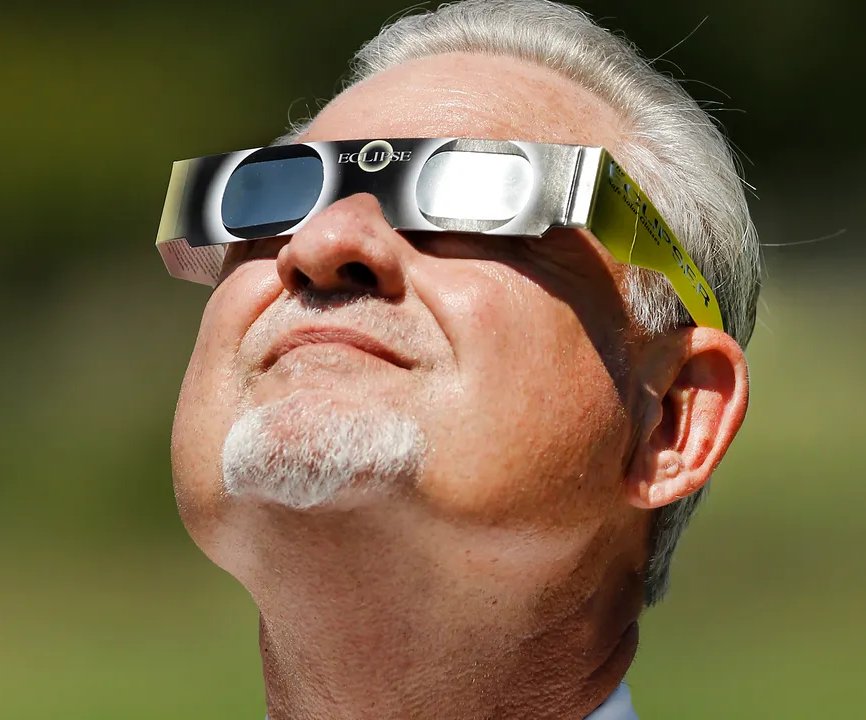
Before I move on to my next story a word of warning about looking directly at the Sun at any time, not just during an eclipse. Yes, I know you’ve heard this all before, nevertheless get a good pair of eclipse glasses before April 8th and BE SURE TO USE THEM! I’m certain by now you’re as tired as I am about hearing the warnings but you’d be surprised at just how many people ignore those warnings no matter how many times they hear them. So, please get a good pair of eclipse glasses and use them when viewing the eclipse. By the way, the Sun is interesting to look at, WITH GLASSES, even when there’s no eclipse.
It takes a really stupid person to look directly at the Sun anytime, even during an eclipse. (Credit: NBC)So be a smart person and never look directly at the sun without a good pair of Eclipse glasses! (Credit: USA Today)
Some astronomical events last a little longer than an eclipse however, giving an observer chances on several nights to see it, and one of those may happen later on this year. The star system designated as T Coronae Borealis (T CrB) is known to astronomers as a repeating nova, that is a star system that periodically increases in brightness by hundreds or even thousands of times for short periods of time, usually around a month. Now we’re not talking about a supernova here, you know those massive stars that can end their brief lives in huge explosions that can outshine their entire galaxy for a month or so. Such stars can only explode once and then leave behind either a neutron star or a black hole. (See my post of 26 May 2021 for more information on Supernovas) Ordinary nova may not be as spectacular but some nova can repeat their brilliant displays.
The T Coronae Borealis system consists of a white dwarf star that is stealing material from its red giant companion. Eventually that material builds up on the white dwarf’s surface until it erupts as a nova explosion. (Credit: BBC Sky at night Magazine)
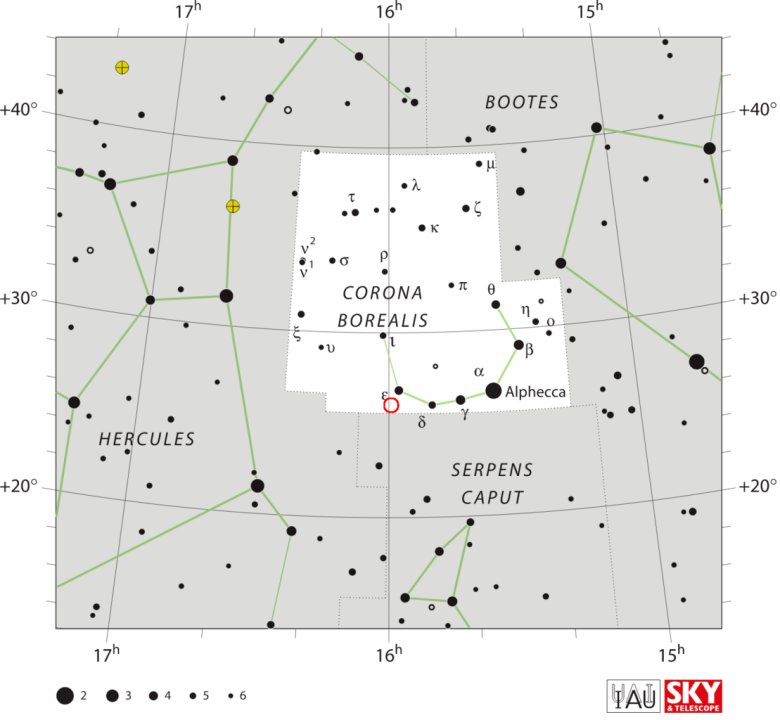
T Coronae Borealis is a double star system that lies about 3,000 light years away in the constellation Coronae Borealis or the Northern Crown. The system consists of a white dwarf star that is closely orbited by a red giant. The two stars are in fact so close that the white dwarf is stealing material from the outer envelopes of it companion. Eventually enough matter falls onto the surface of the white dwarf to trigger a fusion eruption, causing the dwarf to shine thousands of times brighter, for as long as the eruption lasts.
The location of the constellation Corona Borealis between Hercules and Bootes. T CrB cannot normally be seen without a fairly large telescope but when it goes nova, red circle, it could be as bright as nearby Alphecca! (Credit: KTLA)
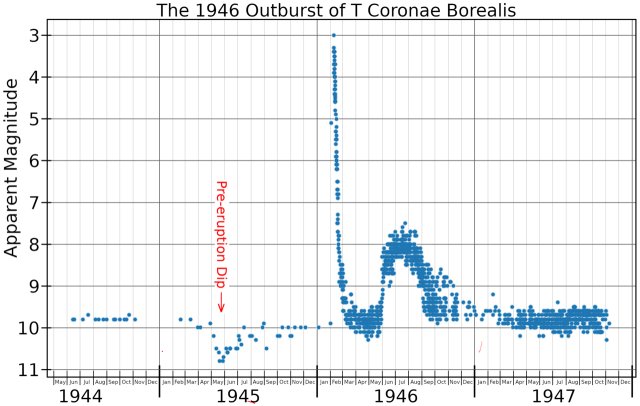
T Coronae Borealis is one of only five known periodic novas in our galaxy and has been observed to erupt every 80 years for the last several centuries. The last time the system went nova was back in 1948 so it’s about due. The best estimate is that the system will erupt sometime between now and September, but of course it’s always hard to make accurate estimates about something that is happening 3,000 light years away.
Plot of the light curve of T CrB during its last nova event back in 1948. (Credit: Pope Pompus, CC BY-SA 4.0)
Normally T Coronae Borealis shines at a magnitude of +10, far to dim to be seen with the naked eye, even with really dark skies our human vision cannot see anything higher than a +6. As I said however as a nova the star could shine thousands of times brighter, reaching up to perhaps a +2, about the same level of brightness as Polaris the north star and therefore quite visible, even with city lights. And T Coronae Borealis should remain that bright for at least a week giving everyone in the northern hemisphere at least several chances to see this rare event.
You can watch Television or you can go out and look at the most awesome spectacle there is to see. Even without a rare event like and eclipse or nova, the Universe just can’t be beat. (Credit: Scout Life Magazine)
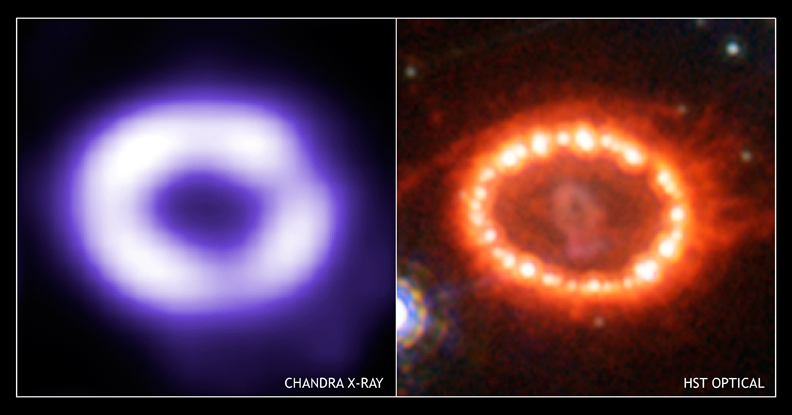
Speaking of supernovas the last such giant event in our galaxy happened back in 1987 when a star in the Large Magellanic Cloud, a satellite galaxy to our Milky Way, exploded. SN 1987A as it is known was the closest supernova to Earth since the time of Kepler back in the late 17th century and the first, and so far only, supernova for which we actually have a picture of the star before it exploded. (Again see my post of 26 May 2021))
Current images of the expanding debris from SN1987a as seen in visible light by the Hubble space telescope (r) and in X-rays by the Chandra X-ray space telescope. (Credit: Wikipedia)
Now when a star goes supernova the outer layers of the star are ejected out into the interstellar medium seeding that medium with the heavier elements that had been generated in the star. The star’s inner core however collapses inward becoming either a neutron star or a black hole.
The intense magnetic field of a neutron star can cause it to emit strong radio waves making it appear to pulse like a lighthouse. Such ‘pulsars’ are well known from supernova remnants like the Crab Nebula. (Credit: NASA)
Now ever since the explosion of SN1987A dissipated astronomers have been searching for any sign of the compact object that was left behind. Astronomers know of many such objects known as pulsars like the one at the heart of the Crab Nebula supernova remnant. Thirty-five years of searching however failed to find any trace of whatever was left of the star that became SN1987A.
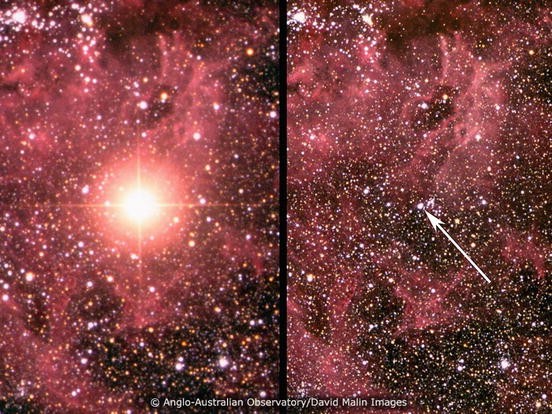
The only supernova for which we have an image before it exploded the progenitor star of SN1987a is shown in the right image while the left image shows the star at the peak of its brightness. (Credit: SpringerLink)
Until now, now new observations by the James Webb Space Telescope (JWST) have detected light coming from argon and sulfur atoms surrounding a neutron star at the heart of the supernova remnant. The kind of light Webb detected indicates that the atoms had been electrically charged or ionized by the intense radiation from the neutron star. Although not a direct detection of the neutron star astronomers are calling it a ‘fingerprint’ and it is certainly the best evidence so far.
Hubble (r) and Webb (l) space telescope images of SN1987a. The Webb image not only shows greater detail but does so at different wavelengths of light allowing more data to be collected. In this way astronomers have found the smoking gun of the neutron star at the heart of the supernova debris. (Credit: Business Insider)
Proving once again that ‘The Greatest Show on Earth’ is actually not on our planet but in the skies above our heads.
The novel ‘Dune’, by author Frank Herbert is, like Tolkien’s ‘Lord of the Rings’ and Martin’s ‘A Game of Thrones’ best known for the author’s ability to convincingly create a world unlike anything the book’s readers have ever experienced. The world of ‘Dune’ takes place about 9,000 years from now when humanity has spread to a number of different star systems. Interstellar travel is only possible however, thanks to a mystical drug known as ‘spice’, which can only be found on the desert world called Arrakis.
Poster for the Movie Dune, Part 2 (Credit: GadgetMates)
How the ‘spice’ works is never fully explained, suffice it to say that ‘spice’ is a hallucingenic, mind expanding drug, of the sort that were all the rage back in the 1960s when ‘Dune’ was written. Obviously this ‘spice’ is the most valuable and sought after commodity in the known universe. ‘Dune’ is about the political intrigues and violent conflicts over control of the ‘spice’.
Back in the 1960s many people, including respected scientists, thought that hallucinogenic drugs could open our minds to new possibilities, new modes of thought. The results didn’t quite live up to the hype. (Credit: Amazon.com)
Now world building of this sort takes time and a lot of attention to details, which is why stories like ‘The Lord of the Rings’ and ‘A Game of Thrones’ are really long books, so long in fact that they are usually cut into several books. The original ‘Dune’ remained as one book but Frank Herbert and his son have written a number of sequels that take place on the desert world Arrakis.
The original Dune novel was so popular that author Frank Herbert had to turn it into a trilogy. Dune Messiah the movie is currently under consideration by the producers of Dune pt. 1&2. (Credit: Amazon.com)
Still, trying to turn a large work like ‘Dune’ into a single movie is a recipe for disaster as was demonstrated by the Dino de Laurentiis version in 1984, well known in SF circles as something to be laughed at despite having some really good actors in it. In order to come in under budget the special effects were childish and there was simply not enough time to really enter the world of ‘Dune’.
Poster for the 1984 version of Dune. The entire book in only 2 hours with some of the worst special effects I’ve ever see did not make for a good movie! (Credit: Wikipedia)
The producers of the latest version of ‘Dune’ recognized this problem and so they immediately decided to split ‘Dune’ into two movies, each longer than the entire 1984 version. What they didn’t recon with was the covid-19 pandemic, which forced the two parts of ‘Dune’ to be released 3 years apart.
Poster for Dune Part 1 which you’d better see before watching part 2! (Credit: Medium)
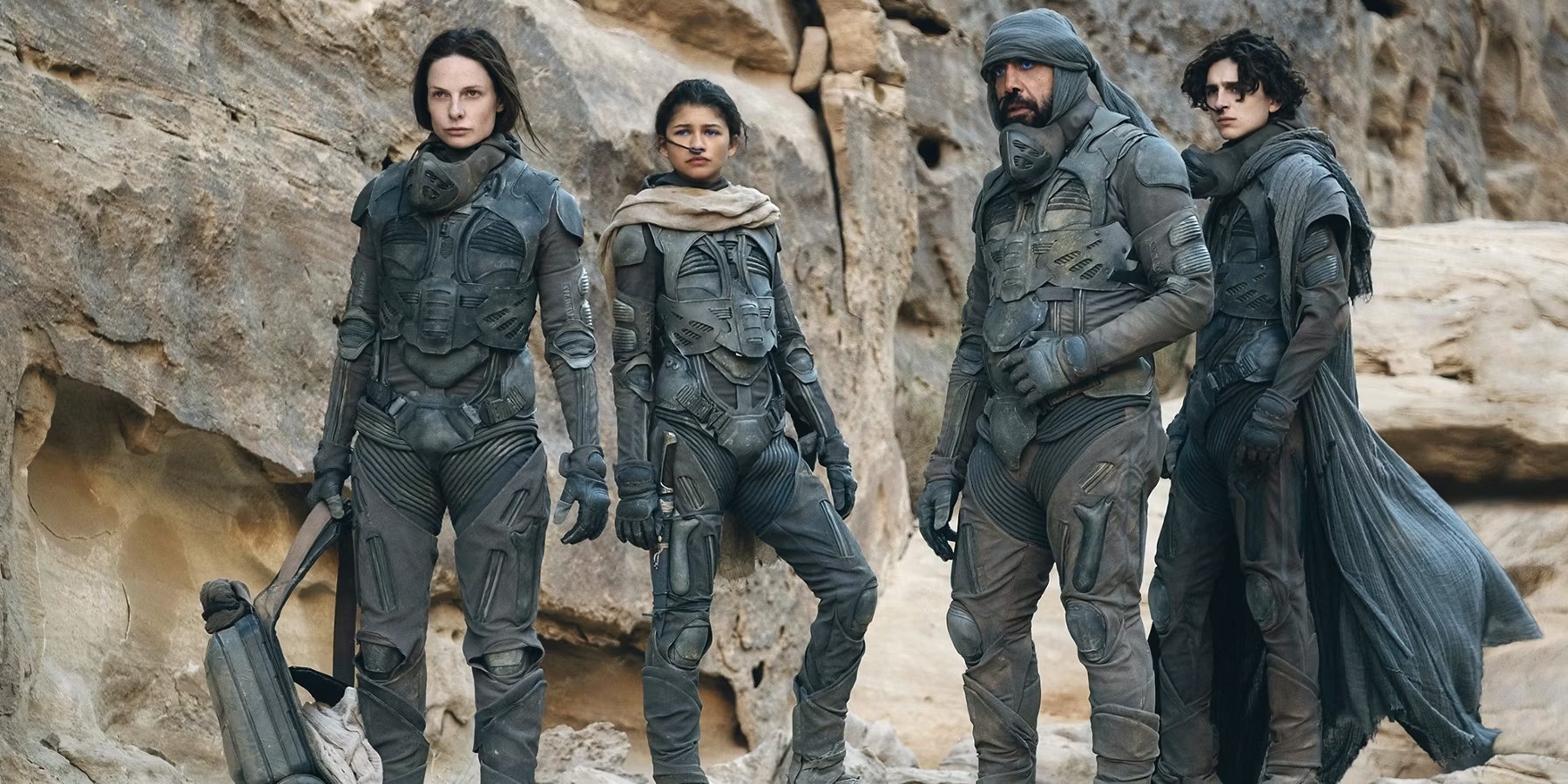
In Part 1, Duke Atreides has been granted the planet Arrakis by the Emperor, played by Christopher Walken, to replace Baron Harkonnen, played by Stellan Skarsgard, because the Baron has failed to put down a insurrection by the native people of Arrakis known as the Fremen. The takeover is really a trap however because the Emperor is jealous of the Duke’s influence with the other noble houses. Thanks to treachery the Harkonnens attack and destroy the Atreides, only the Duke’s wife Jessica, played by Rebecca Ferguson, and young son Paul, played by Timothȇe Chalamet, manage to escape into the desert. There’s a lot more to Part 1 then that but I don’t want to give too much away.
In part 1 of Dune the family Atreides takes control of the planet Arrakis from their enemies the family Harkonnen. Needless to say the Harkonnen’s are looking for some revenge. (Credit: The Gamer)
I do have to mention the giant worms that inhabit the deserts of Arrakis however. These animals attack anything that causes a vibration and can easily destroy almost anything they can reach, making the harvesting of the ‘spice’ quite dangerous. Anyway Part 1 ends with Paul and his mother making contact with and being tentatively accepted by the Fremen.
At the end of part 1 Paul (far right) and his mother Jessica (far left) are on the run from the Harkonnen when they meet up with a group of the native Fremen. (Credit: The Gamer)
In part two Paul and Jessica learn Fremen ways, including how to actually ride the giant worms. At the same time the Harkonnens begin an offensive against the Fremen meant to eliminate them. Part 2 is therefore the story of the fight between the Harkonnen, backed by the Emperor and the Fremen with Paul and Jessica gaining power within Fremen society.
One of the best parts in Dune the novel is Herbert’s description of how you get on a worm in order to ride it. But getting off again is probably every bit as dangerous and never described at all! (Credit:Great Freakin Robot)
On top of all the political intrigue and battles there’s a heavy coating of religious mysticism in ‘Dune’. Everybody has prophecies, the Bene Gesserit sisterhood have their prophecy of a superman type, the Fremen have their prophecy of a saviour etc, etc. The question is, is Paul the one who was foretold?
Paul being ‘tested’ by the BeneGesserit Reverend Mother in Part 1. From the very beginning of Dune Paul is treated as as sort of Messianic figure by several of the religious cults in different societies in Dune. (Credit: Polygon)
While the special effects in ‘Dune Part 2’ are quite good I do have a couple of criticisms. For one thing the editing is a bit annoying, Paul has many visions during the story and it’s often hard to tell reality from vision, you can get quite confused if you’re not paying attention and aren’t familiar with the story. Some of the acting isn’t great as well, particularly Timothȇe Chalamet who seems to be sleepwalking a good part of the time. Finally, as I mentioned above the novel really glosses over how interstellar travel works, well in ‘Dune Part2’ it’s completely ignored, I believe it was mentioned briefly in part 1.
In the novel Dune the Guild of Navigators who pilot ships between the stars are so deformed by the spice that they are hardly human. This is badly explained in the novel but almost completely ignored in the movies Dune 1&2. (Credit: Pinterest)
Those are a few of my problems with the movie ‘Dune Part2’ but I have to be honest, I’ve always had a few problems with the novel Dune ever since I first read it back in the 70s. First of all, on the desert world Arrakis, where do the worms get enough food to grow so big? Second, and more importantly, if the ‘spice’ is absolutely necessary for interstellar travel, something that again is never really explained, how did humanity ever get to Arrakis in the first place to discover the ‘spice’? I know that’s nitpicking but in a story that pays so much attention to detail in the rituals of the various societies portrayed, those questions leave quite a big hole to me.
One thing that spice does it turn your eyes blue! Everyone who lives on Arrakis for a while gets this effect. (Credit: YouTube)
Nevertheless ‘Dune’ is a classic of Science Fiction and it deserved a decent treatment as a movie. So go see ‘Dune Part2’, but only after seeing part 1, otherwise you’ll be completely confused as to what is going on.
Back around one hundred years ago it was thought that the story of civilization could basically be told in approximately a linear fashion. Agriculture in the eastern Mediterranean gave rise to the cities of Mesopotamia and Egypt. Civilization then moved westward to first Greece, then Rome leading finally to Germany, France and Britain. There were a few outliers of course, mysterious cultures in China or Meso-America but really the main thrust of human progress was westward across the top of the Mediterranean basin.
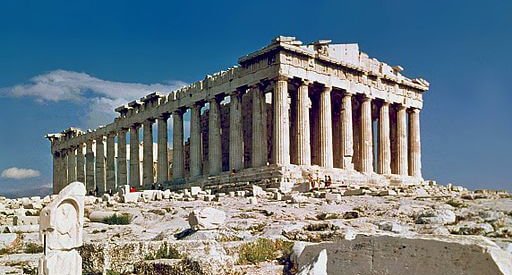
We Europeans still like to maintain that ‘civilization’ really started with the Greeks. O’k the Egyptians were kinda like a prelude but it was really the Greeks that count! (Credit: The Mind Attic)
Today we know better. Hundreds of discoveries from excavations around the world have shown us that as long ago as 30,000 years or even earlier, wherever human beings settled they began to develop distinct cultures. In today’s post I’ll be discussing two examples of this, one is the discovery of an entirely new and unknown civilization that flourished in the Amazon jungle some 2,000 years ago but I’ll begin with a study showing that long before the classical Greek period there already were distinct and sophisticated cultures in Europe.
The discovery in America of civilizations that had no connection of any kind to old world cultures came a something of a shock. (Credit: Context Travel)
The people who lived in Europe during the Ice Ages are often depicted as ‘Cave Men’, Neanderthals, barely surviving in a harsh environment with nothing but stone tools and wooden clubs. However by around 34,000 years ago the Neanderthals were gone and the Homo sapiens who replaced them were entering the Neolithic or New Stone Age, a period of increased material culture.
From the first evidence of Stone Age people living in Europe the Cave Man has often been portrayed as nothing more than a brutish clown. (Credit: Shutterstock)
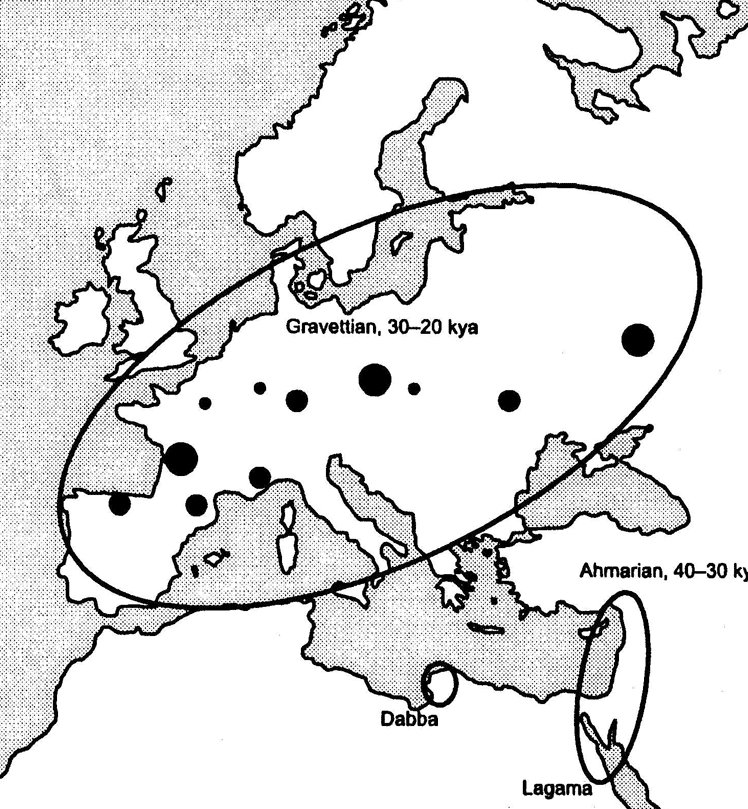
The people in Europe at that time have been given the name Gravettian culture and who lived right across Europe from the steppes of Russia to the Iberian Peninsula. The British Isles and Scandinavia were covered in Ice at this time so it’s not thought that the Gravettians ever settled there. Although these people remained hunter gatherers they also began making their clothes, needles for sewing have been found at their sites, carved small human figurines, know as Venuses because they were mostly large-breasted female figures, and they made extensive use of jewelry. By the way, we have no idea what these people called themselves, the name Gravettian comes from the name of the ‘Type Site’ in France at Le Gravette against which the other 133 known Gravettian sites are compared.
From about 30,000 to 20,000 years ago the Gravettian culture was widespread across northern and western Europe. Bear in mind the British Isles and Scandinavia were under ice at this time. (Credit: OpenEdition Journals)The Gravettian culture is probably best known for the numerous small, carved figurines called ‘Stone Age Venus’. The emphasis on a woman’s sexual characteristics is obvious. (Credit: Onlinehome.us)
Because their tools, artwork and jewelry were roughly similar it was thought that the Gravettians represented a single, widespread culture. Minor differences were thought to be due to local conditions. The people living near a seashore for example might make greater use of seashells while those living in the interior would make greater use of animal bones and teeth. Still, on the whole the Gravettians were a single culture.
Throughout their range the Gravettian people often wore beaded jewelry headcaps. Recent DNA analysis also indicates that they were probably fairly dark skinned. (Credit: EurekAlert!)
That view has now been brought into serious question by a new study published in the journal Nature Human Behavior by doctoral student Jack Baker at the University of Bordeaux. What Baker did was to survey all of the literature concerning Gravettian sites dating back to the mid-1800s. He then classified the thousands of beads detailed in those papers that were used in jewelry into 13 types based upon what material they were made from, clam shell or snail shell, deer tooth or fox tooth, along with other design elements.
Literally thousands of many different kinds of objects, used as beads for decoration, have been unearthed at Gravettian sites. (Credit: Ancient Origins)
He then examined the classification patterns that he found at the different Gravettian sites, compared them to neighboring sites and discovered that, judging by their jewelry the Gravettians possessed nine distinct cultures. Baker theorizes that the differences in jewelry may have allowed different Gravettian ‘clans’ to recognize ‘friend from foe’ although he also thinks that at the borders between cultures a sharing of jewelry may have taken place. All of which shows that, even in Europe there was a lot more to building civilization that we ever thought.
Did the Gravettians use fashion as a means of identifying friend from foe? We certainly do that today, so when did this particular form of prejudice start? (Credit: RootsWeb – www.iabrno.cz)
The second discovery relates to the civilizations of Meso-America, extending and highlighting the uniqueness of those cultures when compared to the western Greco-Roman world. It also enhances our understanding of the pre-Colombian civilizations that inhabited the Amazon River basin, cultures whose very existence were unknown just thirty years ago. Since then however considerable evidence of several complex societies has been discovered from Bolivia through to the mouth of the Amazon, societies that date back as much as 1,500 years. (See my Post of 4 April 2018)
Recent discoveries have shown that even in the densest jungle the Amazon river was home to an extensive and sophisticated culture. (Credit: Scientific American)
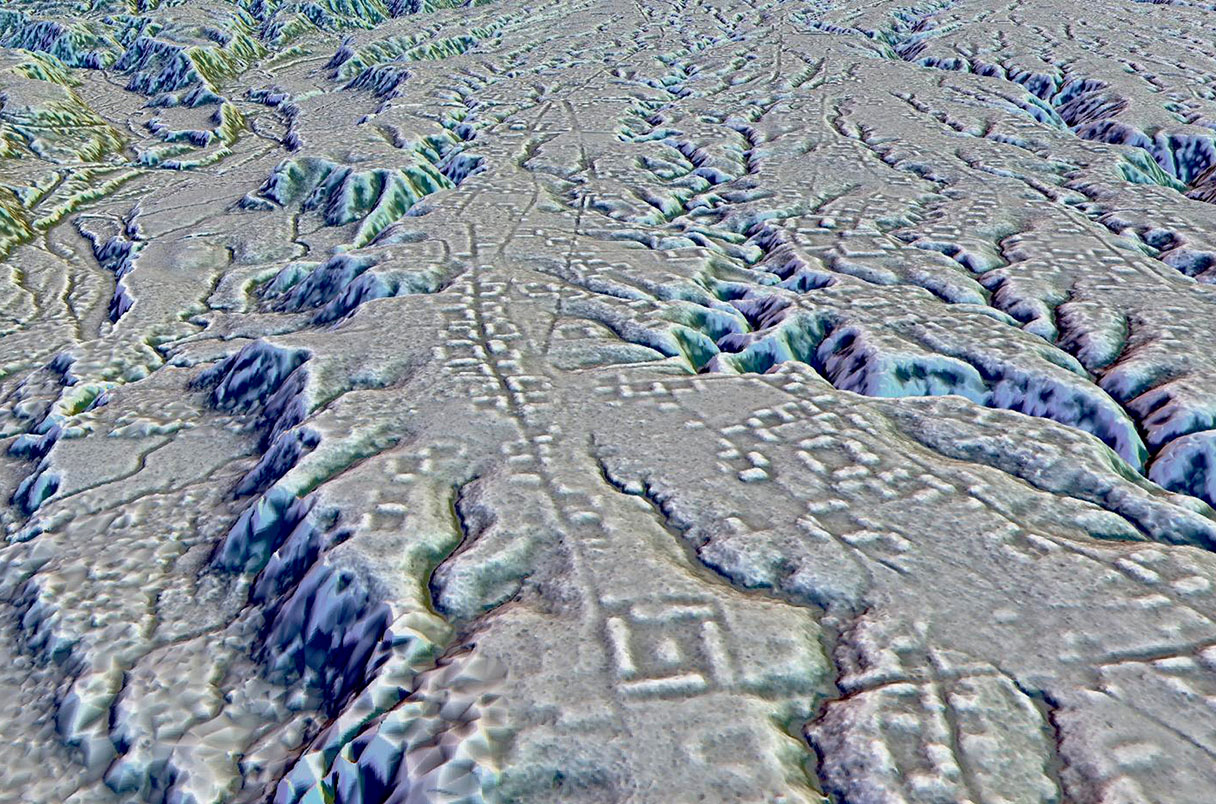
The new discovery, announced in the journal Science not only extends the size of the Amazon culture into the eastern portion of the country of Ecuador but it also extends it back in time to at least 2,500 years ago based the excavations carried out so far. As with many of the latest archaeological discoveries the finds in Ecuador’s Upano valley were first uncovered by an airborne survey of the region using LiDAR, the laser version of radar.
An image generated by LiDAR of a portion of the Upano valley in Ecuador. The many homesteads or settlements are obvious. The population here must have been considerable but without the congestion of the cities of western cultures. (Credit: Wikipedia)
What the survey revealed was over 6,000 platform like earthen mounds averaging 20m by 10m and 2-3m in height and the platforms were normally arranged in groups of 3-6. Lead researcher Professor Stephen Rostain of the National Centre for Scientific Research in France theorizes that each platform could serve like a yard for a single family dwelling although some platforms were large enough for extended family to live there, or even contain communal or ritual structures. These groups of platforms were then connected by a series of extremely straight roads, so straight, considering the hilly terrain that Professor Rostain thinks there must have been some reason, perhaps religious, for making them so straight.
A few excavations have now been carried out in the Upano valley but many sites remain as we learn more about this unknown civilization. (Credit: CNN)
So far only a few of the platforms have been excavated so we can only estimate that the Upano valley civilization began around 2,500 years ago and lasted just about 1,000 years. With 6,000 platforms remaining unexamined there’s a lot to be learned, and a lot of work to be done.
Some of the artifacts recovered so far from the Upano valley. How much more is there waiting to be unearthed? (Credit: Cronología del valle del Upano)
The more archaeologists discover about the many civilizations spread around the world the more it becomes obvious that building civilizations is not confined to any particular region of ethnic group. It’s just something human beings do.
The bad news came shortly after New Year’s with the announcement by climate scientists that the year 2023 was on average the warmest year ever recorded for our planet, surpassing the previous record holder 2016 by nearly a tenth of a degree Celsius. While a 0.1ºC increase may not sound like a great deal that happening for the entire planet over an entire year represents an enormous amount of extra heat in the atmosphere.
2023 was not only the hottest year ever recorded it broke the previous record by an astounding amount. Also, notice how the ten hottest years ever have all been in the last ten years!!! (Credit: News Center Maine)
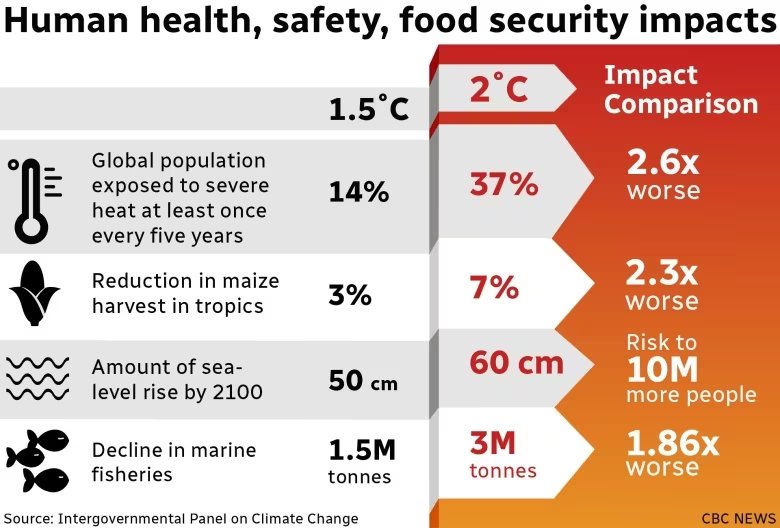
The final tally for 2023 was an increase of 1.48ºC above pre-industrial temperatures; just slightly below the 1.5ºC increase that climatologists have been warning for decades will bring on ever greater climate disasters. Worst still, if you consider the 12 month period from the first of February 2023 to the 31 of January 2024 we broke that 1.5ºC barrier.
Scientists have been warning us for decades that climate change starts to get real bad when we go over 1.5 degrees C above pre-industrial levels. Well, we’re past that now and can 2 degrees be far away? (Credit: CBC)
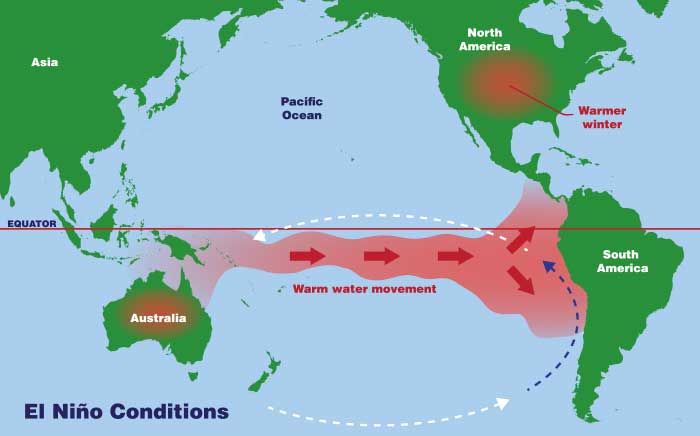
Meteorologists point out that the strong El Nino pacific weather pattern that developed around May in 2023 added to the historic heat levels measured from June to December, and now January 2024 as well. That El Nino is expected to continue for some time in 2024 so it is perfectly possible that 2024 may wind up being even hotter than 2023. So we are now getting a taste of a world above that 1.5ºC, a world with severe weather year round, from tornadoes during the winter months to endless wildfires, floodings etc.etc. The question is, are people paying attention.
The Pacific phenomenon known as El Nino can effect weather patterns around the World. (Credit: SciJinks)
I’m afraid that the answer to that question is no. The climate deniers are still out there, still trying to convince people that civilization will collapse if we don’t keep on burning coal, oil and natural gas. There has been a shift in their arguments however. With the actual measured data clearly showing that the last ten years, 2014 to 2023, were the hottest ten years ever recorded the petroleum industry and its apologists are no longer trying to assert that global warming simply isn’t happening, or at least that human activity isn’t to blame for it. No, instead they are now trying to convince people that, while climate change may be happening, it’s really not going to be that bad and besides there’s nothing we can do to stop it.
And if all of you Republicans who believe climate change is a Chinese hoax will clap your hands the bad weather will just go away! (Credit: Los Angeles Times)
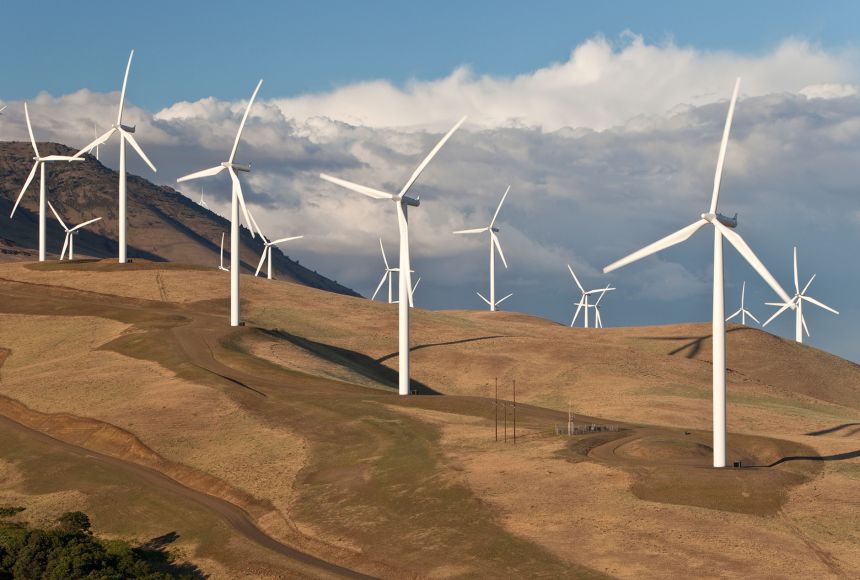
This ‘New Denialism’ is showing up in ever increasing numbers of YouTube videos, facebook posts, and other forms of social media. This new denialism is characterized by attacks on possible solutions to global warming along with the worldwide climate movement. False claims that Solar and Wind energy don’t work and that climate scientists are either alarmists or corrupt, I’ll have more to say about that later, have increased to 70% of anti-climate videos on YouTube while actual claims that climate change isn’t happening have dropped to only 14%. Some of the claims come close to hysteria, ‘They’re trying to take away your cars and stoves’ for example or that wind turbines cause cancer. For the most part however the deniers claim that clean, green energy will simply not work and attempts to reduce green house gas emissions will destroy the economy.
Of course what they are really saying is that the economy of the billionaires and millionaires will be harmed if we get rid of fossil fuels! (Credit: Aurora Sentinel)
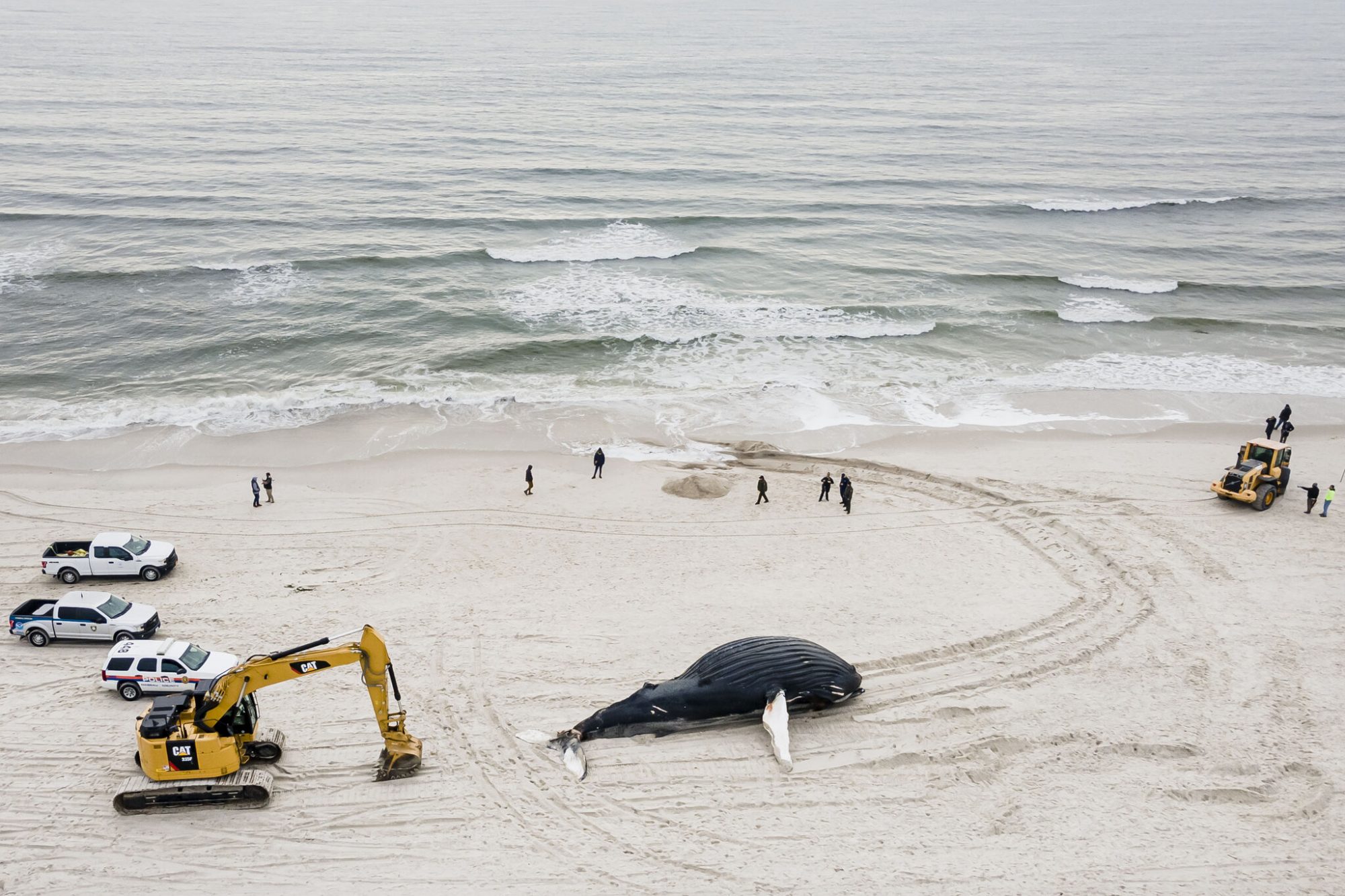
One recent claim even asserted that the sonar surveys carried out in preparation for the construction of wind farms along the US Atlantic coastline were causing whales and dolphins to beach themselves. This is despite the fact that the beachings occurred more than nine months after the surveys had been completed. Republican State Legislators in the State of New Jersey even tried to get a bill passed to ‘Save the Whales’ by halting further development work on the wind farms. I’m certain it’s the first time any of them ever cared about Whales.
In the last three months 24 whales and dolphins have washed up on the US East Coast. That’s a tragedy but it’s also 9 months after the sonar surveys for offshore winds farms were completed! (Credit: The New York Times)
At the same time other bills and zoning regulations are also cropping up across the country that are designed to restrict if not halt the construction of clean energy wind and solar energy installations. As many as 15% of the counties in the US have passed bans or moratoriums that effectively make it impossible for anyone to construct a large scale wind or solar farm, even on their own property. Worst still, many of the places that are banning green energy projects are the best places for such projects. Think about it, Texas obviously gets a lot more sunlight than Maine, but Texas is an oil state and the politicians in Texas would rather force people to keep burning fossil fuels than allow anyone to build solar power projects. That’s despite the economic benefits from the money for the energy produced along with all the good paying green energy jobs. It’s an old story, many of the people who oppose wind and solar projects actually accept the need for green energy to combat climate change, they just don’t want them in their backyard.
Currently a large majority of Americans feel that we should increase our energy production through the use of wind and solar power, but why does it have to be near me!!!!! (Credit: National Geographic Society)
After all of that bad news I do have a small piece of good news. The climate deniers on the web have many times not only lied about climate science but the scientists who are trying to warn us about the climate disasters we now face. These falsehoods have many times gone far beyond criticizing the work the scientists are doing to include allegations that the scientists are taking bribes for falsifying climate data and even claims that the scientists are guilty of crimes, even sex offenses.
How could any human being be so proud of being so stupid? (Credit: Inside Climate News)
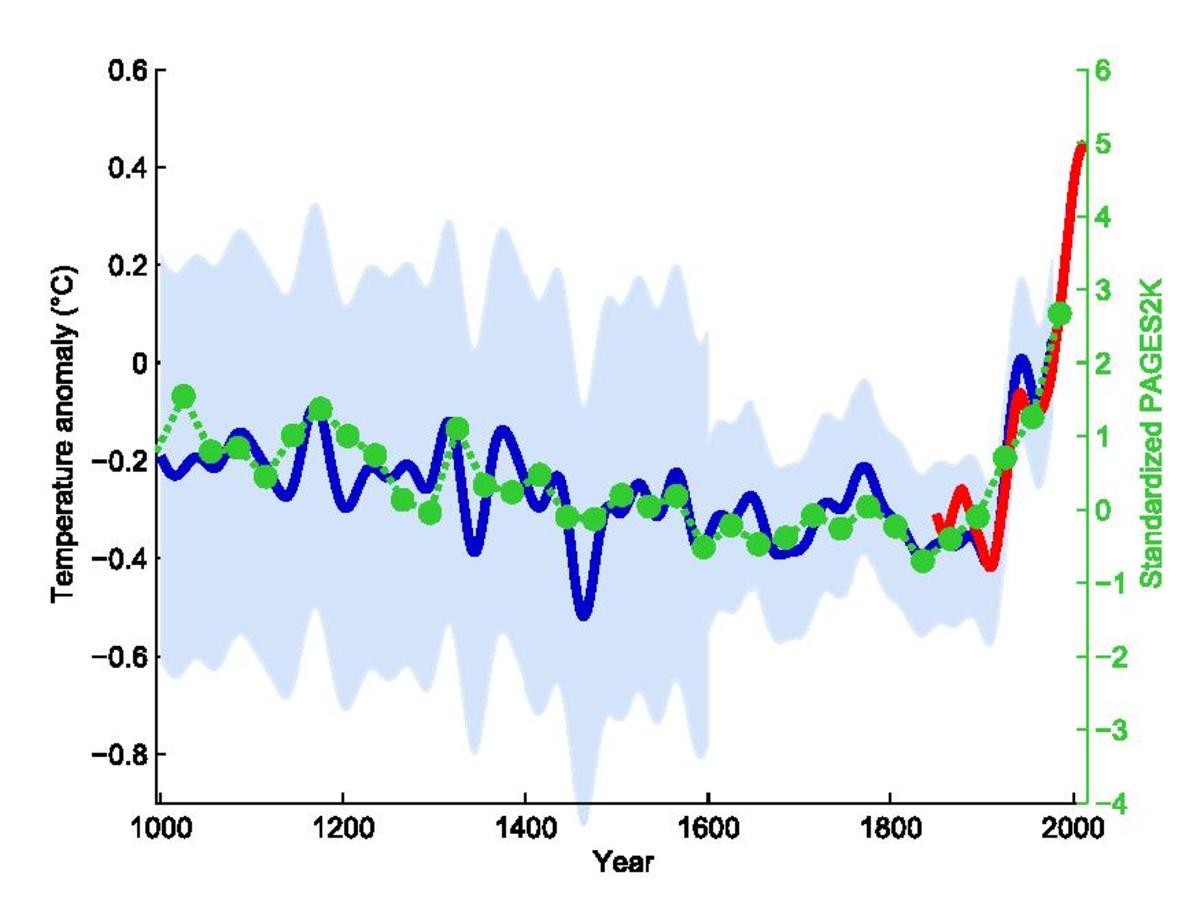
Well one noted climate scientist decided to fight back. Michael Mann is a highly regarded climatologist at the University of Pennsylvania here in Philadelphia who has long been in the forefront of the fight to convince the public of the serious threat that greenhouse gasses pose. It was back in 1998 that Doctor Mann published his ‘Hockey Stick’ graph of global temperatures over the past several hundred years.
The famous ‘Hickey Stick’ graph of global temperatures over the last thousand years. For the first approximately 800 years the temperature was slowly getting colder, we’re still really in an ‘Ice Age’ after all. In the last 150 years however global temps have gone up three times as much as they’d gone down in the previous 800 years. (Credit:
Dr. Mann had used his research in tree rings, coral reefs and ice cores to show that global temperatures had been relatively stable for centuries before the start of the industrial revolution but that ever since humanity had begun to burn large quantities of fossil fuels global temperatures had spiked dramatically. The graph of that increase was said to resemble a hockey stick, laid on the ground with its blade pointing up, hence the name. That graph became famous and made Mann the target of right-wing critics more interested in defending fossil fuels than the truth or a dedicated scientist’s reputation.
A jury may have found that climate deniers defamed scientist Michael Mann (r) but of course the plaintiffs are appealing that judgement. (Credit: YouTube)
Two conservative writers in particular, Rand Simberg of the Competitive Enterprise Institute and Mark Steyn of the National Review went so far that in 2012 Professor Mann sued them for defamation. It took twelve years of legal wrangling but in early February a jury in Superior Court for the District of Columbia finally agreed with Mann and awarded the climatologist $1 Million in punitive damages. Of course both defendants have announced that they will be appealing the decision so this case isn’t over yet. Still it demonstrates that those people, not just scientists but everyone who is concerned for our planet, can and should stand up to the bullies who ignore the harm they are doing to the world so long as they can make a quick buck.
There’s plenty to talk about this month in Space. For both manned and unmanned spaceflight there’s good news and bad news so let’s start with manned spaceflight first.
Manned spaceflight began with the flight of Yuri Gagarin in 1961. His single orbit of the Earth made him the ‘First Man in Space’. (Credit: ThoughtCo)
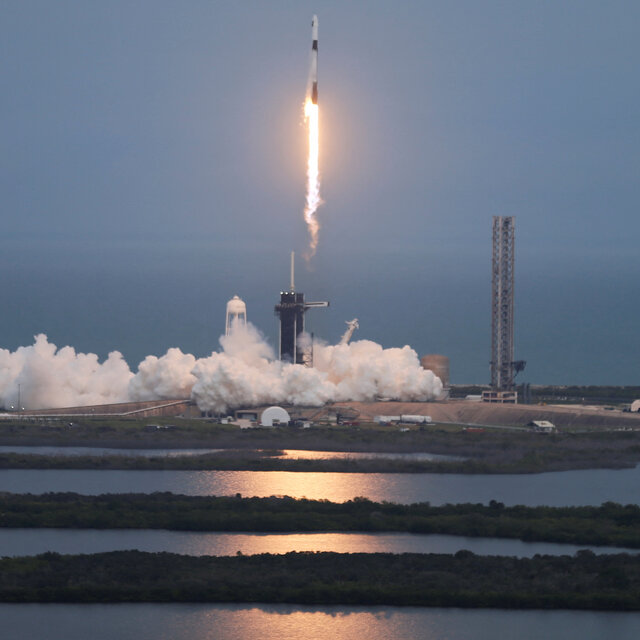
The good news of course is the successful launch on January 18th of the Axiom-3 (Ax-3) private mission to the International Space Station (ISS). Although the mission is a private one the crew are not millionaire tourists, they are astronauts representing four different nations. Mission Commander Michael Lopez-Alegria is a dual US-Spanish citizen who has previous flown in space with NASA. The other three crewmen are all space novices with Walter Villadei of Italy serving as Pilot along with Marcus Wandt of Sweden and Alper Gezeravci of Turkey as mission specialists. Astronaut Gezeravci represents Turkey’s first astronaut.
Launch of the Ax-3 mission aboard their Falcon-9 rocket. Although the four passengers were not tourists they were paying costumers of a private company that can arrange for anyone to travel into space. For about $55 million USD! (Credit: The New York Times)
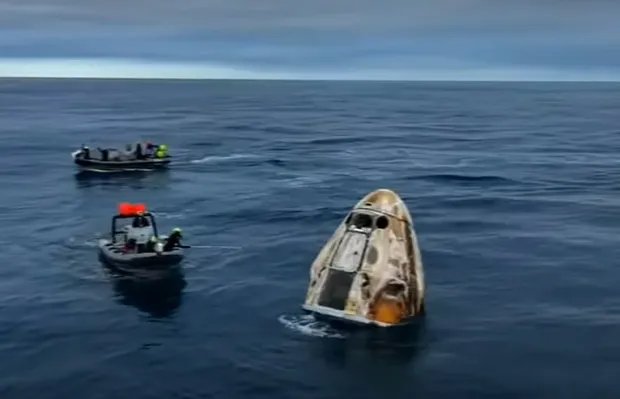
After docking at the ISS on January 20th the four astronauts spent two weeks performing experiments before returning to Earth on their Dragon capsule. The Ax-3 mission is Space X’s twelfth manned mission and as I’ve said before Space X is making the whole process of traveling to Low Earth Orbit (LEO) a routine affair. While the return of the Ax-3 mission was delayed by two days owing to bad weather at the landing zone in the Gulf of Mexico off of Pensacola, Florida the actual re-entry was uneventful, the four astronauts splashing down on February the ninth.
The Ax-3 capsule floats peacefully in the waters off of Florida while awaiting recovery by Space-X personnel. The whole operation of traveling into space is becoming just as uneventful, which is the whole idea! (Credit: Orlando Sentinel)
That’s the whole point of the Space X – Axiom collaboration. Using Space X’s reusable Falcon 9 rocket and Dragon Capsule the cost of space travel is steadily coming down, the four nations involved in Ax-3 mission each paid $55 million dollars to send their astronauts into orbit. because of that small countries and corporations can now send scientists and engineers into LOE to do research aboard a new generation of space stations, and the cheaper it gets the more that will do so.
In the Movie ‘2001: A Space Odyssey’ the Orion Shuttle takes passengers to an orbiting space station. We’re not quite there yet but it won’t be long now! (Credit: CultTVMan’s Hobbyshop)
Getting beyond LOE is another matter however. Only one nation, the US has ever succeeded in taking astronauts to Earth escape velocity and the last time they did that was back in 1972. Back in December of 2022 NASA finally succeeded in sending an unmanned, but man capable Orion capsule on a journey around the Moon on its Artemis 1 mission. At that time it was anticipated that the first manned mission, Artemis 2 another trip around the Moon, would take place later this year.
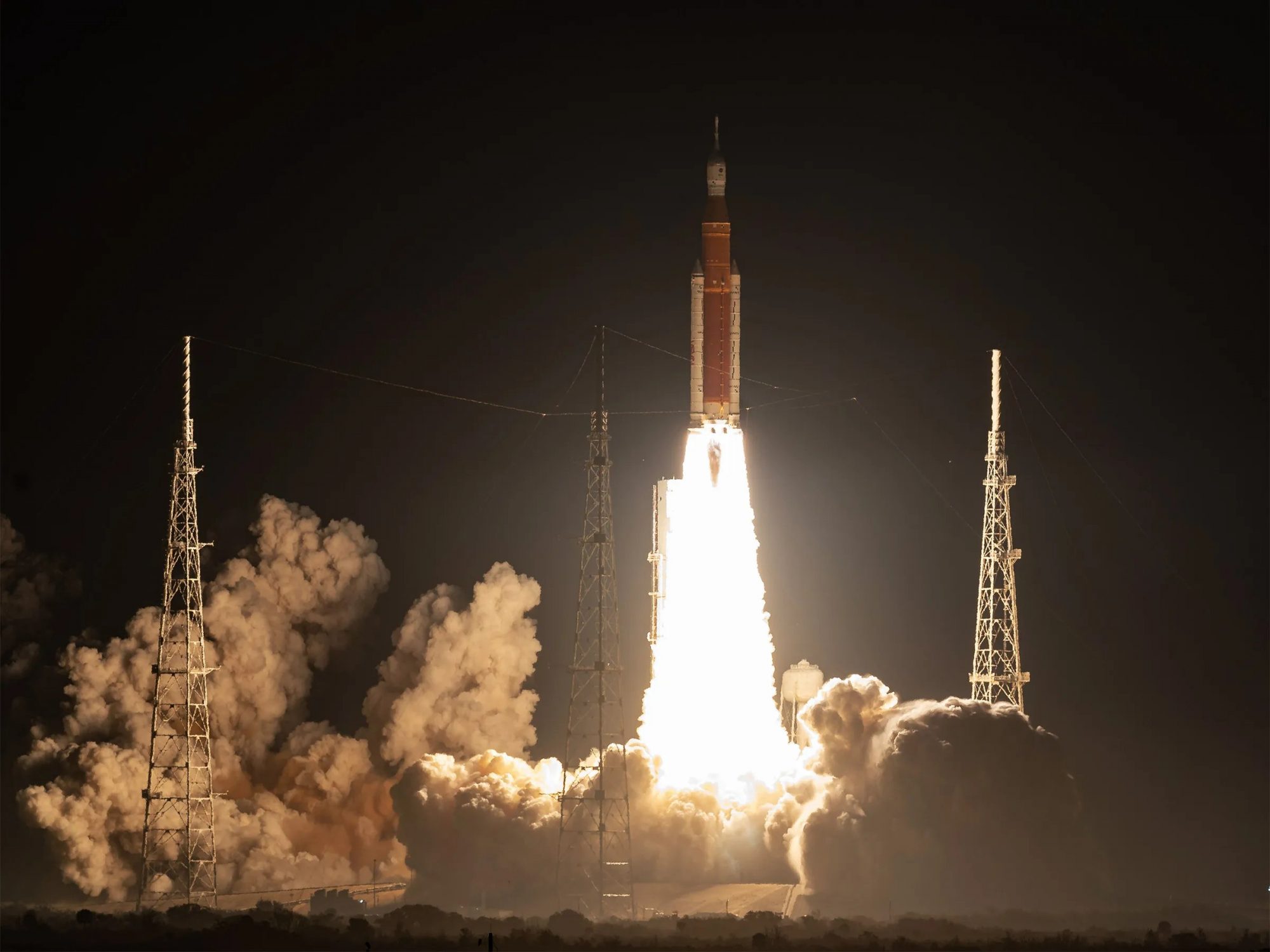
Launch of the unmanned Artemis-1 mission to the Moon. Although no astronauts were aboard this was the first flight of a man capable mission to the Moon since 1972. (Credit: Wired)
That mission has now been delayed however. On January 9th NASA announced that the Artemis 2 mission would take place No Earlier Than (NET) September of 2025. That schedule change will then affect all subsequent missions in the Artemis program. Artemis 3, the first mission to attempt a landing, will now take place NET late 2026 and most likely will be pushed back into 2027.
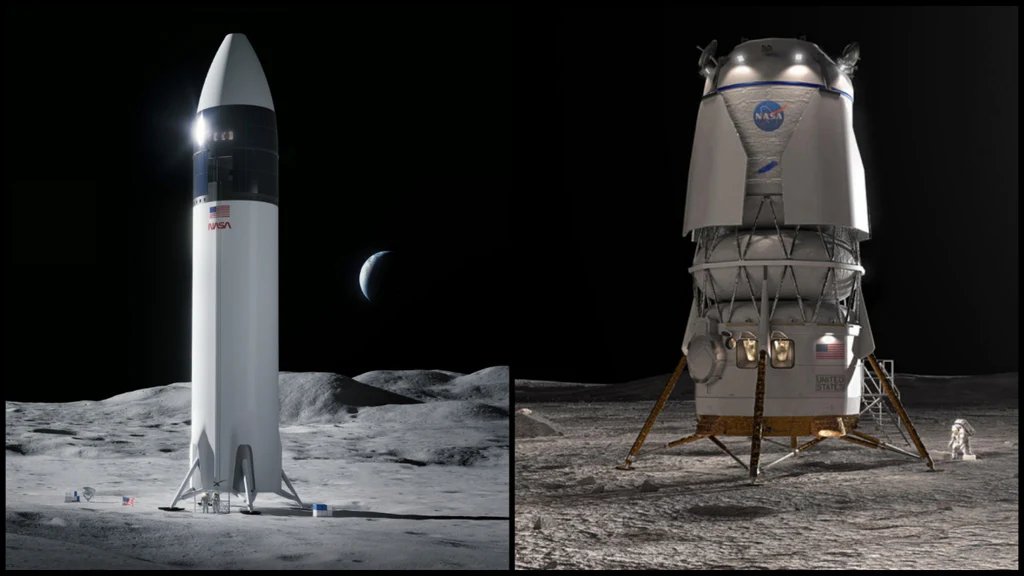
In just a few years one of these landers will be taking humans back to the Moon. Space X on the left or Blue Origin on the right. Which is still up in the air at the moment. (Credit: Tesmanian)
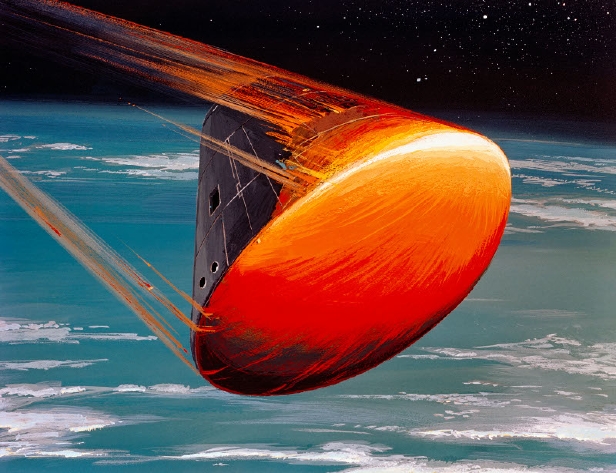
The major reason for the delay is the Orion capsule’s heat shield, which during reentry on the Artemis 1 mission did not behave in a ‘nominal’ fashion. Finding out exactly what happened is taking longer than expected and with several additions technical issues as well it was decided to announce the delays now.
When a spacecraft re-enters our atmosphere it is traveling at thousands of kilometers per hour. Friction causes the capsule to slow down but all of the heat generated by that friction has to be dissipated by a heat shield. (Credit: All About Space)
The delay in the Artemis missions does not mean that the Moon is lonely however. In January there were two separate attempts at landing a robotic probe on the Lunar surface and again with mixed results. The first to launch was the Peregrine probe that represented the first try at a landing on the Moon by a private corporation; Pittsburgh based Astrobotic Corporation. Sounds a bit like the Ax-3 mission doesn’t it. Similarly to Axiom Space, the idea in the Peregrine lander was that countries or corporations could pay to put an instrument or experiment onboard Peregrine, which Astrobotic would then launch to the Moon.
The launch of the Peregrine Moon lander went well. The first ever mission for the new Vulcan rocket was flawless. The lander itself didn’t work so well however. (Credit: Astrobotic Technology)
Peregrine started out with an auspicious launch, the first ever for the new Vulcan rocket from United Launch Alliance (ULA). Vulcan performed well, lifting off from Kennedy Space Center and putting Peregrine into a trajectory for the Moon. However, almost immediately after separating from it’s launch vehicle the probe suffered a fuel leak that spelled disaster for the 1.2 tonne lander. Peregrine never succeeded in leaving Earth orbit and in fact about a week after launch the probe fell back into Earth’s atmosphere and burned up.
This did not happen. The Peregrine lander failed to even leave Earth orbit and fell back into the atmosphere after just a few days in space. (Credit: New Atlas)
The Japanese space agency JAXA was a bit luckier with its Smart Lander for Investigating the Moon or SLIM lunar probe. The landing on the Moon went extremely well with SLIM making the most precise touchdown ever on the Lunar surface, within about 100m of it’s intended position.
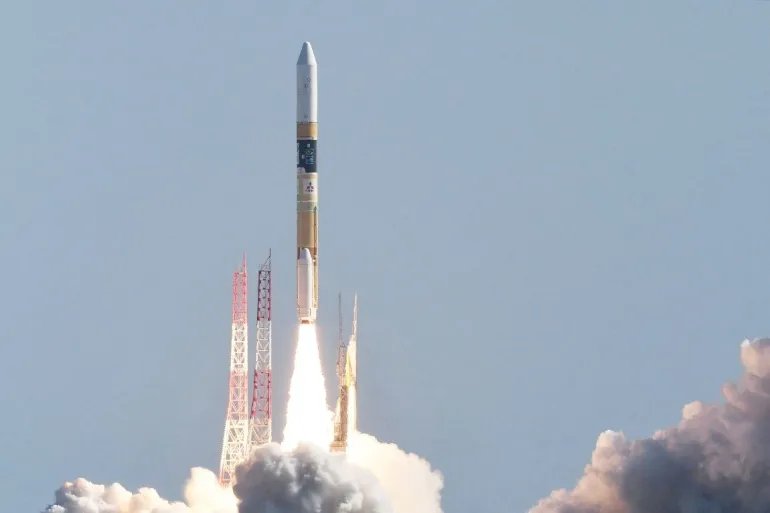
Launch of Japan’s SLIM Lunar lander. (Credit: Al Jazeera)
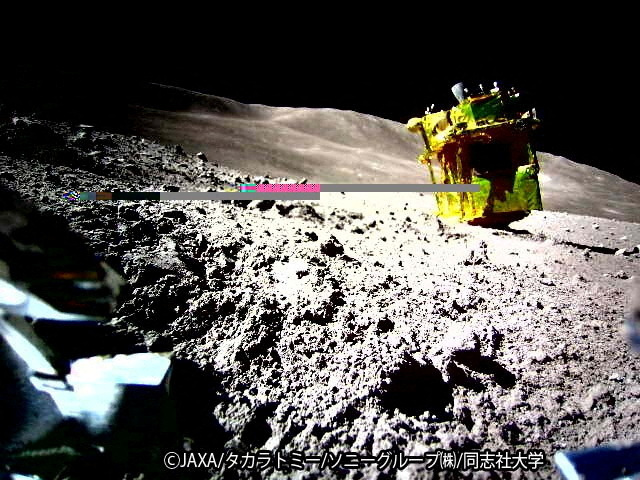
Almost immediately however the engineers in Japan noticed that the power levels in the lander’s batteries were dropping rapidly, the craft’s solar arrays were not providing any power to recharge them. Acting quickly the engineers downloaded every image, every bit of data they could from SLIM. Then, about three hours after touchdown on the Moon’s surface the lander was shut down to conserve the last 12% of battery power remaining.
The launch went well and the landing was almost exactly where it was intended but SLIM is upside down! In this position its solar panels are unable to generate full power and it’s questionable how long the lander can continue to operate. (Credit: Reuters)
After several days of investigating what happened the engineers at JAXA realized that the spacecraft had somehow landed on its head, it was upside down on the Lunar surface. In that position its solar panels weren’t getting enough of the Sun’s light to fully power the probe causing the drop in electrical power.
With no clouds to obscure the Sun solar power on the Moon is even more efficient than here on Earth. But you do have to point your solar panels at the Sun. (Credit: IEEE Spectrum)
The Sun does move across the sky during the Lunar day however and on the 28th of January SLIM’s solar arrays began to produce enough power to allow the engineers in Japan to bring it back to life, for a while at least. The long Lunar night is coming during which time the probe will have to depend on whatever energy is stored it its batteries, so whether SLIM can survive to continue its mission is questionable.
Whether on the Moon or here on Earth a dead battery is never a good thing. (Credit: Interstate Batteries)
That’s the reality of operating in space however; there are successes, failures and sometimes even partial successes. Like a child learning to walk we are learning how to live and work in space, you have to expect an occasional fall now and then.
People have had some crazy ideas about how we’re live in space but what’s not crazy is the idea that before too long we will be doing so! (Credit: IFL Science)
One last sad note, NASA’s venerable Voyager 1 spaceprobe is in trouble. The probe, which was launched way back in 1977 and is now 24 billion kilometers from Earth is the farthest man-made object ever and has for the last 10 years been sending back data about conditions in interstellar space.
It must be lonely out there. Voyager 1 has now officially left our Solar System. Until 2 months ago it was still sending back data about the conditions in interstellar space but unless NASA engineers can figure out what’s wrong with it the venerable probe could be lost forever. (Credit: Interesting Engineering)
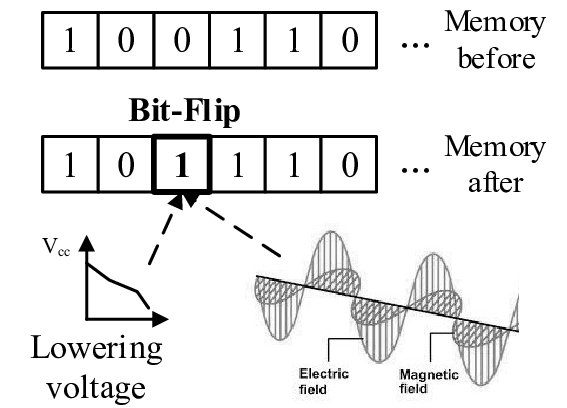
The trouble started back in November when the data sent back from Voyager suddenly became a repeated pattern of meaningless 1’s and 0’s before turning into what’s known as a ‘carrier tone’, nothing more than a steady hum that at least let’s engineers at NASA know the probe is still there. After several months of investigation the engineers are convinced that the problem lies in the spacecraft’s Flight Data Subsystem and could be something as simply as a single corrupted bit in the memory.
Sometimes even just a single corrupted bit in a program is enough to cause everything to go haywire. (Credit: ResearchGate)
Fixing Voyager’s problem is going to be a very difficult problem, if it can be done at all. The probe is so far away that it takes 45 hours to send a radio signal and get a response back, and right now Voyager isn’t responding. Also, the spacecraft is more than 45 years old, making it older than some of the engineers trying to fix it.
At least when you try to fix an old car you have the car itself in front of you. Voyager 1 is now 24 billion kilometers away. Try fixing that! (Credit: YouTube)
Now Voyager 2 is still transmitting, sending back data from outside our Solar System. Nevertheless, sooner or later we are going to have to accept the loss of both Voyager space probes, let’s just hope it’s not yet!