I was quite young when I first heard about the mysterious phenomenon known as ‘Ball Lightning’ and I remember thinking that was the craziest idea I’d ever heard of. After all everybody knew that similar electrical charges repel each other, and when you get a build up of positive or negative charges the force pushing them apart is so great that it causes the burst of energy we call lightning. The notion of a stable build up of charges that could last for several minutes in a small volume of space just made no sense.

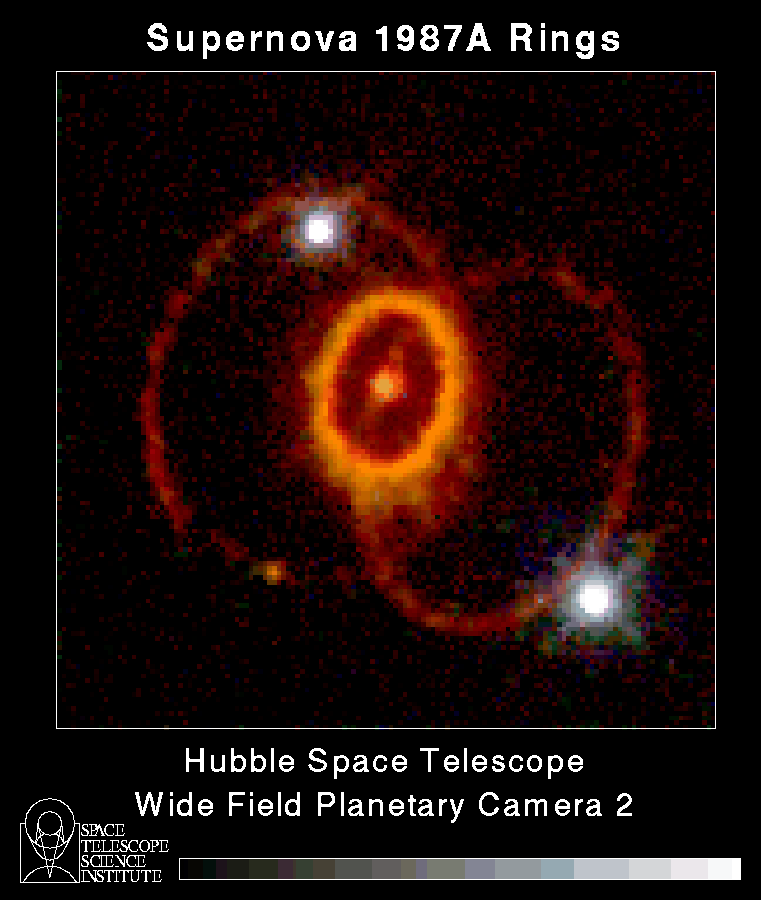
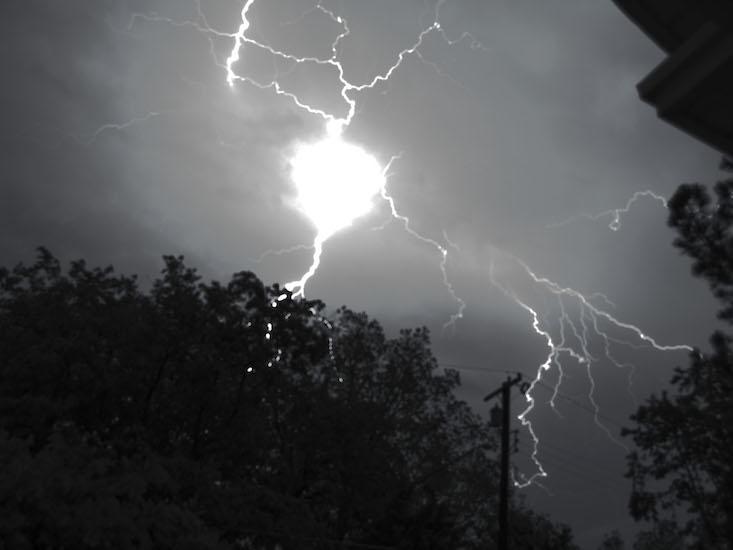
A rare sight to see, ball lightning is usually observed during a strong normal lightning storm (Credit: Nautilus / Science Connected)
Since that time I’ve learned a lot more about electro-magnetism, about resonate cavities, about plasmas, about the weird world of Quantum Electro-Dynamics (QED) and I still think ball lightning is hard to accept. Most scientists seem to agree with me because there are dozens of very different theories about the nature of ball lightning. Everyone of these hypotheses have some problems explaining all the observations of ball lightning and none of them have gained anything like a consensus of support.
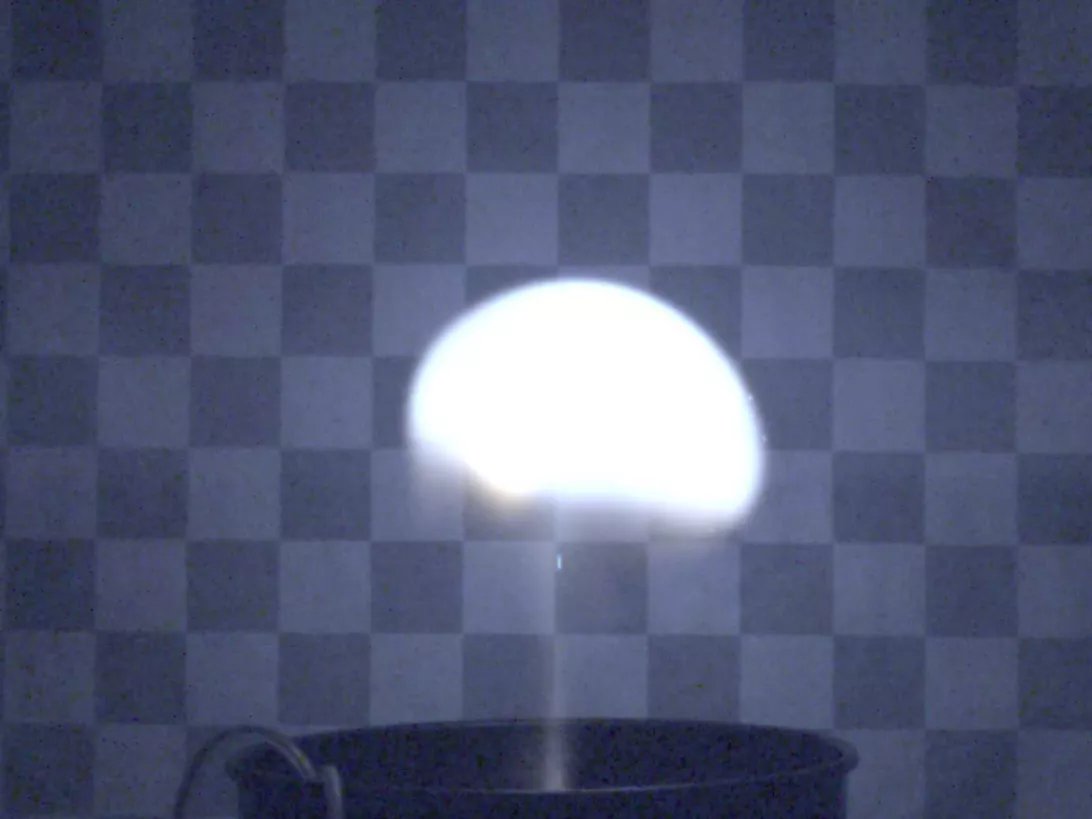
Phenomenon similar to Ball Lightning have been created in a labouratory but are they the exact same thing? (Credit: CNET.com)
For
those who aren’t familiar with the rare and unpredictable sightings of ball
lightning the phenomenon is usually, but not always observed during a fierce
lightning storm. The ball itself can vary from a few centimeters to a few
meters in diameter, the shape is normally spherical or pear shaped, hence the
name, but a few observations of a ring like structure have been made. The ball
glows fairly brightly like a household electric lamp with any colour in the
spectrum but red and yellow predominate.

The movements of ball lightning tend to be horizontal at a steady velocity around 10 meters per second although some have been seen to remain motionless. Very strangely ball lightning has occasionally been observed in the interior of aircraft that are moving at hundreds of kilometers per hour. Despite the plane’s speed however the ball moves through the cabin at a relative speed consistent with observations made on the ground! Finally ball lightning can either dissipate quietly or explosively, it has even been the cause of several deaths.
A 19th Century Newspaper illustration of an observation of ball lightning. (Credit: National Geographic)
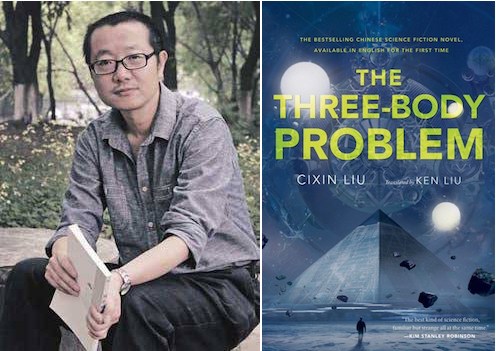
So I suppose it’s about time some science fiction writer got around to using ball lightning as the focus for an SF novel. Chinese science fiction author Cixin Liu has done so and his novel ‘Ball Lightning’ is a daring and imaginative story that starts as a scientific study about the nature of ball lighting and leads to the development of ball lightning weapons. Readers of this blog might recognize Cixin Liu as the author of the ‘Three Body Problem’ trilogy and ‘Ball Lightning’ is a similar wild ride.
Cover of ‘Ball Lightning’ by Cixin Lui. (Credit: Amazon.com)
Liu assumes one of the more outlandish theories about the nature of ball lightning as his starting point and takes off from there. Before long Liu is describing quantum phenomenon that are observable in the macroscopic world, even using the thought experiment of Schrödinger’s cat to question whether or not someone who is killed by ball lightning is alive or dead, or in an indeterminate quantum state.
Cixin Liu is also the Author of the ‘Three Body Problem’ trilogy. (Credit: Tor.com)
I do have a slight criticism, in the novel China goes to war but their adversary in the war is never named. However the USS Stennis, an American Guided Missile Destroyer, is explicitly named as one of the ships attacking the Chinese fleet. Now if you’re going to name your enemy’s warships you may just as well go ahead and name your enemy. In fact Liu’s descriptions of battle in general could use a little more blood and thunder. I have the feeling Liu is a pacifist who would rather not talk about fighting at all. Wouldn’t it be nice if he didn’t have to?
‘Ball Lightning’ is now the fourth novel by Cixin Liu that I have reviewed, all of them thought provoking and wildly creative. I’m certainly looking forward to reading his next novel ‘Supernova Era’ and when I do you can be certain to read about it here at Science and Science Fiction.
‘Supernova Era’ is the latest novel by Cixin Liu. (Credit: Amazon.com)
There
a lot going on in space right now. There’s both good news and bad. Let’s deal
with the bad news first.
By now I’m certain that you’ve heard about the problems that occurred during the Orbital Test Flight (OTF) of Boeing’s Starliner space capsule. Planned as an unmanned flight to the International Space Station (ISS) the OFT was to be the last scheduled test of Starliner before manned missions could begin hopefully starting early next year.
The launch of Boeing’s Starliner capsule on its OFT appeared to be perfect! (Credit: Forbes)
The
launch of Starliner took place as scheduled at 6:36AM on December 20th with the
Atlas V booster rocket making what looked like a perfect takeoff. The trouble
started about 15 minutes later as the capsule was ordered to make a 40 second
burn designed to circularize the spacecraft’s orbit. That orbital insertion
burn suffered an ‘anomaly’ however, burning for far too long and using up the
majority of Starliner’s maneuvering fuel.
Because of that anomaly Starliner was left without enough maneuvering fuel to successfully make its planned rendezvous with the ISS. Since the mission could not complete its most important objective it was quickly decided to terminate the planned eight-day mission after only two days. Starliner’s re-entry and landing took place without incident on the 22nd of December.
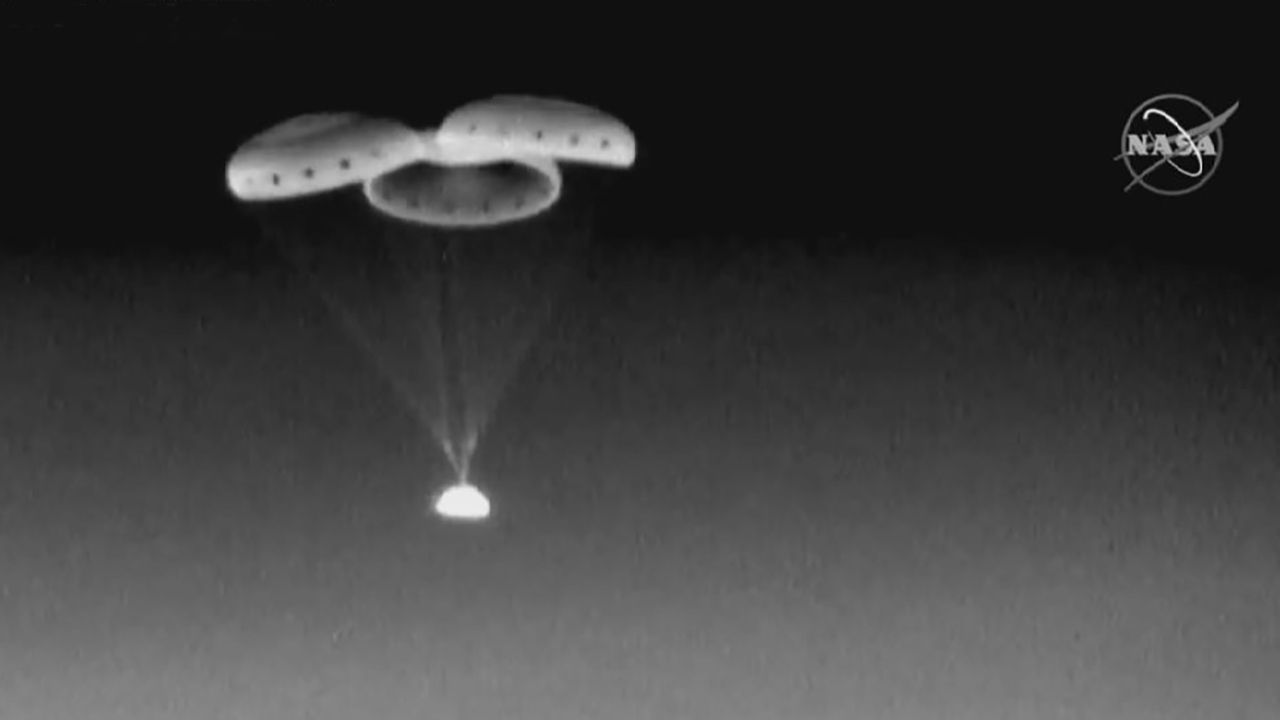
The Starliner’s reentry and landing went off without a hitch! (Credit: News 13)
Faced with Starliner’s problems both NASA and Boeing stressed that had any astronauts been on board they would never have been in any danger. Indeed, it is likely that a human pilot would have recognized that there was a problem with the engine burn and quickly corrected it before the capsule had used up so much fuel.
NASA chief administrator Jim Bridenstine puts on a confident face but Starliner has problems. How long will it take to fix them? (Credit: Phys.org)
Still there definitely was a problem and speculation as to the cause is already spreading across the Internet. At the moment it appears that what happened was that the computer onboard Starliner grabbed the wrong ‘Start Time Clock’ signal from the rocket’s first stage clock. (Since the liftoff of the first stage is the official start of the mission its clock is the master clock for the entire launch system and payload.) By grabbing the wrong time Starliner thought it was in a different segment of the mission and performed an orbit insertion burn rather than the required orbit circularization burn.
How long of a delay this problem is going to cause for the Starliner program is unknown at present. The solution could be just a software fix but hey, the solution to the problems of Boeing’s 737 max 8 aircraft was only supposed to be a software fix and that program is still a mess after more than a year. The big question is probably whether or not NASA will require another OFT in order to verify that the fix, whatever it is, really works. In that event the first manned launch of Starliner would almost certainly be pushed back into late next year.
Meanwhile
Boeing’s rival Space X is also preparing for the final test of its Dragon
capsule early next month, in this case the test an in-flight abort test. So the
space race between Boeing and Space X as to which will be the first to
successfully launch a manned mission could go down to the wire. Right now it’s
anybody’s guess who will win.
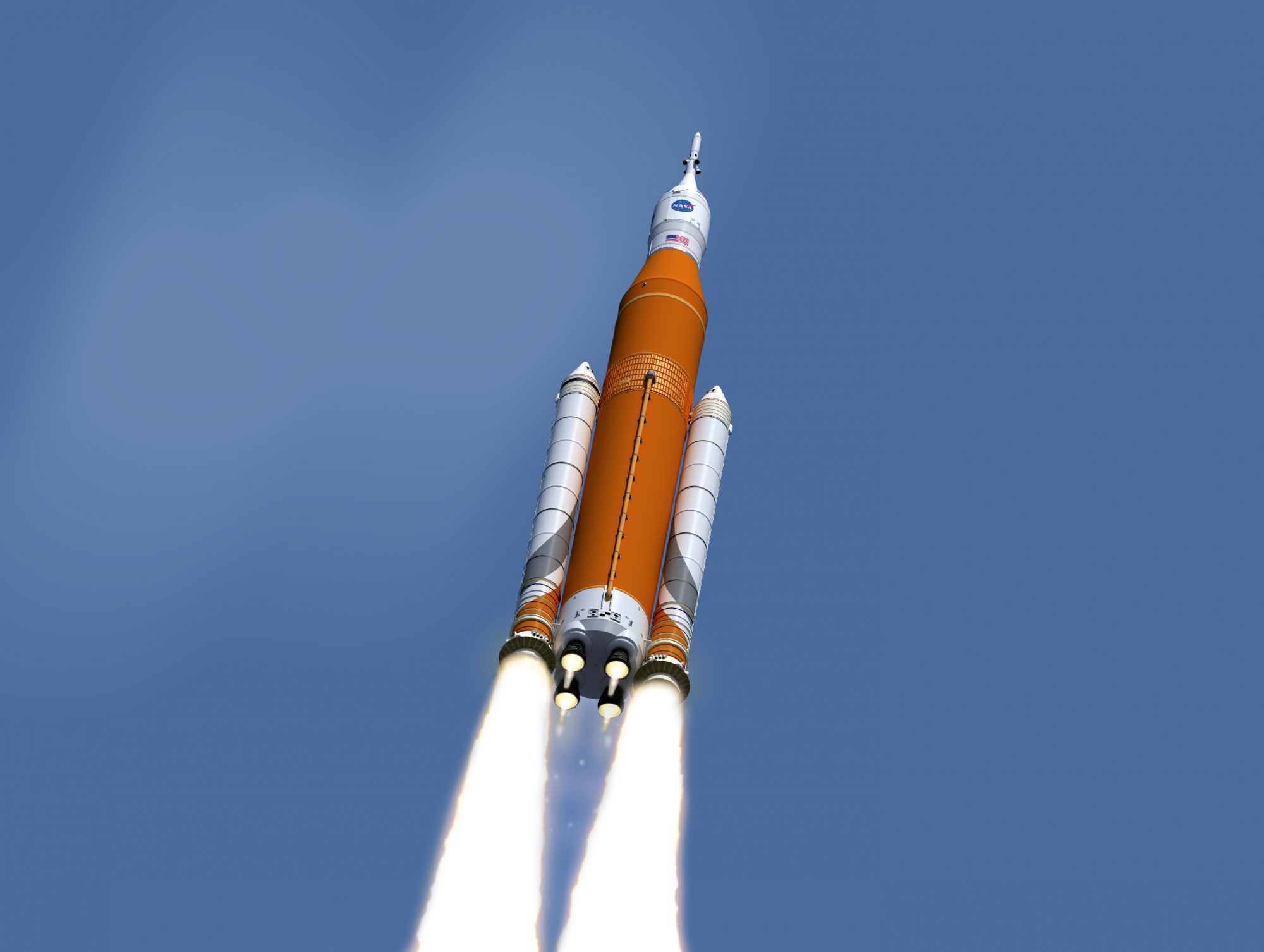
NASA also has a capsule of their own, the Orion capsule which is designed to carry astronauts beyond Low Earth Orbit (LOE), back to the Moon and perhaps one day even to Mars. For its Lunar missions Orion will be launched atop NASA’s massive Space Launch System (SLS). Both programs are several years behind schedule however and in fact the problems with the completion of the SLS is causing another blackeye in Boeing’s reputation.
The Orion capsule launched atop the SLS in this artist’s impression. Maybe one day we’ll see it for real. (Credit: NASA)
The current hope is that an unmanned flight test of both the SLS and Orion, officially referred to as Exploration Mission -1 or XM-1, will take place in late 2020 with a goal of taking the capsule into and back from Lunar orbit. XM-1 will be the first mission in NASA’s ambitious Artemis program for returning humans to the Moon by 2024, a program that I have previously criticized as being already behind schedule, overly ambitious and underfunded.
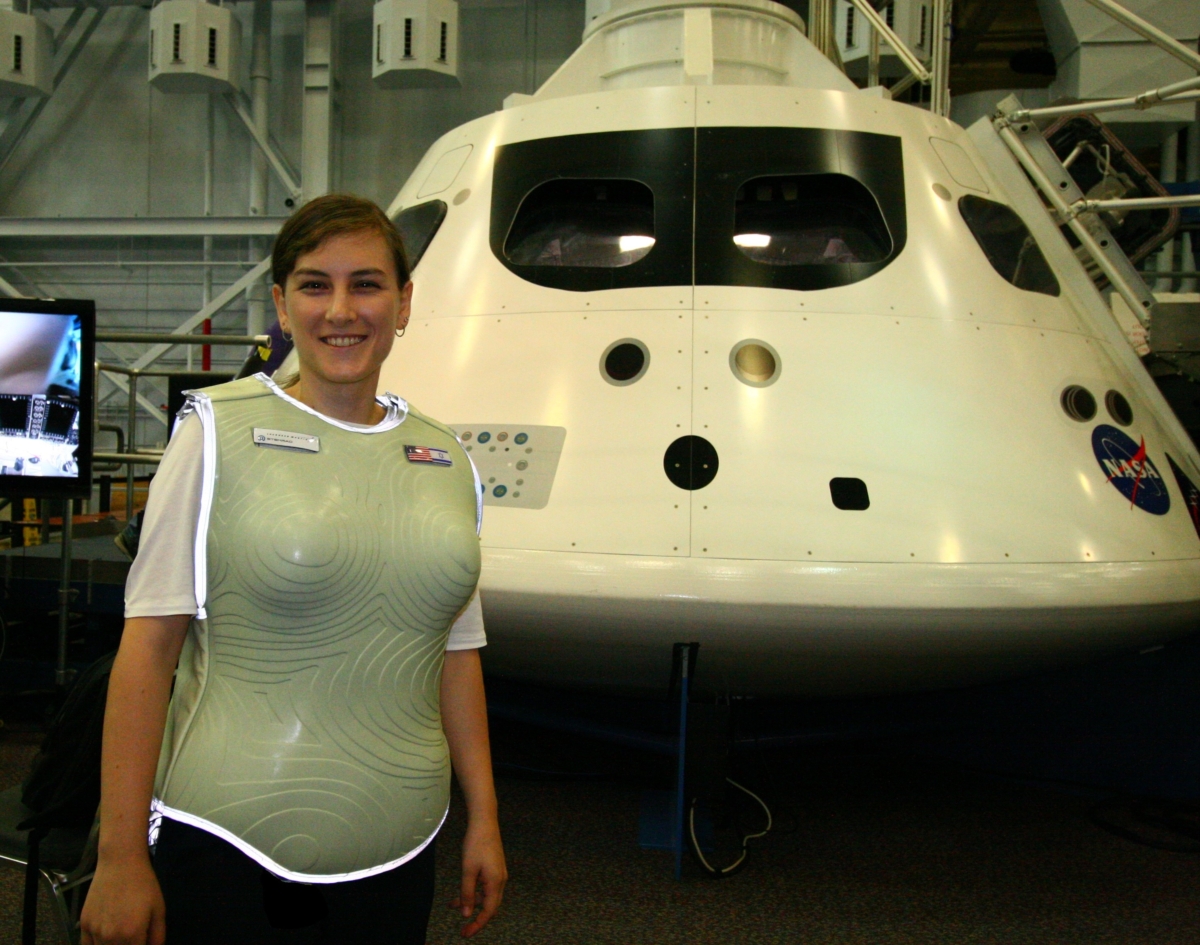
Now NASA has announced plans to include two human dummies in the Orion capsule for that initial test flight. The dummies will be used to measure the effectiveness of NASA’s new anti-radiation vest known as StemRad. The space agency has long been concerned about the exposure to radiation that astronauts will be subjected to on missions beyond Earth’s protective magnetic field and into deep space. StemRad is one of the solutions the space agency is currently developing.
Model wearing the StemRad anti-radiation vest. (Credit: Space.com)
Employing
polyethylene blocks to shield against solar radiation StemRad is designed to
fit over the vital organs of its wearer giving the maximum of protection while
imposing the minimum restrictions on the wearer’s movements. Also, because
studies have shown that woman are more susceptible to harm from radiation than
men are the dummies to be sent to the Moon will be female.
The
plan for the XM-1 mission is for both dummies to be outfitted with radiation
sensors but only one will wear StemRad. A direct comparison of the radiation
exposure between the two dummies will then be a measurement of the
effectiveness of the vest. At the moment StemRad is ready to go, it remains to
be seen if Orion and the SLS will be.
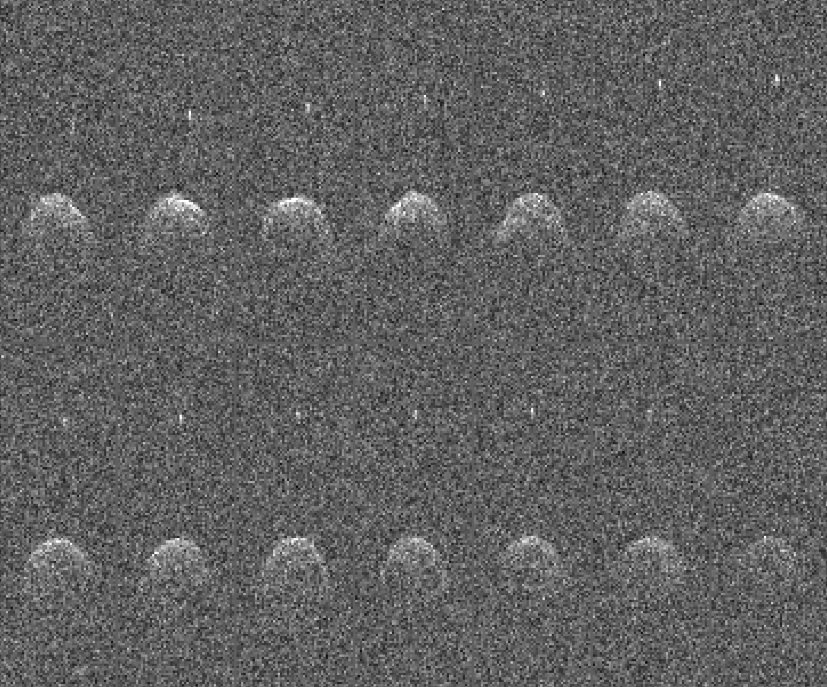
Finally a somewhat smaller story caught my eye, a story about a space mission that could have huge consequences some day in the future. In my posts of 14 October 2017 and 11 May 2019 I talked about NASA’s plans for a mission to attempt to perturb the orbit of the smaller of the two asteroids in the system known as Didymos. This perturbation is intended as the first practical test of a planetary defense system. Officially the mission is known as the Double Asteroid Redirection Test or DART and the plan is to literally have a space probe slam into the smaller asteroid called Didymoon.
Radar scan from Earth based radio telescope of Didymos and Didymoon. (Credit: Wikipedia)
Scheduled to be launched aboard a Space X Falcon 9 rocket in July of 2021 the DART probe is expected to reach Didymos in October of 2022. Once DART has impacted into Didymoon Earth based telescopes will then monitor the changes in the smaller asteroid’s orbit caused by the crash.
NASA plans to impact a spacecraft into Didymoon to see what effect it will have on the asteroid’s orbit around its bigger companion. (Credit: NASA)
Of course a second space mission to measure those changes from close up would provide even more accurate measurements and now it appears there will be such a mission. The European Space Agency (ESA) has officially approved a new mission called Hera that will study the Didymos system starting in either 2025 or 2026.
The ESA’s HERA mission will provide precise follow up measurements of the Didymos system. (Credit: ESA.int)
In addition to measuring the effect of the Dart collision Hera will also land a small cubesat on each asteroid. Together the DART and Hera missions will give scientists their first actual measured data of an asteroid deflection. Such information will help in the development of a defensive program to protect our plant from an asteroid collision like the one that caused the extinction of the dinosaurs.
So as you can see it was a busy month in space. Some progress, some problems, I suppose that’s why they call it rocket science.
We humans have used the waters of our world as highways for more than ten thousand years now. We have transported ourselves and our possessions across the waves in ships that have all too often proven to be fragile when compared to the fury of the ocean’s storms.
As every seaman knows a storm at sea is much more dangerous than one on land! (Credit: Steam Community)
Modern
archaeologists look upon those shipwrecks as a treasure trove. Sent to the
bottom in almost a single moment the vessels and their cargo have remained
undisturbed by man ever since. An accidental time capsule of their time and
culture, shipwrecks contain not only those goods that were considered valuable
enough to trade with other peoples but also those items the crew and passengers
used everyday.
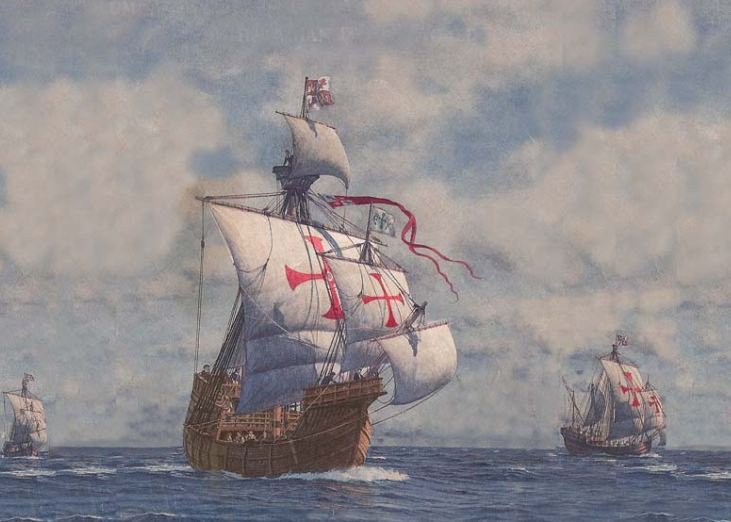
Throughout history there have been many attempts to salvage some of the cargo from shipwrecks that were known to be carrying treasure. The Spanish fleet that was sunk by a hurricane while transporting Aztec gold is a famous example. However, without advanced underwater technology such endeavors have been mostly fruitless. Either the wreck was too deep to be reached by free divers or the cargo was so spread across the ocean floor that very little could be found and recovered in the limited time the divers could remain underwater.
The Spanish trasported the gold they stole from the native Americans back to Europe in a treasure fleet. Not all of those ships completed the voyage. (Credit: Armstrong Economics)
Real underwater archaeology only began with the development of submersible vessels and the Self Contained Underwater Breathing Apparatus or SCUBA gear. These inventions allowed scientists to both descend much deeper into the ocean depths and remain at the bottom far longer. Nevertheless underwater archaeology remains considerably more difficult and expensive than its landlubber cousin.
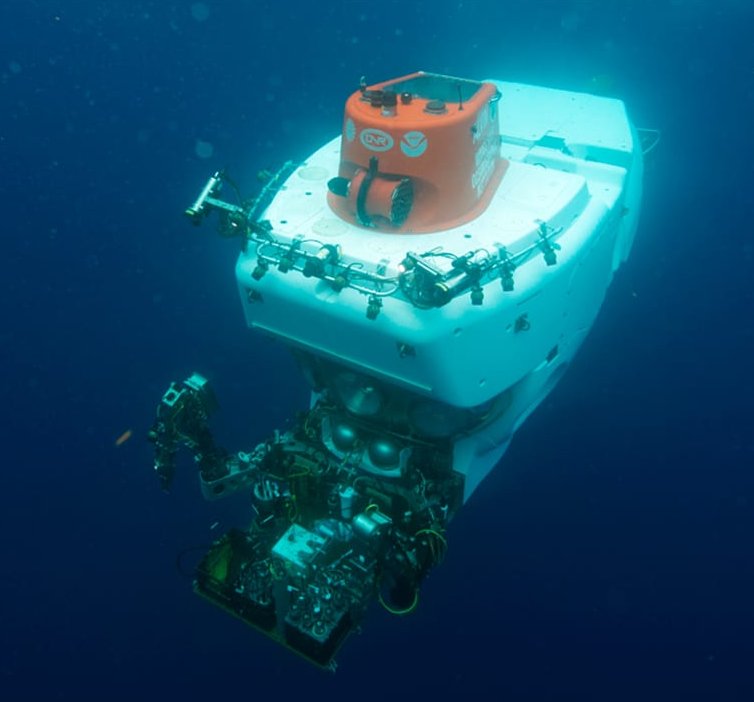
The Submersible Alvin, operated by Wood’s Hole Oceanographic Institute, has explored the wrecks of many ships. (Credit: Woods Hole Oceanographic)
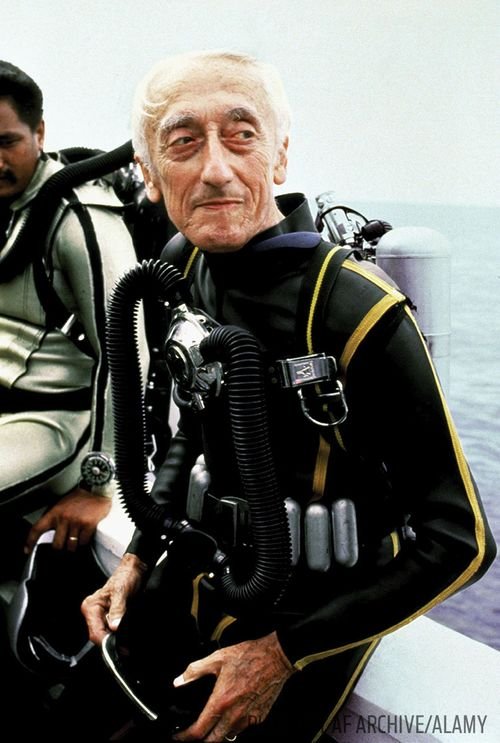
The inventor of SCUBA gear was Jacques eves Cousteau. (Credit: Sport Diver)
Now if you think about it there are really two distinct types of shipwrecks that are studied by marine archaeology. The difference between the two is whether or not the ship was built of wood or steel. In the former case the ship itself has almost certainly decayed away leaving only the metal or ceramic items it carried that can be recovered and studied.
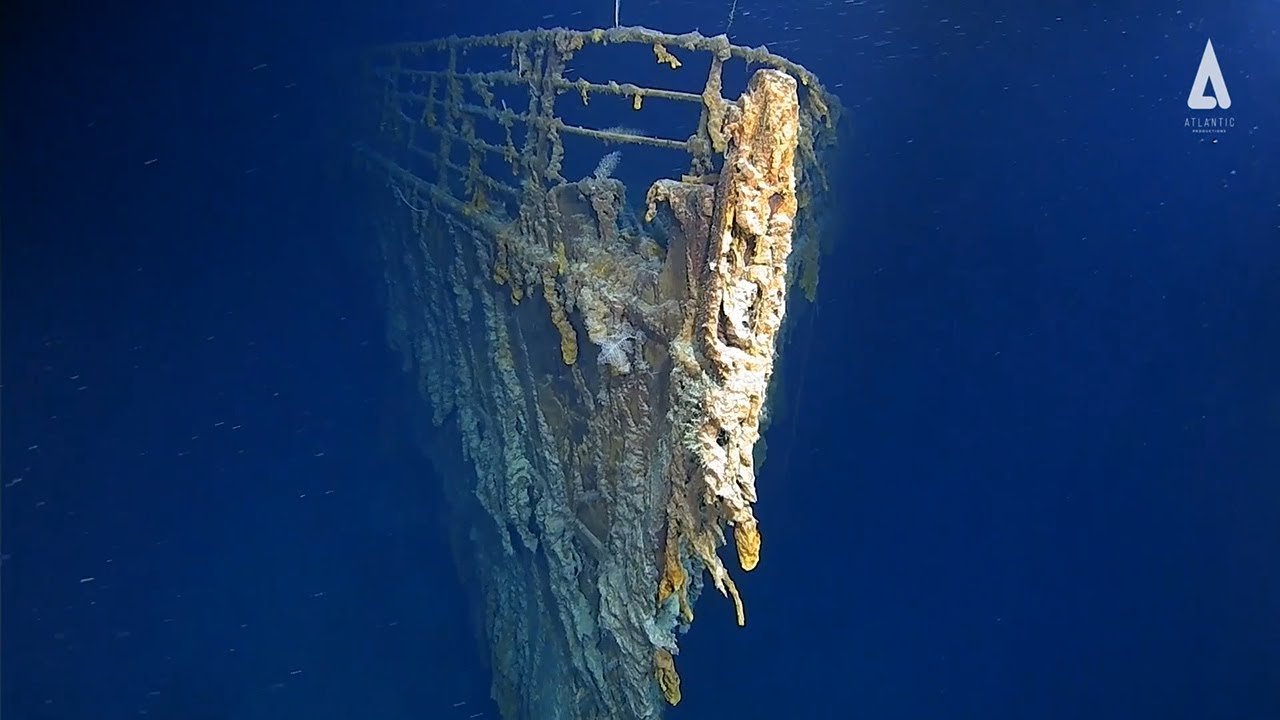
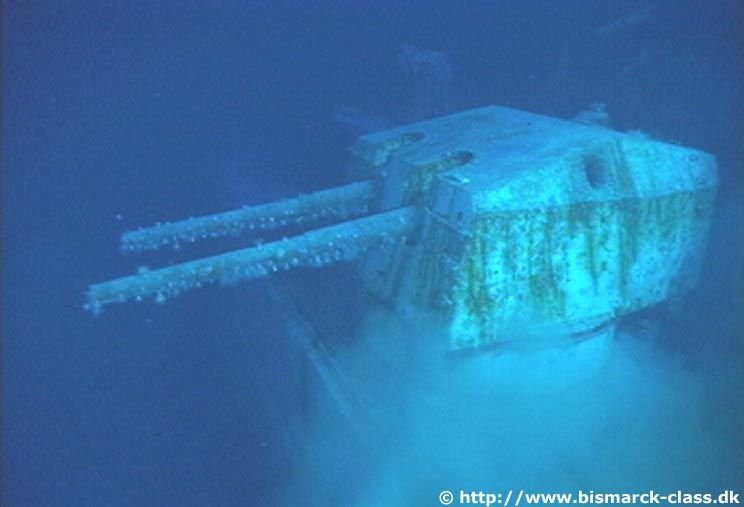
In a steel shipwreck however the ship itself is the biggest artifact to be found. Think of those haunting images of the Titanic, or the Bismarck. In those cases the fact that the ship is still clearly recognizable only makes the damage the vessel has suffered more poignant.
Ghostly image of the bow of the Titanic. The ship is still recognizable despite the ravages of time. (Credit: YouTube)One of the Bismarck’s gun turrets. Again the ship is still clearly recognizable. (Credit: Pinterest)
Two recently discovered shipwrecks illustrate these differences because one of the ships has been dated to the period of the early Roman Empire while the second is a German warship that was sunk by the British during WW1. Since we know the name and historical details of the German ship I’ll begin with her.
Launched on the 23rd of March in 1906 the armored cruiser SMS Scharnhorst was the flagship of Imperial Germany’s Far East squadron tasked with the defense of Germany’s Asian colonies. At the outbreak of WW1 the commander of the squadron, Vice-Admiral Maximilian Graf von Spee was ordered to both attack British shipping as well as get his squadron back to Germany so that they could add their strength to the Imperial Grand Fleet.
The SMS Scharnhorst photographed before the start of World War 1. (Credit: Pinterest)
Steaming
across the Pacific the Scharnhorst and her companions encountered a smaller
group of Royal Navy ships off the coast of Chile at Coronel. In the battle that
followed two British ships were sunk without a single German causality.
Alarmed
by this defeat the British dispatched two Battle Cruisers and five armored
cruisers to intercept von Spee’s squadron. The two fleets met in the South
Atlantic near the Falkland Islands and in a running battle the Scharnhorst
along with three other German ships were sunk on the 8th of December 1914.
Admiral von Spee, his two sons and the ship’s entire crew of 860 went down on
the Scharnhorst, altogether 2,200 German sailors died in the battle.
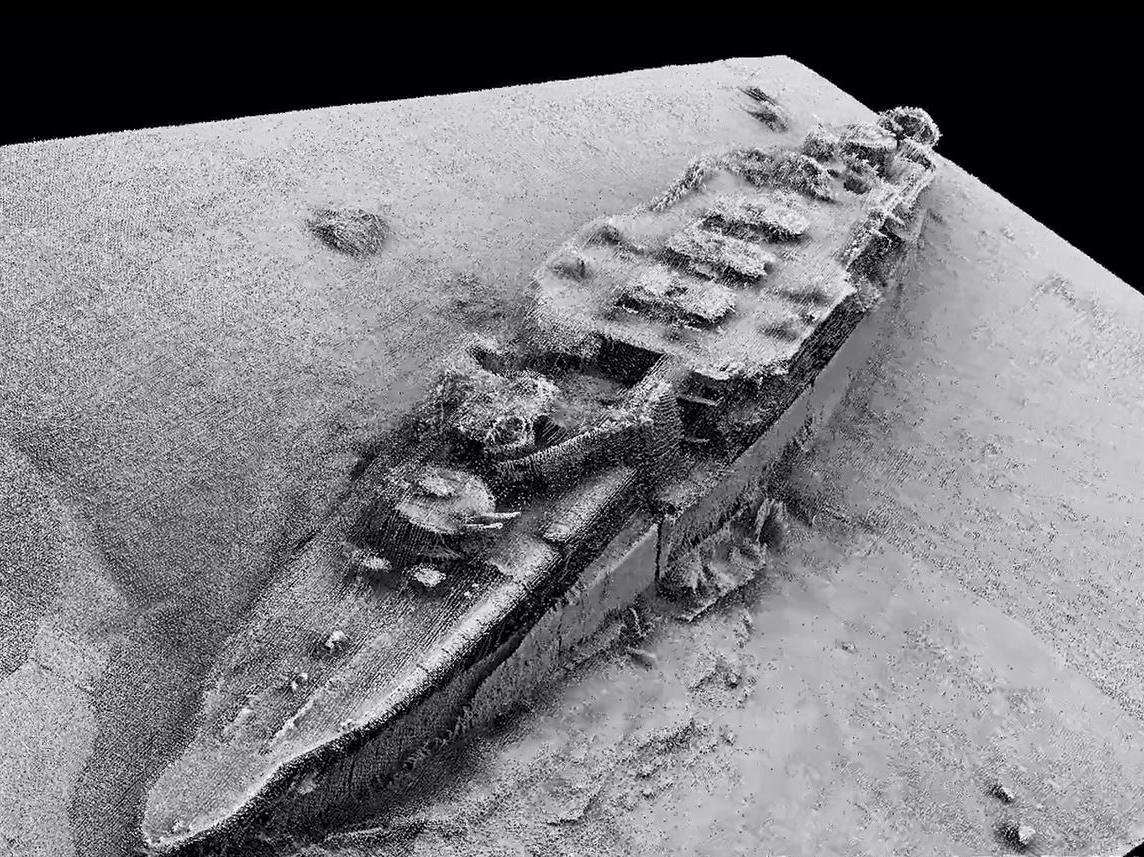
To commemorate the 100th anniversary of the Falkland’s battle an effort was made to locate the wreck of the Scharnhorst. However it wasn’t until this year when the deep submersible ‘The Seabed Constructor’ along with four Remote Operated Vehicles (ROVs) became available that the Scharnhorst was finally discovered. The once feared warship rests at a depth of 1,610m and the Falkland Maritime Trust team who discovered her was careful not to disturb the wreck in any way. Indeed the marine archaeologists are seeking to have the Scharnhorst site protected by law out of respect for those who fought and died aboard her.
Sonar scan of the Scharnhorst as she lies on the bottom. (Credit: The Independent)
The
Archaeologists who discovered the Roman-era trading ship about two kilometers
outside the harbour of the Aegean island of Kefalonia did not have to worry
about disturbing human remains. Whatever members of the crew of the 2,000 year
old vessel may have gone down with the ship their bodies have long since
decayed along with the wood out of which the ship was made.
While
we have no knowledge of the ship’s name or its history at an estimated size of
35m in length by 12m in width the wreck is the largest from the classical
period to be discovered in the eastern Mediterranean.
The location of the wreck was actually discovered by a sophisticated sonar scan of the area that used Artificial Intelligence (AI) to perform the image-processing that made the wreck site discernable. After being identified as a possible archaeological site the wreck was then visited by an ROV to investigate. See image below.
The sonar scan of the Roman era wreck. Not much to see here, it takes an expert to recognize the remains as a ship. (Credit: Mother Nature Network)
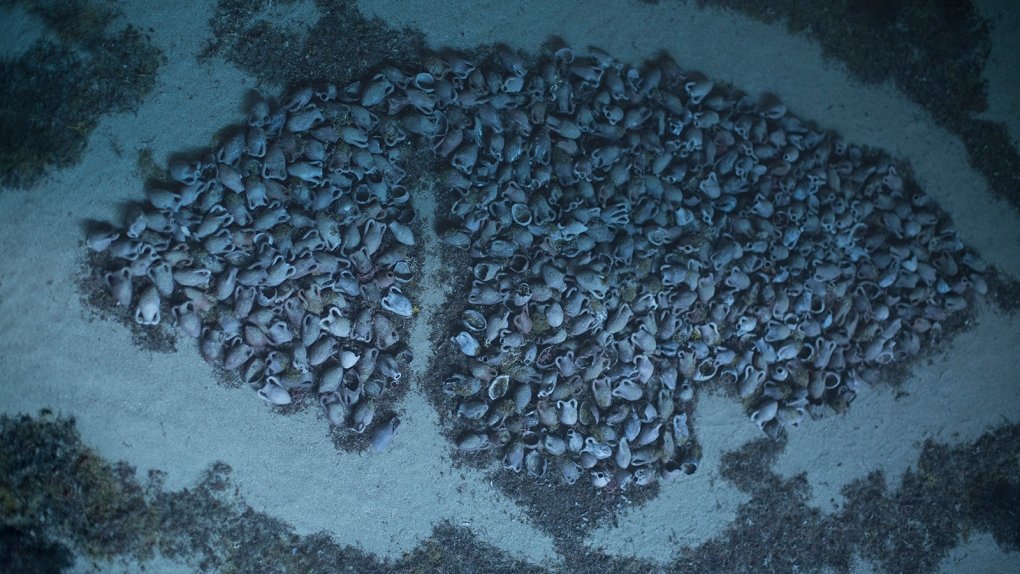
The most obvious evidence remaining that there was a shipwreck at the site was two concentrated groupings of amphorae, large ceramic containers used 2,000 years ago to transport goods like olive oil, wine, nuts or grains. The two groups of amphorae, which probably relates to the ship’s forward and aft cargo holds, are estimated to contain about 6,000 ceramic vessels.
The ship itself may have decayed away but the ceramic shipping vessels known as amphorae make a ghostly impression of it. (Credit: CTV News)
So
far nothing has been removed from the site but the archaeologists at the
University of Patras who announced the discovery hope to soon recover a few of
the amphorae. Once recovered the scientists will perform a DNA analysis in
order to ascertain what sort of cargo the ship was carrying when it was sunk. A
more detailed survey of the wreckage could also teach archaeologists much about
how trade was carried out during the time of the Roman Empire.
Throughout
our history trade and warfare upon the oceans and seas has been one of the
driving forces of human progress. Thanks to marine archaeology we are learning
more and more about how that progress was achieved.
Our desire for, and our ability to produce art is one of the characteristics that separates human beings from the other animals on this world. In fact many anthropologists and psychologists would assert that that the beginning of art history is actually the beginning of human history. After all art stems directly from the human imagination, which is perhaps the thing that most makes us human.
Among the most recognizable of human creations art has a way of reaching deep into our soul. (Credit: Quora.com)
The study of early art is therefore a critical part of the study of early humanity. Examples of Stone Age art are as rare as other Stone Age artifacts however so scientists greet each new discovery as if they had unearthed a gold mine, which to them it is.
Not all Stone Age art is cave paintings. Many carvings, such as this Stone Age Venus, have also been discovered. (Credit: Britannica.com)
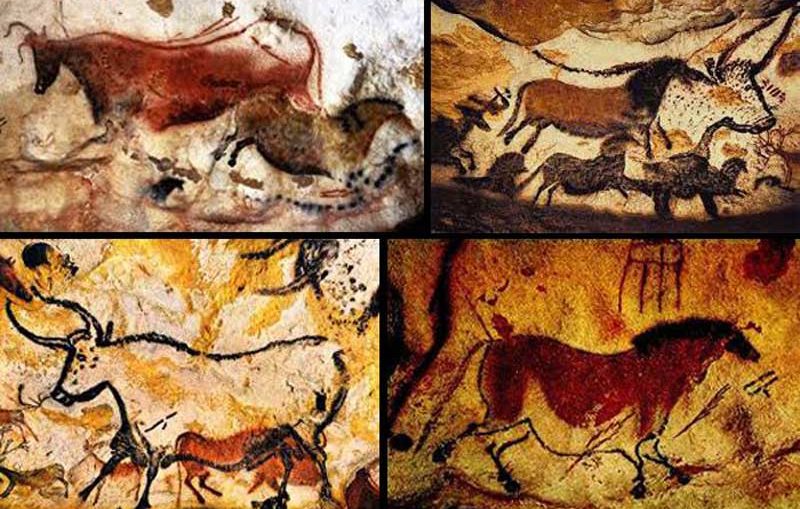
One of the best known forms of early art is cave painting, drawings or engravings that are found on the walls and ceilings of caves. Examples of cave art were first discovered in France in the 1940s and soon hundreds of other such decorated caves were being found throughout the world. The artwork represented in these caves varies greatly but three main themes seem to dominate, drawings of the animals that early humans lived with, drawings of humans themselves and enigmatically, outlines of human hands. These were made by the artist placing their hand on the cave wall and blowing paint, probably through a tube of some sort, onto the hand leaving an outline of the hand on the cave wall.
A few of the Cave Paintings discovered in a cave at Lascaux France. (Credit: NoiseBreak)
Are these outlines of human hands our first attempts at making our mark on the world, of leaving a legacy? (Credit: Massive Science)
Determining the age of cave paintings can be enormously difficult however and so the question of which cave paintings are oldest, and therefore where cave painting originated, can generate a lot of controversy. Europe, Africa, Asia and Australia all have examples of cave art that have been dated to more than 40,000 years ago. Perhaps rather than competing to see in which area of the world humans first began to create art we should simply marvel at how long ago it was and at the skill that even those early artists showed.
Now a series of pictograms from a cave on the Indonesian island of Sulawesi just to the east of Borneo have been discovered that may represent the oldest known attempt to tell a story with art. The images painted are familiar in some ways, figures of animals that can be identified as local species along with clearly human figures. Looking at the first image below the large image is that of species of small buffalo known as an Anoa that inhabits the island. The second image shows a local species of swine called the Sulawesi Warty Pig.
Image of an Anoa from a cave on the island of Sulawesi. (Credit: BBC)
Image of a Sulawesi Warty Pig from the same cave. (Credit: BBC)
Both animals are accompanied by human-like figures arranged in a manner that suggests a hunt. That suggestion is further strengthen by the fact that some of the humans are carrying items that could be spears or rope. If that is the case then the cave art in Sulawesi may be the earliest attempt that we know of to use art in order to illustrate a story.
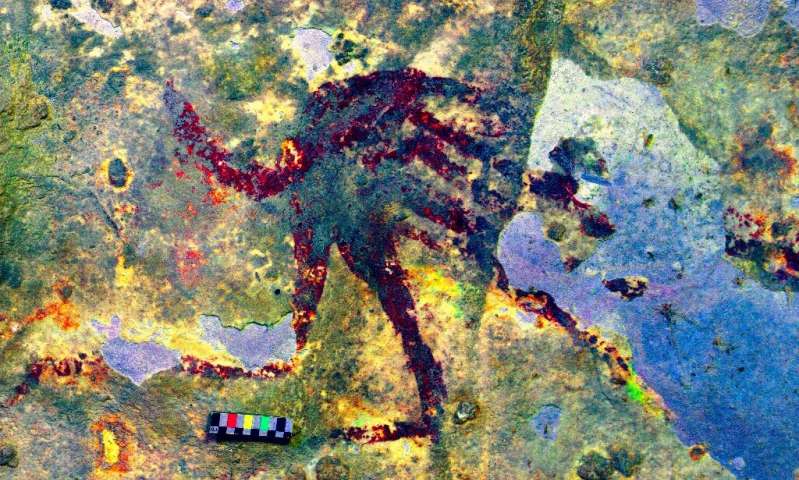
However there are also several other figures that have really piqued the interest of archaeologists. These small figures appear to combine human and animal characteristics. The image below illustrates this with human-like creatures that also seem to possess a tail or snout. Such human animal hybrids, technically known as therianthropes are very common in later mythology, hey we still talk about werewolves and mermaids. To have evidence of such supernatural beings from so long ago is astounding however.
One of the strange, half human, half animal figures found in the Sulawesi Cave. (Credit: Phys.org)
As
to the age of the paintings in the Sulawesi cave the archaeologists were able
to conclude that some of the images date to as long ago as 43,900 years. They
did this by radioactive measurements of the calcite deposits that have built up
on top of the images. Since the calcite is on top it must have formed after the
images were made, measuring the ratios of Uranium to Thorium in the calcite
then tells you old it is and the images beneath can only be older.
The
cave where these new paintings were discovered is just the latest of 242
similar caves with artwork found in them on just the island of Sulawesi. How
many more caves remain to be discovered only time will tell. Cave art is
teaching us a great deal about the growth of the early human imagination, the
thing that truly sets us apart from the other animals.
Without our Sun life here on Earth would be impossible, we all know that. The Sun’s light not only keeps our planet warm but through the process of photosynthesis generates the food we need to survive. Recognizing this importance for centuries now scientists have examined the Sun with every instrument in their possession. However the very energy that the Sun produces can make it difficult to study. After all, if you get too close you could suffer the same fate as Icarus.
Right now our Sun is going through Solar minimum in its 11 year sunspot cycle. We have had 271 days with NO observable sunspots so far this year. (Credit: Spaceweather.com)
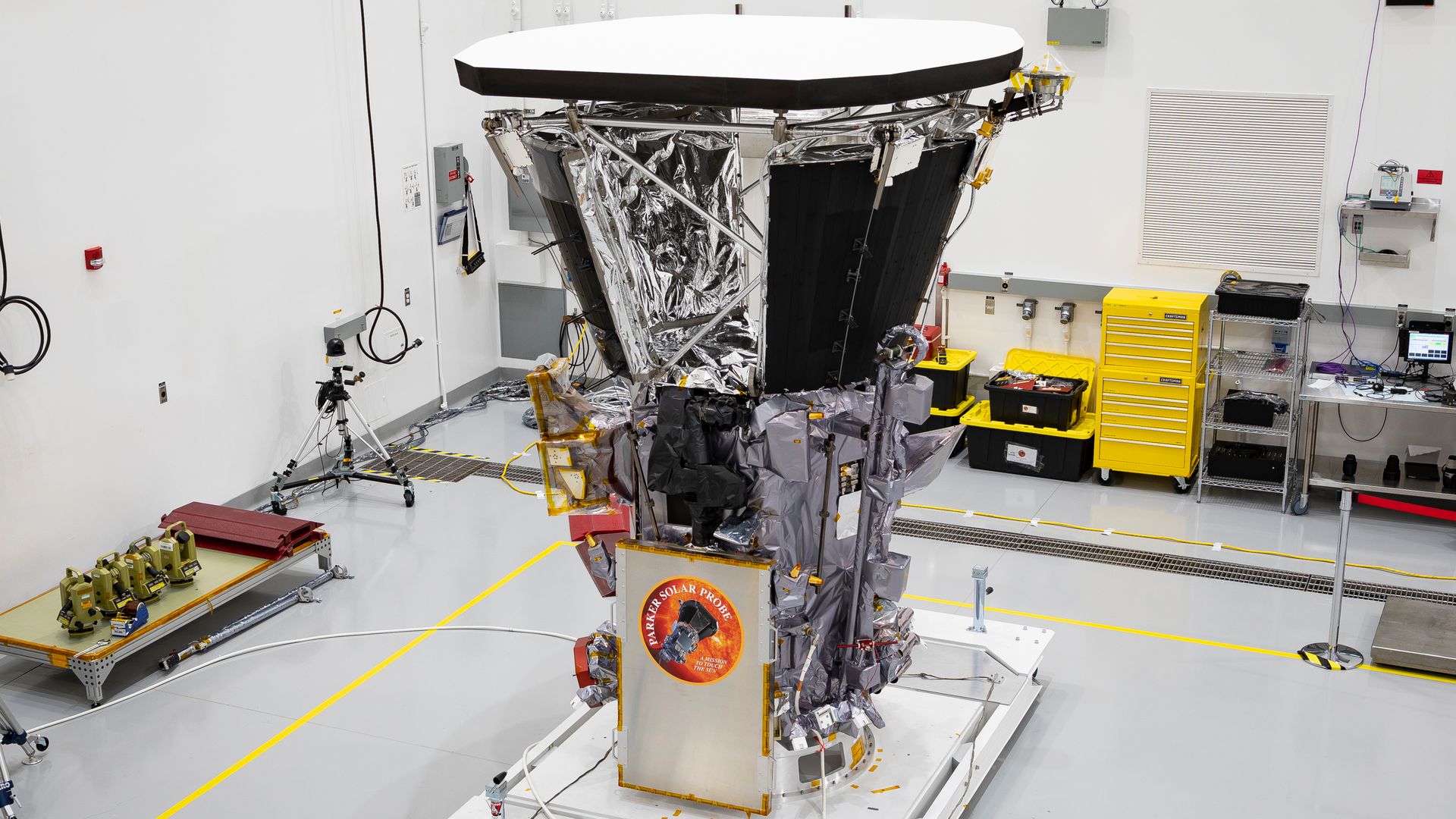
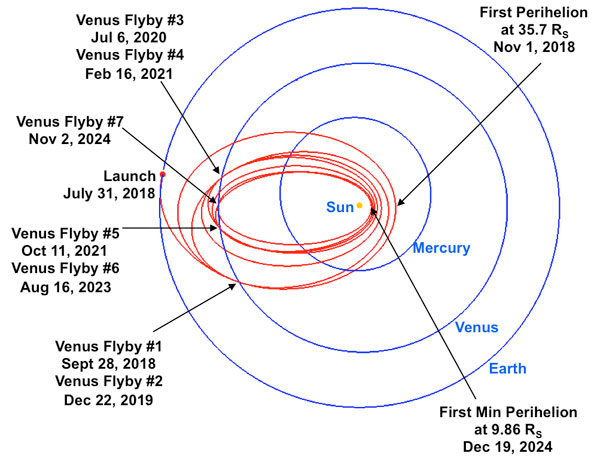
NASA’s Parker Solar probe is the space agency’s latest attempt to get up close and personal with our parent star. Launched back on August 12th of 2018, see my posts of 7 June 2017, 5 September 2018 and 3 November 2018, Parker is designed with a special ‘heat shield’ to protect its delicate instruments from being destroyed by the Sun’s heat. Nevertheless even Parker cannot remain too near the Sun for too long. Instead the probe has been placed in a highly elliptical orbit that takes it in as close as 24 million kilometers to the Sun before sending it back out to 100 million kilometers, a distance that will allow the that heat shield a chance to cool off.
The Parker Solar probe nearly completion. The heat reflector / shield at the top protects the delicate instruments beneath from the Sun’s intense radiation. (Credit: Axios.com)
The planned orbital plot for the Parker Solar Probe is the most complex set of maneuvers ever attempted for a spacecraft. (Credit: Sky and Telescope)
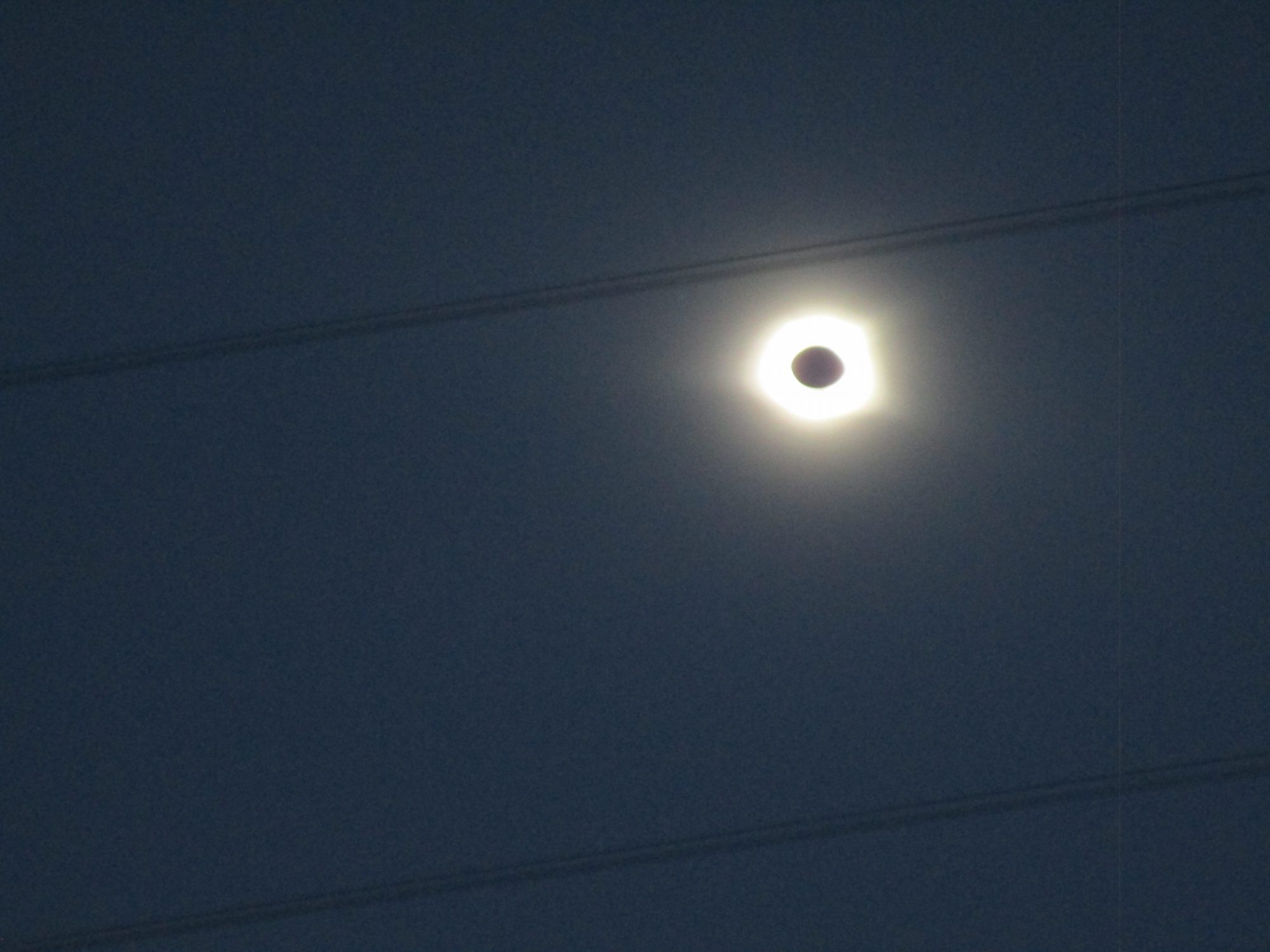
At its closest approach Parker actually flies within the Sun’s atmosphere, the corona, that glow around the Sun that can only be seen during a total eclipse. The question of why the corona is so hot, over a million degrees Kelvin, while the Sun’s surface is relatively cool, about 6,000 Kelvin, is one of the mysteries that Parker was built to study.
A picture I took of the solar eclipse back in August of 2017. At totality the Sun’s corona becomes visible. (Credit: R. A. Lawler)
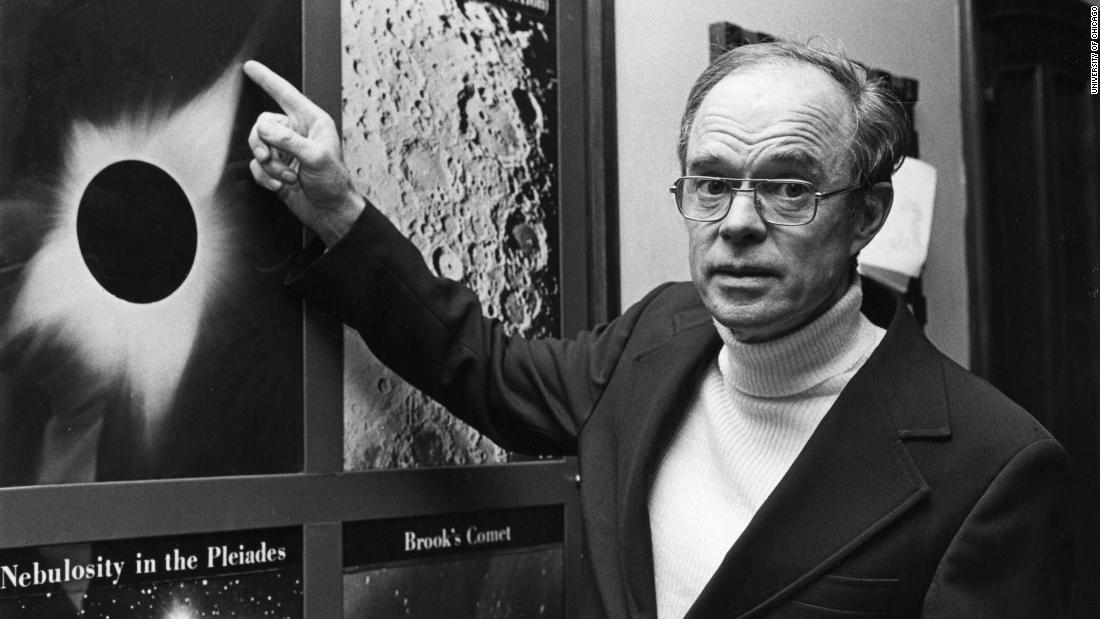
Learning more about the how the Sun generates the Solar wind, the steam of high-energy particles that among other thing causes auroras here on Earth, is another of the Parker Probe’s main missions. That particular mission is only appropriate since the spacecraft is named for Eugene Parker; the astrophysicist who back in the late 1950s first predicted the existence of the Solar wind. In fact Parker is the first NASA spacecraft to be named for a living scientist, a measure of the respect with which Eugene Parker is held in the space community.
Eugene Parker describing the Solar wind that he predicted. (Credit: CNN.com)
So
far the Parker Solar probe has completed three of its planned 24 close passes
and now NASA has released the first data dump of measurements taken by the
probe. In a series of papers presented at the fall meeting of the American
Geophysical Union on December 11th NASA scientists revealed new discoveries
about how the Sun generates the Solar wind along with how the magnetic fields
within the corona switch polarities on a period ranging from a few seconds to a
few minutes.
The papers also detail how the density of dust particles in the atmosphere actually goes down as you get closer to the Sun. This phenomenon is probably due to the pressure of the light and sub-atomic particles being ejected by the Sun and of which the Solar wind is formed. During its most recent close approach back in November Parker was actually able to observe the effect of a Coronal Mass Ejection (CME) on the Solar wind revealing how a CME acts as a ‘snowplow’ pushing the wind ahead of it with increased energy.
A Coronal Mass Ejection (CME). (Credit: Flickr)
And
the Parker probe’s mission is only beginning; NASA is planning on another 21
close approaches to the Sun. In fact just next month Parker is scheduled to use
a gravity assist from the planet Venus which will send it on an orbit that
takes it even closer to the Sun. Eventually the space probe is expected to come
within a mere 6.16 million kilometers of the Sun and to reach speeds of 690,000
kilometers per hour, a wild ride indeed.
The
Parker Solar probe’s mission is scheduled to last through 2025, who knows what
secrets it will learn in that time about the star that is the very center of
our Solar system.
Living creatures are the most complex structures known to science so its not surprising that mistakes can be made in their construction. Yes, those mistakes can certainly be tragic when you think about those children who are born with birth defects, but still it’s not surprising. The study of creatures who are born with a radical difference between them and other members of their species is formally known as Teratology which literally means ‘the study of monsters’. I suppose that says something about the social attitudes of even well educated scientists back about two hundred years ago.
Something as simple as a colour mutation is still considered a subject in the science of Teratology. (Credit: Isn’t That Interesting)
Back then teratology was one of the ways biologists could learn something about the way organisms grow. Sometimes you can learn more about a system from the way it breaks than you can from when it is working perfectly. For example, about a hundred years ago geneticists began raising fruit flies, drosophila melanogaster, as a way of studying inheritance. Fruit flies are easy to raise, have very short generations and importantly only four chromosomes so they are perfect for genetic studies.
Some of the reasons geneticists use fruit flies, Drosophila species, as subjects to study. (Credit: SlideServe)
The researchers noticed that once in a great while a fly would be hatched with a superfluous leg where one or both of its antennas should be. This happens because the antennas of insects are in fact modified legs! Mutations such as this are known as atavisms from the Latin for ancestor. In other words some defect has caused a body part to develop as it would have developed in an ancestral species rather than the way it should in the species today.
A common mutation in fruit flies is the replacement of an antenna with a leg. This is a form of Atavism. (Credit: Slideplayer.com)
The same phenomenon has been observed in horses whose hooves are just the middle finger of the original mammalian five digits. Sometimes however a horse is born with either digit two or four, or both showing. This is evidence that long ago the ancestors of horses had more toes than now, all the way back to the five digits of the first land dwelling vertebrates.
Image of a Horse with an extra hoof (left front) caused by an ancestral digit reappearing. (Credit: The Perfect Hoof)
Atavisms are one form of malformation, others include missing parts, a condition that can often be lethal, extra parts, such as a sixth finger, as well as parts in the wrong places. An example of that final category of malformations happened to make the news recently, Narwhal the puppy with a tail growing out of its forehead.
I don’t care if he does have a tail growing out of his forehead, that’s a cute puppy!!! (Credit: CNN)
Narwhal was found abandoned in Missouri and taken to Mac’s Mission, a non-profit animal shelter that specializes in special needs animals. When found Narwhal was an estimated 10 weeks old and is perfectly healthy except for that extra tail. He does have a normal tail where it’s supposed to be by the way. The extra tail is not causing Narwhal any pain or discomfort nor does he appear to have any control over it, it simply flops from side to side as Narwhal plays.
X-ray of Narwhal’s head showing no bones connecting his extra tail to his skull. (Credit: Irish Times)
Presently
Narwhal is not eligible for adoption as the staff at Mac’s Mission would like
to let him get a little older and make certain that his extra tail is not going
to be a problem in any way. Narwhal has become an Internet sensation however
with over 10,000 likes. A popularity that the staff at Mac’s Mission hope will
bring attention to the important work that they are doing.
Then, just a day after the first news items about Narwhal was published another example of an animal with extra parts was discovered. In a forest on Michigan’s upper peninsula a hunter turned wildlife photographer named Steve Lindberg, who also happens to be a former state representative, discovered a three antlered deer. Looking at the image below you can see that the animal has a normal, five pointed antler on the left side of his head but two smaller antlers on the right side of his head.
Deer with three antlers spotted on Michigan’s upper peninsula. (Credit: Detroit Free Press)
Mr.
Lindberg was able to observe the ‘One in a Million’ deer for several hours and
the animal appeared to not be suffering in any way from its extra antler.
Unlike Narwhal, who has been thoroughly examined by a vet, scientists have only
Mr. Lindberg’s images with which to study the deer. Based on those photos
naturalists cannot be certain whether the malformation is caused by a normal
antler that split in two, each half continuing to grow, or is the third antler
a true mutation.
If
the extra antler is due to a mutation, Narwhal’s extra tail almost certainly
is, then there is a possibility that their offspring could inherit their extra
body part. That means that a few years from now more three horned deer might be
seen on Michigan’s upper peninsula.
As for Narwhal, exotic pets are very popular right now and a dog with an extra tail in its forehead is certainly exotic. It’s actually possible that Narwhal could father an entirely new breed of dog, an example of what Darwin called ‘Artificial Selection’ and discussed at length in ‘The Origin of Species’.
In the long run of course evolution depends on the birth of individuals who differ in some way from all of their ancestors. Mutations are the raw material that natural selection uses to create new species. They don’t give superpowers nor are they anything to be afraid of. They are just a part of the way life works.
This is not the way mutations actually work. (Credit: Nerdist)
We’ve all heard stories about how the frozen remains of Wholly Mammoths are sometimes found in near perfect condition in the cold artic tundra of Siberia. Well its not just Mammoths that have been discovered, reindeer, bears even artic hares and foxes are occasionally found there.
37,000 Year Old baby Mammoth found in the Siberian tundra. (Credit: Telegraph)
Now a new and potentially very important find has been made along the Indigirka River, northeast of Yakutsk, considered the world’s coldest city. The find made by Doctor Sergey Fedorov of the Institute of Applied Ecology at Russia’s North-Eastern Federal University is that of the frozen corpse of a puppy and the biggest new may be that so far scientists can’t decide whether it’s a dog or a wolf. The remains have been given the name Dogor which in the local Yakut language means ‘friend’ but the English pun of ‘Dog or ?’ was intentional.
Dogor the 18,000 year old puppy found frozen in Siberia. (Credit: The New York Times)
Dogor’s preservation is so good that even his teeth are in perfect condition. (Credit: Smithsonian Magazine)
From an initial examination Dogor was a male and appears to have been about two months old when he died. When samples of Dogor were radiocarbon dated they were found to be 18,000 years old but after DNA sequencing was performed at Sweden’s Centre for Palaeogenetics the scientists were unable to decide whether Dogor was a dog or a wolf. That is despite the centre having Europe’s largest bank of DNA samples of canines from around the world to use as comparisons.
Of
course the most exciting result would be if Dogor turned out to be neither a
wolf nor a dog but a transition between them. We all know that wolves were the
first animals to be domesticated by humans, becoming dogs in the process, and
if Dogor is an example of that transition then he may be able to tell us quite
a bit about how humans first came to domesticate wild animals.
Which begs the question, what do we know about when, where and how humans turned wolves into dogs?
Dogs have been our companions for so long we’ve forgotten where, when and how we first brought them into our lives. (Credit: Thinglink)
I remember fifty or more years ago the leading theory for wolf-dog domestication was that about 20,000 years ago, probably somewhere around the Ural Mountains in Russian, a band of hunter gatherers killed some adult wolves and then came upon the wolves’ now orphaned pups. Rather than killing the pups the humans decided to make pets of them and when the pups grew up the humans practiced selective breeding, that is only allowing those pups we liked to breed. After several generations the wolves would have become tame, the first step in becoming a dog.
European cave painting of a man with a dog. Obviously we’ve been together a long time. (Credit: Kamloops this Week)
The problem with that scenario is that wolves are wild animals and even if raised from pups when they grow up they will be much too difficult to handle. This same thing is true of chimpanzees; people often buy baby chimps as pets only to have to get rid of them when they grow up because adult chimpanzees are just too big and strong and wild to be a good pet!
Making a pet of a baby wild animal may seem like a good idea but when they grow up it definitely isn’t. (Credit: The Dodo)
So how did wolves ever become tame enough so that humans would ever even consider taking them in as pets? The current thinking goes something like this. Twenty thousand years ago or so, as groups of hunter gatherers feasted on their kills and other foods they would throw their waste onto nearby garbage piles, paleoarcheologists have found the remains of some of these garbage dumps by the way. Those garbage piles attracted scavengers, wolves among them and those wolves who were the least afraid of humans got the most of the leftover food scraps.
In
time some wolves might even begin to follow the humans as they moved from one
campsite to another, hunter gatherers are nomadic after all. Over several
generations the wolves would become more dependent on humans, and the humans
would become used to having the wolves around, perhaps even using the wolves as
proto-watchdogs. How long this process may have taken is unknown but there is
evidence that it actually may not have taken very long.
That evidence comes from an experiment that began in 1959 in the old Soviet Union. In Russia the breeding of animals for their fur is a big industry and zoologist Dmitry Belyayev thought that he could use a farm for raising foxes as a place to study the process of domestication by selective breeding.
Dmitry Belyayev with some of his domesticated foxes. (Credit: BBC)
Doctor
Belyayev proceeded by separating the foxes on the farm into three classes.
Those foxes that either fled from humans or behaved aggressively were placed in
Class III while those in Class II neither avoided nor encouraged human contact.
Class I was reserved for those foxes that showed signs of friendliness towards
their handlers. The animals in Class I were then only allowed to breed with
other Class I animals.
By
the sixth generation Belyayev was forced to create another category, Class I
Elite for those animals that actively sought human contact. What’s more the
ways in which the Class Ie animals tried to attract their handlers was
remarkable similar to a dog’s behavior, tail wagging, whining and licking hands
and faces.
There were also actual changes in the fox’s physical morphology, their snouts became shorter and rounder, their skulls became wider. Even their ears changed, becoming floppy like a dog’s instead of pointing stiffly upward like a wild fox’s, and a wolf’s.
As Belyayev’s foxes became tame they also began to take on the physical characteristics of dogs, including floppy ears. (Credit: Noellembrooks.com)
Doctor
Belyayev’s experiment is still continuing although it is now being conducted by
Doctor Lyudmilia Trut of the Institute of Cytology and Genetics in Novosibirsk.
Doctor Trut was a graduate student of Doctor Belyayev and the two worked
together for many years.
Thanks
to the work of researchers like Doctors Belyayev and Trut along with the
discoveries of Doctor Fedorov and the scientists at Sweden’s Centre for
Palaeogenetics we are learning a lot more about where, when and how the dog first
became man’s best friend.
Let’s
face it; good movies about engineering are few and far between. Hollywood seems
to be convinced that any movie that doesn’t have fights or romance can’t
succeed while solving problems with logic and technical skill is just so
boring.
That’s why I’m so pleased that this year we have two, ‘The Current War’ earlier this year, see my post of the 30th of October, and now ‘Ford versus Ferrari’. Like most stories that are based on history ‘Ford versus Ferrari’ needs a little background information at the start.
Poster for ‘Ford versus Ferrari’ from 20th Century Fox Pictures. (Credit: Galleria.com.mt)
At the dawn of the 1960s Ford Motor Corporation was running a distant second to its huge rival General Motors in car manufacturing. Ford’s chairman, Henry Ford the second, the grandson of it’s famous founder was looking for some way to get his company out of the doldrums it was in, enter Lee Iacocca, played by Jon Bernthal.
The Real Lee Iacocca with his brainchild, the Mustang. (Credit: Fortune.com)
Iacocca
recognized that the baby boomers were growing up, with driver’s licenses and
money in their pockets and they were looking for something sexy to drive.
Historically Iacocca’s biggest achievement was his design of the Mustang, which
was definitely the car boomers wanted to drive. I’ve owned five of them!
Another
idea that Iacocca had to make Ford cars seem sexy was for the company to join
the international racing circuit by buying the small Racing car company
Ferrari, famous for it’s victories at the 24 hours at Le Mans. Enzo Ferrari,
owner of Ferrari motors, turned down Ford’s offer however. More than that,
Ferrari insulted both Ford cars and Henry Ford II himself. Henry Ford now
wanted revenge and he had the money to buy it, enter Carroll Shelby.
Shelby, played by Matt Damon is the center of ‘Ford versus Ferrari’, an engineer, auto designer and racecar driver who has retired from driving for health reasons. To do the actual driving Shelby hires Ken Miles, played by Christian Bale.
Matt Damon (l) plays Carroll Shelby while Christian Bale (r) plays Ken Miles. (Credit: Rolling Stone)
Together Shelby and Miles take on Ferrari, the bureaucrats at Ford and occasionally each other in their effort to build the GT40 MkII. Their chief opponent during much of the movie is not Ferrari but rather Ford Executive Vice President Leo Beebe who just sees Miles as an unreliable, non-team player.
A Ford GT40 Mk II. (Credit: Robb Report)
It
should be noted that the families of both Leo Beebe and Henry Ford II have
criticized the portrayal of their relatives and refused to cooperate with the
filming of ‘Ford versus Ferrari’ as did Ford Motor Corporation itself. That’s
one of the problems with Hollywood in general. Sometimes, in an effort to
increase the dramatic tension in a story real people can become nothing more
than cardboard villains for the ‘good guys’ to fight.
As they develop the GT40 MkII, the Ford team participates in several races including the Daytona 500 but the climax of the movie is the 24hrs at Le Mans in 1966. The racing sequences in ‘Ford versus Ferrari’ are exceptionally well done giving the movie a degree of excitement rare in historic films where the outcome is an established fact.
Racing scene from ‘Ford versus Ferrari’. (Credit: 20th Century Fox)
As
to the performances, all of the actors do a good job, Caitriona Balfe as Ken
Miles’ wife Mollie in particular deserves a special mention. Nevertheless it is
Matt Damon and Christian Bale who dominate the movie, both of their
performances receiving mention as having Oscar potential.
All in all the entire production of ‘Ford versus Ferrari’ is top notch with real sets and real cars and a minimum of CGI. One thing that I found remarkable as well as amusing was the enormous number of classic early 60s cars they managed to find just to use in the background of various scenes.
One of the best parts of ‘Ford versus Ferrari’ was the way they managed to evoke a real feeling of the 1960s. Caitriona Balfe as Mollie Miles. (Credit: Collider)
‘Ford
versus Ferrari’, along with ‘The Current War’ is the sort of movie I’d like to
see more of, a movie about people who succeed because they known what they’re
doing rather than just because they can beat up somebody else. So if you get
the chance go see ‘Ford versus Ferrari’, it’s a wild ride.
Earlier
this year I celebrated the fiftieth anniversary of the Moon landing of Apollo
11 by publishing a series of eight articles about the ‘Space Race’ of the
1960s. I enjoyed that task so much that I decided to write a few more posts
about some of the other cool technologies that made the news during that
decade; I hope you’ve been enjoying them.
In this post I’ll be talking about lasers, those intense beams of light that can not only cut through steel but also read the data off of DVDs, print our documents, are used to measure distances with extreme accuracy and are even used in medical surgery, especially eye surgery. Most people know that the word LASER is an acronym standing for ‘Light Amplification through Simulated Emission of Radiation’ and many have heard that the property that makes a laser beam different is something called ‘coherence’.
In the 1960s Lasers were devilish weapons the bad guys used to threaten James Bond! (Credit: Pinterest)
This coherence actually comes in two forms, spatial and temporal. In spatial coherence the photons, the particles of light are emitted in very precisely the same direction resulting in the very narrow beam that lasers are best known for. Temporal coherence means that those photons all have very precisely the same frequency. It also allows laser pulses to be very accurately timed, On and Off along with the amount of time a pulse lasts.
The property that makes a laser beam different from ordinary light is called Coherence. (Credit: Sciencewise.info)
The phenomenon that produces Laser light is a purely quantum mechanical effect that was first recognized by Albert Einstein in 1917. Einstein was working on the problem of how an atom with its electrons in the minimum energy or ‘ground state’ can be excited into higher energy state by absorbing a photon of just the right energy. At the same time an atom that is in an excited state can also decay back into its ground state by emitting a photon with the exact same energy.
Einstein was calculating the probabilities of a Atom absorbing or emitting a photon when he discovered the possibility of Stimulated Emission. (Credit: Sciencewise.info)
As
he calculated the probability per unit time of that decay process occurring
Einstein also noticed that the probability increased a lot if another photon of
just the right energy happened to be near the excited atom. The photon
stimulated the decay of the atom and the emission of a second photon identical
to the first!
For
the next several decades simulated emission remained nothing more than an
interesting possibility. It wasn’t until 1928 that Rudolf W. Ladenberg even
confirmed its existence but the idea of a practical usage of the phenomenon
seemed almost impossible. That would require a material that had the majority
of its atoms in the excited state, at condition called a population inversion
and which was thought to never occur in nature.
It wasn’t until 1951 that Joseph Weber suggested that a microwave cavity could be used to produce a population inversion, by confining the atoms and pumping in energy the atoms could be ‘supercharged’. A small microwave signal could then simulate all of the excited atoms to decay greatly amplifying that small initial signal. The device was first build two years later and called a Maser for Microwave Amplification through Simulated Emission of Radiation. Masers are still used today by radio astronomers to amplify the extremely weak signals they study.
Charles Townes and the first MASER, a radio version of a laser that was actually invented first! (Credit: IEEE Spectrum)
With the Maser showing how it could be done the hunt was on for a material that could create a population inversion at optical wavelengths. As often happens nowadays there were several teams of researchers who came close, Bell Labs and Columbia University among others. It was Theodore H. Maiman at Hughes Research Laboratories who produced the first laser by employing a synthetic ruby crystal pumped by a flashlamp to produce a pulse of red laser light at a wavelength of 694 nanometers.
Theodore Maiman holding the parts of the first Laser. (Credit: SciHi Blog)
It wasn’t long before continuous lasers were also developed using helium or neon as the lasing material. Then in 1970 Zhores Alferov in the USSR along with Izuo Hayashi and Morton Panish at Bell Labs demonstrated that semiconductor material could also be employed as a lasing material. Before long lasers were being manufactured cheaply and in mass quantities.
The workings of a semiconductor laser. (Credit: Google Sites)
Today lasers are everywhere; they are in the checkout scanners at supermarkets, our DVD and CD players and laser printers and if you get your TV signal on optical fiber it’s a laser that transmits the signal going through the fiber. Research into new types of lasers is ongoing and laser manufacturing is a big industry. The non-semiconductor laser industry is today valued at more than $2 billion dollars while semiconductor lasers total more than $3 billion.
Today Lasers are so cheap you can buy one for just a few bucks! (Credit: Thorlabs)
Lasers
seemed almost magical back in the 1960s, a symbol of how far our science and
technology had come in its control of nature. Today we pretty much take them for
granted. That’s progress I suppose.
Suspended Animation is defined as is an extreme slowing, or even stopping of the physiological processes of a living creature for a period of time and then fully resuscitating that creature back to its normal life. During suspended animation the heartbeat, breathing, even the metabolic processes of individual cells are slowed if not halted entirely.
Suspended Animation as imagined in Science Fiction. (Credit: Outer Places)
Also commonly known as hibernation, in nature suspended animation is used by many creatures to ‘sleep’ their way through periods of scarce resources. The classic example is of course that of bears hibernating through the winter when there is little food for them to eat but there are also creatures who suspend their life processes during times of drought or extreme heat.
Female Bears even give birth to their cubs while hibernating. (Credit: Country Life)
In science fiction suspended animation has played a key role in many SF stories, novels and movies. In those stories suspended animation allows human beings to undertake long space missions without expending the resources, food, water and air that such long voyages would otherwise require. Some of the most famous SF stories employ suspended animation for this purpose including ‘2001: A Space Odyssey’, ‘Alien’, the ‘Space Seed’ episode of the original Star Trek, I could go on and on.
Here’s the reason why space scientists are interested in Suspended Animation. (Credit: Animalsake)In the ‘Space Seed’ episode of ‘Star Trek’ Khan and his companions escaped the 20th Century by using Suspended Animation. (Credit: Paramount)
And
make no mistake NASA is keenly interested in the possibilities that suspended
animation could bring to their goal of exploring space. Problem is however,
unlike bears human beings don’t hibernate, even when we sleep our metabolism
hardly changes from its normal rate.
Medical doctors are also very interested in the possible uses of suspended animation in treating patients suffering from traumatic injuries. Surgery is very stressful and surgeons often need to hurry through an operation so that the patient won’t die on the operating table while they are trying to save them. The ability to place the patient into suspended animation would allow surgeons to just take their time and do a more through and careful job.
Surgeons often have to rush through operations if they are to have any chance of saving a patient’s life. Suspended Animation could give them more time in which to do a better job. (Credit Getty Images)
Based upon our knowledge of other mammals that do hibernate the key to suspended animation is hypothermia or a chilling of the body’s temperature. You see our brain cells begin to die after just five minutes without oxygen and even muscle cells will start to die after an hour. If the temperature of the cells can be reduced however their oxygen requirement is also reduced and they can survive much longer.
Cooling the body temperature is a key part of suspended animation because it greatly reduces the metabolic rate. (Credit: FutureTimeline.net)
There
are plenty of examples people who have actually survived cardiac arrest for
long periods of time because their bodies were kept cold. Unfortunately none of
these occurrences happened under labouratory conditions so they provide only
anecdotal information.
In
order to obtain actual measurements of how suspended animation works scientists
have been forced to do experiments with animals. A 2005 study was conducted at
the University of Pittsburgh’s Safar Center for Resuscitation Research. In this
series of experiments dogs were placed into suspended animation by draining the
blood out of their systems and replacing it with a low temperature solution.
The animals were clinically dead for a period of three hours but when the blood
was returned to their circulatory systems and an electric shock employed to
restart their hearts the dogs were revived, most without any evidence of brain
damage.
A
similar experiment was carried out the next year at Massachusetts General
Hospital in Boston. In this study pigs were used as the test animals. In the
experiment the pigs were first anaesthetized and then given a severe injury
comparable to one that a shooting or car crash victim might receive.
When
half of the animal’s blood was lost it was replaced by a chilled saline
solution and the pig’s body kept at a temperature of about 10ºC. While the
animal was in suspended animation the injuries were repaired after which the
lost blood was replaced and the pig brought back to life.
In
the Boston experiment a success rate of 90% was achieved. What the researchers
found most important was the way that suspended animation allowed them the time
they needed to operate on the test animals.
Now for the first time this technique is being used on human beings, not chosen test subjects but the actual victims of car crashes or shootings. Emergency room surgeons at the University of Maryland Medical Center in Baltimore are attempting to employ suspended animation to prolong the life of car crash or shooting victims who have gone into cardiac arrest and whose chance of survival is only 5% due to the severity of their wounds.
Emergency room patients whose injuries are severe and who have gone into cardiac arrest generally have less than a 5% chance of surviving. (Credit: Wikipedia)
As
in the earlier animal studies the victim’s blood is replaced with a chilled
saline solution and the body’s temperature is brought down to around 10ºC. The
surgeons then have two hours to repair the victim’s injuries before the blood
is replaced, their body warmed up and the heart restarted.
The
plan is for a trial of the technique with 10 people, the results will then be
compared to those for 10 people who have been treated with standard emergency
room procedures. The final comparison will then be published, hopefully early
next year.
Now
the purpose of this study is not to develop suspended animation as a means of
enabling humans to explore the Solar System. As lead surgeon Samuel Tisherman
wants everyone to know, “We’re not trying to send people off to Saturn.
We’re just trying to buy ourselves more time to save lives.”
Nevertheless
you can bet that NASA is paying attention to the study. If suspended animation
works in the operating room there will be further experiments designed to
increase the time that a human being can be kept in hibernation. Suspended
animation would be a real game changer in human exploration of space, the
question is, how long will it be before we are ready to employ it?