Let’s be honest, we humans like to celebrate, we like to have a good time and we’re always looking for a reason, any reason to party. Now some of the reasons we celebrate are quite personal, it’s my birthday or it’s our wedding anniversary. Others are special for a small group of people; perhaps your bowling team just won the league championship. And of course there are the special days set aside every year for an entire population, either national or religious, to come together as a community and reaffirm the bonds that they all share. Those days are called holidays and some of them are historical in nature while others are our way of marking the changes in the seasons as we go through the year. Both kinds of holidays do have one thing in common however, we have mythologized them to the extent that sometimes it is difficult to decide where reality ends and mythmaking begins.
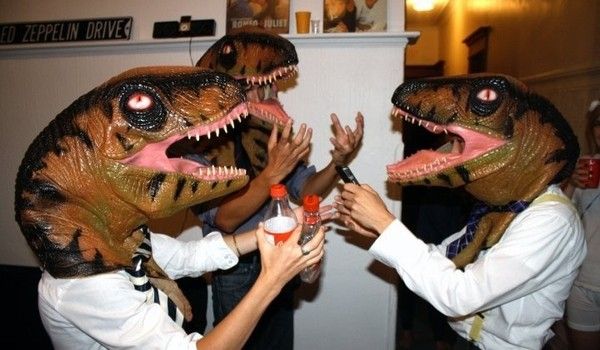
Let’s be honest, we humans will take any excuse to celebrate! (Credit: Pinterest)
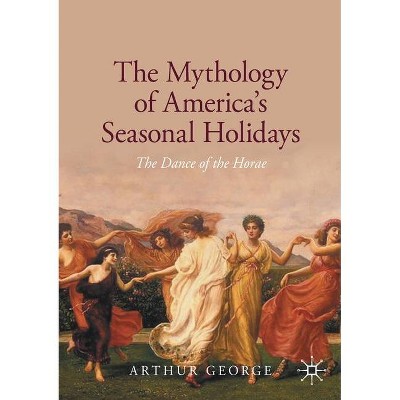
That’s where ‘The Mythology of America’s Seasonal Holidays’ by Arthur George comes in. Starting, as our year does, with the celebrations for New Year’s Day Mr. George examines Groundhog’s Day, Valentine’s Day, Carnival or Mardi Gras, Easter, May Day, Independence Day, Halloween and Thanksgiving before finally concluding with Christmas.
Cover of ‘The Mythology of America’s Seasonal Holidays’ by Arthur George. (Credit: Target)
For each holiday in turn Mr. George follows basically the same methodology, beginning with the origins of each holiday. The ancient festivals of Greco-Roman, Celtic, Hebrew and Germanic cultures are scrutinized, as is early American history. The festivals of these cultures provide the clues as to why a particular American holiday exists in the first place along with why it is celebrated at the time of year that it is. Following the growth of each holiday from its roots to the present day Mr. George then goes on to highlight how the various rituals associated with each developed.
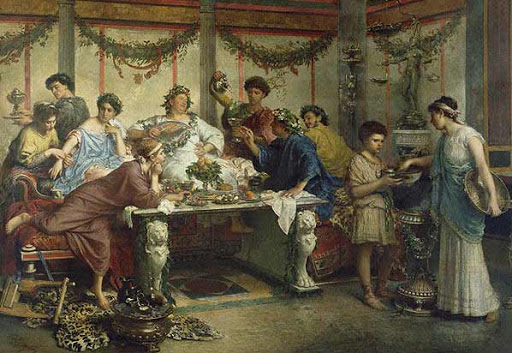
The Classical Romans liked to enjoy themselves and celebrated many holidays both private and public. (Credit: Nova Roma)The ancient Gaels (Irish) celebrated the end of the year at Samhain (Sow-Ween) which today we continue to celebrate as Halloween. (Credit: Reuters)
Of course many, perhaps most of our holidays are rooted in nature. The renewal of life every spring along with the end of the growing season in the fall are obvious examples but Mr. George shows in detail how even Groundhog’s day and May Day have for thousands of years been observed in connection with the yearly cycle of the Earth. At the same time other holidays, more political in nature still tend acquire features over time that relate to the time of year in which they occur, a picnic or baseball game on the 4th of July for instance.
The Maypole has been used to celebrate the beginning of new life at spring for thousands of years. (Credit: Omilights)
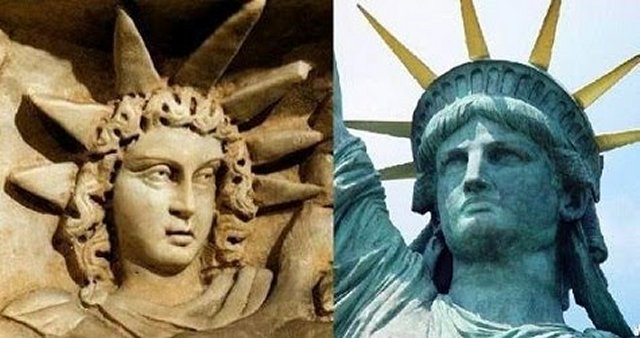
While the mythology surrounding religious festivals is well recognized Mr. George also succeeds in illustrating the legends associated with our secular holidays as well. From the figure of Lady Liberty to the fact that the phrase ‘The First Thanksgiving’ was only coined some 200 years after the event it was used to describe Mr. George clearly shows how we humans like to embroider the truth around those days we consider important.
Out Lady Liberty is actually MUCH older than the USA. She has a clear relation to the Roman Goddess Libertas. (Credit: Ancient Pages)
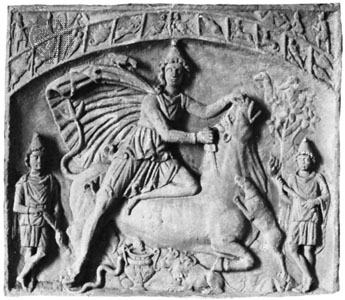
More than that however, Mister George also delves into the psychological aspects of our holidays. In the book he also investigates the emotional benefits we humans derive from celebrating the renewal of vegetation in the spring or the shortest day of the year, December 25th. In ancient Rome, the Winter Solstice was known as the ‘Birthday of the Sun’, which of course eventually became Christmas, the birthday of the son of god.
December 25th was also the birthday of the Persian God Mithra whose worship spread throughout the Roman world in the years just before Christianity gained control. (Credit: Britannica)
I do have two very small complaints about “The Mythology of America’s Seasonal Holidays’. One is that on several occasions Mister George limits himself with only covering the highlights of how a particular holiday developed. The reader often gets a distinct feeling that he could say a lot more if he wanted. At the same time the narrow focus on American holidays is quite arbitrary, comparisons to modern holidays in other countries are completely absent. I think that both problems stem from Mr. George’s desire to prevent the size of the book from getting too large, which books on mythology often do.

People in other parts of the World like to celebrate just as much as Americans. Mr. George could have spent a bit of time discussing those holidays. (Credit: Afro Tourism)
Nevertheless
‘The Mythology of America’s Seasonal Holidays’ is both an interesting and
enjoyable book. If you want a better understanding of how much of our national
culture began and grew, Mr. George’s book belongs in your library.
Back on the 26th of October 2019 I published a post about how, during the 1960s there was a considerable effort made to develop the technologies that would allow human beings to live and work at the bottom of the Ocean. As I was growing up it seemed to me that the efforts of those aquanauts paralleled in some ways those of the astronauts in outer space, both seeking to explore and colonize new frontiers for the human race. And like the space race, during the 1970s public interest in living beneath the sea plummeted. However while manned space travel limped along for the next few decades stuck in Low Earth Orbit (LOE), efforts to colonize the oceans virtually disappeared.
Mercury Astronaut AND Sealab Aquanaut Scott Carpenter epitomized the exploration of ‘the new fronteir during the 60s. (Credit: Diving Almanac)
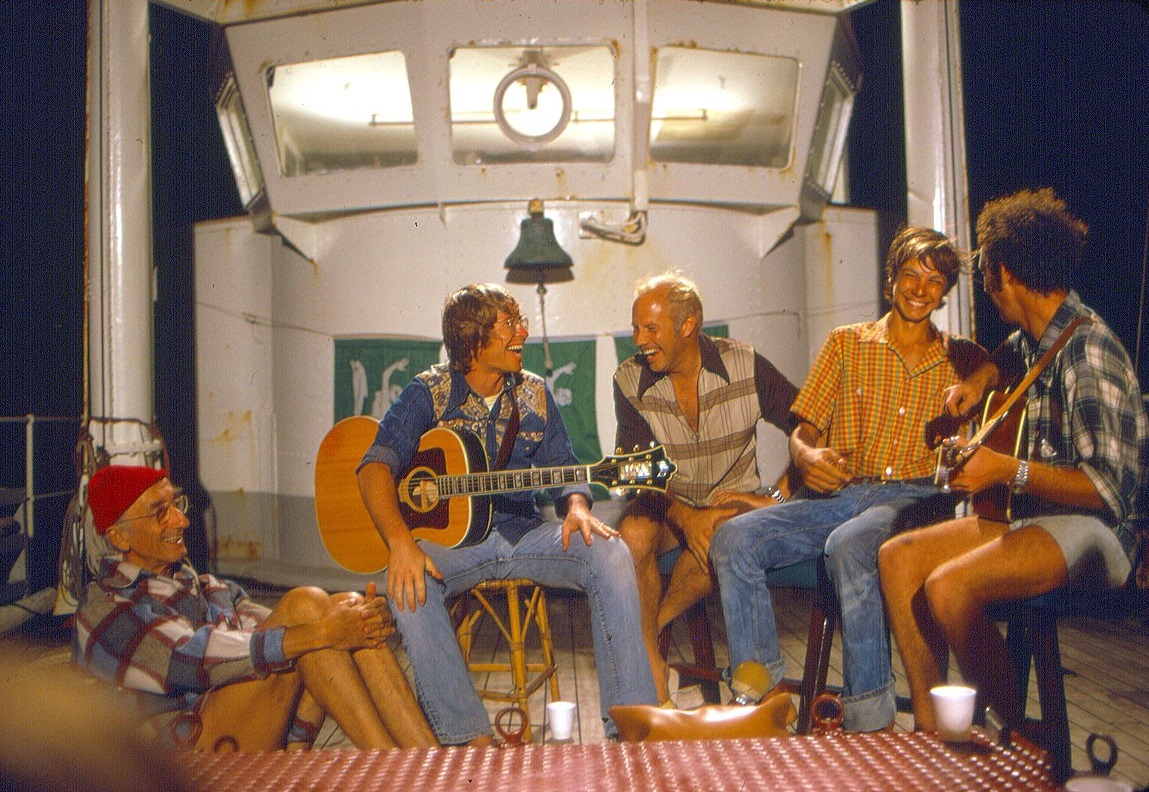
To me it’s not surprising therefore that even as NASA plans for a return to the Moon in the next half dozen years or so there is also renewed interest in exploring and settling the ocean depths. And one of the leading figures in this revival of ocean exploration has a lot of family tradition backing him up. He’s Fabien Cousteau, the grandson of Jacques Yves Cousteau, the engineer and oceanographer who designed and developed the Self Contained Underwater Breathing Apparatus or SCUBA gear and who on his ship the Calypso brought the mysteries of the sea into our living rooms through his documentaries “The Undersea World of Jacques Cousteau.”
Musician John Denver, with guitar, partying aboard Calypso with Jacques Cousteau, far left. (Credit: Blue Ocean Network)
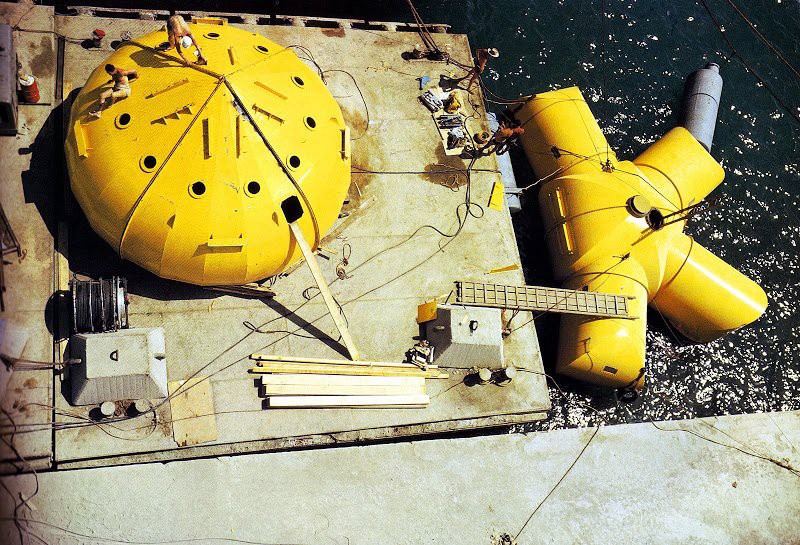
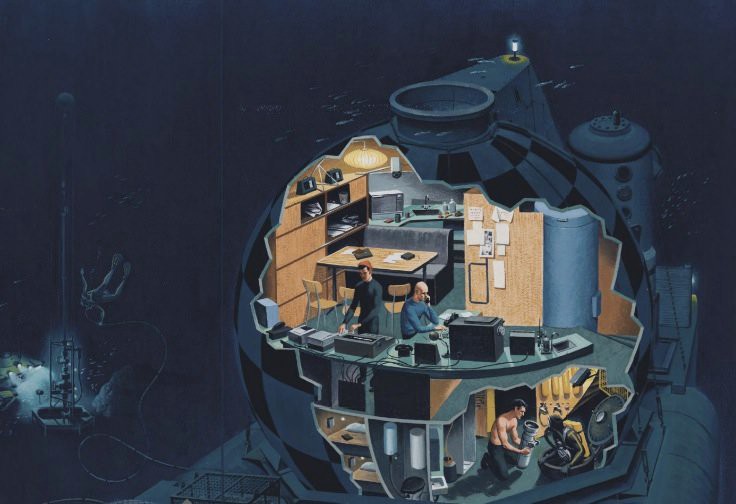
Now during the early 1960s Jacques Cousteau had personally organized and led the Conshelf Project that consisted of three separate manned habitats on the seafloor. In 1962 Conshelf 1 allowed two men to live for a week at a depth of 10m off of the Southern coast of France. Conshelf 2 followed in 1963 with six men living for a month at 10m in the Red Sea. Conshelf 3 in 1965 was the most ambitious with six men living at a depth of 100m for three weeks.
The two main structures of Conshelf 2 waiting to be installed on the seafloor. The starfish like structure on the right is the living quarters while the round house on the left is the garage for a two man mini-sub. (Credit: Medium)Artist’s illustration of the interior of Conshelf 3. (Credit: Medium)
With that kind of family history you would expect that Fabien’s proposed undersea habitat would be both ambitious and well conceived. Project Proteus, named for a Greek sea god who was the son of Poseidon, is really a scaled up version of Conshelf 2 in that the main structure will be at a depth of 20m off of the coast of the island of Curacao in the Caribbean.
Designed to have more than 350 square meters of living space, Proteus will be a two-story structure housing a crew of twelve. Unlike previous underwater habitats where scientists would collect samples and data to be studied at a later time in labouratories on land Cousteau intends for Proteus to have enough space for a full sized, state of the art labouratory of its own.
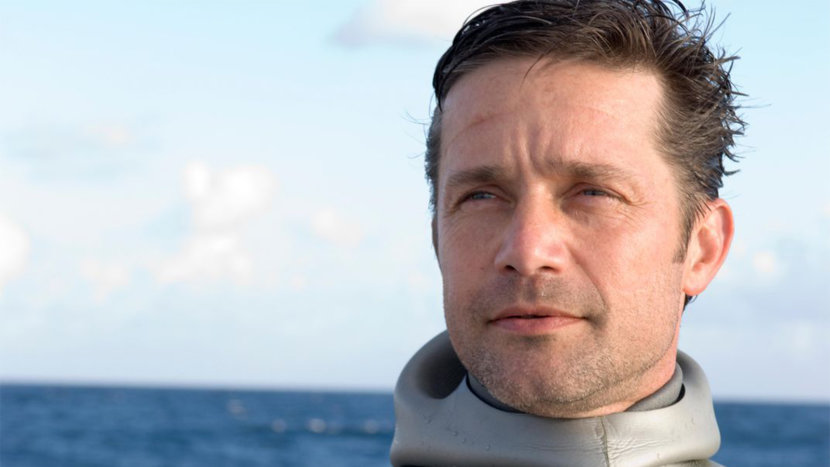
Artist’s illustration of the planned design for Project Proteus)The face of a man with a vision. Fabien Cousteau’s Proteus Project isn’t lacking for daring, it’s just needs money! (Credit: Science / How Stuff Works)
The estimated price tag for the construction of Proteus along with the first three years of operation is $135 million US dollars, which Cousteau and his team are currently busy trying to raise. Cousteau is promoting Proteus as an International Space Station (ISS) for underwater research and like the ISS it is planned that Proteus will be permanently manned with groups of scientists coming to stay for a period of weeks or months and then being relieved by other scientists.
Will Proteus become a long term science research station in an alien environment? Only time will tell. (Credit: Wikipedia)
In addition to studying the sea bottom as a large scale, long term habitat Proteus will also enable scientists and engineers to identify and solve some of the many problems humans face living in the oceans. For example, in an underwater home you can’t cook using an open flame, it would quickly use up all of your oxygen. At the same time stepping outdoors simply isn’t as easy as it is from any home on land. If humans are ever going to establish permanent settlements in the seas these and many other technical problems are going to have to be solved. And we need to solve them because in the years to come we are going to have to make better use of our ocean’s resources, while at the same better protecting all of the many creatures living there.
Just as the development of agriculture did 20,000 years ago, the farming of the seas has the potential to transform the way we live. (Credit: New Atlas)
Back in the 1960s it was said that since all life had come from the sea originally, so by exploring the oceans we were just returning to our ancient home. The Proteus project, like the ISS now in orbit, could be our first real home in a new world.
Many people picture John Wayne or some other cowboy star as the archetype of the rugged, self assured, always ready to stand up for what he thought was right American. This myth of the pioneer individualist wasn’t created by Hollywood; in fact it at least dates back to the days of James Fennimore Cooper and his character Hawkeye in ‘The Last of the Mohicans’. Still Hollywood built on that image, making the ‘Wild West’ the natural environment where America’s national character both evolved and flourished.
Like it or hate it, images like this just scream American! (Credit: Roger Ebert)
Check out the resemblances between Daniel Day Lewis as Hawkeye in ‘The Last of the Mohicans’ and John Wayne as the Ringo Kid in ‘Stagecoach’. (Credit: Graphic Arts – Princeton University)
Historically frontier regions have been known to attract people who were not only seeking a better life but a life less constrained by the rules and mores of society. In order to survive in such harsh, lonely conditions those settlers had to be not so much strong in a physical sense but resilient and adaptable. The question today would be, are those traits still present in the descendants of those pioneers one hundred years after the close of the frontier.
Does building a new life in an unpopulated wilderness require a certain type of person or breed them? Probably both! (Credit: Boston University)
So is there actually such a type of person, psychologically speaking that is, and how would we go about measuring the traits of the sort of person who exemplifies the pioneer spirit? And where would you find such a person today?
Psychologists at the University of Cambridge have attempted to do just that. Using the results of an online personality test completed by over 3.3 million Americans they employed the respondents zip codes to separate out those who lived in rugged, mountainous regions, such as the Rocky Mountains from their lower altitude, more comfortably urban neighbors. By comparing the two populations the researchers hoped to discover if the people living in harsh, unpopulated surroundings actually developed a distinct personality.
Even today living in the Rocky Mountains is rustic and can certainly generate a feeling of isolation. (Credit: Pinterest)
To carry out their analysis the researchers assessed the results of the psychological testing using a standard psychological model known as the ‘Big Five’ for five fundamental personality traits. Included in the big five model are such characteristics as ‘Agreeableness’, ‘Extraversion’, ‘Conscientiousness’, ‘Neuroticism’ and ‘Openness to Experience’.
‘Big Five’ personality traits in Psychology. As an experiment try rating yourself in these terms. (Credit: Simple Psychology)
When the inhabitants of the Rocky Mountains were evaluated according to those categories they demonstrated low levels of ‘Agreeableness’, ‘Extraversion’ and ‘Conscientiousness’. These results indicate a personality that is marked by a lack of trust, more territorial, more self reliant and rebellious. On average the Rocky Mountain residents also showed low values of ‘Neuroticism’ showing a more secure, less neurotic mental state, which would give them the mental stability to deal with problems on their own, without any help from others. Finally they showed high values for ‘Openness to Experience’ showing that Mountain folk also have to be ready to accept new situations and do whatever it takes to survive.
People in the Rockies aren’t without culture but it’s their own culture. (Credit: Twitter)
The psychologists separately analyzed the results from respondents who lived in the Appalachian Mountain regions, which were settled just about a hundred years before the Rockies, to see if there were any significant differences between the two groups of mountain dwellers. The scientists found that while the psychology of the residents of Appalachia were similar to those in the Rockies the eastern mountain inhabitants displayed more ‘Agreeableness’ and less ‘Openness to Experience’. Could this mean that the frontier attitude lessens with time. That as a region becomes more settled, even if it remains less densely populated, the inhabitants of mountainous areas will become psychologically more similar to their low land, urbanite neighbors? That’s a question that only more data and further analysis can answer.
The similarities between the people of the Rockies and Appalachians are easy to spot but the differences are important as well. (Credit: YouTube)
What
the results of the University of Cambridge do show is that the environment in
which we choose to live says a great deal about our personality. And in return
of course that environment will have its evolutionary effect on us. Just one
more way of saying that we are a part of our environment.

The asteroid that killed off the dinosaurs 66 million years ago may get more press coverage but when it comes to the biggest extinction event of all time the Permian extinction of 252 million yeas ago has no rival. More than 70% of all land species and 95% of all marine species disappeared within the space of just a few thousand years. And even those species that lived through the extinction must have suffered an unimaginable loss of individuals, leaving the entire Earth an almost lifeless, barren planet.
Along with thousands of other types of living creatures the Permian extinction killing off the last of the Trilobites! (Credit: Science Alert)
Unlike the Cretaceous extinction, which most paleontologists now agree was caused by an asteroid or comet striking our planet; the exact cause of the Permian extinction has been more controversial. The majority opinion is that it was triggered by a massive volcanic outbreak in the region of Russia known as the Siberian Traps. It is thought that the massive amounts of carbon dioxide, sulfur dioxide and other pollutants released by the volcanoes caused tremendous changes in the climate leading to the massive dying. Sound familiar!
Massive volcanic eruptions certainly contributed to the destruction at the end of the Permian but were they the only cause? (Credit: Sci-News.com)Geological maps of the Siberian Traps region. The huge extent of volcanic rock must have been caused by massive eruptions unlike anything seen on Earth since. (Credit: Saturian Cosmology)
Now a new study by scientists with the European Union funded BASE-LiNE Earth project have been able to outline a blow-by-blow description of the sequence of events that took place 252 million years ago. According to their website the BASE-LiNE Earth project is “… an international training, research and career development network for highly motivated young scientists…” The goal of BASE-LiNE Earth is to “…extend the knowledge on the complex and long-term Phanerozoic seawater history…” In other words the BASE-LiNE Earth scientists hope to use the latest scientific tools to learn more about the conditions in Earth’s oceans throughout the past half billion or more years.
Some of the members of the Base-LiNE Earth Project. (Credit: Base-LiNE Earth)
One of the sources of information that the BASE-LiNE Earth researchers hope to use is the fossilized shells of the marine invertebrates known as brachiopods. These small bivalved creatures are among the earliest animals to develop hard parts and since their shells were produced using the substances in the oceans at the time they lived those fossilized shells still carry the chemical traces of the composition of those ancient waters. By the way, although brachiopods superficially resemble clams in possessing two shells the animal inside those shells was very different, coming from an entirely different phylum.
It’s easy to recognize a brachiopod from a clam because each brachiopod shell is symmetric while it’s only when you put the two clam shells together that you get symmetry. (Credit: Skeptical Squirrel)
Back in the period of Earth’s history before the Permian extinction brachiopods greatly outnumbered clams, dominating the ecosystem of every ocean in the world making them the most common type of fossil from that early period of life. Therefore using brachiopod shells as time capsules of conditions from right before and during the Permian extinction makes perfect sense.
A few species of Brachiopod did survive the Permian extinction but today they are very rare. I have thousands of fossil brachiopod but I’ve never seen a live one! (Credit: www.baseline-earth.eu)
Using well-preserved shells of brachiopods collected from the mountains in the Southern Alps BASE-LiNE team leader Dr. Hana Jurikova was able to determine the pH of the oceans during the course of the Permian extinction. pH of course is a measure of acidity which is directly tied to the amount of carbon-dioxide dissolve in water. Now ocean acidification by itself is deadly to many marine organisms like brachiopods because it reacts with the calcium in their shells weakening and dissolving them. Harming if not actually killing the animal inside. And as we are all aware today the amount of carbon dioxide is also directly linked to the global temperature. So the fossilized shell of an ancient brachiopod can tell us a lot about the world’s temperature 252 million years ago.
Some brachiopod fossils. Since the animal that made them used chemicals absorbed from the seawater in which they lived these shells contain information about the oceans millions of years ago. (Credit : Illinois State Geological Survey)
So
the question becomes, did the massive volcanic eruptions of the Siberian Traps
release enough carbon dioxide to cause the Permian extinction by itself or were
there other factors involved as well? On the basis of their analysis of
fossilized brachiopods the BASE-LiNE Earth study team concluded that amount of
carbon dioxide in Earth’s oceans and atmosphere was more than sufficient to
caused the great dying. If this result holds up it will mean that the smoking
gun for the greatest killing in the history of Earth has at last been found.
And if the greatest mass extinction of life on Earth was due to nothing more than carbon dioxide being released into the atmosphere what lesson does that hold of us today. It is true that the fossil fuels we burn for energy aren’t releasing as much carbon dioxide as the Siberian Traps did but hey, we’ve only been at it a 150 years or so. The Permian extinction was just a random act of nature but the extinction event we are causing now will be the work of our own selfishness and stupidity.
If a massive release of CO2 caused the greatest extinction event in Earth’s history you have to ask yourself, are we causing another? (Credit: Scientific American)
But some life did survive the Permian extinction and as the environmental conditions slowly returned to normal those survivors found themselves in an almost empty world, but a world of opportunity. In many ways the whole world was like the newly formed Galapagos islands where only a few creatures were able to colonize and diversify and evolve into many new kinds of animals, like dinosaurs, birds and mammals.
Some of the earliest mammals, known as synapsids, looked more like reptiles but there is evidence that immediately after the Permian extinction some were already developing hair and other more mammalian features. (Credit: Morgan’s Lists)
In
fact a new study by Professor Mike Benton and Masters Student Tai Kubo at the
University of Bristol in the UK now asserts that it in the period immediately
after the Permian extinction that warm-blooded animals first evolved and
spread. Professor Benton and Mr. Kubo base their conclusion on an analysis of
hundreds of fossilized trackways of four legged vertebrates, reptiles both
immediately before and after the Permian event.

What the footprints revealed is a major change in the gait of creatures as they walked. Before the Permian the trackways they found had the left and right feet spread far apart, a gait typical of an animal with a sprawled posture where the legs come out from the side of the body. Such an anatomy is typical of a slow moving cold-blooded animal such as an alligator or lizard. See image below.
The trackways of animals after the Permian extinction indicate a major evolutionary change in the anatomy. (Credit: University of Bristol)
Immediately
after the Permian extinction however a new kind of trackway appeared, one where
the right and left footprints were much closer together, almost in a line. Such
a gait indicates that the animal’s legs come straight down from the body, an
anatomy more similar to that of a modern dog or horse, the anatomy of fast
moving, warm-blooded animals.
Benton and Kubo recognized that this change occurred in two major groups of reptiles, the synapsids and archosaurs, the ancestors of mammals and dinosaurs/birds respectively. While there had been some evidence of the presence of hair in the synapsids from this time period the work of Benton and Kubo represents the earliest evidence for warm blood in the archosaurs.
The Archosaurs eventually develop into both the Dinosaurs and Birds. (Credit: Britannica Kids)
Of
course Professor Benton and Mr. Kubo are assuming that an upright posture is a
definitive sign of an animal’s being warm blooded, which may be going a bit too
far. While in modern animals the two characteristics may be intimately linked
was that true 250 million years ago?
Still
the study carried out by the paleontologists is further evidence that mass
extinctions, however terrible to the creatures that experience them, can also
open up new opportunities for evolution to make great leaps forward. A reminder
that, without those mass dyings, we ourselves would not be here.
Oftentimes when you hear someone describing the process of evolution they will say something like “We evolved from the Animals”. Sort of making it sound as if the whole purpose of evolution was to get to us so that now that we’re here evolution is over!
The Standard image of Human Evolution makes it all seem as if we were the preordained result. This cartoon version of reality ignores that fact that evolution is still an ongoing process. (Credit: Daily Mail)

O’k maybe that’s a bit of an exaggeration but in general we humans don’t think of evolution as something that’s still going on inside of us. Well a new study by Doctor Jaliya Kumaratilake of the University of Adelaide along with Professor Maciej Henneberg and Dr. Teghan Lucas at Flinders University has detailed an anatomic change in the bodies of a large section of the population over the last 150 years. The study, which was published in the ‘Journal of Anatomy’, concerns the arteries that supply blood to our forearms.
The Human Arterial System supplies both oxygen and food to all of the cells of our body. (Credit: ThoughtCo)
Let me back up a bit and explain. You see when our forearms first begin to develop as a fetus in our mother’s womb they are each supplied with blood by a single artery known as the median artery. As our forearms become more fully developed two other arteries grow, one on each side of the median artery known as the radial and ulnar arteries and as those arteries mature the median artery disappears, in most people.
A most mature adults the only two arteries in the forearm are the Radial and Ulnar. The Median artery has disappeared. (Credit: Pinterest)
In fact when Kumaratilake, Henneberg and Lucas examined autopsies and other records dating from the 1880s they found that back then approximately only 10% of adults still possessed their median artery. Going forward in time the researchers found that the percentage of adults who kept their median artery increased until at present over 30% of the population now has three functioning arteries in each forearm.
An increasing number of Adults however are retaining their median artery from the womb. Is this a sign a that evolution isn’t finished with us yet? (Credit: Robert Haladaj et al in the Medical Science Monitor)
That’s
a significant evolutionary shift in a population for such a short period of
time. According to Doctor Lucas, “If this trend continues, a majority of
people will have median artery of the forearm by 2100.” Professor
Henneberg meanwhile points out the benefits of having a third artery in
increasing blood flow to the arm.
The median artery is actually not the only evolutionary change that medical professionals have noticed taking place in the human body. One that may surprise you is a reduction in the number of people suffering from impacted wisdom teeth.
Wisdom teeth are the last of our teeth to develop and erupt, often in our 20s. (Credit: WebMD)
Wisdom teeth, or technically third molars are the last teeth to appear in the human mouth, typically erupting somewhere during the late teens to early twenties. It is the opinion of most evolutionary biologists that our ancestors developed the third molar in order to help deal with the rougher, courser food in their diet.
A wisdom tooth that fails to develop properly can cause a great deal of trouble, and pain! (Credit: Summit Dental Center)
Whether because of a lack of space or because the third molar comes in sideways wisdom teeth often butt up against the second molar, technically known as being impacted. Such impacted molars can lead to tooth decay and cause a great deal of pain. Because of these problems third molars are often removed by oral surgery.
Over the last 50 or so years however dentists and dental hygienists have noticed a small but still noticeable decline in the number of people having wisdom teeth at all. I for one never had them. This is considered to be another sign of continuing evolution in the human body. In fact geneticists have even identified two genes, PAX9 and MSX1 that pay a role in whether or not a person develops those pesky third molars.
Our early ancestor diet was courser and needed more grinding by our teeth. That’s why they evolved wisdom teeth. (Credit: Genetic Literacy Project)
Interesting thing is, until about 300 years ago while more people may have had wisdom teeth very few suffered from them. It’s our modern diet of soft sugary foods that made wisdom teeth a problem in the first place and so it may be that natural selection is actually reacting to a problem that we ourselves have caused!
Our modern diet requires less chewing so that now wisdom teeth can become more of a problem than an asset. (Credit:Science Alert)
Time
never stands still, and evolution is simply the changes that occur to living
creatures as the conditions in which they live change. It’s not surprising
therefore that evolution hasn’t finished with us yet!
Just
a couple of weeks ago, 14 October, I published a post discussing the winners of
the 2020 Nobel prizes in the sciences. While I covered the recipients of the
physiology, physics and chemistry awards I purposefully skipped the winners of
the Nobel for economics.
You see Paul Milgrom and Robert Wilson, both of Stanford University in California, were recognized by the Nobel committee for their work in the branch of mathematics known as Game Theory and I was planning to write a post about game theory. I decided therefore to wait and include Professors Milgrom and Wilson in this post.
The Economics prize was not actually a part of Alfred Nobel’s will but initiated by the Sveriges Riksbank in Norway in memory of Nobel. This year’s recipients are Paul Milgrom and Robert Wilson. (Credit: Business Standard)
Now we all have played games in our lives, and we know that most of those games involve some degree of chance or luck, various outcomes each have there own probability of occurring. But game theory is not probability theory, although there is certainly some overlap.
Games of chance like Roulette are certainly games but there’s a lot more to Game Theory than just the laws of Probably. (Credit: The Conversation)
As an example, in a game of poker probability theory can tell you exactly what your chances are of filling an inside straight. Game theory on the other hand will help you decide whether or not trying to fill an inside straight is a good strategy to win the game. In other words game theory is about making decisions. Not just in contests but also in everyday life by treating our interactions with each other as games that we are trying to win. The two main assumptions in game theory are that the decision makers, unsurprising known as players, are rational, that they want to maximize the benefit to them, and that they understand the game they are playing enough to make competent decisions.
Winning at Poker, like winning at life, requires more than just winning individual hands. You need to develop a long term strategy for the entire game. (Credit: Liveabout)
One
of the best-known and most often discussed problems in game theory is known as
The Prisoner’s Dilemma. This game is often described as having two men who have
committed a crime of some sort, been captured by the police and separated. The
separation is important in order to keep they two players from acting in
concert.
The police have some evidence against the two prisoners but not a lot so they would like to get one of the crooks to confess and rat on his buddy. So the police separately offer each crook a deal for a light sentence if he’ll cooperate. The other crook would then get a full sentence.
The best outcome of the Prisoner’s Dilemma is if both crooks keep silent, but if your accomplish betrays you you’re screwed. So, do you trust him???? (Credit: Britannica)
If
both criminals refuse to cooperate there’s a fair chance that they could both
go free but there’s a 100% chance of a light sentence for betraying the other
guy. And remember the prisoners are separated so they have no idea what their
cohort will do. Trust is a hard thing to do if you’re afraid that the other guy
could be selling you out!
This kind of situation actually crops up all the time in real life, basically anytime two people have to trust each other in order to maximize their shared gain. Whether it be some form of commerce between two individuals or anything up to two nations forming an alliance in war the prisoner’s dilemma plays a large part and history has shown that whenever things start to go wrong the most often chosen solution is to stab the other guy in the back! In fact the prisoner’s dilemma has been used to explain why so many different kinds of animal become instantly hostile when confronted by another member of their species. Yes game theory has its uses in evolutional theory too.
The Prisoner’s Dilemma has many applications in real life as well. (Credit: Pinterest)
At least betrayal is the best solution to a single prisoner’s dilemma game. You see game theory also has to consider the possibility of multiple prisoner’s dilemma games between the same two players, such as in international trade which can go on for centuries. In such circumstances it can be shown that after just a few games the benefits of trust quickly outweigh the risk.
The Most Possible case is for each Player to mix ‘Defect’ and ‘Cooperate’, sounds like normal life to me! (Credit: SlidePlayer)
Almost
any sort of human interaction can be modeled as a game and therefore subject to
analysis by game theory. All that is required is that the individuals involved
are making rational decisions based on their knowledge of the situation.
One of the most important concepts in game theory is known as a Nash Equilibrium, named for Nobel Prize winner John Nash who was the subject of the 2001 movie ‘A Beautiful Mind’. In the prisoner’s dilemma game discussed above the Nash equilibrium is for both of the crooks to confess.
Mathematician John Nash was a pioneer in the field of Game Theory. (Credit: Scientific American)
Another easy example is sometimes known as ‘The Battle of the Sexes’ and involves a couple who are going out on a date. Now say the man wants to go to a sporting event while the woman wants to go to a concert, but since this is a date the important thing is that they go together. The Nash equilibrium in the case is that they both either attend the sporting event or the concert. As you can see game theory is really about using logic rather than branches of mathematics like calculus or trigonometry.
Another game similar to the Battle of the Sexes is the Chicken Game. In this game mutual disagreement leads to a disaster. (Credit: Slideshare)
Now game theory is not without its problems. You’ll recall I said above one of the main assumptions is that the players are rational. Well experimental psychologists have long criticized that assumption. Another common criticism is that game theory fails to take in account the fact that some players are better at the game than others, that some of us are talented.
Babe Ruth was successful simply because he had Talent. Talent is something Game Theory has difficulty incorporating into its structure. (Credit: SB Nation)
The Hawk Dove Game successfully models the costs and benefits of both survival strategies. (Credit: Triton World)
Nevertheless game theory has become an important tool in evolutionary studies, political science and especially economics. Which brings us back to professors Milgrom and Wilson whose work in game theory involved developing methods for analyzing auctions. In particular they developed formats for certain auctions where the interest of the auctioneer is to benefit everybody, i.e. society, rather than just maximizing their own profit.
Auctions are a common technique for a buyer to receive the highest price for their commodity. (Credit: Artsy)
The
auction formats developed by Milgrom and Wilson were put into practice by the
US government in 1994 when the Federal Communications Commission (FCC)
auctioned off certain radio frequencies for use in the first cell phones!
Unlike much of game theory the work of Milgrom and Wilson has already found
considerable practical applications.
Still
game theory is one of the newest branches of mathematics, and is rapidly
growing. I expect that more Nobel prizes are in the future for game theory.
There’s quite a wide variety of news items happening that deal with space to talk about this month. Both manned and unmanned programs are involved. I think I’ll start with the news of Earth’s second Moon. You heard me right, Earth’s second Moon.
Our planet has only one large Moon which we have christened ‘The Moon’! (Credit: The Fayetteville Observer)
Over the last decade or so astronomers have been finding quite a few space rocks, very small asteroids orbiting the Sun in an orbit that brings them close to that of our Earth’s. These objects are collectively known as ‘Near Earth Objects’ or NEOs and some may actually pose a threat of striking the Earth in the coming decades.
In 2018 the small space rock 2018 VP1 came close to our Earth twice! 2018 VP1 is classified as a Near Earth Object or NEO. (Credit: Orlando Sentinel)
It’s
also possible that on occasion one of these space rocks may get captured by the
Earth’s gravitational field and become a ‘mini-Moon’, at least for a few months
or years. This happened back in 2006 and 2007 when the NEO named 2006 RH120 was
briefly captured and again from 2018 to 2020 with 2020 CD3.
Now it looks as if Earth is about to gain another mini-Moon for a while as the object 2020 SO is on an incoming trajectory. Between now and next March 2020 SO will make two loops around the Earth before heading back out into interplanetary space. Click on the link following to be taken to YouTube video of 2020 SO’s orbit. https://www.youtube.com/watch?v=sxPYh1s8KB4
And
2020 SO appears to be an oddball for yet another reason. You see 2020 SO’s
orbit around the Sun is the closest match to Earth’s of any object yet
discovered and that made astronomers suspicious. Checking the object’s orbit
backward in time they think they’ve figured out just what 2020 SO really is.
It seems that 2020 SO is probably man made! NASA now believes that 2020 SO is actually the Centaur stage of the rocket that sent the Lunar lander Surveyor 2 to the Moon back in September 1966. If true that would mean that 2020 SO has been just floating around out there for more than 50 years.
An upper stage Centaur booster about to be loaded onto an Atlas rocket. The Centaur is a commonly used booster for sending space probes beyond Earth Orbit. (Credit: Spaceflight Now)
The Surveyor 3 space probe on the Moon’s surface as photographed by the crew of Apollo 12. Surveyor 2 crash landed on the Moon but it’s Centaur booster went past the Moon into interplanetary space. (Credit: NASA)
It makes sense if you think about it. By now humanity has sent close to a hundred space vehicles beyond Earth orbit into interplanetary space. Every one of those vehicles had to be accelerated to escape velocity by means of a booster rocket and those boosters didn’t just vanish after they had completed their task. They’re all still on an orbit around the Sun that occasionally intersects that of Earth’s.
The largest of these boosters would be the nine S-IVB stages that sent the Apollo astronauts to the Moon. They’re all still out there and now it seems that one of them is coming home for a brief stopover. As astronomers get better at keeping track of NEOs I daresay that we’ll be seeing a lot more visits from our long lost offspring.
The S-VIB stage of Apollo 8 photographed by Apollo 8 between the Earth and Moon. There are 9 such rocket stages floating somewhere near our Earth! (Credit: CollectSpace)
In other news, aerospace giant Boeing has suffered another problem in its efforts to launch the corporation’s Starliner commercial crew vehicle. After last year’s Unmanned Test Flight (UTF) of Starliner that was plagued by numerous software problems Boeing has been working full blast to correct the issues so that a second UTF can been carried out before this year is over, something that looks ever more doubtful. Even if a successful UTF can be accomplished this year the first Crewed Test Flight (CTF) in NASA terminology of Starliner will come no earlier that the middle of 2021.
Boeing’s Starliner manned space capsule has yet to carry anyone. Maybe next year. (Credit: Wikipedia)
And now it’s been announced that that first manned mission will have to be with a new commander. Christopher Ferguson, the commander of the final flight of the space shuttle, had been assigned as CTF commander back in August of 2018. Now however the veteran astronaut is stepping down from the mission in order to spend more time with his family.
Veteran Astronaut was scheduled to be mission commander of the first manned flight of Starliner, technically the Crewed Test Flight (CTF). Now however he has stepped back from his assignment for personal reasons. (Credit: SoundCloud)
Starliner’s
new commander will be NASA astronaut Barry Wilmore. Meanwhile Ferguson, who is
an executive at Boeing, will remain involved with the program but such a major
change in personnel is just one more complication for Starliner.
Meanwhile Boeing’s competitor Space X is also having a few difficulties of its own. An October 2nd unmanned launch of a Space X Falcon 9 rocket was halted just 2 seconds before liftoff because of what has been described as an anomalous rise in pressure in one of the nine Marlin engine’s turbomachinery gas generator.
Static test firing of a Space X Merlin rocket engine. A recent Space X launch was aborted two seconds before launch due to excessive pressure in an engine’s gas generator. (Credit: Wikipedia)
That scrubbed flight has prompted NASA to delay the next Space X manned mission to the ISS, previously scheduled for the 31st of October. That mission, officially designated as Crew-1 Mission because it is actually the first mission in Space X’s contract to deliver NASA astronauts to the ISS, has now been officially pushed back to early to mid November. The extra time is to allow Space X to carry out a through investigation into what happened in the Oct 2nd launch attempt.
The crew of Space X’s Crew Mission 1 flight training for their mission. (Credit: NASA Blogs)
Hopefully
Space X will quickly identify the cause of the problem so that NASA’s
commercial crew program can finally get unto some kind of a regular schedule.
The whole idea of having two commercial carriers was so that if one had a small
problem, like Space X’s engine issue, the other could take up the slack.
Because of Boeing’s major and continuing difficulties however even small
problems at Space X can become major headaches.
Finally, we do have one scheduled space event to look forward to during the rest of this month. On October 20th the Osiris-REX space probe, which has been in orbit around the asteroid Bennu for almost two years will descend down to the rocky surface in an attempt to collect a sample of the asteroid’s material.
Artists impression of Osiris-REX reaching out to grab a little piece of the asteroid Bennu. (Credit: FIS Technology)
This
will be the first of potentially three touchdown sampling attempts, each
landing lasting for no more than 5-10 seconds. During the few seconds of
contact Osiris-REX’s robotic arm will reach out and suck in as much as 50-60
grams of dust and other material. The material collected will then be stored in
a nitrogen bottle. Since Osiris-REX has three such bottles there can be a
maximum of three collecting attempts.
The site chosen for Osiris-REX to make its first attempt is a small crater named Nightingale which was chosen because, based on observations over the last two years the material there is considered to be ‘fresh’, that is uncontaminated by the solar wind. At the same time there is a small area, only the size of two or three parking spots that is flat and boulder free for the landing.
A silhouette of Osiris-REX against its chosen landing area on Bennu. Not a lot of room to maneuver. (Credit: Kids News)
And Osiris-REX will have to carry out the landing all on its own because at a distance of about 330 million kilometers the time it takes a radio signal to go from the probe to ground control is about 18.5 minutes. That time delay means that any last minute adjustments to Osiris-REX’s course will have to be made by the probe itself.
Osiris-REX is scheduled to leave the asteroid Bennu next March to begin a return journey that will bring its collected samples back to Earth on September 24, 2023.
P.S. Since I wrote this post Osiris-REX has successfully carried out its first touch down and NASA’s scientists are now trying to evaluate how much material was gathered.
If you think about it, over the last four hundred years humanity’s growing science and technology has given us an enormous amount of control over many aspects of nature. The speed and distance we can travel has steadily increased, as has both the size and number of structures we can build. We grow more food than ever and whether we like it or not we are even changing the weather. Can you say climate change! We have discovered the very code of life itself and begun to understand how to alter and mold living things to suit our desires. We now have many ways of controlling space and material objects that would seem like magic to our ancestors of a thousand or more years ago.
Thanks to our control over Nature we have been able to build ourselves a world completely unlike anything in Nature. (Credit: Invisiverse)
But we still have virtually no control over time. Oh, we can measure it’s passing with an accuracy that, at the risk of repeating myself, is almost magical. We can’t stop time of however, and although Einstein’s two theories of Relativity do describe how the passage of time can be slowed that slowing requires either velocities approaching the speed of light or immense gravitational fields such as those around black holes.
A modern Atomic Clock is accurate to something like one second in a billion years. Scientists can use that precision to make measurements of phenomenon that last only a billionth of a second. (Credit: WatchPro USA)
And
even theoretically we can’t go backward in time. In fact many scientists have steadfastly
maintained that time travel to the past is logically impossible because of
something known as the grandfather paradox.
What is the grandfather paradox? Well it works like this. What if you were to travel backward in time and murder your grandfather before he fathered your own father? In that case you would never have been born and if you were never born how could you go backward in time to kill someone?
In the Grandfather Paradox the very existence of a Time Machine leads to a Logical Absurdity. (Credit: YouTube)
This idea of the dire consequences to the present of doing anything in the past has been the central idea in many Science Fiction stories like Ray Bradbury’s ‘The Sound of Thunder’ as well as movies such as ‘Back to the Future’. Many scientists feel that the logic of the grandfather paradox is so tight that traveling into the past is simply a pipe dream better left to science fiction writers.
In Ray Bradbury’s ‘The Sound of Thunder’ hunters travel into the past to hunt a T Rex. Despite their best efforts they change the past, changing their present! (Credit: Deviant Art)In ‘Back to the Future’ the same idea is used for humour as Marty has to repair the damage he’s done to the past or he’s a goner! (Credit: Universal Pictures)
Still theoretical physicists and mathematicians looking for solutions to Einstein’s field equations occasionally came up with equations that, while physically hard to interpret seemed to include the possibility of going backward in time. Collectively these solutions are known as ‘Closed Timelike Curves’ or CTCs and where initially discovered back in 1937 by Jacob van Stockum and later extended by Kurt Gödel in 1949. Basically a CTC describes the movement of a material particle that loops endlessly through time and space in a circle. This would imply that the existence of a particle following a CTC would be extremely limited in both time and space.
Every observer exist at a single point in space-time. Since nothing in the Universe can move faster than the speed of light that observer can only be effected by events within his Past Light Cone while he can only effect events with his Future Light Cone. (Credit: Wiktionary)Under Certain conditions however, such as near a black hole, a light cone can be tilted. Continuous tilting results in a Closed Timelike Curve. (Credit: SlideShare)
Physically it is hard to understand how any particle following a CTC could interact with other more normal particles. Such a path in Space-Time would seem to imply the possibility of events happening without causes since to the normal particle the CTC particle can appear to pop into existence without reason. At the same time to an outside observer a particle inside a CTC might appear to experience an event before its cause!
Because
of such paradoxes many physicists expect, or perhaps hope that an eventual
unified theory of gravity with quantum mechanics might eliminate CTCs as even
being mathematically possible. Other physicists however prefer to try to make
sense of these weird solutions to the field equations.
One of those physicists is Germain Tobar, a student at the School of Mathematics and Physics at the University of Queensland in Australia. With the assistance of his colleague Dr. Fabio Costa, Tobar has analyzed CTCs in such a way that he maintains opens up the possibility of time travel into the past.
Germain Tobar (r) with his advisor Dr. Fabio Costa. (Credit: News.Com.au)
But
what about the grandfather paradox? What about the problem of actions in the
past changing the present? Well in Tobar’s analysis what happens if you were to
try to change the past then the universe would react so as to avoid the
paradox, to repair the damage you have caused in other words.
I won’t go into the math. (Actually I am going through the Math, trying to remember what I learned in my course in General Relativity but I won’t impose it on you.) However, it appears to me that in Tobar’s treatment if you were to go into the past and kill your grandfather then when you returned to your present you would find yourself with a different grandfather or something equivalent. Sounds to me kind of like what Marty and Doctor Brown did to repair things in ‘Back to the Future’ except that this repairing would occur naturally, automatically.
I have to admit I have real problems with that idea. Remember, the past starts just an instant ago! What if you were to step into a time machine and go back ten minutes and murder yourself just as you’re stepping into your time machine? I’m sorry but I can’t imagine how the Universe could repair that damage, how it could change things so much so quickly in order to somehow avoid the paradox!
Maybe it would work something like this? (Credit: xkcd)
Time
Travel would be the ultimate power, the ability to undo all of our mistakes, to
right all of the wrongs we’ve done. Perhaps for that very reason it is the one
power that will always elude us.
Early October is always that time of year when we all take a moment from the mundane news to recognize those scientists who are making fundamental contributions to our knowledge of the world around us. The cause of this annual ceremony is of course the announcement of the winners of the Nobel Prizes for the natural sciences of Physics, Chemistry, and Physiology.
The Nobel Prize. Oh, there’s also about a million bucks involved as well. (Credit: Phys.org)
This year the Physiology, i.e. Medicine prize was announced first and has been awarded jointly to Harvey J. Alter, Charles M. Rice, both of the United States, along with British Born Michael Houghton. Fittingly in this year of the Covid-19 pandemic the work for which these three scientists have been recognized deals with the identification of and drug treatments for the deadly viral disease, Hepatitis C.
This Year’s prize winners for Medicine are (left to right) Harvey J. Alter, Michael Houghton and Charles M. Rice. (Credit: Firstpost)
Hepatitis in general is classified as an inflammation of the liver and is most commonly caused by one of five different viruses giving rise to Hepatitis A, B, C, D and E. Of these Hepatitis A and B were the first to be studied and vaccines are now available to provide immunity against those forms of the disease. The cause of Hepatitis C however remained elusive for many years, making the search for effective means of treatment difficult.
Hepatitis is really several diseases that all cause an inflammation of the liver. Hepatitis is a very serious disease that if left untreated often results in death. (Credit: DW)
It
was in the 1960s that Doctor Alter succeeded in demonstrating that Hepatitis C
was in fact a completely different disease from the types known at that time, A
and B. Due to Alter’s work Hepatitis C was for a time actually known as
Hepatitis ‘non-A’, ‘non-B’.
Following up on Alter’s work Doctor Houghton then was able to isolate the genetic structure of a previously unknown virus in Hepatitis patients. Finally it was Doctor Rice who showed that the new virus alone could cause Hepatitis. Once the cause of Hepatitis C was known tests and treatment techniques could be developed for the virus so that today Hepatitis C is a treatable disease.
Like all viruses the Hep C virus is simply a strand of genetic material, RNA in this case, surrounded by a protective shell of proteins and lipids. (Credit: Wikipedia)
The Physics prize came second and was also awarded to a trio of scientists. Sir Roger Penrose of Oxford University in the UK received half of the award while Reinhard Genzel of Germany and Andrea Ghez of the United States shared the other half. The three were all honoured for their pioneering work on Black Holes.
The 2020 Nobel Physics recipients are (left to right) Sir Roger Penrose, Reinhard Genzel and Andrea Ghez. (Credit: Hindustan Times)
In fact it was Sir Roger, along with the late Stephen Hawking who were the first physicists to take seriously the idea that the odd solutions to Einstein’s field equations might have a physical reality. (Einstein himself could never made up his mind on whether or not black holes existed.) Penrose and Hawking spent decades mathematically working out the details of what a black hole would look like (pun intended). For much of that time they continued working despite the fact that there was absolutely no observational evidence to confirm any of their theories.
Perhaps the two men most associated with Black Holes. Stephen Hawking (l) and of course Albert Einstein. (Credit: ABC)
In fact much of the first evidence for black holes came from the work of Genzel and Ghez who were investigating the supermassive object at the center of our galaxy known as Sagittarius A. Using some of the world’s largest telescopes Genzel and Ghez developed techniques to see through the clouds of gas in the Milky Way’s center. Those techniques enabled them to study Sagittarius A and demonstrate that it was an immense black hole, confirming many of the theories of Penrose and Hawking. Supermassive black holes like Sagittarius A are now thought to exist at the center of every large galaxy.
In the constellation of Sagittarius lies the center of our Milky Way galaxy. There sits a supermassive black hole millions of times as massive as our Sun. (Credit: NASA)
So
if Sir Roger is now getting a Nobel Prize why isn’t Hawking? The answer to that
question is easy, he’s dead and according to the terms of Alfred Nobel’s will
that set up the Nobel prizes only living persons can receive the award. If you
think that’s not fair, well it really isn’t. However, this is actually not the
first time that a scientist has died before his work was sufficiently confirmed
to be considered for the prize.
Actually I rather doubt that any of this year’s physics recipients would have won their awards if it hadn’t been for last year’s ‘photograph’ of a black hole, see my post of 17 April 2019. That image was the confirmation of many theories about black holes and undoubtedly convinced the Nobel committee that it was time for researchers studying black holes to finally be recognized.
The first ‘photo’ of a Black Hole, actually taken at microwave frequencies. This is the supermassive black hole in M87 and the accretion disk around it. (Credit: NPR)
No such prompting was required in order to choose the recipients of this year’s chemistry prize. Emmanuelle Charpentier of the Max Planck Institute in Berlin and Jennifer A. Doudna were honoured for their work on the gene editing tool CRISPR. See my posts of 5 August 2017, 1 December 2018 and 18 Aug 2019 for discussions of just how enormous a breakthrough CRISPR is.
CRISPR is the most accurate and precise tool yet discovered for the editing of genetic material. (Credit: YouTube)
The
award to Doctors Charpentier and Doudna is unusual for several reasons. One
reason is that the first major papers describing CRISPR were published less
than a decade ago in 2011 and 2012. Nobel prizes are normally awarded for work
that dates back several decades, remember what I said about Roger Penrose and
Stephan Hawking above. This is in order to make certain that a great deal of
conformational evidence has been accumulated supporting the work before the
prize is awarded.
Over
the last half dozen years however CRISPR has proven to be such a marvelous tool
for genetic studies that the evidence of its importance is overwhelming. CRISPR
has given science the most precise and useful tool that it has ever had for
literally changing the code of life itself and we are only at the beginning of
understanding all that it can do.
The other reason that this year’s chemistry prize is notable is because it represents the very first time that two women have shared the prize. It is unfortunately true that the majority of Nobel Prize winners are white men, with a small number of Asian men thrown in.
Like Hypatia of Alexandria Women have often made important contributions to science and mathematics. (Credit: Historic Mysteries)
Personally I want both greater female and minority participation in the sciences because the more scientists we have, whatever their colour or sex, the more discoveries we will get. For that reason I congratulate Doctors Charpentier and Doudna and hope that other women will soon join them in making equally important advances in our understanding of the Universe. Like Doctors Alter, Rice, Houghton, Penrose, Genzel and Ghez, and hey, let’s not forget Hawking, they all deserve our recognition for their work of discovery.
“Lovecraft Country’ is a new series on HBO from executive producers Misha Green and J. J. Abrams. Based on a novel by Matt Ruff ‘Lovecraft Country’ is a chronicle of the adventures of a young black couple Atticus Freeman, played by actor Jonathan Majors, and Leticia Lewis, played by Jurnee Smollet-Bell. Taking place in the 1950s in ‘Lovecraft Country’ Atticus and Leticia, along with their relatives and friends must not only endure the prevalent racism of the time but also survive the machinations of a secret occult society of rich white people.
Official HBO poster for Lovecraft Country starring Jonathan Majors and Jurnee Smollet-Bell.(Credit: HBO)
Now
let’s be honest right from the start. As an old, college educated white man I
have had little personal experience of what it’s like to be discriminated
against. (And by little in the instance I mean none!) I have, in my life and
career known a wide diversity of different people and I hope that I have
treated them based upon what kind of person they are rather than the group to
which they belong. I had thought, just a few years ago that as a society we
were making progress toward racial equality but lately it has become painfully
obvious that bigotry runs deep in this country, and will take many more years
to eliminate, if indeed we ever do.
And that’s one of the interesting aspects of ‘Lovecraft Country’. By illustrating some of the mechanics of historic Jim Crow racism such as ‘Sundown Towns’ (no blacks allowed after sundown) and tour guides for blacks (listing restaurants, motels and other establishments in cities and towns that serve blacks and are ‘safe’ to go to) you can acquire some feeling for what it was like to be black in a segregated America.
Atticus (l) with his Uncle George who publishes a ‘Travel Guide for Negros. There really were such guides back in Jim Crow America. (Credit: Insider)
But of course ‘Lovecraft Country’ is a supernatural horror show and quite a good one, with some familiar monsters such as ghosts and vampires being used in very unusual ways as well as some completely new otherworldly creatures. Despite the title ‘Lovecraft Country’ makes no use of H. P. Lovecraft’s ‘Olde Ones’ such as Yog-Sothoth or Nyarlathotep although Cthulhu does make a very brief appearance in a dream sequence right at the very beginning of episode one. Incidentally Cthulhu gets beaten up by Jackie Robinson with a baseball bat, something I admit I could never have imagined.
Jackie Robinson about to beat on Cthulhu in a dream at the beginning of ‘Lovecraft Country’. (Credit: HBO)
The important difference however is that in a Lovecraft story the humans in contact with or worshipping the daemons and monsters are ‘men of a very low, mixed blooded, and mentally aberrant type’. The quote is from Lovecraft’s story the ‘The Call of Cthulhu’ and is just one example of the way that Lovecraft usually described minorities.
Waiting ever in the shadows, Cthulhu is a symbol of our fear of the unknown. (Credit: Mod DB)
In ‘Lovecraft Country’ on the other hand most of the wizards are rich white people. This is in fact a deliberate twisting of the racism in Lovecraft’s own works and when combined with the normal, mundane bigotry of the 1950s does succeed in making young, attractive, well dressed, rich white people seem like monsters. And remember this is an old white guy talking!
In Lovecraft Country a secret cabal of rich white men are wizards pursuing Atticus because, despite being black he is the last direct descendant of their founder! (Credit: HBO Watch)
Another
difference between Lovecraft’s stories and ‘Lovecraft Country’ is sex. There’s
quite a bit of hanky panky going on in ‘Lovecraft Country’, most of it
pertinent to the storyline. On the other hand it would be hard to have less sex
than there is in Lovecraft’s works.
Technically “Lovecraft Country’ is very well made, the special effects are quite good, at times even chilling. The performances of the actors are also engaging, especially that of Majors and Smollet-Bell. Several of the ‘minor characters’ have also been given storylines of their own in addition to their parts in the main story of Atticus and Leticia.
One of the monsters in ‘Lovecraft Country’ is the Shoggoth. Although different from Lovecraft’s Shoggoths it is still a fearsome creature. (Credit: The New York Times)
I’ve
just finished watching episode seven of ‘Lovecraft Country’ out of a total of
ten so there are three episodes left to the series. If you haven’t started
watching it yet don’t worry, this is HBO so I’m certain that they’ll be
rebroadcasting the entire series before long. If you’re the type who enjoys a
good supernatural horror story you should certainly check it out.
But before I go I would like to take a few minutes to discuss what kind of writer H.P. Lovecraft was. Did he write Science Fiction or Fantasy or Horror or what? Of course you could just say that Lovecraft, like most storytellers wrote whatever he felt like, mixing all three categories as necessary in order to tell his tale.
Howard Phillips Lovecraft. He looks more like an accountant than the genius who imagined countless worlds beyond our own! (Credit: Reddit)
That’s a bit of a cop out however. I think the best way to understand Lovecraft writings are to recognize that they all deal with the strange, the unfamiliar, the alien. Lovecraft never could have written the kind of stories and novels that a Jane Austin or Ernst Hemingway or others like them wrote. Writing stories about a couple who fall in love or a man who faces up to his fears…how boring, how pedestrian, give me a tentacled monstrosity from beyond the stars!
Another member of ‘ye Great Old Ones’ is Yog Sothoth, a formless mass of malevolence. (Credit: StarfinderWiki)
And
Lovecraft’s fixation on that which is different is almost certainly connected
with his streak of racism, literally treating someone, or something unfairly
and unjustly because you perceive them as alien. Throughout his works Lovecraft
often uses the same negative, pejorative adjectives to describe his
extraterrestrial god-daemons as he does to describe non-white humans.
Psychologically it is called xenophobia, a neurotic fear of anything that is
different.
Living in what was a pretty racist period in history Lovecraft’s xenophobia paradoxically not only fueled his vivid imagination but also twisted it into something that at times became morbid and sub-human. I freely admit that I love the way Lovecraft could describe a Universe that is both larger and more diverse than most writers, most people could ever imagine. However I also recognize that Lovecraft used the immenseness of the Universe as a source of fear and loathing, not the place of wonder and beauty that I see in all of its diversity.
But if we are to call ourselves rational creatures shouldn’t we be able to control our fears and learn to appreciate everything the Universe has to offer? (Credit: Notable Quotes)
‘Lovecraft Country’ has something of that same attitude; basically just that the Universe is a big scary place and we human beings should be afraid of it. Personally I may enjoy stories built on that sort of framework, as I enjoy ‘Lovecraft Country’. In the long run however, I do prefer those Science Fiction stories that have a more hopeful view of the Universe and our future in it.
So what should we do with H. P. Lovecraft? Should we follow the advice of Shakespeare’s Mark Anthony when he says “The evil that men do live after them, the good it oft interred with their bones, so let it be with Lovecraft?” Remember Shakespeare himself said quite a few racist things. Do we throw away everything Lovecraft ever did? Do we censor the past in a vain effort to clean it up so that it cannot offend our modern sensibilities?
Intended to be anti-racist, ‘The Adventures of Huckleberry Finn’ are now considered to be rather embarrassing! How far should we go in trying to ‘correct’ the mistakes of the past? (Credit: Medium)
Perhaps we should do what ‘Lovecraft Country’ does, turn racism around on itself and thereby demonstrate that it is really the racists, and racism itself that is truly ‘vile, loathsome and sub-human”!!