Space Weather

So far this year has turned out to be a pretty mild one as far as Space Weather is concerned. What’s Space Weather, you ask? Isn’t space a vacuum and you can’t have weather is a vacuum, can you?

It is certainly true that the density of matter in the space between Earth, the Moon and the other planets is usually less than ten atoms per cubic centimeter, that’s less than one billionth billionth of air density at sea level! Not only is the density extremely low but the matter that is out there is usually in the form of elementary particles, protons and electrons rather than stable atoms. How could such nothing have anything that could be called weather?

Well it turns out that while there may not be very much out there, what there is has a lot of energy in it. In fact those few protons and electrons go speeding through the Solar system at more than 10,000 times the wind speed of a hurricane! And since those particles have electric charge at that speed they can generate some pretty powerful voltages and magnetic fields.

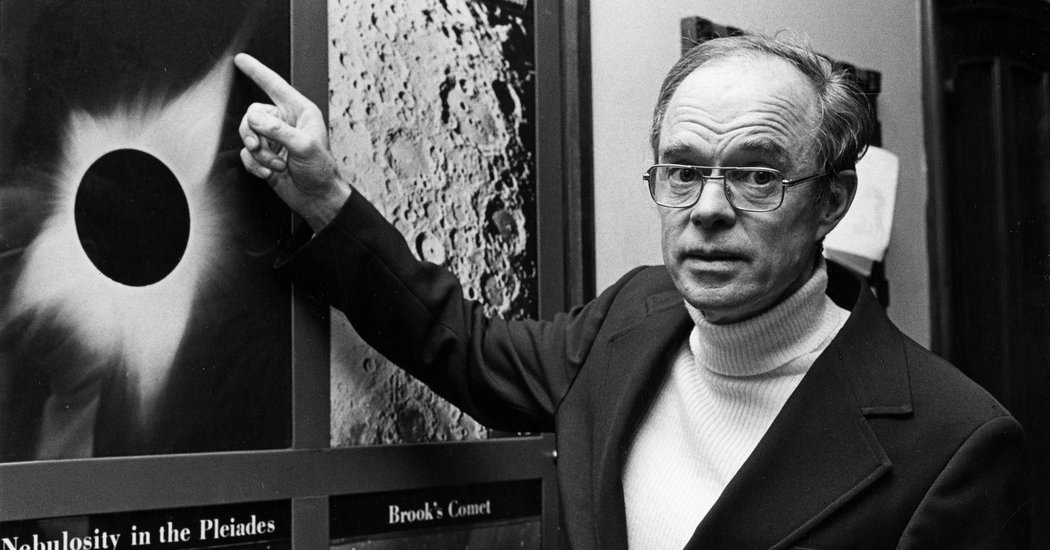
As you might guess space weather is almost totally dominated by the Sun with more than a million tons of material evaporating away from the Sun’s surface every second. Known as the Solar Wind this flow of particles was first predicted in 1957 by the astrophysicist Eugene Parker, for whom NASA’s new Parker Solar Probe is named.

Eugene Parker Explaining the Solar Wind (Credit: New York Times)
The Parker Solar Probe (Credit: NASA)

It is the Solar Wind that is responsible for both the Aurora and the belts of radiation that circle the Earth known as the Van Allen belts. Further out in space it is the Solar Wind that generates the tails of comets and which keeps those tails pointing away from the Sun.

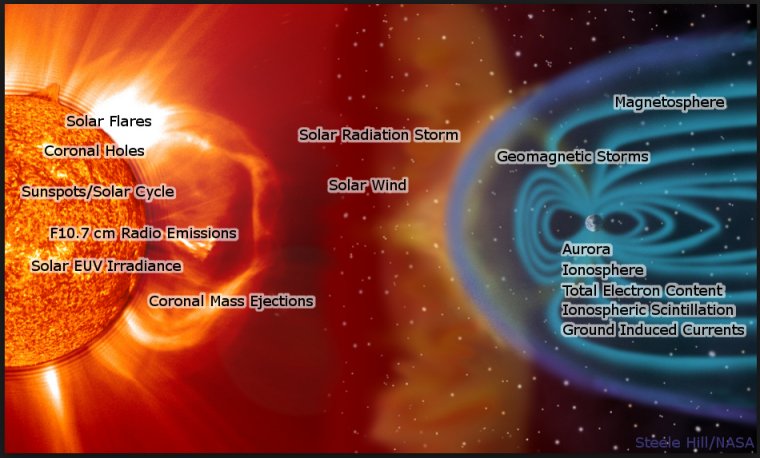
Space Weather is Caused by the Sun (Credit: NOAA)

The power of the Solar Wind varies with the Sun’s approximately eleven-year sunspot cycle and right now the Sun has been quite quiet. During periods of intense sunspot activity however the Solar Wind becomes not only more powerful but more erratic, with massive explosions on the Sun’s surface called Solar flairs blasting out millions of tons of material generating events known as Coronal Mass Ejections or CMEs.

Although it went unrecognized at the time, the first detection of a CME striking the Earth occurred in early September in 1859! On the first of September that year British astronomer Richard Carrington noticed a bright spot on the Sun, a Solar flair. The next night, the night of the second a huge auroral display was seen over much of northern hemisphere, even as far south as Panama. At the same time the brand new U.S. telegraph system experienced unexplained electrifications with operators being shocked and telegraph paper being set on fire.

A similar strike by a CME today would destroy most of the satellites we have in orbit and lead to massive electrical blackouts here on Earth. In fact a magnetic storm from the Sun in March of 1989 is credited with causing a total blackout of the Hydro-Quebec power grid in Canada. Also, the effect that so much radiation might have on astronauts out in space is still unknown but is expected to be a serious health risk.

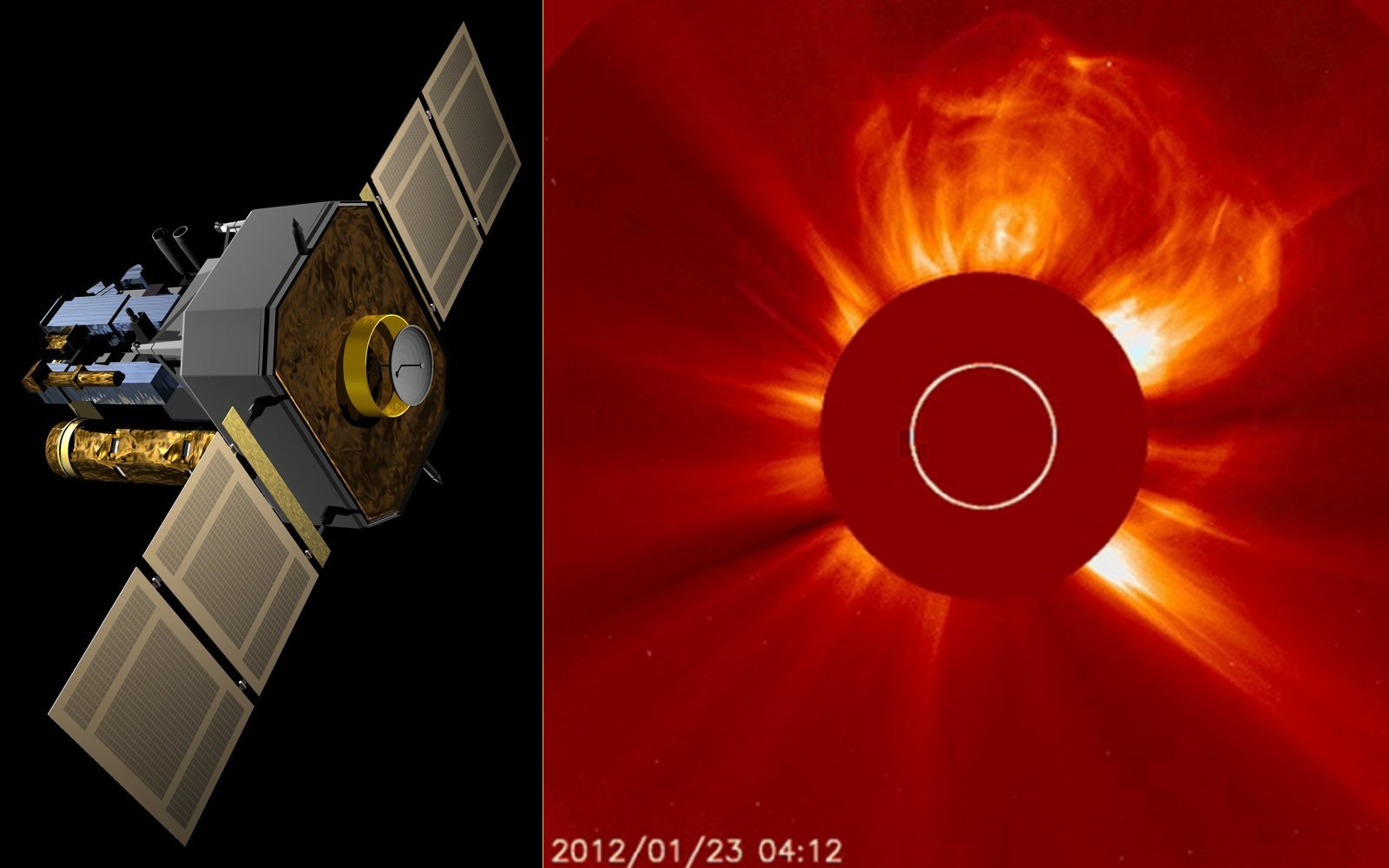
These days NASA and other space and scientific agencies keep a constant watch on the Sun using satellites such as the joint NASA-ESA Solar Heliospheric (SOHO) and the Solar-Terrestrial Relations Observatory (STEREO) spacecraft. To these satellites will soon be added the Parker Solar Probe, a spacecraft that will travel closer to the Sun than any other man-made device ever has. A daily report for space weather is now being issued to provide warnings for satellite operators, communications corporations as well as power grid utilities.

The SOHO Satellite and an image it took of a Solar Flair (Credit: NASA)

Many scientists and engineers are presently working to develop technologies to protect our electronic infrastructure against the ravages of extreme Space Weather; I know quite a few of them in fact. But the next solar storm could strike at almost any time and there’s a great deal of work to be done. If you’d like to visit NOAA’s website for the daily space weather report click on the link below. (It’s a really cool site!)

https://www.swpc.noaa.gov/

A hundred years ago Space Weather was completely unknown and almost impossible to detect. As our modern societies grow ever more dependent on electronics however the destructive potential of Space Weather is one more way that outer space is now becoming a place that we need to pay close attention to.

Gene Editing discovers a potential cure for Muscular Dystrophy, and a look back at the Jerry Lewis Telethon.

These next three days are celebrated as the Labour Day weekend here in the US and is also considered the unofficial end of summer. Back when I was growing up it was also the time of the Jerry Lewis telethon to benefit the fight against the disease Muscular Dystrophy (MD), a disorder that causes an almost total loss of strength and control of the muscles and is the leading genetic cause of death in children.

The Jerry Lewis Telethon began in 1966 and continued until 2010 (Credit: CBS)

Starting in 1966 and continuing until 2010 Jerry hosted the annual charity event which featured other celebrities and entertainment and which managed to raise $2.45 billion dollars for the study and treatment of MD. Despite the success of the telethon, and the large amount of money raised however MD has proven to be an intractable illness with little progress being made toward a treatment.

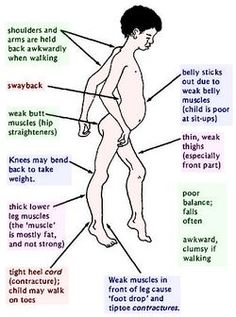
For those who aren’t familiar with MD it is a genetic disorder that prevents the production in the cells of the muscles of a shock absorbing protein called dystrophin. The lack of dystrophin causes the muscle cells to weaken and degenerate leading to a general failure of the bodies muscles. The first symptoms usually appear before a child is one year old.

Symptoms of MD (Credit: Pinterest)

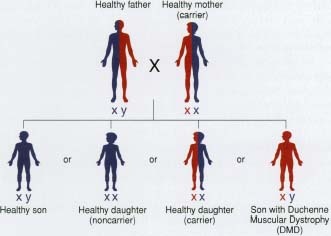
Since MD is a genetic disorder it is not contagious but rather must be inherited from both parents, each of whom must carry a single recessive MD gene. Having a single MD gene does not cause the disease but by looking at the image below you can see how a man and woman, each of whom have one MD gene on their chromosome pair, can pass it on to their children.

Inheritance of a Recessive Genetic disorder such as MD (Credit: Human Illnesses)

Since a child gets one gene from each parent 25% get clean chromosomes from both parents, the child on the left. This child will not develop MD nor can it pass the mutated gene to its children. 50% of the offspring will get an MD gene from one parent but not the other; these are the two children in the middle. These children will not develop MD but carry the gene and can pass it on to their children just as they received it from their parents. Only the child on the right, the 25% who receive the MD gene from both parents, will actually develop the disease.

There has recently been some progress that offers a glimmer of hope in the fight against MD. The research was conducted on a family of dogs, King Charles Spaniels to be exact, who were found about ten years ago to also suffer from MD. The research used the new science of gene editing and in particular the gene cutting tool CRISPR that I discussed at some length in my post of 5Aug2018.

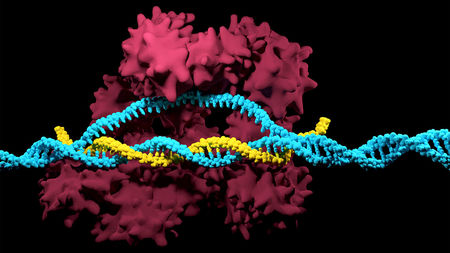
To put it simply CRISPR uses a virus, yes a virus to cut a section of DNA out of a chromosome with a cell and replace it with a different DNA section. The work was led by Eric Olsen at the University of Texas Southwestern Medical Center and consisted of using CRISPR to replace the mutated DNA in four one-month old male dogs.

CRISPR Working at the Molecular Level (Credit: Science)

Gene editing and CRISPR have been used before to treat other genetic disorders but MD was considered a long shot because the gene that manufactures dystrophin is the largest in the human genome and a large number of different mutations can lead to the disease. Still Dr. Olsen and his team injected the four dogs with millions of CRISPR viruses that were programmed to find and replace the mutated dystrophin gene.

The results were better than the researchers had expected. According to Dr. Olsen the dogs ‘…showed obvious signs of behavioral improvement…running, jumping…it was quite dramatic.”

Now this is only a test on four dogs, much more research will have to be carried out before any testing is conducted on humans. Still this is one more case where gene editing, and CRISPR in particular are giving us tools to fight diseases against which we once had no hope.

Which brings us to the ethical question. Changing the genes of a one-month old infant, dog or human, is playing god if anything is. And the technology that can ‘repair’ a child with MD can also create a ‘designer baby’ if that’s what we want.

As I said in my post of a little over a year ago my opinion is that we should move forward with gene editing but slowly, maintaining ethical controls on the research. I also that it is very important that we have a full-scale public debate now about how we as a society will regulate and control gene editing.

I’ve now told you my opinion, what’s yours?

Drought in England is helping to reveal lost Archeological sites.

Over this summer of 2018 Climate Change has brought extreme weather conditions to many of the regions of Europe. In both Portugal and Southern France monsoon-like rains have caused widespread flooding while areas to the north have seen droughts more severe than any in recorded history. England in particular is suffering from an almost complete lack of rain.

But every cloud has a silver lining they say (weather pun intended) and in England archeologists have been making the best of the situation by rediscovering hundreds of ancient homesteads, villages, hillforts and other sites, from the air!  Flying over the parched, brown grasses of the English countryside ghostly lines known as cropmarks become visible appearing to trace the outlines of long vanished human habitation. See images below.

Per-Historic Ceremonial sites in Eynsham, Oxfordshire (Credit: Historic England)
Roman Farm, Bicton, Devon (Credit: Historic England)

It’s hard to imagine how a buried stonewall or even a ditch that was filled in long ago could still effect the plants that are now growing above them. However even tiny chemical differences in the soil can show up as a slight variation in plant colour under the right conditions, such as a drought. These differences may be almost imperceptible from the ground but from the air…well the images speak for themselves. According to Historic England’s Chief Executive Duncan Wilson, “This spell of very hot weather has provided the perfect conditions for our aerial archeologists to ‘see beneath the soil’ as cropmarks are much better defined when the soil has less moisture.”

Pre-Historic Enclosure in Churchstanton, Somerset (Credit: Historic England)

Damian Grady, the Manager of Aerial Reconnaissance for Historic England agrees adding, “This has been one of my busiest summers in 20 years of flying and it has been very rewarding making discoveries in areas that do not normally reveal cropmarks”. By the way, just last year the Aerial Reconnaissance branch of Historic England celebrated it’s 50th birthday.

Aerial Reconnaissance is becoming one of the most important tools in the field of archeology with good reason. Trying to find Iron Age or older farm sites by exploratory digging is both expensive, time consuming and can often come up empty handed. On the other hand, a pleasant afternoon’s flight in a small plane with a camera can disclose the exact location of dozens potential areas worth excavating.

Abandoned Medieval Settlement in Nobel Northamptonshire (Credit: Historic England)
All of the sites aren’t ancient. This is a WWII AA Battery from Bolton upon Dearne (Credit: Historic England)

While England is at present one of the leading countries for aerial archeology the Middle East and even South America are also using the technique to great effect, rediscovering sites lost to mainstream history. (See my post of April 4th 2018.) There are still large areas of the world remaining to be surveyed from the air however. The great steppes of Russia and central Asia have been inhabited for tens of thousands of years and we know very little about the people and cultures that arose there. Aerial reconnaissance could cover those seemingly endless square kilometers of grassland and potentially discover hundreds of places to excavate and study.

Even while they are excited to be making all of these wonderful discoveries the archeologists at Historic England know that their good luck has come at the expense of all of the farmers whose crops are withering from a lack of rain. Another example of how Climate Change may very well bring some benefits to a small percentage of the human race, even as it brings ruin to the lives of many.

If you’d like to know more about Historic England’s aerial reconnaissance of if you’d just like to see some more of these fascinating images click on one of the links below to be taken to their website.

https://historicengland.org.uk/whats-new/research/50-years-flying/

https://historicengland.org.uk/whats-new/news/hot-dry-summer-reveals-hidden-archaeological-sites

Was there a Universe before the Big Bang? Two Researchers think they have found the evidence in the Cosmic Microwave Background (CMB).

For over fifty years now the ‘Big Bang Theory’ has been the cornerstone of our understanding of how the Universe came into being. According to the theory a little more than 13 billion years ago an incredibly dense ‘singularity’ exploded hurling matter and energy out into space (Which didn’t exist before the explosion). That matter would slowly cool to form stars and quasars and galaxies and all of the other astronomical objects we see through our telescopes today.

The strongest evidence for the Big Bang comes from observations of the Cosmic Microwave Background (CMB), literally the leftover heat from that explosion that fills all of space. The image below shows the CMB as measured by the WMAP Satellite.

The Cosmic Microwave Background as measured by the WMAP satellite (Credit: NASA)

Still, right from the very first there have been physicists and cosmologists who asked: What was going on before the Big Bang? What in fact caused the Big Bang? (Actually, since on cosmic scales time and space are pretty much the same those two questions can be combined as: What is going on outside of the Big Bang?)

Cosmologists have speculated about cyclic Universes where the expansion of the Big Bang comes to stop, leading to a collapse called a Big Crunch which then rebounds as another Big Bang starting the cycle all over again. Then they are other theories about a ‘Multi-Verse’, where our Big Bang was just one of an infinite number of Big Bangs of various sizes, shapes and properties. My favourite theory is that our Universe is just a Black Hole inside an even bigger Universe. What we call the Big Bang was the instant the Black Hole in that other Universe formed.

If you think these ideas border on crazy, well wouldn’t any theory about how our Universe began sort of have to be! The problem with all of these theories however is that the evidence needed to confirm any of them would have to have come through the Big Bang. In other words that evidence would have had to survive the unimaginable temperatures and pressures at the beginning of our Universe and few physicists thought such survival was possible.

Now however two mathematical physicists think they have found just such evidence buried within the data of the CMB. V.G. Gurzadyan of the Yerevan Physics Institute in Armenia along with Roger Penrose of The Mathematical Institute in Oxford in the UK have been working on a variation of the cyclic Universe that they call Conformal Cyclic Cosmology (CCC). In CCC each Universe, remember we’re talking about a cycle of Universes now, expands until all of the matter has spread so thin that time and space no longer really exist because there is nothing with which to measure them! The Universe has now returned to the initial condition of the Big Bang so another Big Bang occurs to start everything all over again!

One of the interesting things about CCC is that in the theory the Big Bang itself takes a little longer and is therefore less violent. Less violent enough for some traces of really powerful events, like a merger of supermassive black holes for example, to send some evidence through the Big Bang.

It would work like this, see image below. The start of a merger of two supermassive black holes would send a powerful ripple of electromagnetic and gravitational energy spreading through space and time. Once the merger is completed the ripple would cease. As the ripple spread out it would form a cone in space-time which eventually would impact on the next Big Bang causing the formation of concentric circles that could show up on the CMB.

Effect of a Black Hole Merger on a subsequent Big Bang (Credit: Penrose and Gurzadyan)

Now searching through all of the CMB data for such traces is the sort of tedious, painstaking work that only a computer could do but Penrose and Gurzadyan believe they have found some. The plots below show some of the evidence, the data peaks being the rings. The image below that shows two superimposed rings on the CMB data. (That means the rings have been artificially placed on the data as an aid to seeing them) I have to admit that I have some trouble seeing the signal through all of the noise but nevertheless I’m intrigued by the possibility of detecting ‘fossils’ of pre-Big Bang existence.

Data Plots from the WMAP Satellite data (Credit: Penrose and Gurzadyan)
Rings Superimposed on WMAP data to illustrate fossil traces from pre-Big Bang Event (Credit: Penrose and Gurzadyan)

Theories like that of Penrose and Gurzadyan are always greeted with a good deal of skepticism, as they should be. Other physicists and cosmologists will now scrutinize Penrose and Gurzadyan’s math and calculations to see if they can find any flaws. At the same time I’m certain that Penrose and Gurzadyan will be looking for more ‘fossils’, more evidence to support their claims.

If Penrose and Gurzadyan are right it would be one of the biggest finds in science in this century. Only time and more data will tell for sure.

Book Review: ‘The Glass Universe’ by Dava Sobel

Former New York Times science reporter turned author, Dava Sobel has become a popular advocate for the understanding of science through the telling of it’s history. In her earlier books ‘Longitude’ and ‘Galileo’s Daughter’ Ms. Sobel showed how, through science single individuals could change the world.

Dava Sobel (Credit: Random House)

In ‘The Glass Universe’ Ms. Sobel tells the story of the female ‘computers’ who worked at the astronomical observatory at Harvard University between the years 1880 and 1950. The contributions of these poorly paid, often ignored and rarely appreciated geniuses played a significant role in shaping the way we view the Universe today.

The Glass Universe cover (Credit: Random House)


Ms. Sobel starts the story with Dr. Henry and Mrs. Anna Draper, amateur astronomers who have taken an interest in two of the cutting edge astronomical techniques of the time, astrophotography and stellar spectra. (Stellar spectra by the way is using a prism to break the light coming from a star into a rainbow, this spectra will show the spectral lines of the elements within that star) Henry Draper had set for himself the task of photographing the spectra of as many stars as he could.

The Drapers contact one of the leading astronomers of the day, Edward Pickering, newly appointed head of Harvard University’s observatory, for advice but Henry Draper died before he could make any real observations. Feeling that she was unable to continue the work herself Anna Draper instead endowed Harvard Observatory, and her friend Dr. Pickering with a generous fund to carry on the work her late husband had hoped to do. In time Mrs. Draper’s generosity will lead to the acquisition of half a million photographic astronomical plates along with the compilation of the all of the data they contain.

Now in the late 19th century a computer was a human being who carried out the drudgery of long mathematical calculations or tabulations. Every scientific labouratory or observatory had at least a few of these computers, who were normally young male students. Harvard observatory however already had a few female computers; they were cheaper than their male counterparts, and with Mrs. Draper’s endowment Pickering hired several more to assist with the recording of the data on all the photographic plates he and the other male astronomers were taking.
Edward Charles Pickering and his Lady ‘Computer’ 1913 (Credit: Racingnelliebly.com)

Before long however, the ladies were making discoveries of their own from within all of the data they were recording. Williamina Fleming for example discovered over three hundred variable stars along with ten novas. Then there was Annie Jump Cannon who in the course of her career analyzed the spectra of more than a million stars and who invented a system for classifying stars that with only a few changes is still in use today.

Also there was my favourite, Henrietta Swam Leavitt who studied those variable stars that exhibited a steady, rhythmic pattern. These stars were called Cepheid variables because the brightest such star in our sky is beta in the constellation Cepheus. In photographic plates from Harvard’s southern hemisphere observatory in Peru Ms. Leavitt discovered about 150 such stars in the Small Magellanic Cloud. By recording the period, maximum and minimum brightness of each of these stars Miss Leavitt uncovered a relation between brightness and period that allowed astronomers to use the Cepheid variables as yardsticks for measuring distances throughout the Milky Way and into other galaxies.

Henrietta Swan Leavitt and her Relationship for Cepheid Variables (Credit: Public Domain)

But don’t get the idea that ‘The Glass Universe’ is only about the female astronomers, we get to meet and learn about some of the best known male astronomers of all time as well. Men like Ejnar Hertzsprung who discovered both giant and dwarf stars and was the first astronomer to use Henrietta Leavitt’s Cepheid yardstick. Or Henry Norris Russell, who studied the composition and evolution of stars. These two men are often thought of as a pair because they both worked, independently on what has become known as the Hertzsprung-Russell diagram of stellar evolution. Then there is Harlow Shapley who became director of Harvard University after the death of Edward Pickering and who used Henrietta Leavitt’s yardstick to determine the size of our Milky Way and our Sun’s position in it.

The Hertzsprung-Russell Diagram. The letters across the bottom are the Stellar Classification Scheme developed by Annie Jump Cannon. (Credit: Cornell.edu)

Then there was Solon Bailey who studied globular clusters. Oh, and I can’t forget Edwin Hubble who used Henrietta’s yardstick (are you getting the idea that Henrietta’s work is really important) to measure the distance to the Andromeda Galaxy, proving that it was outside the Milky Way and a galaxy in its own right.

Still, ‘The Glass Universe’ is really about those poorly paid, often ignored and rarely appreciated geniuses who, as Dava Sobel put it “Took the Measure of the Stars”. I’ve know about these great discoveries, both those by the woman and the men, my entire adult life. For me therefore, the delight in reading ‘The Glass Universe’ was in seeing how all of these scientific advances fitted into one another, how the researchers worked together, or occasionally against each other, to give us a new view of our Universe.

I heartily recommend Dava Sobel’s ‘The Glass Universe’. Without doubt it is one of the best books about science and the way human beings do science that you will ever come across.


Paleontology News for August 2018.

Paleontology is in a very real sense the study of origins, of beginnings. Paleontologists study the history of life in order to discover when and how different kinds of living creatures came into being. This month I’d like to discuss two such origin stories. In one case the discovery of the earliest known Pterosaur, those flying reptiles who shared the ancient Earth with the dinosaurs but first some new discoveries about the very beginnings of all the animals on Earth, including you and me!

Today pretty much everybody knows that more than a billion years ago the first living creatures here on Earth were tiny, microscopic single-celled organisms like bacteria and amoeba. Sometime in the distant past some of these single celled creatures learned to live together in groups like those in a sponge. In time, although still many millions of years ago, some of the cells began to perform one function, like digesting food while other cells performed other functions like motion or grabbing food.

Groups like this, where different cells concentrated on different functions to the mutual benefit of all the cells were the first multi-cellular organisms. It is from these creatures that all of the living things see every day have evolved.

The earliest fossils we have of multi-cellular life are collectively known as the Ediacaran Biota because they were first discovered in the Ediacara region of Australia. Since their first discovery Ediacaran fossils have been found throughout the world and have been dated to between 635 and 541 million years ago.

Because these creatures lived before the evolution of hard parts like bones or bark or shell they do not fossilize well and can be very difficult to study. In some cases paleontologists cannot even tell whether a specimen is a plant or an animal. The images below show several different types of Ediacaran creatures.

Dickinsonia costata from the Ediacaran Period (Credit: Alamy)
Spriggina a fossil from the Ediacaran Period (Credit: NetMassimo)
Tribrachidium heraldicum from the Ediacaran (Credit: Yale News)

A new study published in the journal ‘Paleontology’ seeks to clear away some of the mystery in the Ediacaran Biota and definitively identify the earliest known animal. The study, co-authored by Jennifer F. Hoyal Cuthill of Cambridge University and the Tokyo Institute of Technology, boy I wouldn’t want her commute between jobs, and Jian Han of the Shaanxi Key Laboratory of early life at Northwest University in Xi’an China has provided an evolutionary link between several species in the Ediacaran period to a later species of animal in the Cambrian period (540-485 Million years ago).

The animals in question certainly look more like plants; see artist’s impression below. Known collective as the Petalonamae because of their petal like branches only close examination of the anatomic details in the fossil remains show that the animals are in fact more highly evolved relatives of the sponges. The image below shows a fossil from the Ediacaran period on the right while the fossil  that belongs to the Cambrian is on the left.

reconstruction of a Petalonamae(Credit: Jennifer H. Cuthill)
Ediacaran Fossil (r) compared to Cambrian descendent (l) (Credit: Jennifer H. Cuthill)

The results of the study by Doctors Cuthill and Han reveal some of the details of how the animal kingdom itself came into being. A rather important chapter in the history of life.


Another chapter in the history of life deals with those flying reptiles, the pterosaurs who filled the sky during the time of the dinosaurs. Now a new species has been identified in fossils unearthed in the state of Utah. At an estimated age of 210 million years old the new pterosaur is some 65 million years older than the previous oldest known flying reptile.

The new species has been named Caelestiventus hanseni by its discoverer Professor Brooks Britt of Brigham Young University. While the specimen was not yet fully grown it already had a wingspan of a meter and a half. The images below show first the almost perfectly preserved skull of C. hanseni and below that an artist’s impression of what the pterosaur might have looked like.

Skull of Caelestiventus hanseni (credit: Nate Edwards)
Caelestiventus hanseni (Credit: Michael Skrepnick)

Thanks to the work of dedicated researchers like Doctors Cuthill, Han and Professor Britt we are slowly, bit by bit filling in the missing pages to the story of life on Earth.

Theo Jansen and his Strandbeesten, is he an Artist or an Engineer, and Why can’t He be Both.

There’s always been a close connection between art and science. For example everyone is aware of the fact that Leonardo de Vinci was as interested in inventing things as he was in his paintings. Many well-known artists have also been architects designing magnificent buildings while many of the world’s great engineering feats; bridges, skyscrapers and the like are also considered works of art.

So it isn’t really all that surprising that Dutch artist Theo Jansen studied physics as a student at Delft University of Technology. Born in Scheveningen in the Netherlands on March 14th, 1948, Jansen was from his childhood interested in both science and art. The Image below is of Theo Jansen.

Theo Jansen (Credit: Wikipedia)

Jansen’s work has consisted of a large number of what are known as kinetic sculptures, literally sculptures that move. His first attempt came in 1979 when he built and flew a four-meter wide flying saucer made from PVC pipe and filled with helium. As you might guess the artwork was mistaken for the real thing by many people and caused quite a stir.

Then in the mid-80s Jansen developed a ‘Painting Machine’ which employed a photoelectric cell to turn ON or OFF a spray can of paint allowing the machine to paint the outlines of people as well as other objects.
Jansen’s chief fame however has come from his design and construction of what he calls Strandbeesten (Dutch for Beach Beasts) starting in the 1990s. Usually powered by the wind the Strandbeesten are large constructions that walk across the sand much like a living creature, indeed Jansen himself describes his creations as artificial life. The image below shows one of Jansen’s Strandbeesten.
One of Jansen’s Strandbeesten (Credit: Chicago Reader)

All of the Strandbeesten are constructed around a basic mechanism that converts the rotation of an axis into a walking motion of six or more legs using triangles and linkages made of sections of PVC. Although still made from simple materials like PVC, wood and fabric for the sails, Jansen’s creatures have evolved a great deal over the last twenty-five years. Some are now able to actually detect the ocean water when they step in it and alter their course to avoid going in any deeper! Another version can detect a storm approaching and anchor themselves to the ground to prevent any wind damage.

A More massive Strandbeesten (Credit: ArtFutura)
A Snake like Strandbeesten (Credit: Domus)

In the future Jansen hopes to design and construct entire herds of Strandbeesten to wander the Dutch coastline. Also NASA is considering using Jansen’s basic motion mechanism in a design for a possible Venus lander. The environmental conditions on Venus are so harsh that conventional motors and wheels won’t work so Jansen’s approach might be a possible alternative.

I’ve included several images of Jansen’s creations in this post but to fully appreciate the Strandbeesten you must see them in motion. The links below will take you to some youtube videos that show better than I can ever say in words just how weirdly wonderful they are.

https://www.youtube.com/watch?v=KsqlnGMzMD4

https://www.youtube.com/watch?v=On8v-Wr3XxU

Theo Jansen is just another example of how art and science can not only compliment each other but actually merge together to form some of humanity’s most beautiful creations.


Space News for August 2018.

The future of manned space flight takes center stage this month. There’s some good news, some bad news and a big announcement so let’s get to it!

Starting with the good news a major new survey has been published in the journal ‘Genes’ discussing the research and advances in biotechnology that could help us grow food on Mars. Obviously such technology will be absolutely necessary for any long term human base on the red planet, let alone a settlement.

Authored by the Australian scientists Briardo Llorente, Thomas C. Williams and Hugh D. Goold the survey article is entitled ‘The Multiplanetary Future of Synthetic Biology’. The article begins by reviewing the difficulties that we know will be encountered when we try to grow food on Mars. Chief among these will be the fact that the surface of Mars receives only 43% as much sunlight as does the Earth because of the red planet being about 75 million kilometers further from the Sun.

The authors point out however that in general the plants of Earth only absorb about half of the light that falls upon them, in fact plants reflect almost all green light, that’s why they look green! Genetic modification of Earth plants to enhance the process of photosynthesis is a real possibility with our growing knowledge of the chemistry of chlorophyll (see my Post of 23June2018).

At the same time any plants we attempt to grow on Mars will have to be ‘designed’ to survive and grow in an environment extremely hostile to most life on Earth. Some of the hostile factors that plants on Mars will have to endure include extreme cold and long periods of drought. However there are already plants here on Earth that have adapted to such conditions and genetic studies of those plants should provide clues to help genetically engineer other plants to adapt to them as well. The image below illustrates some of the genetic engineering of traits that will be needed to develop plants suitable for life on Mars.

Desired Plant characteristics to be Genetically engineered (Credit: Llorente, Williams, Goold)

Another study however puts something of a roadblock in the way of terraforming Mars by adapting plants to endure the conditions there. Now everybody knows that the process of photosynthesis requires two main ingredients, sunlight and carbon-dioxide. Well, we’ve already mentioned sunlight but a new study by Bruce Jakosky, professor at the University of Colorado at Boulder and Christopher S. Edwards, Assistant Professor at Northern Arizona University has concluded that Mars lacks sufficient CO2 to either promote plant growth on a large scale or to help raise the planet’s temperature by using the CO2 as a greenhouse gas. The image below shows an artist’s impression of what a terraformed Mars could look like compared to the Mars that we see today.

Mars Terraformed (credit: Kevin Gill)

The study was funded by NASA and made use of all of the available data from the many spacecraft, both landers and orbiters that have been studying Mars over the last several decades. This implies that the results of the analysis conducted by Professors Jakosky and Edwards is based on the best knowledge humanity has so this study could be bad news for those planning on colonizing Mars.

Of course it has already been suggested that Mar’s deficiency in CO2 could be fixed by importing the gas from elsewhere in the Solar System. Comets are known to possess large amounts of CO2 as well as even more water, which Mars could certainly use as well.

Imagine the possibility of rerouting the orbit of a couple of comets so that they are captured into Mars orbit allowing their resources to be sent down to the planet’s surface. Sounds like the plot of a science fiction novel, ‘The Comet Cowboys!’

Finally today there was a big announcement today by NASA of the astronauts selected for the first four missions of the space agency’s Commercial Crew Program. These missions, with spacecraft designed and built by the private corporations Boeing and Space X will be the first time in seven years that astronauts will launch from American territory.

The initial, unmanned test missions for Space X’s dragon and Boeing’s Starliner capsules are scheduled for later this year while the first actual manned missions will take place early next year. These test missions will then be followed up with the first operational mission to the International Space Station (ISS) at a later date.

As I mentioned above the first test mission for each spacecraft will be unmanned, the crews for the second test mission are:

Space X’s Dragon: Astronauts Bob Behnken and Doug Hurley

Boeing’s Starliner: Astronauts Eric Boe, Nicole Anapu Mann and Boeing Astronaut Chris Ferguson.

The crews for the first operational flight to the ISS are:

Space X’s Dragon: Astronauts Victor Glover and Mike Hopkins

Boeing’s Starliner: Astronauts Josh Cassada and Suni Williams

The image below shows the chosen astronauts with the Space X Dragon and Boeing Starliner Capsules in the background.

Astronauts selected for First Commercial crew Program Missions (Credit: Engadget)

For the latest information about the crews selected for the Commercial Crew Missions click on the link below to be taken to NASA’s official site!

https://www.nasa.gov/press-release/nasa-selects-astronauts-for-first-us-commercial-spaceflights-0

Scientists Create Fastest ever Man-Made Spinning and Vibrating Objects.

Most people are aware of the fact that in order to learn more about the Universe scientists are constantly striving to develop more precise, more sensitive measuring instruments. Now scientists at Purdue University have succeeded in constructing the world’s fastest man-made vibrating and rotating objects. Devices that could be turned into scientific instruments of unparalleled sophistication.

What Professors Tongcang Li and Jonghoon Ahn of Purdue’s Department of Physics and Astronomy along with the Birck Nanotechnology Center have done is to fabricate silica particles in a dumbbell shape as small as 170 nm in length (that’s less than one fifth of a millionth of a meter). These particles are then levitated in a vacuum chamber by means of a 500 mW laser. Think of how light these particles must be if they can be held up by half a watt of light! The images below, taken with an Scanning Electron Microscope or SEM, show several of the silica particles.

Silica Nano-Particles (Credit: Li and Ahn, Purdue University)

Now, laser light is a part of the electromagnetic spectrum and therefore contains electric and magnetic field components which oscillate at the frequency of the light. These oscillations can take two forms known as polarizations, the first is called linear polarization, see animation below, because the electric and magnetic field components go up and down, or back and forth on a line.

Linear Polarization (Credit: Edmund Optics)

The second form of polarization is called circular polarization because the field components rotate around in a circular motion. See figure below. The circular motion can be either clockwise (Also called left handed) or counter-clockwise (right handed).

Circular Polarization (Credit: Wikipedia)

The effect of these two kinds of polarization on the silica dumbbells is quite different. Linear polarization causes the dumbbells to begin to vibrate along the line of polarization while circular polarization causes the dumbbells to rotate. With the technology that they have developed the researchers at Purdue have surpassed one billion vibration or rotations every second. The image below shows Professors Li and Ahn at work in their Lab.

Professors Li and Ahn in their Lab (Credit: Purdue University)

Impressive as those results are, how does that make these silica nano-dumbbells more sensitive, more precise scientific instruments? Well the dumbbells themselves held up by the laser are functionally identical to an instrument know as a torsion balance that was invented by Henry Cavendish to measure the value of Newton’s gravitational constant. The scientists at Purdue hope that their version of Cavendish’s instrument will be capable of measuring gravity at the atomic level giving physicists clues into the nature of quantum gravity!

Also, the rotating particles could be used to study the nature of the quantum vacuum through an effect known as vacuum friction. If you’re thinking that there’s nothing in a vacuum to generate friction you have to remember that we’re talking about the quantum world here. According to Quantum Field Theory virtual particles pop into and out of existence continually and these can interact with the rotating dumbbell causing friction. Vacuum fiction was predicted decades ago but has still never been directly observed, hopefully Purdue’s rotating particles will soon give us a better window into the reality of the quantum field.

Experimental measurements are the way we actually know things, theories on the other hand are the connections between our measurements. The more precisely we can measure things, the more different ways we have to measure things the more we know. It’s as simple as that.

Nobel Physicist Burton Richter, Discoverer of the J/ψ Particle, Dead at the Age of 87.

Experimental Physicist, Director of the Stanford Linear Accelerator Center (SLAC) and 1976 Nobel Laureate Burton Richter passed away on July 18 2018 at the age of 87. Best known for his work in establishing SLAC as one of the premier scientific institutions in the world Dr. Richter was one of the founding fathers of the ‘Standard Model’ of particle physics due to his discovery at SLAC of the J/ψ Particle in 1974.

Burton Richter (1931-2018) (Credit: AZ Quotes)

I was fortunate enough to meet Dr. Richter twice in my life. The first time was as an undergraduate student at Drexel University when Dr. Richter came to give a seminar. The second time was at SLAC itself when I visited there in order to consult with two of SLAC’s engineers on a program for which I was engineering manager. I can still remember the first time I drove down Interstate 280 from San Francisco over the 3.2 kilometer long building that holds the Linear Accelerator at SLAC, see images below.

SLAC as you see it driving along I280 near Palo Alto, Ca. (Credit: Terra Galleria)
The Linear Accelerator at SLAC (Credit: Flickr)

In order to understand the significance of Dr. Richter’s discovery of the J/ψ Particle in 1974 I’ll have to back up a bit and discuss the Quark theory of the 60s. Throughout the 1950s and early 60s a new generation of atom smashers were discovering a myriad of new particles in addition to the familiar Proton, Neutron and Electron. Some of these particles had masses midway between the electron and the proton/neutron and were called mesons of which the π-mesons (now just called pions) and K-mesons (Kaons) are examples. Other particles were even heavier than the proton/neutron such as the Δ and Σ (Delta and Sigma) particles.

This particle zoo confused everybody and the theorists went to work trying to find a simple scheme to make sense of it all. It was theoretician Murray Gell Mann who figured it all out. Dr. Gell Mann predicted the existence of three new particles which he called quarks, the Up, Down and Strange quarks.

The middle mass mesons, Gell Mann proposed, were composed of a quark-antiquark pair while the heavier particles were composed of three quarks. For example the proton is composed of two ups and a down while the neutron is composed of two downs and an up. The still heavier particles had one or even two strange quarks in them which would eventually decay turning their particle into either a proton or neutron.

The strange quarks were well named. There was no real theoretical reason why it should decay at all or why it should only decay into up quarks, never the down quark. Throughout the 1960s Quark theory seemed a little too strange for most physicists.

The first experimental evidence for quarks came in 1969 when Burton Richter and his team used the linear accelerator to fire electrons off of protons in what is known as ‘deep inelastic scattering’. The results of these experiments indicated that protons were in fact made up of smaller ‘chunks’ and probably three of them.

Then in 1973 theoreticians suggested that if there was a fourth quark, given the name ‘Charm’, it would suppress the strange quarks ability to decay into a down quark, matching observations. So the hunt was on!

Quarks have a peculiar property however, they are never found alone. You can find a quark-antiquark pair or three quarks together but never one all by itself. Therefore the easiest way to find a charm quark would be to find a charm-anticharm meson.

It turned out to be a tie. Dr. Richter and his team found their ψ particle on almost the same day as Samuel Ting and his team at Brookhaven National Laboratory found their J particle. It was quickly recognized that the two particles were both the charm-anticharm meson and because the two teams had discovered them simultaneously it become known as the J/ψ meson. A fourth quark had been discovered and Burton Richter and Samuel Ting shared the 1976 Nobel Prize for their work.

Samuel Ting and his team To Brookhaven National Laboratory (Credit: BNL)
Discovery Peak in Energy for the J/ψ Particle (Credit: Wikipedia)

In the years since the discovery of the charm quark two more quarks have been found, bottom and top and physicists have learned that quarks come in pairs, up and down, strange and charm, bottom and top. These pairs are known as generations and whether there are any more generations, or just why exactly there should be generations is still unknown.

The breakthroughs that Burton Richter achieved are now a large part of the standard model of how the Universe works at its most basic, elementary level. Not a bad way to have spent one’s life.