Trump’s Science Budget, or lack thereof.

I’d like to take a bit of a break from my series ‘What is Science Fiction’ to talk a little about the impact of the recently announced White House budget for 2018 on science. (Don’t worry, the final installment of “What is Science Fiction” will be posted this week.)

This is Donald Trump’s first budget and shows very clearly his intent for the future of such agencies as NASA, NOAA, NSF and the Department of Energy. We already knew that the EPA and National Institute for Health were going to take a big hit and boy did they! The EPA’s budget is cut by almost a third while the NIH losses 18% of it’s funding. I guess Donald Trump doesn’t want us to know how sick we’re getting from all the pollutants industry is dumping into the environment. Still, as I said we knew those cuts were coming.

Trump Budget cuts to Science

The cuts at the Department of Energy were a bit more of a surprise. While the overall reduction is only 5% the cutback in scientific research controlled by the DOE is 20%. Not many people know that the DOE runs America’s high energy physics programs and other basic research installations like the Laser Interferometer Gravity wave Observatory (LIGO) which just last year announced the first detection of gravity waves.

These cuts not only threaten America’s leadership in almost every field of scientific research but will cause many of our most brilliant and gifted young students to abandon careers in basic science. From the building of the very first atom smasher by E. O. Lawrence back in 1934 America has always led the world in physics experiments but no more! Europe has the Large Hadron Collider at CERN and the Chinese are building dozens of scientific centers while we just let them take the lead. I guess Physics is a little too complicated for Donald Trump to understand.

One complete omission from the White house budget is the funding for the National Science Foundation (NSF), it’s just simply not mentioned at all. However republicans over the last few years have begun to criticize the NSF for funding programs related to the environment and social sciences so you can bet on the NSF loosing some of it’s funding.

The one piece of good news in the budget is the fact that NASA’s funding is only cut by 0.8%. Even that silver lining has a cloud around it however as the funding for Earth research from Space is drastically cut. At the same time Trump has issued an executive order directing NASA to focus on a manned journey to Mars in the 2030s. I guess even Donald Trump is able to understand that a trip to Mars is something to brag about.

If you’d like to read more about the exact figures for Donald Trump’s science budget click the link below to read an article from ‘Nature’.

http://www.nature.com/news/us-science-agencies-face-deep-cuts-in-trump-budget-1.21652

And what’s the reasoning behind all these cutbacks in the very programs that make the United States the most technically advanced nation in the world. Is it to assure health care for all Americans, please don’t make me laugh. Is it to lower the deficit, nah republicans only care about deficit spending when it’s the democrats doing the spending. It’s so that we can spend more money on a military that already costs more than the next five nations spend on their military.

Hopefully Donald Trump will have the same success with his budget that he just had with his healthcare repeal and replace. Hopefully we can force the congress to put some of the science funding back into the budget. Neil deGrasse Tyson has called the Trump budget the “Make America Weak, Sick and Stupid Budget”. I certainly agree.


Human Machine Interface

In one sense of course, Human Machine Interface has been around since the invention of the wheel. Over the last twenty years however progress has been particularly rapid and Human Machine Interface has become both very advanced and quite intimate.

Much of the progress has taken place in the design and development of prosthetic devices to replace body parts lost by disease, injury or congenital condition. Modern materials along with engineering design and miniature electronics have produced artificial limbs that can function nearly as well as a limb of flesh and blood.

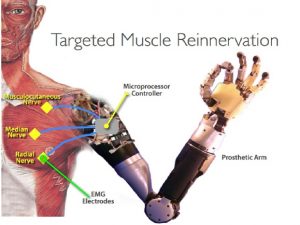
Some of the best available technology today employs the residual nerve signals or muscle contractions that would have controlled the missing limb to now control the movements of a myoelectric prosthesis. These devices have enabled thousands of people to regain the better part of the functioning of their lost limb. The picture below shoes a basic layout of a myoelectric artificial arm and hand.

Myoelectric Prosthetic Arm and Hand

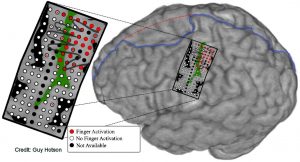
Some of the most advanced work is now being accomplished by John Hopkins Medicine and involves a direct control of a prosthetic limb by the mind itself. To read the brain’s signals a sensor pad with 128 electrodes is surgically implanted on the region of the brain that controls arm and hand movement. The sensory data is then analyzed by a computer which then controls a robotic hand. The team that is conducting the research claim that they can reproduce 88% of the functioning of a normal hand with the test subject being able to individually move the robotic thumb and fingers. The picture below shows the sensor pad and where it was implanted on the brain.

Sensor Pad implanted on the Brain. Credit: Guy Hotson

If you’d like to read more about the research being conducted at John Hopkins click on the link below.

http://www.hopkinsmedicine.org/news/media/releases/mind_controlled_prosthetic_arm_moves_individual_fingers_

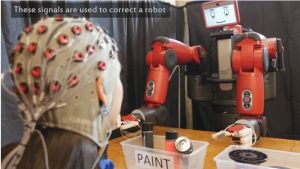
Another project taking place at MIT involves actual mind control of a robot. The picture below shows the experimental setup.

MIT Mind Control of Robot Experiment

In the experiment a human subject places a skullcap over their head which measures their brainwaves. The brainwaves are then analyzed by a computer which uses them to control a robot. In the experiment the robot is carrying out a simple task of sorting objects into one of two bins. So far the researchers are successful in commanding the robot into which bin to place the object with only their brains 70% of the time so we have a way to go before we can make robots dance just by thinking them to do so but it is a start. If you’d like to read more about the research at MIT click on the link below.

http://www.wbur.org/bostonomix/2017/03/08/mit-mind-controlled-robots

In some respects human control of what machines are capable of doing is almost a definition of technology. We’ve been getting better at it for thousands of years but progress is accelerating and what we may be capable of in just a few decades is staggering.


Space News for March2017

The past couple of weeks have seen several interesting news items related to manned space flight so I thought today would be a good day to catch up on Space News.

First off last week both Space X corp and the Russians succeeded in launching resupply missions to the International Space Station (ISS) with Space X also successfully landing the first stage of their Falcon rocket after it had placed the Dragon capsule into orbit. These resupply missions are becoming routine and that’s a good thing! It means we are finally building the infrastructure the space which will enable us to concentrate on new missions going further into space.

Speaking of going further into space, Space X announced last week that they are preparing a mission to take two paying customers out to, but not landing on, the Moon. This mission has tentatively scheduled for late next year (2018). Along with NASA’s announcement last month that the first mission of their Space Launch System / Orion spacecraft might now be manned (see my post of 22Feb for that news) this means that there could be two independent missions to Lunar orbit next year (actually I bet they’ll both end up in 2019 but still that’s progress!) If you’d like to read Space X’s official announcement click on the link below.

http://www.spacex.com/news/2017/02/27/spacex-send-privately-crewed-dragon-spacecraft-beyond-moon-next-year

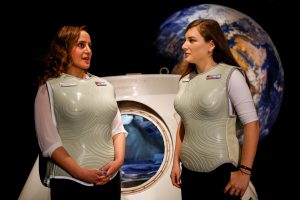
Now, for the fashion conscious among us (certainly not me) there was a press release for a company called StemRad based in Israel. StemRad already has a reputation for designing and manufacturing radiation protective gear for workers in nuclear power plants now they’re working on gear for astronauts. StemRad called the press release to show off the new radiation vest that they had developed and which they called the AstroRad. The vest is intended to protect human tissue from the effects of the radiation encountered on deep space missions such as to the Moon or Mars. NASA will be testing the vest on their planned Lunar missions.

The vests are form fitting and tailor made for each astronaut. The picture below shows the vests being worn by two of StemRad’s employees.

StemRad’s Radiation Vests

If you’d like to read more about the AstroRad vest click on the link below.

http://www.businessinsider.com/r-mars-astronaut-radiation-shield-set-for-moon-mission-trial-developer-2017-3

Finally the space company Blue Origen released an animation of how their soon to be completed Glenn rocket will be recovered after launching a payload into orbit. The critics are all saying that it looks awfully familiar and that Space X doesn’t need animations since they have actual footage of them landing one of their rockets! Still, more companies competing against each other should help bring down the cost of space travel. If you’d like to see the animation click on the link below.

http://www.theverge.com/2017/3/7/14841128/blue-origin-ocean-landing-rocket-animation-spacex-comparison

Before I go I have an announcement of my own to make! If you look over at the right hand side of the page you’ll see that I have now started a bookmarks section where I will be providing links to other web sites devoted to Science and Science Fiction. Even better you’ll see that this blog has been chosen by Feedspot Blog Directory as one of their Top 100 science blogs. In fact Science and Science Fiction debuted at #73 on their list which includes such well known sites as Scientific American, Discover Magazine, National Geographic and Popular Science. O’k they’re all in the single digits while I’m 73 but still it’s cool just being on the same list! And remember, this blog is only 6 months old!

Physics Seminar: Free Neutron Decay

Back in High School you probably learned that the atoms that make up everything around us are themselves made up of three types of particles, Protons and Neutron sit at the center of the atom in the nucleus while electrons go spinning around the nucleus. What you might not have learned in High School is that the Protons and Neutrons are made up of particles called quarks and that sometimes Neutrons can ‘decay’ into a Proton, electron and an anti-Neutrino!

Two days ago I attended a physics seminar at my old Alma Matter Drexel University entitled “The Life and Death of the Free Neutron’ given by Doctor Nadia Fomin, Assistant Professor at the University of Tennessee and a researcher at Oak Ridge Laboratory and the National Institute of Standards and Technology (NIST).

For those of you who have never had the pleasure of attending a science seminar let me take a brief moment to give you an idea of what it’s like. A visiting scientist is invited to come and give a talk by a member of the local faculty whose own research is in the same general field. First there is an introduction by the local faculty member mentioning where the visitor is currently working, where they received their degrees and a short description of their research.

Then we get the meat! For the next 45 minutes or so you get to listen to a lecture on the latest research being conducted, the cutting edge of science in action. If the visitor is an experimentalist as Doctor Fomin was you get to hear about the development of their instruments as well as their results but if the visitor is a theoretician you could be treated to 45 minutes of solid math, what could be better than that! After presenting their results the lecturer will then take about 5 minutes to relate what they think their results mean, how they effect what we know about the Universe. Finally there’s about ten minutes given to questions from the audience.

The question period can be the most interesting. I have attended several seminars where a member of the audience was well known to disagreed with everything the visiting speaker was saying and everybody else was just waiting for the clash when the two scientists argued their case. Now there’s no yelling or cursing, everything is calm and deliberate but this is the cutting edge of science in action. Two opposing models of how the Universe behaves, each side has some evidence and a lot of theories as support but neither side has enough to convince the other.

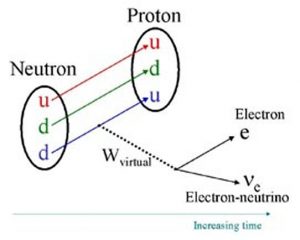
So that’s what attending a scientific seminar is like. Let’s get back to Professor Fomin and her measurements of the decay half life of a free Neutron. Ever since the Neutron was discovered by James Chadwick in 1932 scientists have know that a free Neutron, one that was not confined to the nucleus of an atom, would after some time decay into a Proton and an electron and it was some missing energy in this decay that led Wolfgang Pauli to predict the existence of the Neutrino (although in Neutron decay it’s actually an anti-Neutrino that gets produced). To understand the reaction take a look at the Feynman diagram below.

Free Neutron Decay

The Neutron and Proton are both composed of three quarks, two Ups and a Down for the Proton and two Downs and an Up for the Neutron. Now the decay of the Neutron takes place via the ‘Weak Nuclear Interaction’ and it’s half life was first measured after world war 2 to be something around 15 minutes. That doesn’t sound very scientific does it, well Neutrons are very hard to measure, they’re much smaller than an atom, they have to electric charge so it takes a lot effort to learn almost anything about them.

We have made progress since the 1940s, and Doctor Formin and her colleagues are a part of that progress. The best current estimate of the free Neutron half life is between 870 and 880 seconds and the hope is that with new instruments before long that range will be reduced to 0.3 seconds.

Why should we care? What difference does it make whether the Neutron’s half life is 874 or 875 seconds? Well, it does matter because the half life of the Neutron plays an important role in models of the early development of our Universe. Shortly after the Big Bang the universe was a foaming sea of elementary particles that quickly became atoms of hydrogen and helium along with a bit of lithium. Right now the biggest unknown in just how that process took place is the Neutron half life! Also, numerous theories uniting gravity to quantum mechanics, the so called ‘Theories of Everything’ make predictions about the half life of the Neutron and with a better measurement of the half life we can eliminate some of the wrong theories.

Physics began some four hundred years age with Galileo making measurements of falling objects. Measurement is central to what physics is and how it works. I look forward to hearing about Doctor Formin’s results when she gets her new instruments.

The Mysterious Tully Monster and other Fossil News

One of the most mysterious of all known fossils is an ancient animal known as the Tully monster. Named for it’s discoverer Francis Tully who first found the enigmatic creature in 1958 at the Mazon Creek fossil site in Illinois. The Mazon Creek site is world famous because it is one of the very few places on Earth where the remains of the soft parts of animals were well preserved.

Think about it, when you go to a museum to look at their dinosaur collection what you really see are the dinosaur bones, the hard parts of the animals. Whenever paleontologists find even a tiny fragment of the soft anatomy of an animal it is a rare and very valuable find.

The Tully Monster had no hard parts, and it is only known from the specimens of it that have been found at Mazon Creek. Worse, whatever relatives Tully may have had also had no hard parts because we have only guesses as to what kind of animal it is. Take a look at the picture below to see just how strange this ‘monster’ was.

The Tull Monster

The long pincer out front, we’re not quite sure if that’s where the mouth is, and the eyes on a bar across the back are certainly weird if not monstrous. What kind of animal Tully is has been debated for years.

Last year, a paper in the journal Nature by Victoria E. McCoy of Yale University and others announced that the Tully monster was a vertebrate, that it had a backbone along with a gill sack and liver and was distantly related to us. This week however another paper by Lauren Sallan of the University of Pennsylvania pushed back, declaring that the ‘gill sack’ and ‘liver’ were misinterpreted and that the eyes of Tully monster were ‘cup eyes’ similar to those possessed by a snail not a vertebrate. It seems we still have no idea just what Tully is. As it happens I live in Philadelphia and attended Drexel University across the street from the U. of P. so obviously I think Professor Sallan is right! In fact it looks as if the Tully Monster is going to remain a mystery for some time to come and isn’t that the way a monster should be!

I myself have a sizeable fossil collection and hope one day to do some collecting at Mazon Creek. If you’d like to learn more about the Tully Monster and the Mazon Creek fossils (there are a lot of other interesting creatures found there) I recommend ‘The Mazon Creek Fossil Fauna’ by Jack Wittry and available at amazon.

The Mazon Creek Fossil Fauna by Jack Wittry

Another fossil related bit of news also deals with the problems of identifying long extinct animals know only from a few specimens. In this case it’s the discovery of an ancient “bristle” worm which was not only very large but came equipped with a set of equally large snapping jaws. A member of the phyla annelid, segmented worms, this worm was approximately a meter in length with jaws about half a centimeter (So the jaws weren’t really that big but for animals of this kind they were huge). In a marine environment bristle worms often live in tubes which they have constructed out of sediment and a chemical they secrete. The fossil was found in rocks over 400 million years old and may have been an active predator, using its jaws to seize and chew its prey.

The history of life on this planet is both long and complex. With several million different kinds of creature alive today and many times that number that are now extinct there’s always new and fascinating discoveries to be made!


NASA at a Crossroads. On to Mars or back to the Moon.

Over the last four presidential administrations NASA’s long term goals for human spaceflight have been pulled back and forth so drastically it almost appears as if we’ve been going backward rather than forward. While Bush#1 wanted to go to Mars, Bill Clinton said let’s build the Space Station that Ronald Reagan called for (at least that actually got done). Then Bush#2 said let’s go back to the Moon while Obama only suggested going to a near Earth asteroid as a stepping stone to Mars.

Now we have a new administration, one who seems to have even less of a plan for space than the ones I’ve just mentioned, so I’m gonna give’em one.

Of course my heart says Mars. I was fourteen years old when Apollo 11 landed on the Moon and I can’t accept that we haven’t already gotten to Mars. I desperately hope that we will reach Mars during my lifetime so my heart says Mars!

My head says back to the Moon and here are my reasons why. Next year NASA will launch it’s first Space-Launch-System/Orion capsule mission and there is now talk of making that first mission a manned mission. Now the SLS launch vehicle is really just a modified version of the Ares V rocket that was conceived as a part of Bush#2’s ‘Constellation Program’ for going back to the Moon, and the Orion capsule isn’t even modified as far as I know. So, late next year we could very likely have two of the three major systems for a Moon landing. All we’d need is the lander and if NASA were given the direction and funding that could be accomplished in six years or so. The pictures below show the original Constellation Program ‘Parts’ and the, almost completed SLS-Orion for comparison.

NASA Constellation Program


Space Launch System

The resemblance is obvious. Again all we need to get back to the Moon is the Altair lander shown below or a similar lander.

Altair Lander

To go to Mars however, we would be starting from scratch. The idea of the Orion capsule taking anybody all the way to Mars is ludicrous. Not only doesn’t the combined SLS-Orion have the delta vee necessary for a Hohmann orbit  to Mars (that’s the lowest energy required transfer orbit), but there’s no way for three or four astronauts to be stuck inside the small Orion capsule for the more than a year long journey to Mars.

To go to Mars we need a Spaceship, a real one. Maybe not as fancy as the Hermes in the Martian or Discovery in 2001 but still an actual spaceship! And then when we get into Mars orbit we’re going to need a lander to get down to the surface, and even before we send that spaceship everybody always assumes that there will be supplies ‘pre-positioned’ on the surface of Mars awaiting the astronauts. None of this equipment is anywhere past the drawing board, there is absolutely no hardware existing or in the process of construction or even funded. Nothing.

I have a few more reasons for recommending the Moon. As I mentioned above, NASA is studying the concept of pre-positioning equipment and supplies before astronauts land on a planet or satellite. Well we could practice that technique on the Moon a lot more cheaply than trying it on Mars. Indeed, the Moon could be a practice range for landing a big rover, a habitat module, working out regular resupply missions and lot of the techniques needed for a Mars mission could be learned on the Moon.

It’s often been said that the Moon can serve as a stepping stone to Mars and since we’re almost equipped to do that let’s just do it.

The chaotic politics of the last 30 years has resulted in a complete lack of direct in NASA’s goals for human spaceflight. If the current administration were to authorize NASA to build a lander, and provide adequate funding, we could actually accomplish something in just a few years. We could at least get back to where we were when I was a teenager.

I’m not holding my breath!


Two New Continents discovered this Week. Where have they been Hiding?

Over the past week there have been two different news stories announcing the discovery of “Lost Continents”. Spoiler alert, neither is Atlantis and neither is in the Atlantic Ocean.

The first announcement comes from a team of geologists led by Lewis Ashwal of the University of Witwatersrand in Johannesburg South Africa. Professor Ashwal has named his lost continent Mauritia and it lies in the middle of the Indian Ocean. See the picture below.

The Lost Continent of Mauritia

Professor Ashwal bases his discovery on his analysis of Zircon crystals that he obtained on the volcanic Island of Mauritius, from which the continent gets it’s mane. Now the island itself is rather young, having been formed by volcanic activity approximately 8 million years ago. Despite the island’s geologic youth however, when Professor Ashwal measured the age of the zircons he had found there were many as old as 2 Billion Years Old. How could an 8 million year old island have 2 billion year old crystals on it?

First let me say a little bit about zircons or more formally zirconium silicate ZrSiO4. Now zirconium crystals always contain small amounts of the radioactive elements Uranium and Thorium. Once the zircon crystal is formed these unstable atoms begin to decay and by a measurement of the amount of the decay product, mainly Helium, in the crystal geologists can calculate the age of the crystal. Another key property is the hardness of the crystal which allows it to survive harsh environmental conditions like erosion and even metamorphism. Because of these properties, zircon crystals have become one of geology’s most useful tools.

Professor Ashwal also used the most recent studies of the seafloor in the area around Mauritius to outline the extent of his “Lost Continent. According to the professor, 200 million years ago Mauritia was a part of the Super Continent Gondwanaland, which also included South America, Africa, Australia, Antarctica and India. Breaking off about the same time as India some 60 Million years ago Mauritia is now mostly submerged. Only a few small islands remain of what was once a very large landmass.

The second, completely independent announcement of a “Lost Continent came only a few days after the story on Mauritia. This discovery is based upon work by Nick Mortimer a geologist with GNS Science in Dunedin New Zealand. In fact what Mr. Mortimer discovered is that what geologists thought was a single continent encompassing Australia and New Zealand was in fact two continents, Australia being one and New Zealand, with the islands going north up to New Caledonia, making up the “new” continent of Zealandia. The picture below shows how close these two continents are.

New Continent of Zealandia

As with Mauritia, most of Zealandia is presently submerged and also like Mauritia 200 million years ago Zealandia was a part of the super continent Gondwanaland. To me the interesting thing about Zealandia is that it is so close to the Australian continent. Could we be looking at the breakup of one continent into two? If that is so this new discovery could tell us a lot about the breakup of continents in general.

I can still remember back when the idea of “Continental Drift” was just a crazy idea and over the last fifty years we have learned so much about the dynamics of our planet. I don’t know if schoolchildren are going to have to learn the names of Mauritia and Zealandia along with the other seven continents but I do know that there is much more to be learned about our home planet and I look forward to telling you all about it.


Space News for February 2017

Several times now I’ve written a post concerning recent news items dealing with what’s going on in humanity’s exploration of space. I’ve usually titled them ‘This Week in Space’ but I haven’t been doing them every week so what I’m gonna do is make it an official MONTHLY thing.

You may have heard about the first item I’d like to cover. It concerns the ongoing medical examination of NASA astronaut Scott Kelly after his one year assignment to the International Space Station and the comparison to his twin brother astronaut Mark Kelly. Ever since his return to Earth last March Scott has been subjected to perhaps the most extensive set of physical, mental and genetic testing ever conducted on a person.

A similar set of tests are also being carried out on Mark, who flew four shuttle missions but is now retired and who remained here on Earth during Scott’s year long mission. The comparison between the two sets of tests will give scientists their best ever look into the long term effects of living in a zero ‘g’ environment.

While the results are still coming in and being analyzed, some interesting differences have been noted. Perhaps the most troubling for the future of human spaceflight is the detection of reduced bone growth in Scott during the second half of his mission. His loss of bone strength has been noted before in other astronauts but the comparison between Scott and Mark’s bone tissue gives scientists their best measurement of just how much of a difference living in space makes.

Shortly after Scott returned to Earth one group of researchers noted a slight reduction in cognitive ability, the ability to think quickly and clearly. The scientists noted that the change was insignificant and should not effect a journey to Mars or another long duration mission.

Meanwhile genetic testing of the twin astronauts revealed that hundreds of genetic mutations had developed in their respective RNA sequences. The question is whether the increased number of mutations is due to different genes being activated in a space environment, a ‘Space Gene’ NASA officials called it, or are the differences due to the increased amount of radiation Scott received during his year in space.

NASA’s twin study of Scott and Mark Kelly is ongoing and we’re certain to learn more about the effects of weightlessness on the human body. I’m hoping that in another 10-15 years there will be another study of the medical effects of a low, that is lunar, gravity environment.

Another bit of NASA news concerns the initial design study for a possible lander probe mission to Jupiter’s moon Europa. As I sure you know, astronomers are rather certain that beneath Europa’s icy surface is an ocean of liquid water and liquid water means a good chance for life.

NASA is already in the process of developing an Europa flyby spacecraft that is intended to orbit Jupiter in such a fashion that it swings by Europa 45 or more times. Well an Europa lander would then be the next step logical in our search for life on that icy world. Below is an artists idea of what the Europa lander could look like.

Conceptual Drawing of Europa Lander

And if you’d like to read more about the Europa lander from Space.com click on the link below.

http://www.space.com/35655-nasa-lander-jupiter-moon-europa.html

Finally a bit of fun. Astronaut Andreas Mogensen of the European Space Agency (ESA) recently spent six months on the International Space Station (ISS) studying Red Sprites and Blue Jets. These phenomenon are basically forms of lightning produced in thunderstorms that go up into space rather than down to the Earth. Doctor Mogensen has produced a little video describing and showing some of his results and rather than trying to explain further I think I’ll just insert a link to the YOUTUBE video and let him talk. Enjoy!

https://www.youtube.com/watch?v=r50Un4LPTM4&t=70s

I hope that works!

The Robots are Coming, for Your Job. Pt2

Back on 2Sept16, when I was just starting this blog one of my first posts concerned the growing issue of automation eliminating many of the jobs that people depend on for their livelihood. Over the past two weeks I have come across several articles that I believe amplify the issue so this post will be part two of what may well become an occasional series.

The first story comes from the technical magazine IEEE Spectrum. For those who aren’t familiar with the Institute for Electricians and Electrical Engineers the IEEE is the world’s largest technical organization with over a hundred sub societies (I belong to two) and thousands of chapters around the world. The magazine Spectrum is the spokesman for the entire IEEE and as such covers a wide variety of topics related to technology.

The article that caught my attention dealt with the coming development of “Sailorless Ships”, just like driverless cars only much bigger! The same technology will be applied in a whole new way. The author of the article, Oskar Levander, is an engineer with Rolls Royce corp. who is working on the development of these vessels. Again one of the main advantages of the sailorless ship will be cost reduction gained by the elimination of human beings, the jobs of merchant seamen! Mr. Levander believes that in five years time the first such vessels will take to sea and the biggest problem he sees at present is simply the new laws and insurance regulations required to permit these vessels on the ocean.

If this sounds a lot like the current situation in driverless car technology you are absolutely right. At the recent Philadelphia Car Show an industry spokesmen, sorry I didn’t catch the name, stated his opinion that within five years the first commercially available driverless cars will become available for purchase. As with ships,the real problems now are legal and insurance. If you’d like to read the IEEE article on sailorless ships click on the link below.

http://spectrum.ieee.org/transportation/marine/forget-autonomous-cars-autonomous-ships-are-almost-here

The second story that caught my attention comes from the exhibit at the London Science Museum, 500 Years of Robots. BBC news covered the opening of the exhibit and included an interview with Michael Osborne a Professor at Oxford University. During the interview Professor Osborne stated that in his opinion 35% of the jobs in the UK would be taken over by robots and automation by 2030, that’s just 13 years from now!

The jobs that will be eliminated not only include taxi drivers and truck drivers but process handlers, ticket takers and order takers, a wide variety of jobs. And remember, these jobs are not going to Mexico or China they will simply disappear. At the present time McDonald’s has 500 restaurants where the customer orders their meal via a touchscreen without having to even talk to a person. If you’d like to read about the Robot exhibit at the London Science Museum click on the link below.

https://www.cnet.com/news/robots-london-science-museum-exhibition/

One more little example. On the recent PBS series ‘City in the Sky’ the baggage handling system in Dubai was described as the world’s largest and fully automated. The system consists of 48 miles of conveyor belts transferring up to 20,000 pieces of luggage at a time. Each piece of luggage is kept track of by a computerized RFID system with not a single human being in sight as luggage travels from check-in to the correct plane. There is a control room with about a dozen technicians monitoring the performance of the system but no such thing as a baggage handler.

Now I don’t want anybody to think I’m anti-technology, far from it. I’m well aware of how technology creates more jobs than it eliminates but the problem is that the people who get the new jobs are rarely the same people who lost the old ones! Just as at Dubai airport the low skilled jobs are being replaced by high skilled jobs without any thought of what happens to the low skilled worker.

This is a social problem rather than a technical one and the scary part is that right now our government is in the grip of people who are bound and determined not to solve any social problems. The best example I can give of the attitude growing in Washington is to quote the current nominee for Secretary of the Department of Labor. Speaking about the benefits of automated systems replacing human employees Andy Puzder (The CEO of Carl’s Jr. and Hardees Fast food chains) has stated. “They’re always polite. They never upsell, they never take a vacation, they never show up late. There’s never a slip and fall, sex or age discrimination case.” Our future Secretary of Labor obviously isn’t going to be overly concerned with the people who lose their jobs due to automation.

So, what happens to the 45-50 year old truck driver whose 18 wheel big rig is soon going to be operated by a couple thousand dollars worth of transistors. Well of course, he goes back to school to train for a new job in computer maintenance. Yea, right.

I know, I’ve drifted off into politics here and I apologize but this is the real problem facing not only this country but every country in the developed world. Not terrorism or illegal immigration or international trade agreements. And our elected officials along with the news media are simply ignoring it. During the last election Bernie Sanders was the only candidate who talked about it much but hardly anyone was listening. He did manage to force Hillary Clinton to address the issue a few times but again, no one paid any attention. And as far as the eventual winner is concerned, since you can’t bully, insult or cajole a microprocessor Donald won’t understand what’s happening even when it hits him right in the face.

Again, I’d rather be blogging about much more interesting topics but I see us driving straight into a brick wall and I feel I have to at least yell!

New Evidence that the Earth’s Magnetic Field is Flipping

We all know that our Earth has a magnetic field. That’s why compasses work and we know that the field also helps to protect us from radiation coming from outer space. However only a few people are aware of the fact that the Earth’s north and south magnetic poles have flipped many times in the past, and appear to be getting ready to flip again.

By the way, did you know that since a compass’s north pole points north and with magnets opposites attract, then there must be a south magnetic pole up at the actual North Pole! I’ll say that again ’cause I know how strange it sounds. Up at the Earth’s actual North Pole there is a south magnetic pole, that’s why a compass points north. The reverse is also true, at the actual South Pole there is a north magnetic pole.

By measuring the slight magnetic field frozen into igneous rocks as they solidify geologists have been able to determine that the magnetic poles switch positions every couple of hundred thousand years. (Note: The real North and South poles, the axis around which the Earth rotates, are not changing, it’s only the magnetic poles that flip.) The last time the magnetic poles flipped was 720,000 years ago so we are overdue! The picture below is based on current theories on how such a reversal will take place.

Reversal of the Earth’s Magnetic Poles

Also, we know that the Earth’s field is weakening right now. Over the past 150 years, as long as we’ve been measuring it, the Earth’s field has weakened dramatically. And then there’s the South Atlantic Anomaly, a vast region stretching from South Africa to South America where the magnetic field has virtually disappeared and a new magnetic pole looks like it’s starting to pop out! Check out the actual measurements of the Earth’s magnetic field strength in the picture below.

Now a new study of the South Atlantic Anomaly has succeeded in measuring the decline in the field strength over the past 2000 years. Geophysicist John A. Tarduno of the University of Rochester along with Michael K. Watkeys of the University of KwaZulu-Natal have been able to use the archeological remains of iron age huts in the Limpopo River Valley as archeomagnetic samples.

You see, the iron age people living along the Limpopo River had the ritual of burning down their huts during times of drought as a way of ‘cleansing’ them. The heat of the fires caused the magnetic particles in the clay to lose whatever original magnetic orientation they had and then, as the clay cooled the magnetic particles would align themselves to the Earth’s magnetic field at that place and time! This left a record of the changes to the Earth’s magnetic field in South Africa that Professor Tarduno and his colleagues have been able to read. What they have found is that the magnetic field in the past has had periods of rapid decline followed by a slow return. Further evidence that the Earth’s magnetic field is entering a period of flux and perhaps a total collapse leading to a flip. If you’d like to read more about Professor Tarduno’s work click on the link below.

http://theconversation.com/does-an-anomaly-in-the-earths-magnetic-field-portend-a-coming-pole-reversal-47528

So how does all of this effect me, I hear you ask? Won’t I be able to use a compass the next time I go camping? Well there’s a bit more to it than that. The Earth’s magnetic field shields us from the solar wind and the radiation associated with it. As the Earth’s magnetic field weakens we can expect cancer rates, especially skin cancer to greatly increase. The solar wind can also effect both the power grid and the lifespan of satellites in orbit above the Earth. The flipping of the Earth’s magnetic field may take a couple of hundred years to complete and during that time we shall have to learn to live without its protection.