Advanced new design of Photoelectric Cell converts 85% of Sunlight into Electricity.

We’re all familiar with Photoelectric or Solar Cells, those shiny black squares or rectangles that produce electricity whenever light falls on them. Many portable electronic devices such as radios, calculators and even traffic signals get their power from solar cells while if you cover the roof of a home or building with them they can provide most of the power that building uses. And let’s not forget all of the satellites in outer space that are powered by solar arrays, not to mention the International Space Station itself.

This Home must have a low Electric Bill with all of those Solar Cells on the Roof (Credit: New Atlas)
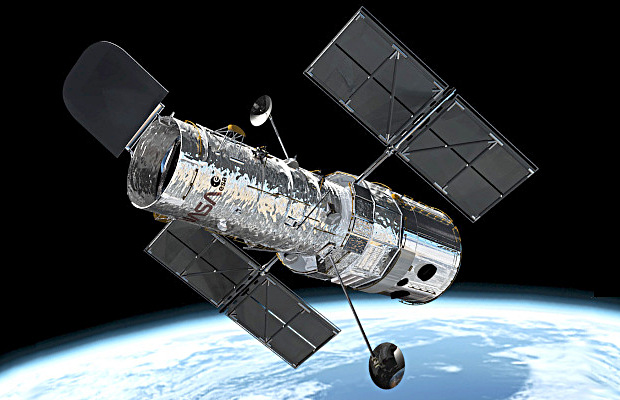
Solar Cells Power the Hubble Space Telescope (Credit: Astronomy Now)

The history of photoelectricity actually goes back to some of the earliest experiments with electricity. In 1873 Willoughby Smith described ‘The Effect of light on Selenium during the Passage of an Electric Current’ while in 1883 Charles Fritts built a solid-state photovoltaic cell by coating the semiconductor selenium with gold to act as the + terminals.

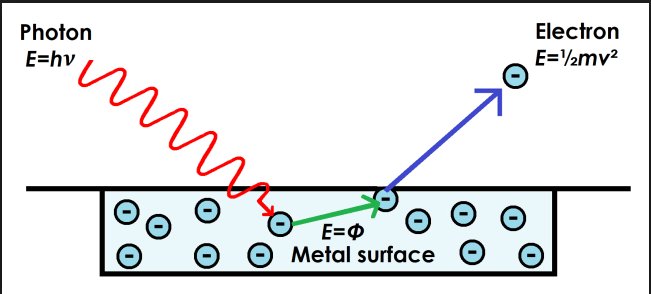
It was Albert Einstein who figured out what was going on. Light, Einstein realized, was made up of subatomic particles and like all particles they had some momentum to them. This momentum could knock electrons away from their atoms and start them moving in an electric current. This is the theory for which he actually won his Nobel Prize.

The Photoelectric Effect (Credit: Pinterest)

Starting around the 1960s people began to realize that the world’s oil supply wasn’t going to last forever and besides burning oil was causing all kinds of pollution that were damaging the Earth. Wouldn’t it be a good idea to get our power directly from sunlight by means of photoelectric cells?

Problem, or rather a trio of problems quickly became apparent. The first is that, while the power in all of the sunlight falling on Earth is tremendous it’s also rather spread out so you have to cover a large area with solar cells to get appreciable amounts of power. The second problem compounds the first because solar cells aren’t very efficient. Only 10-15% of the energy of the light was converted into electricity, meaning you needed to cover an even bigger area to get the power you needed. Finally the third problem was simply price, in the 1960s photoelectric cells were very expensive to manufacture, mainly because no one had ever tried to produce them in large quantities.

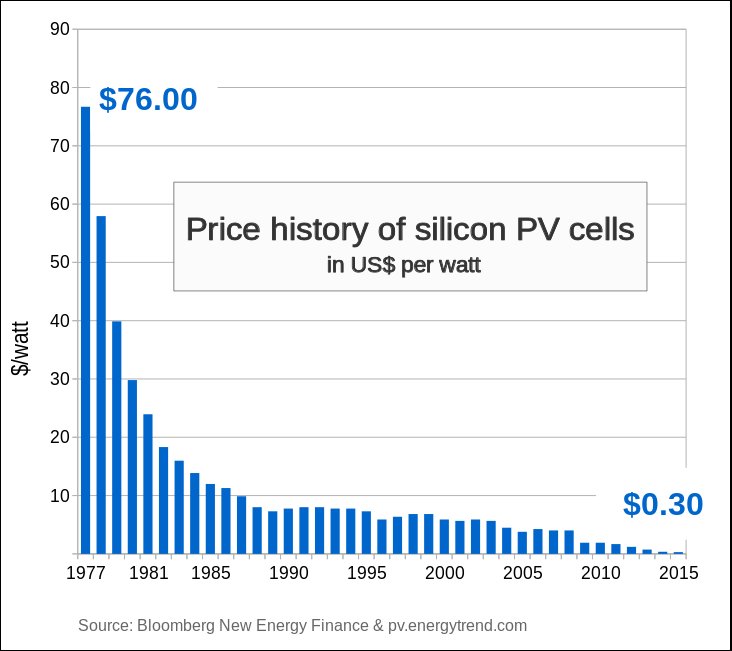
It was the third problem that was solved first. Looking at the chart below you can see how the price of solar cells, per watt of power produced had dropped from $76 dollars in 1977 to about $3 dollars in 2010. Much of this reduction in price came about from improvements in the semi-conductor industry in general. You may not know it but solar cells are manufactured with much the same equipment and in much the same way as the silicon chips running your computer as you read this! So the reductions in the price of integrated circuits over the last 40 years has helped to reduce the price of solar cells at the same time.

The Price of Solar Cells
in Dollars per Watt of Output Power (Credit: Wikipedia)

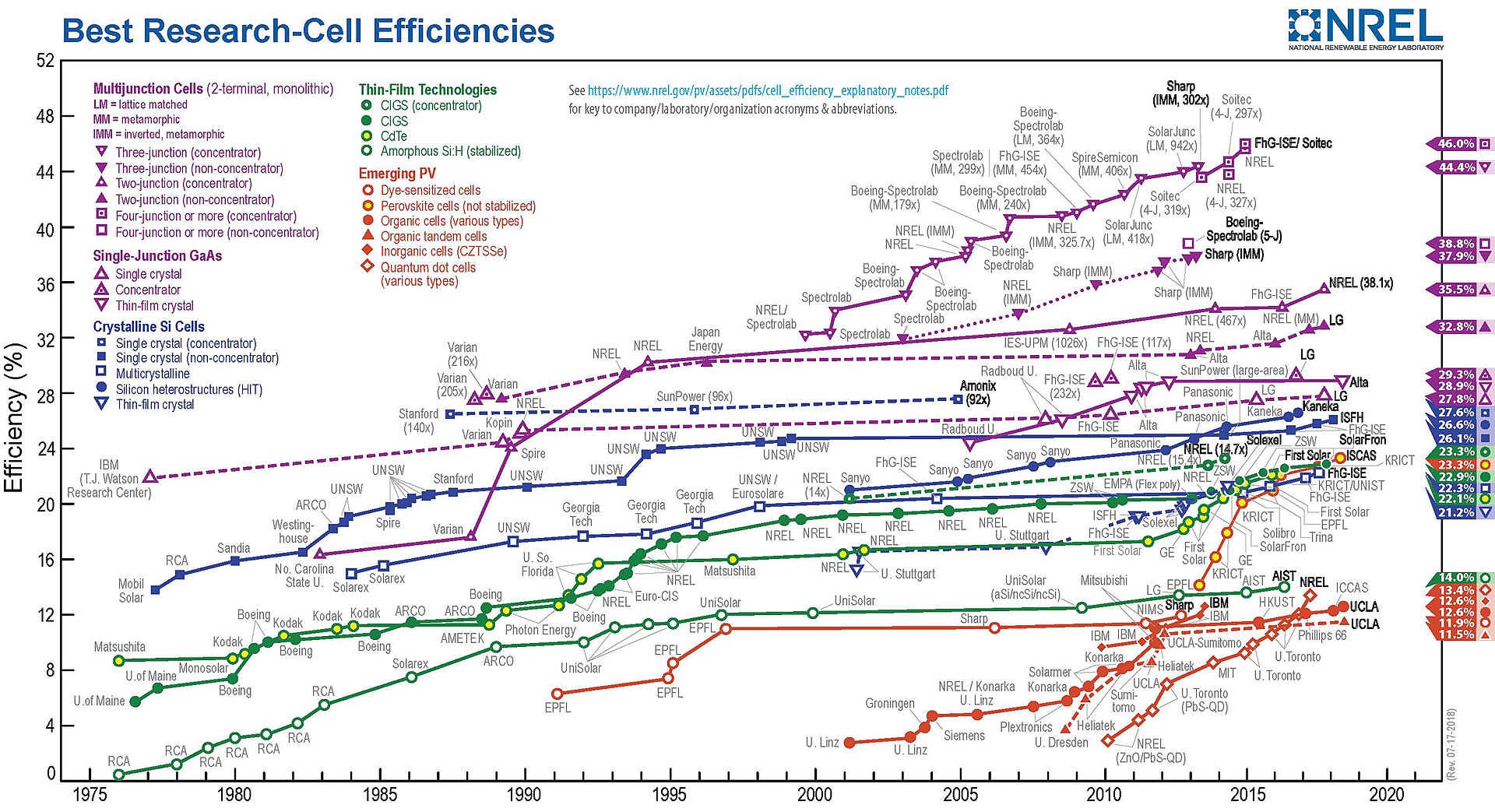
There has also been considerable improvement in efficiency over the last 45 years. Starting with efficiencies below 10% in 1975 new materials and new construction techniques have enabled researchers to make steady, incremental increases in efficiency until now efficiencies close to 50% are possible. The chart below, which details this progress is complicated but worth trying to understand.

The Improvements in Solar Cell Efficiency (Credit: Wikipedia)

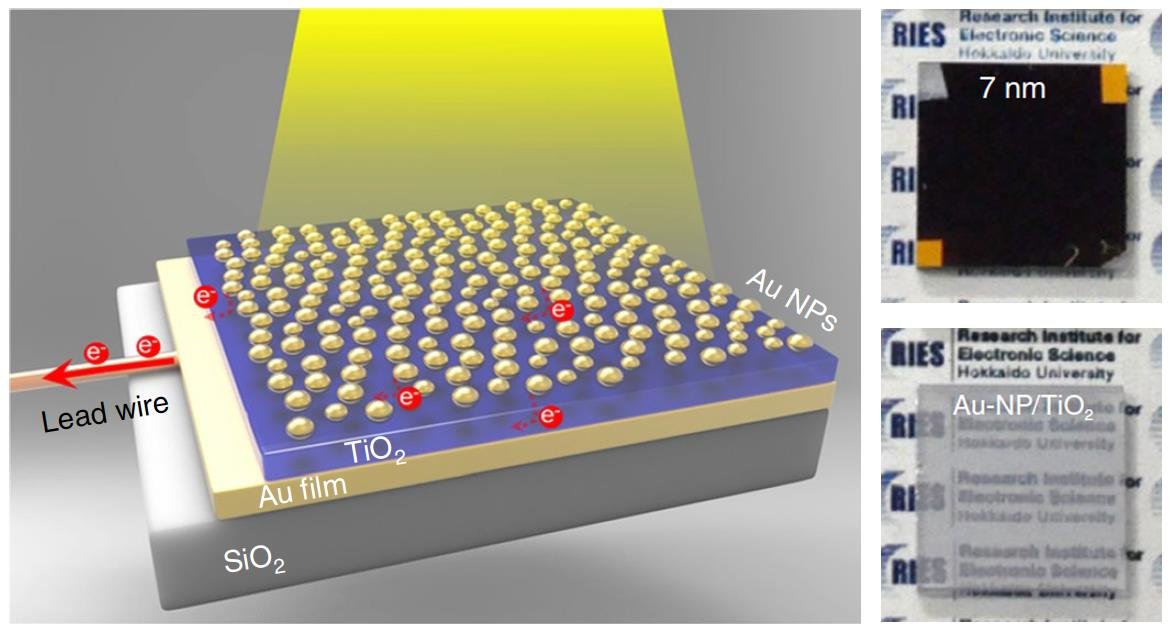
Some new developments may improve the situation even more because a group of materials scientists have announced the development of a solar cell that converts 85% of the light that falls on it into electricity. The team is led by Professor Hiroaki Misawa of the Research Institute for Electronic Science at Hokkaido University and has produced a solar cell that consists of a sandwich of materials 30 nanometers thick. See diagram below.

The 85% Efficient Photoelectrode (Credit: Hiroaki Misawa)

Starting with a substrate of Silicon Dioxide (SiO2) on which is placed a layer of gold film. Next comes a layer of the semiconductor Titanium Dioxide (TiO2) and finally a smattering of gold nano-particles are placed on top. What happens is that light passes through the smattering of gold nano-particles; the TiO2 absorbs some while the full layer of gold reflects the rest back into the TiO2 which absorbs some more! The light continues to bounce back and forth with some more getting absorbed in each reflection.

The question right now is, can these new solar cells be produced cheaply enough, in large enough quantities. Maybe, or maybe other scientists will discover other arrangements of materials that produce the same efficiency. In either case we are getting closer to the goal of directly using the power of the Sun to produce the electricity our civilization becomes more dependent on every day.


Two Stories from the World of Physics.

Back on August the 17th of last year, 2017, the LIGO and Virgo gravity wave observatories not only succeeded in detecting an enormously powerful astronomical event but for the first time they were able to locate the position of the event in Earth’s sky so that other instruments, optical and radio telescopes could observe it as well. I talked about this combination of observations in my post of 22 October 2017 entitled “The Gravity Waves of 17Aug17 become the most Thoroughly Studied Astronomical Event Ever!”

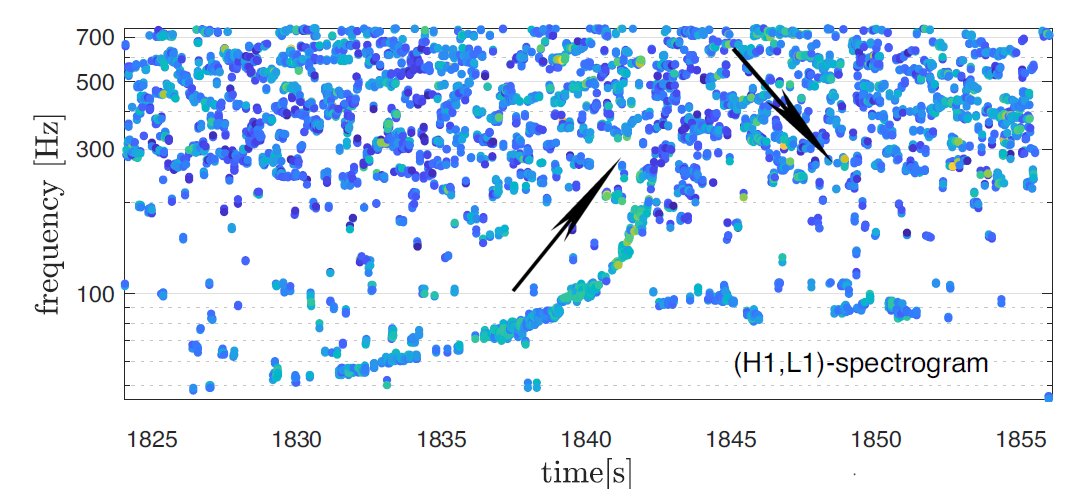
Since then astronomers and astrophysicists have had a year to try and make sense of their observations and a new paper by Maurice van Putten of Sejong University in South Korea and Massimo Della Valle of Inst. Astrofisica de Andalucia in Grenada Spain has provided an almost milli-second by milli-second account of what happened. The event, which had been given the designation GW170817 (for Gravity Wave of 17 August 2017) was first detected by the gravity wave observatories as a powerful ‘chirp’ of ascending frequency as shown in the graph below.

Plot of the Measured Gravity Waves of GW170817 (Credit: Putten and Valle)

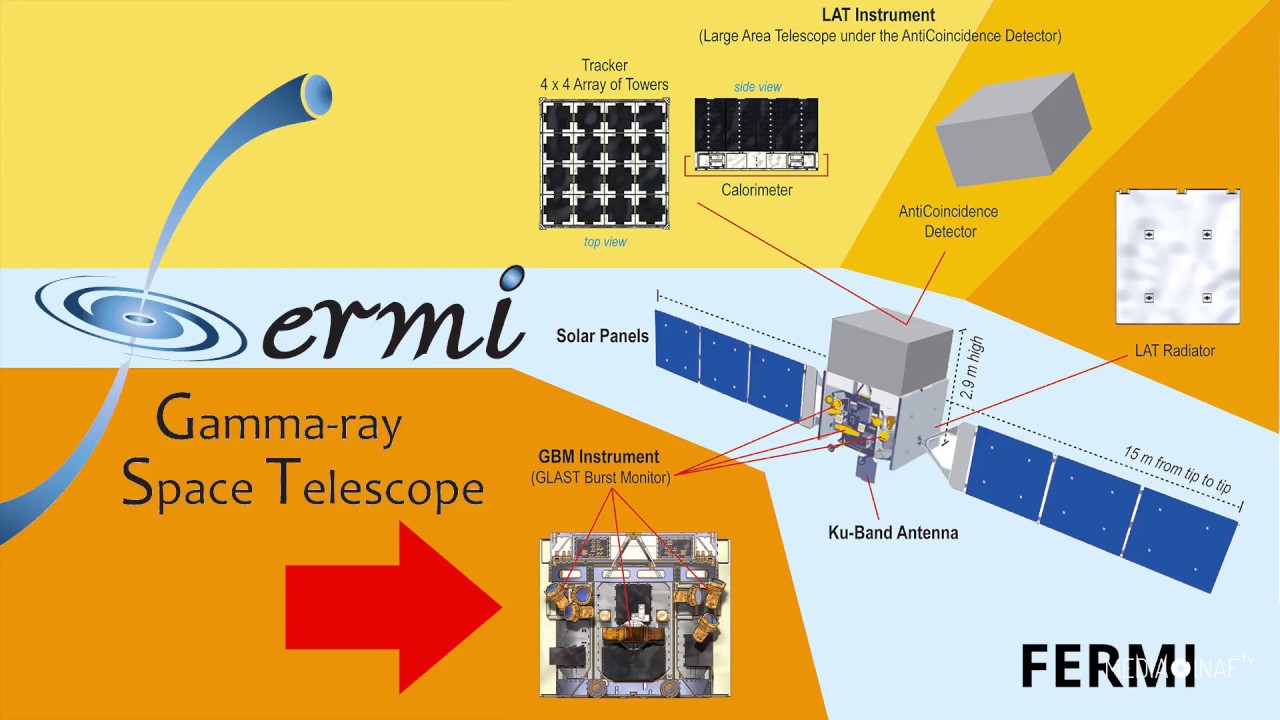
Later examination of the data found the ascending note, beneath and to the right of the upward pointing arrow, was immediately followed by a softer descending note, beneath and to the left of the downward pointing arrow. Then, just 1.7 seconds after the peak of the gravity wave the Fermi-Gamma Ray Burst satellite detected a sudden spike in gamma particles, see graph below.

The Gamma Ray Burst Detected by the Fermi Satellite (Credit: Putten and Valle)
The Fermi Gamma Ray Space Telescope (Credit: Youtube)

By their detailed analysis of the data Doctors van Putter and Valle have concluded that GW170817 was the merger of two massive neutron stars that did not form a black hole as was originally thought. The descending note is the clincher for this, after all if nothing can escape a black hole then how did that descending frequency gravity wave pattern get out? Astronomers believe that the now combined neutron star could still collapse further and become a black hole. In that case LIGO and Virgo may detect further gravity waves coming from there.

Perhaps the best part of the event of 17Aug17 is that since this is the first time we’ve been able to combine the data from many different observations that means we’re probably going to get better with practice. No one knows what we’ll learn from future events but I know that I can’t wait to find out!


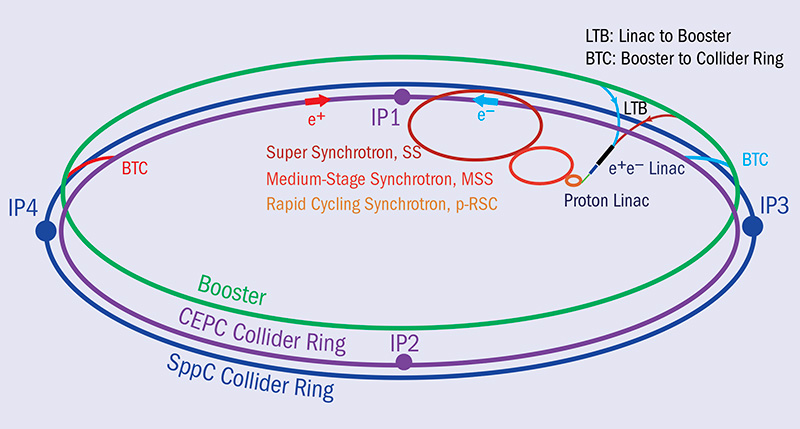
Our second story involves the initial plans for a next generation ‘Atom Smasher’ that will be four times the size, and more than four times as powerful as the Large Hadron Collider (LHC) at CERN, and we may actually get two of them. It was several weeks ago that the scientists at CERN submitted their initial proposal to the European Union for a 100 km in circumference ‘Future Circular Collider’ to replace the LHC. Just this week however, the Chinese government has announced its plans to build an identically sized particle accelerator in their country.

In recent years China has been spending a lot of money on scientific research but this is the first attempt by the People’s Republic to take the lead in high-energy physics. Unlike the collider at CERN, which smashes protons into protons traveling in the opposite direction, the Chinese propose a Circular Electron Positron Collider (CEPC) in which electrons will smash into anti-electrons. Both of the proposed accelerators would produce Higgs particles by the millions allowing a much more precise measurement of their properties.

Proposed Layout of China’s CEPC (Credit: CERN)

There are implications to the Chinese collider beyond physics however. The international physics community has for years been concerned about China’s human rights record including the way thousands of ordinary Chinese citizens have been forced out of their homes in order to make room for large scale project like the CEPC. There has also been concern about recent political developments in China such as Chinese President Xi Jinping’s removal of term limits, which will allow him to remain in power indefinitely. So the question is: How far should the International Scientific community go in cooperating with the People’s Republic?

China’s President Xi Jinping has extended his country’s power and influence but at the cost of Human Rights (Credit: PD)

That’s a question that’s going to be a lot harder to answer than most physics problems!

TV Show Review: Mars, Season 2 on the National Geographic Channel.

Last night, 12 November 2018, the second season of the series ‘Mars’ premiered on the National Geographic Channel. Produced by the Academy Award winning team of Ron Howard and Brian Grazer ‘Mars’ is a combination fictional story of the initial colonization of Mars interspersed with comments by real life experts, it is a docudrama in the terminology of Hollywood.

Mars Season Two on the National Geographic Channel (Credit: National Geographic)

The experts range from scientists such as Astrophysicist Neil deGrasse Tyson to space age industrialists like Elon Musk to science fiction writers like Kim Stanley Robinson. The comments from these experts serve to illustrate aspects of the story, in other words provide a little technical background to the action in the story.

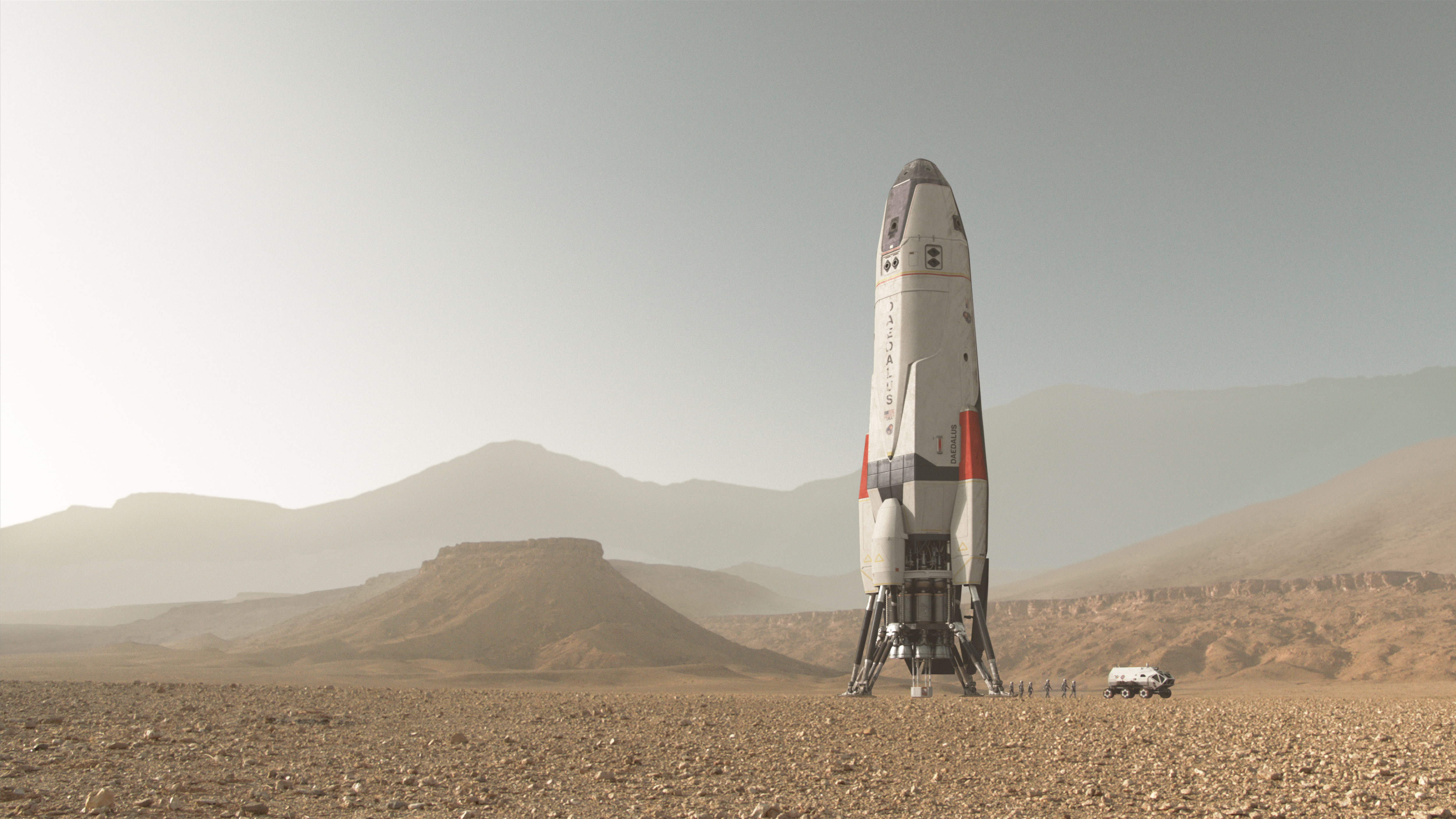
In season one of Mars (See my posts of 15 Nov 2016 and 20 Dec 2016) the crew of the spaceship Daedalus succeed in making mankind’s first landing on the planet, although not without the loss of the spaceship’s commander. The voyage and first attempt at colonization is funded and supported by the ‘International Mars Science Foundation’ or IMSF. Despite several setbacks the crew of the Daedalus establish a base and other colonists join them on the red planet. A disaster that kills several of the astronauts almost causes the end of the mission but the discovery of life on Mars convinces the IMSF leadership to keep the colony going.

The Daedalus Spacecraft from Season One of ‘Mars’ (Credit: GeekWire)

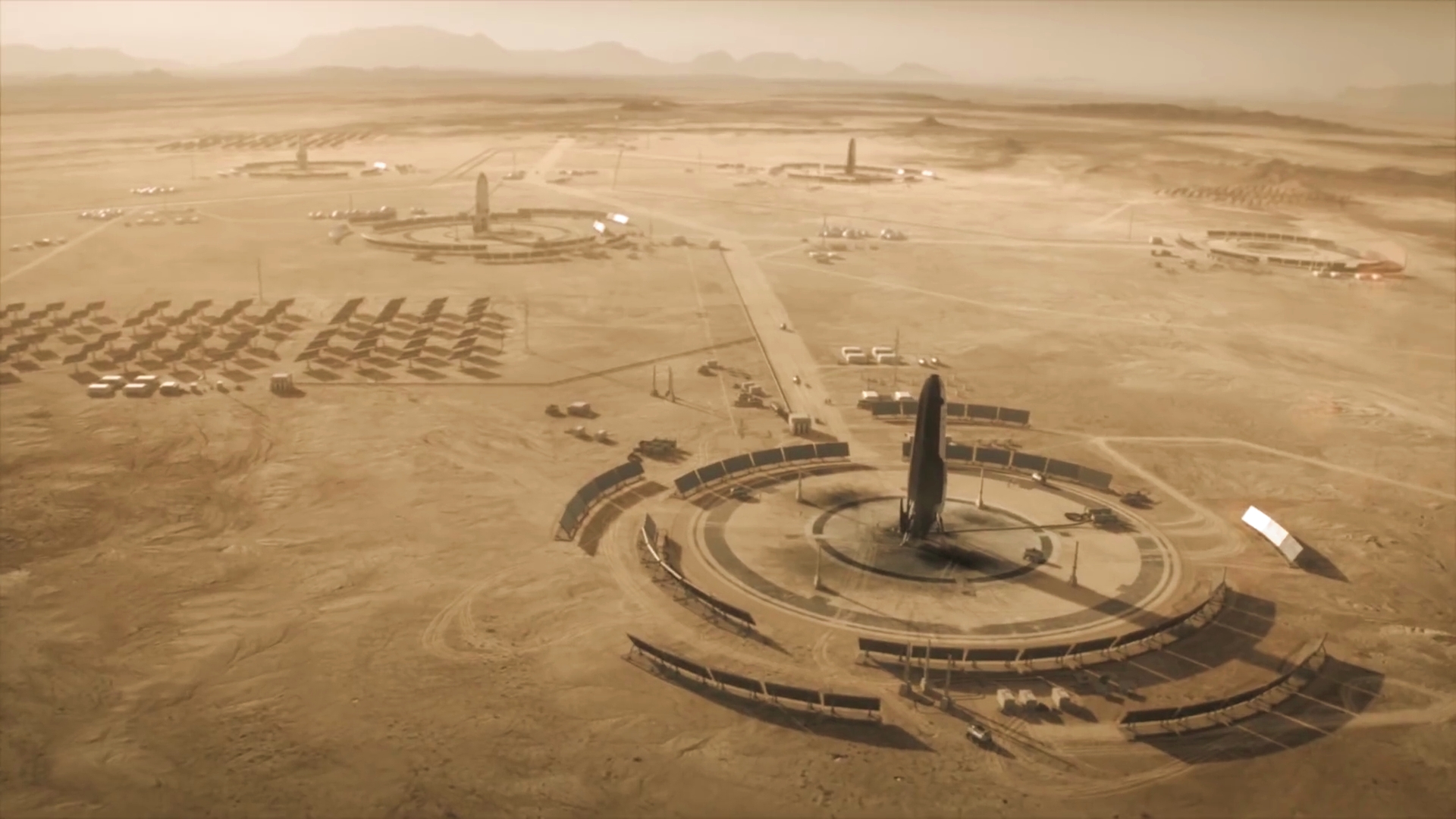
Season two begins five years later, when the base / colony, now named Olympus Town has grown in size to a population of over two hundred. In the opening an entirely new group of colonists arrive seemingly without warning. The new colonists are not scientists or explorers like the astronauts sent by the IMSF. Instead they are mining engineers and workers sent by a private corporation called Lukrum. The two groups get off to a rocky start even before the Lukrum spaceship lands as debris from its heat shield nearly lands on Olympus town.

Olympus Town’s Spaceport (Credit: National Geographic)

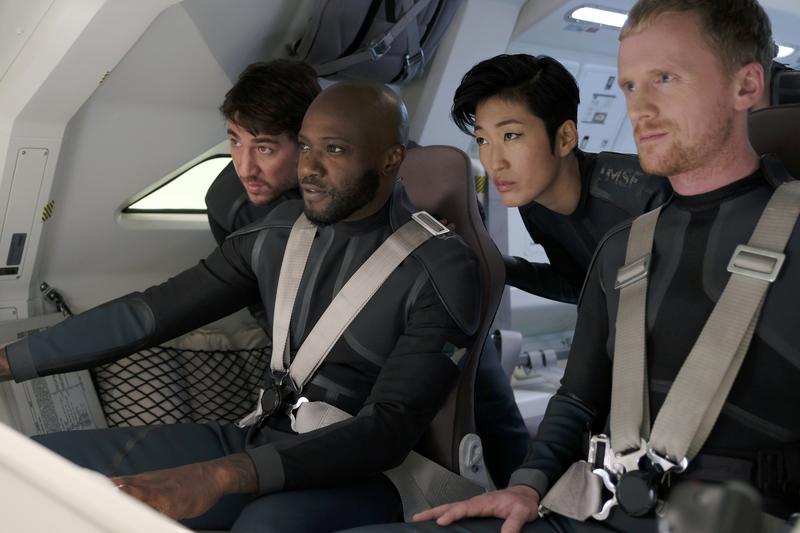
Things quickly escalate when the manager of the mining group, Kurt Hurrelle played by actor Jeff Hephner, informs the commander of Olympus Town, Hana Seung played by actress Jihea, that since his mission did not include the equipment needed to produce water and electrical power her people are going to have to provide these supplies to his people. The big wigs back on Earth eventually work out a compromise where the Lukrum team will provide Olympus Town with the minerals it needs for its terraforming mission in exchange for water and power. Nevertheless it’s pretty obvious that conflicts between the scientists and miners are going to be a major theme in this second season.

Olympus Town Commander Hana Seung (second from right) Goes to meet the new Neighbors. (Credit: National Geographic)

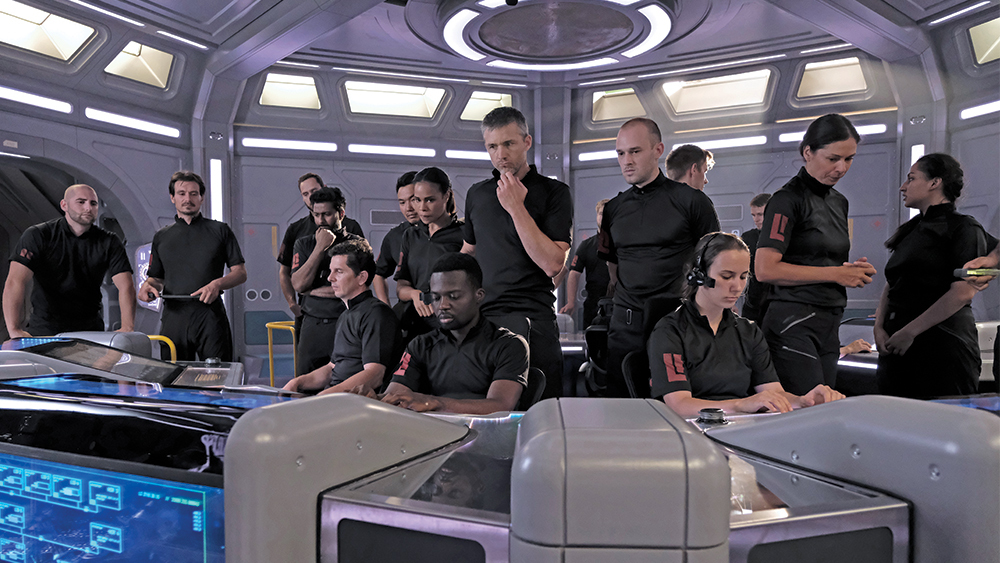
To be honest ‘Mars’ really isn’t a great science fiction story. That’s because the need to tie the drama to each of the difficulties in colonizing Mars, as explained by the panel of experts, makes each episode little more than a moral lesson. (The Grasshopper and the Ant anyone!) In particular, in the first episode the private enterprise astronauts are such jerks that their helmets ought to be painted black like the hats of the bad guys in an old western.

The Lukrum Team led by Kurt Hurrelle  (The one in the center scratching his chin)(Credit: National Geographic)

Still, ‘Mars’ is thoughtful science fiction and in a world of super heroes and Jedi knights that’s a rare treat. So I’ll keep watching ‘Mars’, and I’ll keep hoping that mature, thought provoking science fiction will become a more common phenomenon in our culture.

Back From the Field Night at The Academy of Natural Sciences.

Last night, 8November2018, I was privileged as a member of the Academy of Natural Sciences here in Philadelphia to attend their annual ‘Back From the Field’ night where the Academy’s scientists present an overview of their research accomplishments during the past year. The whole affair is informal however with scientists and members mingling together while discussing the scientific results. (See my post of 4February2017 for more about the Academy)

Logo of the Academy of Natural Sciences in Philadelphia (Credit: ANSP)

Since the Academy resides here in Philadelphia it’s not surprising that many of its scientists concentrate their work in an around the Delaware River valley, studying the health of our local environment and all of the species of life that call it home. At least an equal number however are world travelers, visiting lands as diverse as Cuba, the Philippines, Mongolia and even Antarctica.

The gathering was held in the Academy’s hall of dinosaurs which displays, along with other dino specimens, the bones of Hadrosaurus foulkii, the first dinosaur skeleton discovered in the western hemisphere. While many of the specimens on display last night were even older than the dinosaurs just as many were of species living today.

The First Dinosaur Skeleton Discovered in the USA, Hadrosaurus foulkii at the Academy (Credit: ANSP)

Doctor Dane Ward of Drexel University’s Department of Biodiversity even brought a special treat with him. You see Dr. Ward spent several months over the summer studying a species of small, sting less honeybee found only in Cuba. According to Dr. Ward the honey produced by this Cuban bee is far superior to that of the common European honeybee.

Dr. Ward gave a sample of this honey to the bartender so that he could make a mixed drink unknown out side of Cuba called the Canchanchara. Needless to say I had to give the canchanchara a try and it certainly was quite tasty.

Made with Honey from Cuban Bees the Canchanchara is quite tasty (Credit: Cubatrotter)

The amount of scientific research being carried out by these scientists was too large for me to give more than a brief mention here. There was a team of ichthyologists, scientists who study fish, who are using aerial drones to obtain a census of sea lamprey nests along the banks of the Delaware River. Then there was the team of entomologists; they study insects, who had discovered several new species of grasshopper.

The Sea Lamprey is an ancient, jawless fish that comes into Rivers to Spawn (credit: Holyoke Gas & Electric)

Still another team was studying snails in the Philippines. This research could prove to be very import because remember the Philippines are hundreds of islands. The distribution of snails across all of these islands is very complex with some species of snail inhabiting only a single island while another species can be spread across a dozen or more. The work of trying to work out that puzzle may tell us a great deal about exactly how the forces of evolution split single populations into separate species.

As you can see there was plenty of worth while science to sample but I don’t think that I’ll be surprising any of my regular readers if I tell you that I spent most of my time talking to the paleontologists. Both Doctors Ted Daeschler of Drexel University and Jason Downs of Delaware Valley University are doing their research on fishes of the Devonian. Dr. Downs has been searching for specimens in the cold northern reaches of Canada and has discovered two new species of ancient fish.

Bothriolepis rex is a new species of Ancient Fish discovered by Dr. Downs (Credit: Wikipedia)

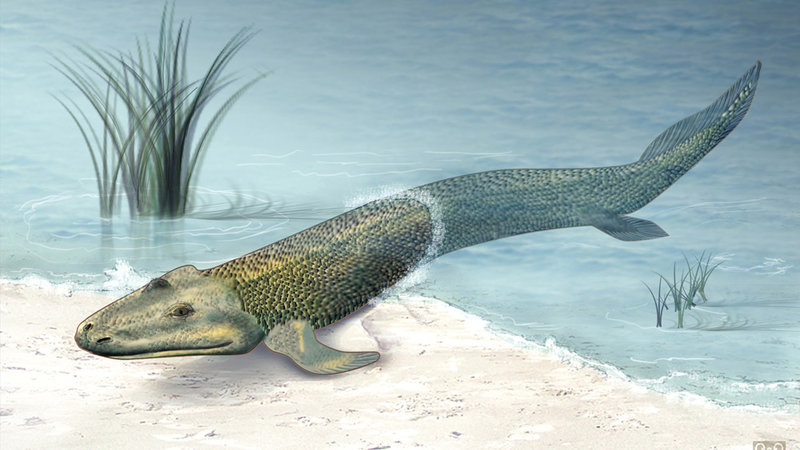
Funny thing is though, that area in Canada was originally surveyed for fossils by a team that was co-lead by Dr. Daeschler, in fact it’s the same area where Dr. Daeschler discovered Tiktaalik, a ‘missing link’ between fish and land vertebrates. Dr. Daeschler may no longer be working in Canada but he must like cold weather because in three weeks time he’s headed for the Antarctic to conduct a more thorough survey of some Devonian outcrops he discovered just last year.

Tiktaalik, the ‘Missing Link’ between Fish and Land Vertebrates (Credit: NPR)

I hope that the things I’ve been discussing have served to whet your appetite for learning more about science. I know that here in Philadelphia I have access to a large number of different centers of science but every large city has its own science museums. O’k so maybe you don’t live in a large city, well many national wildlife refuges or state parks will have a nature center and the people who are working there to help save many threatened species would love to tell you all about it.

Learning about science, about how science is done and who are the people doing it is important for anyone who wants to be an informed citizen but more than that it just fun. That’s right, as far as I’m concerned learning about something new is just about the best time a person can have. What don’t you give it a try?  I leave you today with a link to the Academy of Natural Sciences in Philadelphia, take at look at what they have to offer!

https://www.ansp.org/

The Healing Power of Plants or can You Grow Medicine in your Garden.

Medicinal herbs, home remedies and grandmothers making their special tea, there have always been people trying to use plants to treat diseases. Now it is true that some of our most valuable medicines were first found in plants, just as it is true that some of our most dangerous drugs come from plants. Humans have been experimenting with plants for at least tens of thousands of years and we are actually studying them more today than ever in our history.

Today I’m going to talk about just a few of the plants that have, for good or ill given us some of the medicines and drugs we are most familiar with. I’ll start with one of the best-known painkillers, one that nearly all of us have in our medicine cabinet.

Have you ever seen someone chewing on the bark of a willow tree? That may sound strange to us today but there are historical records of people doing just that going all the way back to Mesopotamia, and the Greek physician Hippocrates discussed the ability of willow back to relieve pain in the fifth century BCE. The secret is in the sap of the willow, which contains salicylic acid, the precursor to common aspirin. In addition to its most common usage as a painkiller aspirin has also been helpful as a blood thinner for patients with either arthritis or heart disease. Aspirin however can cause upset stomachs and internal bleeding in some people.

The Bark of the Willow has been used for millennia for its Medicinal Value (Credit: YouTube)

Ginger is another plant with medicinal use. For centuries people have taken it to relieve the symptoms of nausea and motion sickness. Recent studies have indicated that ginger may even be effective in fighting the nausea caused by pregnancy and chemotherapy.

Ginger Root if known for settling an upset stomach! (Credit: Woodland Essence)

The leaves of the plant Feverfew have often been used to treat high fevers and new studies have show that the plant is also useful in the treatment of migraines and arthritis. Just how effective is still a subject of debate however.

Feverfew is know for Relieving Headaches (Credit: Fair Dinkum Seeds)

Several other common plants have been said for centuries to possess medicinal value but modern research has either failed to either verify the claims or found the healing effect to be minimal. Garlic is one such plant, said by many to lower both blood pressure and cholesterol recent studies by the FDA indicate that the effect to be exaggerated.

Garlic may help to Lower Blood pressure and Cholesterol (Credit: Pulse)

The extracts of the Aloe Vera plant are used by many people for soothing burns and rashes as well as a cosmetic moisturizer. All scientific studies however show little or no actual improvement in skin condition.

The Sap of the Aloe Vera plant is considered by many to sooth Skin Irritation (Credit: Good Housekeeping)

Now of course there are also plants whose effects are so powerful that trying to grow them is illegal in most countries. I’m talking about those plants that produce narcotic and hallucinogenic drugs, plants like marijuana and the poppy. The dried latex of the poppy plant is the narcotic opium that is then used as a base of another two opiates, morphine and heroin. All of these drugs are highly addictive and have ruined millions of lives over the centuries. Nevertheless the drug morphine is still the painkiller of choice by emergency medical practitioners in crisis situations ranging from car crashes to battlefield wounds. So even if opiates are either illegal or at least strictly controlled, for better or worse they are a part of our world.

The Poppy plant whose latex produces Opium and other Drugs (Credit: The Conversation)

So, are you thinking that maybe you could improve your health by growing the right plants in your backyard? Well there are many people who do but before you start digging you should know that every legal herb I’ve talked about is available in pill form in your local health food or drug store so you don’t have to get your hands dirty if you want to take them.

In the years to come scientists will continue to study the many different chemicals that are available. Hopefully they’ll find new drugs that can improve our lives and health.

Space News for November 2018.

This month we’ll talk about four of NASA’s interplanetary probes. We’ll say goodbye to two of the probes as they run out of fuel and scientists here on Earth lose the ability to control them. Another two probes however, are just beginning their work of exploration and hopefully in the next few years we’ll be taking more about the discoveries they’ve made.

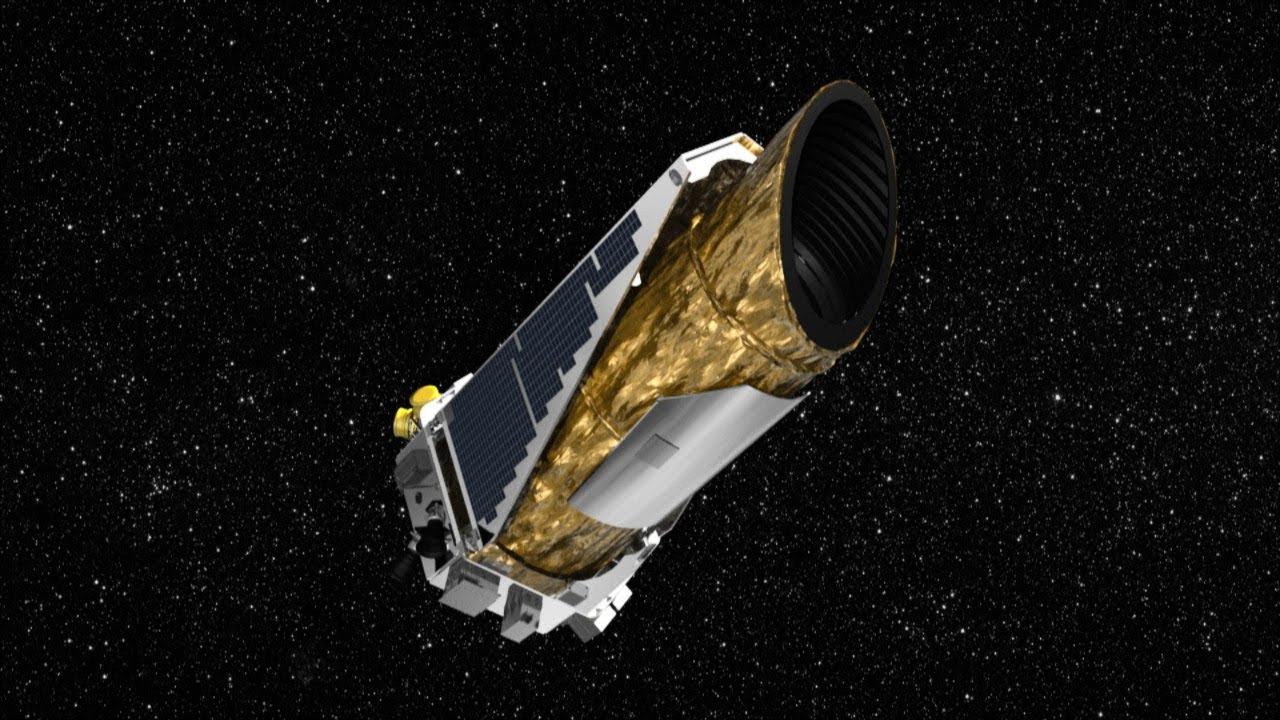
We’ll start with the Kepler space telescope, see image below and check out my post of 28April2018. Launched back in March of 2009 the mission of Kepler was to continuously observe hundreds of thousands of stars searching for small, rhythmic changes in their brightness that could be caused by planets passing in front of them.

The Kepler Space Telescope (Credit: NASA)

During its eleven years of service Kepler observed over half a million stars and is credited with the preliminary detection of 2,662 planets outside of our solar system. Kepler was only designed to detect such exo-planets as they’re called, larger, more precise Earth based telescopes would then carry on the work of learning about these alien worlds.

In order to avoid having the Earth interfere in its observations Kepler was placed into an orbit around the Sun known as an Earth trailing orbit some 130 million kilometers from Earth. Without fuel to maintain its proper orbit and orientation Kepler would be unable to perform its mission.

That fuel has now run out and on October 30 of 2018 NASA announced officially that communication with the Kepler space telescope has been lost and the mission has ended. Still, thanks to the Kepler space telescope astronomers now have 2,662 completely unknown worlds to study!

Another very important space probe has suffered the same fate. The Dawn mission to the two largest objects in the asteroid belt was both the first interplanetary vehicle to orbit two different bodies, not counting Earth, and the first probe to employ an ion rocket as its main propulsion.

The Dawn spacecraft first traveled to the asteroid Vesta, the second largest but heaviest asteroid. Astronomers believed that Vesta was composed primarily of iron and nickel and might have become of core of a planet had not the enormous gravity of the planet Jupiter kept that planet from ever forming. Vesta did indeed turn out to be a very heavy, metal rich asteroid proving the astronomers correct.

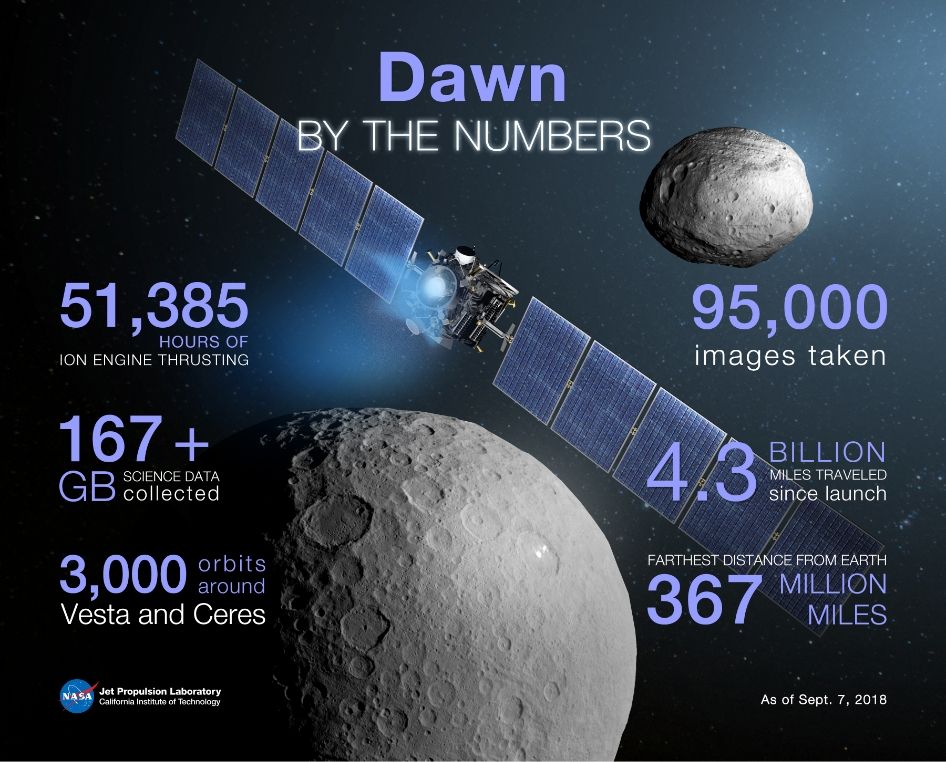
After orbiting Vesta for more than a year and completing its survey the Dawn probe then did something no other probe had ever done. It fired up its ion engines again, left obit around Vesta and traveled to the asteroid Ceres, the largest of the asteroids. The image below shows the Dawn Spacecraft with Vesta, upper right, and Ceres, lower middle.

Dawn with Vesta and Ceres (Credit: SoSialPolitik)

Now ion rockets don’t give you a lot of push, but they give a small push for a very long time. Whereas chemical rockets can use up all of their fuel within minutes an ion rocket can keep firing for years. Dawn was the first interplanetary probe to make full use of all the extra push possible from an ion rocket firing its engines for more than 50,000 hours.

So Dawn became the first probe to orbit and study two different bodies in our solar system orbiting Ceres and Vesta more than 3,000 times.

Like Kepler however even Dawn’s ion rockets eventually used up the last of their fuel and the Dawn spacecraft can no longer keep solar panels pointed toward the Sun, its antenna pointed toward Earth. According to NASA Dawn missed its regular radio check in on both 31October and 1Nov and the mission is presumed to have ended.

Once again however the Dawn probe has provided astronomers with a wealth of data to analyze. Dawn isn’t finished making discoveries.

The end of two of its premier missions however doesn’t mean that NASA is running out of space probes, far from it. Two probes launched over the past two years are approaching their targets and the data should soon start pouring in!

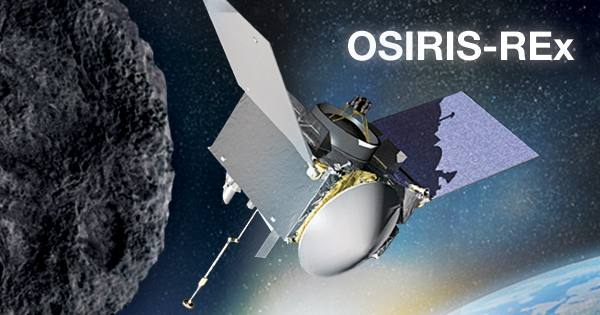
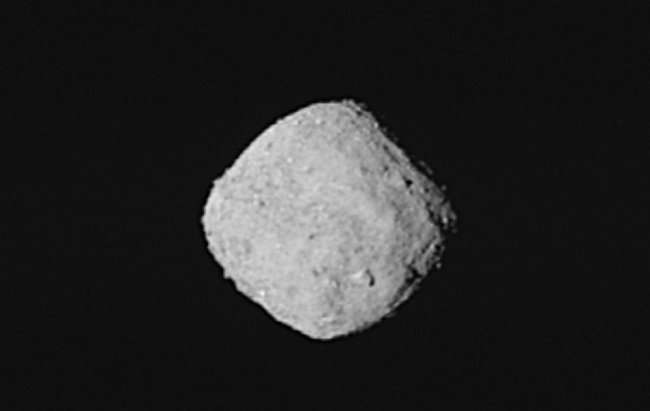
The OSIRIS-Rex probe has been traveling for the past two years toward a rendezvous with the small near Earth asteroid Bennu (See my post of 6January2018). OSIRIS-Rex should reach its destination within a month and recently took a high-resolution image of its target, see image below. Once at Bennu, which is too small to actually orbit, the OSIRIS-Rex will land and collect a sample of the asteroid’s surface to return to Earth. The sample is expected to arrive back here on Earth in 2023 but with all of the probe’s other instruments there’s no doubt that we’ll be learning a lot about Bennu much sooner than that!

ORIRIS-REx (Credit: NASA)
Latest Image (3Nov) of Asteroid Bennu taken by OSIRIS-Rex (Credit: Astronomy Magazine)

Another NASA spacecraft that is well on its way to its target is the Parker Solar Probe which just this past week on 29October became the closest man made object to our Sun (See my posts of 7June2017, 6January2018 and 5September2018). At the distance of 42.73 million kilometers Parker broke the record previously held by the joint German-American Helios-2 probe.

The Parker Solar Probe (Credit: NASA)

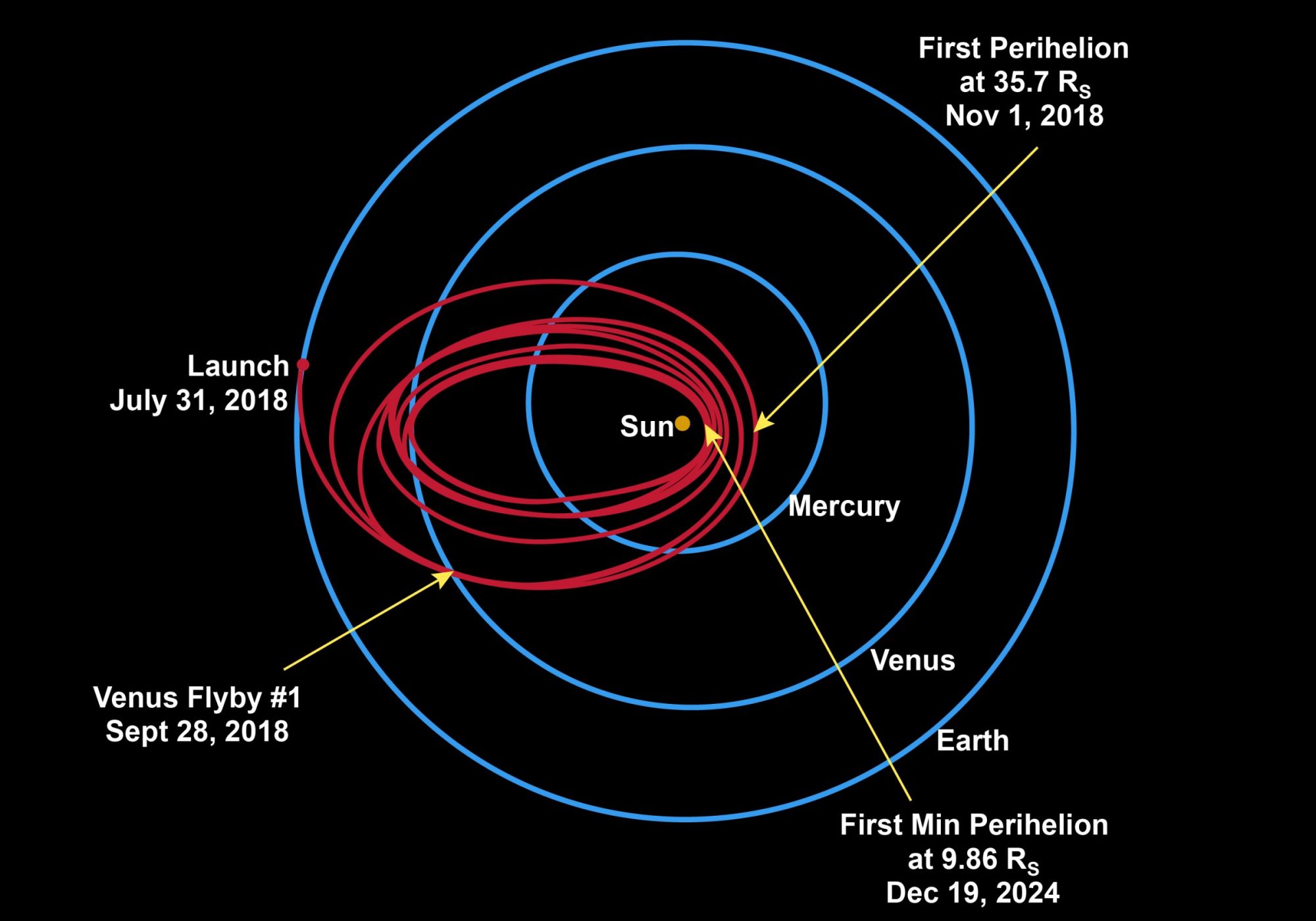
The Parker probe is going to get much closer however. During its six year mission to study the Sun Parker is expected to come as close as 6.9 million kilometers. The Parker probe will study the Sun in an effort to learn more about how the energy the Sun produces by hydrogen fusion in its core moves upward to the Sun’s surface. Parker will also study how the Sun generates its powerful magnetic field. The image below shows the planned trajectory of the Parker probe. Presently the spacecraft is just past ‘First Perihelion’.

Planned Trajectory of Parker Solar Probe (Credit: JPL, NASA)

If you’d like to learn more about any of the four interplanetary probes we’ve talked about click on one of the links below to be taken to the official NASA site for that mission!
https://www.nasa.gov/mission_pages/kepler/main/index.html

https://dawn.jpl.nasa.gov/

https://www.nasa.gov/osiris-rex

https://www.nasa.gov/content/goddard/parker-solar-probe

People often confuse Archaeology and Paleontology. Here are a couple of News Stories that can Illustrate the Difference.

Watching or reading the news you will occasionally come across stories where even a well educated journalist seems to be baffled about whether the topic of the story is Paleontology or Archaeology. After all, both sciences deal with the past, both dig up their evidence from the ground and it seems like much of that evidence consists of bones. Not only that, but there is without doubt a small but very important region of overlap between the two disciplines. So it’s easy to understand how non-experts can get confused.

The big difference between the two sciences is us, human beings. Archaeology deals with the human past, not only human remains but the remains of our activity. Material objects, anything from small tools to entire buildings are just as important to Archaeology as are human bones.

Unfortunately this is most people’s idea of an Archaeologist (Credit: Paramount Pictures)

The subjects of Paleontology on the other hand are all of the creatures that ever lived on this Earth, right back to the very earliest living cell. In some sense therefore Archaeology is a subset of Paleontology. We are still living creatures after all. However the enormous range of material objects left by humans is so large and so unlike the remains of other living things that the two sciences operate in two completely different ways.

The first story I’d like to discuss illustrates this difference by showing how much archaeologists can learn from an ‘artifact’, a tool made thousands of years ago. In this case the tool is a stone spear point made by the earliest inhabitants of the Western Hemisphere in the region now known as Texas.

Pre-Clovis Spear Point found at the Friedkin Site (Credit: Sci News)

The Debra L. Friedkin archaeological site outside of Salado Texas has been excavated by researchers from Texas A&M University for more than a dozen years now. The remains here are some of the earliest evidence of human habitation in the Americas dating back some 15,500 years. These remains predate the classic Clovis remains first found in nearby New Mexico.

Some of the Stone Tools found at the Friedkin Site (Credit: Texas A&M University)

That makes the Friedkin site very important because for decades the Clovis culture, first described in the 1920s from digs outside of the town of Clovis New Mexico, were thought to be the remains of original people who came to the Americas about 13,000 years ago. In the years that followed numerous sites in both North and South America were found that produced artifacts consistent with Clovis culture.

Over the last twenty years however a few sites have been discovered that date several thousand years older than the Clovis sites. So far however these sites have only produced a small number of artifacts, making it difficult to determine whether or not these people were earlier examples of the Clovis culture, or do they represent an entirely new, unknown people.

Texas A&M Professor Michael Waters thinks that the Friedkin site can provide that answer, and in his opinion they are an entirely new people. The artifacts discovered by Professor Waters and his team even include the earliest known stone spearheads, see image above.

“The dream has always been to find diagnostic artifacts such as projectile points that can be recognized as older than Clovis and this is what we have at the Friedkin site.” Waters says. Whether or not other Archaeologists will accept Professor Waters’s conclusions remains to be seen but with each piece of evidence the answer becomes clearer.

Now in that story we were only talking about artifacts, that is objects manufactured by human beings. In this next story the evidence will consist solely of the actual remains of living creatures. So that means this story comes from the science of Paleontology. Also, where the story from Texas dealt with evidence that was fifteen thousand years old, the evidence in this story is over 400 million years old!

Unfortunately this is most people’s idea of a Paleontologist (Credit: Universal Pictures)

The first animals to possess a backbone and an internal skeleton, the first vertebrates that is were fish, although very strange looking fish they were. The earliest fossils date from about 480 million years ago but such fossils are few in number and show little diversity. Vertebrates were a small, not very successful group of animals. About 60 million years later however the fossil record explodes with numerous new species of fish suddenly appearing.

Cephalaspis lyelli, an early jawless fish (Credit: Art.com)

In their search for the explanation of how this explosion of vertebrates happened Paleontologists have looked to find out where this explosion happened. That is, did the diversification of fishes occur in the open ocean or perhaps it occurred around the ancient coral reefs of that period.

Now a new study proposes a different solution. Paleontologists Lauren Sallan of the University of Pennsylvania and Ivan J. Sansom of the University of Birmingham have generated a database of 2,728 specimens of fossil fish from around 420 million years ago. In particular the database records the environmental conditions of where the fossil animal lived.

“The Nice thing about the fossil record,” according to Sallan. “Is that we often find fishes in the context of where they lived. The rock that holds them tells us what their environment looked like, whether it was reef, shallow water, deep water, a riverbed or a lake.”

What Professors Sallan and Sansom have found is that the explosion of fish species occurred in the shallow waters right up near the shore, between the reefs and the beach. In this environment these early fish acquired adaptations, such as bottom dwelling, that later enabled them to fit into niches in both the coral reefs and deeper more open waters.

Living near the shoreline also allowed fishes to adapt to freshwater more quickly and more successfully than other major groups of animals such as the arthropods and mollusks. And there was one more adaptation that that occurred at this time which gave these early vertebrates a distinct advantage. This was when fish first acquired jaws!

Jaws gave fish a big advantage. Osteolepis, and early jawed fish. (Credit: Pininterest)

So there you have it. Two examples of new research, one from the science of Archaeology, the study of humanity’s past, the other Paleontology, the study of life’s past.

Get Ready to Blow Your Mind: Optical Illusions and How They Work.

I think my post today may be a little short on content, but don’t worry, I’ll make up for it with some eye-popping pictures. Before I talk about optical illusions however let’s take a moment to recall just how it is we can see anything.

Without going to any detail, light enters our eyes through the iris, which acts as a lens, and forms an upside down image at the back of the eye. Here light sensitive cells, rods and cones, pick up the light and sent signals to our brain which has to not only turn the image right side up but has to interpret what all of those signals mean. (See Image Below) Optical illusions work by playing with that interpretation by the brain in some way that makes us see things that aren’t really there, or miss something that is.

How the Eye Works (Credit: The Foundation for Fighting Blindness)

Let’s start with a simple example like the two small stick figures shown below.

Simple Optical Illusion. Which HORIZONTAL line is longer? (Credit: Public Domain)

Obviously the entire lower figure is wider than the entire upper figure but is the lower horizontal line, and only the horizontal line longer. It certainly looks like it is doesn’t it! If you measure the two horizontal lines however you will find they are actually the same length. Because the entire lower figure is longer it makes our brain think that the lower horizontal line is longer. It’s the orientation of the < and > lines at the ends of the horizontal lines that trick our brain into thinking that the lower line is longer.

Let’s try the more complex yet similar example below.

Optical Illusion 2. Are the horizontal lines parallel or not? (Credit: Public Domain)

Here we have rows of alternating black and white boxes that are slightly offset from each other vertically. This offset causes our brain to see the horizontal lines as cock-eyed; certainly they don’t look like they’re parallel. But they are parallel, if you don’t think so take out a straight edge and see for yourself.

One more example of this type of illusion is shown below.

How many long square ended blocks are there? Count at both ends! (Credit: Public Domain)

Here we have what appears to be a number of long square blocks but if you go to the left hand side first and count the number of blocks, then go to the right hand side and count again you’ll find that the left hand side has one more block! How is that possible?

What’s going on here? Well our brain can only concentrate on one side of the image at a time and the middle is just a bunch of lines so we don’t see anything wrong, we don’t see the trick unless we stop and carefully examine the situation.

Optical illusions such as these are designed to probe the limits of how our brains process the signals sent to it by our senses and psychologists use them to learn something about how our brains work. We can illustrate another way to trick the brain with an optical illusion like the familiar one below.

Which do you see, the Vase or the faces? (Credit: public Domain)

Which do you see, the two faces or the vase? Of course the image combines both but the trick here is that once our brain has found one interpretation it stops looking for any other! I think that’s a pretty important fact about the brain we just learned don’t you. Let’s try another, similar one.

The image shows different objects depending on which side is up! (Credit: Public Domain)

Here the trick is that, upside down the rabbit has become a mustachioed man. If you only look at one image or the other it’s not so easy to see. Again our brain accepts one interpretation and that’s good enough. It isn’t designed to look for a second.

The last type of optical illusion I’d like to illustrate is the sort where our brain is tricked into seeing motion where there is none. Check out this one.

The Circles seem to rotate even though this is a still image! (Credit: Public Domain)

No this is not a video, nothing is moving trust me but it sure looks like those circles are rotating doesn’t it? The trick here is obvious, by composing an image out of multiple connected curves our brain tries to follow those curves as if they were moving.

Optical illusions such as these are an important tool in studying the brain, how it perceives and reacts to the reality around us, but let’s be honest, they’re also really cool. I’ll leave you with a few more examples. See if you can figure out which type each is.

This one will definitely blow your mind! (Credit: Public Domain)
Find the Hidden image! (Credit: Public Domain)
Yes the circles are really nice and round! (Credit: Public Domain)


Movie Review: First Man

First Man from Universal Pictures (Credit: Universal Pictures)

I don’t think I’m giving away any spoilers by letting you know that ‘First Man’ is a film biography, a filmography of the life of Neil Armstrong, the ‘First Man’ to set foot on the Moon. The creative team of director Damien Chazelle and actor Ryan Gosling, who worked together on the film ‘La La Land’, now bring us a portrait of Armstrong as man who is more comfortable in his relationships with machines than he is with other people. The image below shows Ryan Gosling as Neil Armstrong.

Ryan Gosling as Neil Armstrong (Credit: Universal Pictures)

By all accounts this portrayal is uncomfortably accurate. Astronauts as a group are not overly emotional, preferring to “maintain an even strain” as Tom Wolfe put it in his book ‘The Right Stuff’. Armstrong however was in a class by himself, escaping from almost certain death with a ‘well that’s my job’ attitude while preferring solitude at times of emotional crisis when most of us would seek the company of our family and friends. At times this solitary nature even led to an emotional gulf with his wife Janet, played by actress Clair Foy.

Clair Foy as Janet Armstrong (Credit: Universal Pictures)

The movie begins with Armstrong in the experimental X-15 spacecraft, attached to the underneath of a B-52 bomber and ready to begin a flight. This is the first in a series of incidents when Armstrong could easily have been killed but where his calm ability to choose the best option when there is absolutely no good option prevented disaster.

The centerpiece of Armstrong’s talent for saving the mission against the odds is the flight of Gemini 8 where Armstrong, as commander and David Scott as co-pilot succeeded in making the first docking in orbit of two spacecraft. A few hours after the docking however the combined spacecraft began an anomalous roll. Thinking, hoping that the problem was in their Agena target vehicle Armstrong undocked only to have the roll get much worse. The roll got so bad that Scott blacked out and everyone agrees that Armstrong should have as well, a situation that would have meant death for them both. Armstrong got the wayward Gemini under control however, long enough to make an emergency re-entry, saving both the mission and their lives.

It was Armstrong’s cool headedness in Gemini 8 that led to his being selected as commander for Apollo 11. In the movie the scene where Deke Slaton tells Neil that he is scheduled to be the first man on the Moon the response is typical Armstrong, ‘O’k’ is all he says.

The movie’s the special effects are simple perfect; the attention to detail is exquisite and not just for the spacecraft. Everything has a real 1960s feel to it right down to the haircuts and clothing. There are more actual sets than CGI, which I prefer but the scenes that do employ CGI are some of the best I’ve seen. I’d like to mention one other thing, flying in an experimental aircraft or a spacecraft is a lot bumpier than a normal domestic airline flight and ‘First Man’ gives you enough shaking and rolling to make you feel as if you’re really in the cabin with Neil.

Ryan Gosling time travels back to the 60s in First Man (credit: Universal Pictures)

The climax of the film is of course the landing on the Moon and again Armstrong’s calm determination saves the day when the Lunar Module’s autopilot is about to land them in a crater full of boulders. Seeing the disaster approaching Neil takes control and pilot’s the lander to a save area with only two seconds of fuel remaining. Once they are safely on the Moon, the first men to ever reach our nearest cosmic neighbor, Neil and Buzz Aldrin merely shake hands and get back to work.

There’s been a bit of controversy over the fact that the movie does not show Armstrong and Aldrin planting the American Flag on the Moon. The flag is shown several times but since it did required both men to secure it in the ground, and this movie is about Neil the actual erection isn’t shown. Instead we get a poignant scene where Armstrong takes a necklace that had belonged to his little daughter, dead now seven years, and drops it into a Lunar crater. It wasn’t that he didn’t have emotions; he just preferred to keep them private.

That’s a real change from our current herd of heroes; high-fiveing each other while bellowing like a bull. Or spiking the ball and doing a dance in the end zone. I think we could use a few more Neil Armstrongs, you know the type. The kind who, when you ask them how it felt to be the first man on the Moon reply, “It was my Job”.

The Real Neil Armstrong (Credit: NASA)

The Ice Cube Experiment. High Energy Physics at the Bottom of the World.

Physicists who study the way the Universe works at its simplest, most fundamental level do so by examining the collisions between elementary particles like the electron, quarks and neutrinos. The higher the amount of energy in those collisions the more we can learn about their behavior, the more we learn about the rules by which the universe is built. This is why physicists need to build such powerful particle accelerators such as the Large Hadron Collider at CERN.

However every day the Earth is struck by particles coming in from outer space with billions of times as much energy as the most powerful ever produced by human science. These particles are called the Ultra High Energy Cosmic Rays (UHECR) and physicists would love to be able to use their enormous energy in their experiments. The problem is that we never know exactly where on earth the most powerful of these particles are going to strike so how do we study them? How do we get them inside our instruments so that we can study them? Obviously in order to catch these UHECR you need a really big detector, and a lot of patience.

Enter the Ice Cube Experiment down in Antarctica. This experiment uses a cubic kilometer of the ice on that frozen continent as a detector for UHECR collisions. (That’s a block of ice one-kilometer long by one-kilometer wide by one-kilometer deep) The image below shows the experiments control facility sitting on the Antarctic ice.

The Ice Cube Experiment’s above ground (ice) Control Center (Credit: Scientific American)

The Ice Cube Experiment was constructed by drilling eighty-six, one-and a half kilometer deep holes into the ice and inserting long strings of ultra sensitive light detectors (Called Digital Optical Modules or DOMs) into the holes. (There are 5,160 of these DOMs total) Deep within the ice the only light that will be possible for the DOMS to detect will be that which is given off by the UHECR as they collide with atoms in the ice. The image below shows the overall layout of the Ice Cube Detector.

The Layout of the Ice Cube Experiment (Credit: Ice Cube Collaboration)

The light given off by these fast moving particles is called Cherenkov radiation, which is best known as that eerie greenish-blue glow around a nuclear reactor. Just what Cherenkov radiation is requires a little bit of explanation.

Cherenkov radiation coming from a Nuclear Pile (Credit: Reed Z)

We all know that nothing can travel faster than the speed in a vacuum. However the speed of light in transparent materials, like air or water or glass or ice is lower than the speed of light in a vacuum. So what happens when a sub-atomic particle like a proton is traveling through ice faster than the speed of light in ice? Well, what happens is the particle emits energy in the form of Cherenkov radiation until its velocity is below the speed of light in ice and it is this Cherenkov radiation that the DOMs of Ice Cube detect. The image below shows one of the DOMs.

One of Ice Cube’s Digital Optical Modules (DOMs) (Credit: The Ice Cube Collaboration)

The primary type of elementary particle that Ice Cube is designed to study are neutrinos and yes I know I talk about neutrinos all of the time (See posts of 30 July 2017, 2 December 2017 and 6 June 2018). Over the last twenty years however we have learned so much about our Universe by studying neutrinos and we have the possibility of learning more about Supernova, Gamma Ray Bursts, Blazars and even the Big Bang itself by studying the high-energy neutrinos given off by those events.

In fact according to two recent papers from the teams of scientists running Ice Cube a neutrino event that was detected by Ice Cube on 22 September of 2017 has been traced back to it original source, a Blazar designated as TXS 0506+056. Objects like Blazars have been observed in the past with optical and radio telescope along with X-ray and gamma ray telescopes and now the Ice Cube Detector as well. The image below shows graphically what a detection by Ice Cube looks like.

The Highest Energy Event yet measured by the Ice Cube Experiment (Credit: The Ice Cube Collaboration)

As you might guess there are already plans to expand Ice Cube. Called Ice Cube Gen-2 the design calls for a detector that could be as large as four kilometers in diameter. Such a large detector could record hundreds of events every day that are millions of times as powerful as those produced at CERN. Ice Cube Gen-2 will benefit from the knowledge gained in the construction of the current Ice Cube in an effort to reduce cost.

It’s as simple as this, the more different ways we look at the Universe the more we learn about the Universe. The Ice Cube experiment in Antarctica is a new way of looking and I think that we’re going to learn a lot. If you’d like to learn more about the Ice Cube Experiment click on the link below to be taken to the experiment’s website.

http://icecube.wisc.edu/