We’ve all heard of the ‘Big Bang Theory’, there was even a TV show by that name. The idea that billions of years ago everything that we see in all of Universe suddenly exploded into existence is one of those scientific concepts that has actually managed to creep into the popular consciousness. With all of the effort and discoveries that are being made to try to understand just what was the Big Bang and what caused it to happen I decided in this post to review the past century of research so that any future posts I make about our Universe as a whole will make sense.

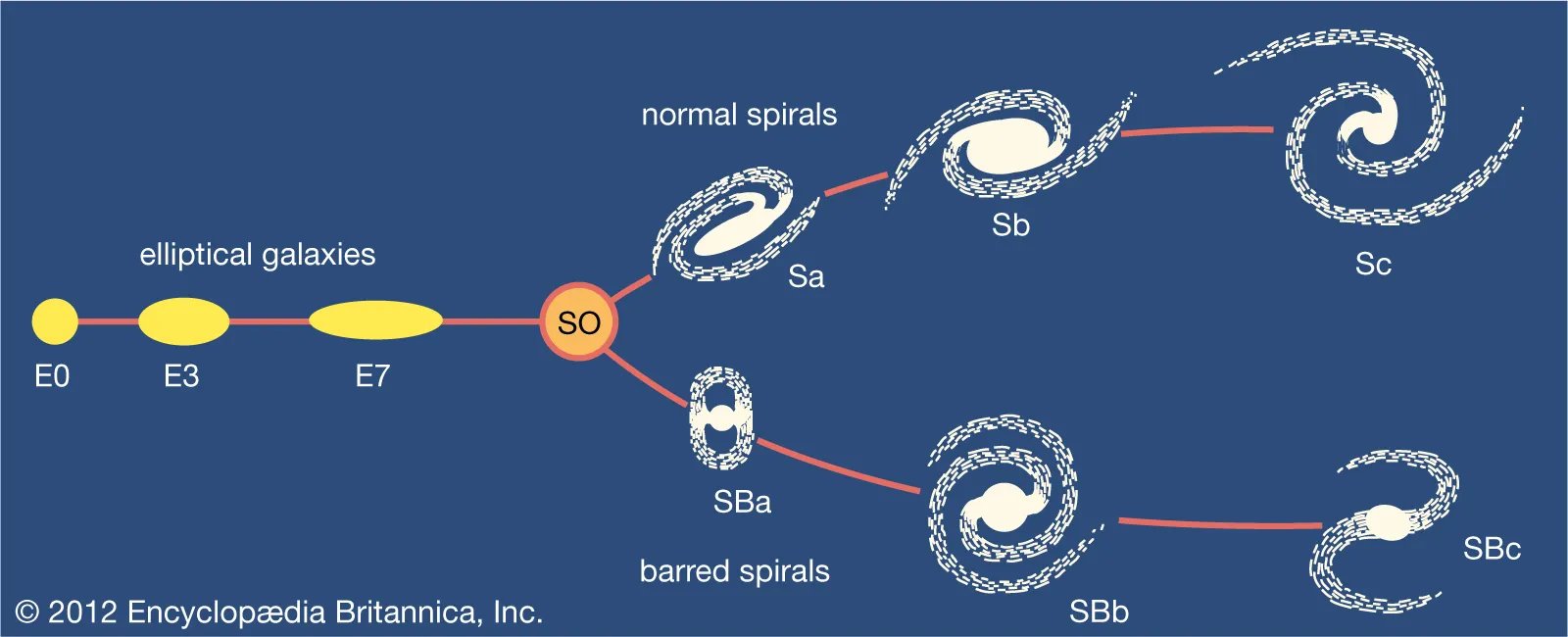
Well it all started with the astronomer Edwin Hubble, for whom the Hubble space telescope is named. Just about one hundred years ago Hubble was trying to determine if the ‘fuzzy nebula’ that astronomers saw all over the sky were objects within our own Milky Way galaxy or galaxies in their own right. By the way the word ‘galaxy’ is just Greek for ‘Milky Way’.

Now measuring distances to objects far outside our Solar System is not easy. Think about it, how would you measure the distance to the Moon, our nearest neighbor. Hubble searched for months to find a particular type of star in the largest nebula Andromeda, a kind of star whose absolute brightness astronomers knew. Then, by measuring that star’s apparent brightness in our sky a simple formula would allow him to calculate the distance to that star and therefore Andromeda. When he found such a star it turned out that Andromeda was far outside the Milky Way, as were many other nebula, they were all galaxies like the Milky Way. In one stroke Hubble had made the Universe many times larger.
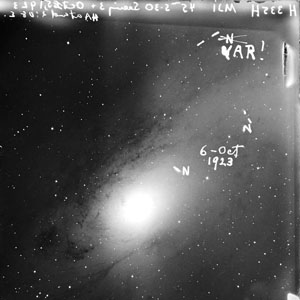
Hubble then decided to measure how fast all those galaxies were moving towards, or away from our galaxy, their radial velocity. Turns out that measuring the radial velocity of a celestial object is actually much easier than measuring its distance because of something called the Doppler effect.
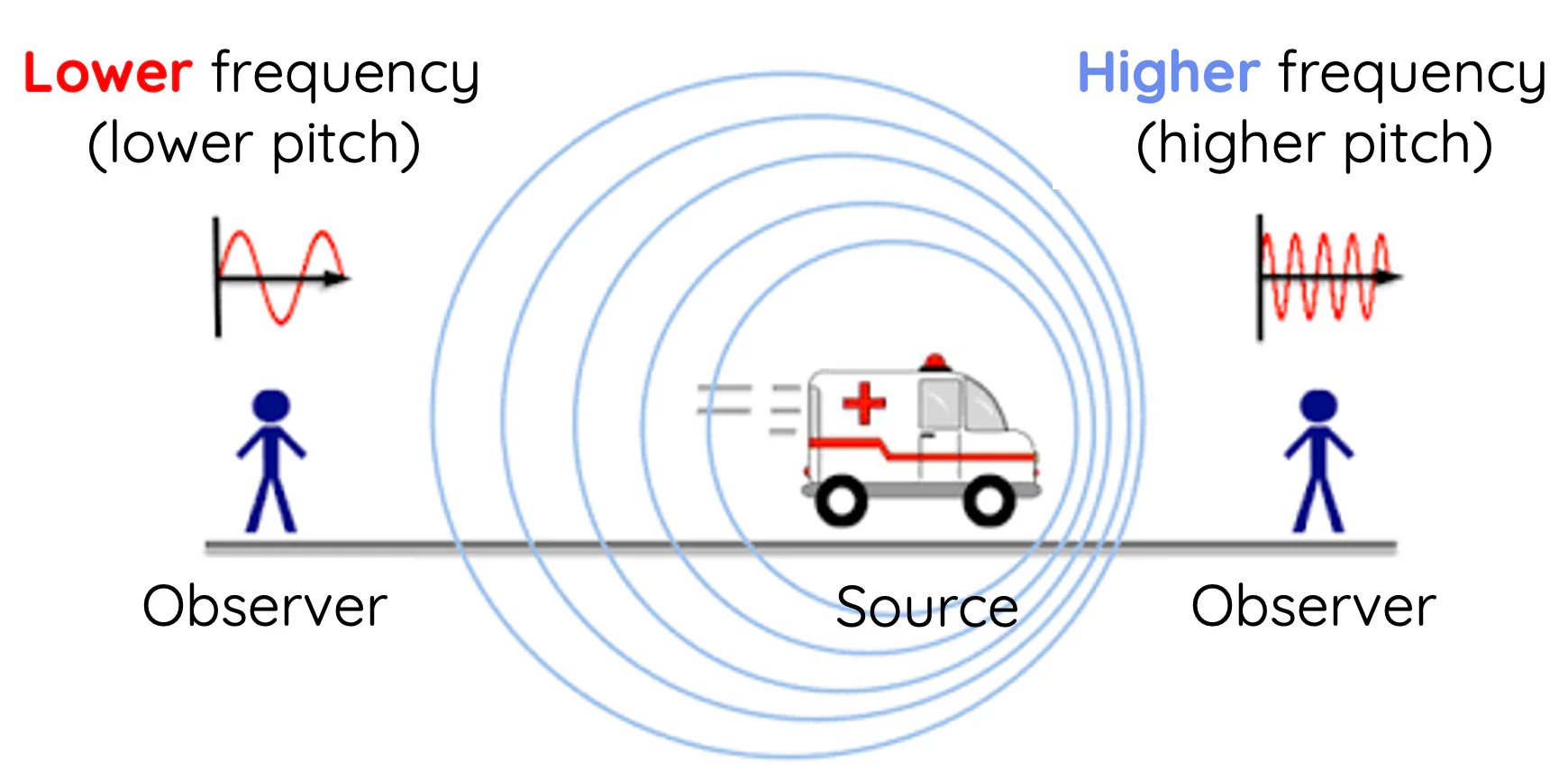
If you’ve never heard of the Doppler effect you still know what it is. You’ve noticed it anytime you were walking down the sidewalk and you heard an ambulance or other emergency vehicle coming towards you with its siren blaring. Remember how the high-pitched sound of the siren drops in tone the instant the vehicle goes past you. That’s the Doppler effect and it’s true of light as well. The light from a star moving toward Earth will get shifted toward the blue part of the spectrum while light from a star moving away will get shifted to the red.
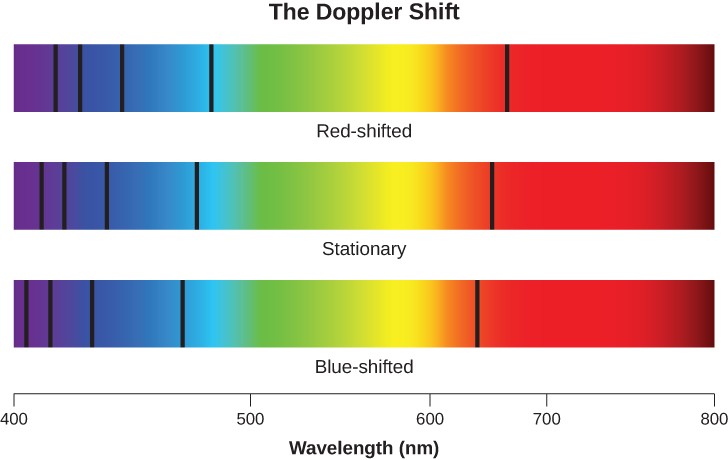
By measuring the amount of the shift Hubble soon determined the radial velocity of dozens of galaxies and discovered that with the exception of a few of the closest galaxies they were all moving away from the Milky Way. All of the galaxies were moving apart, Hubble had not only made the Universe much larger but had discovered that it was expanding.
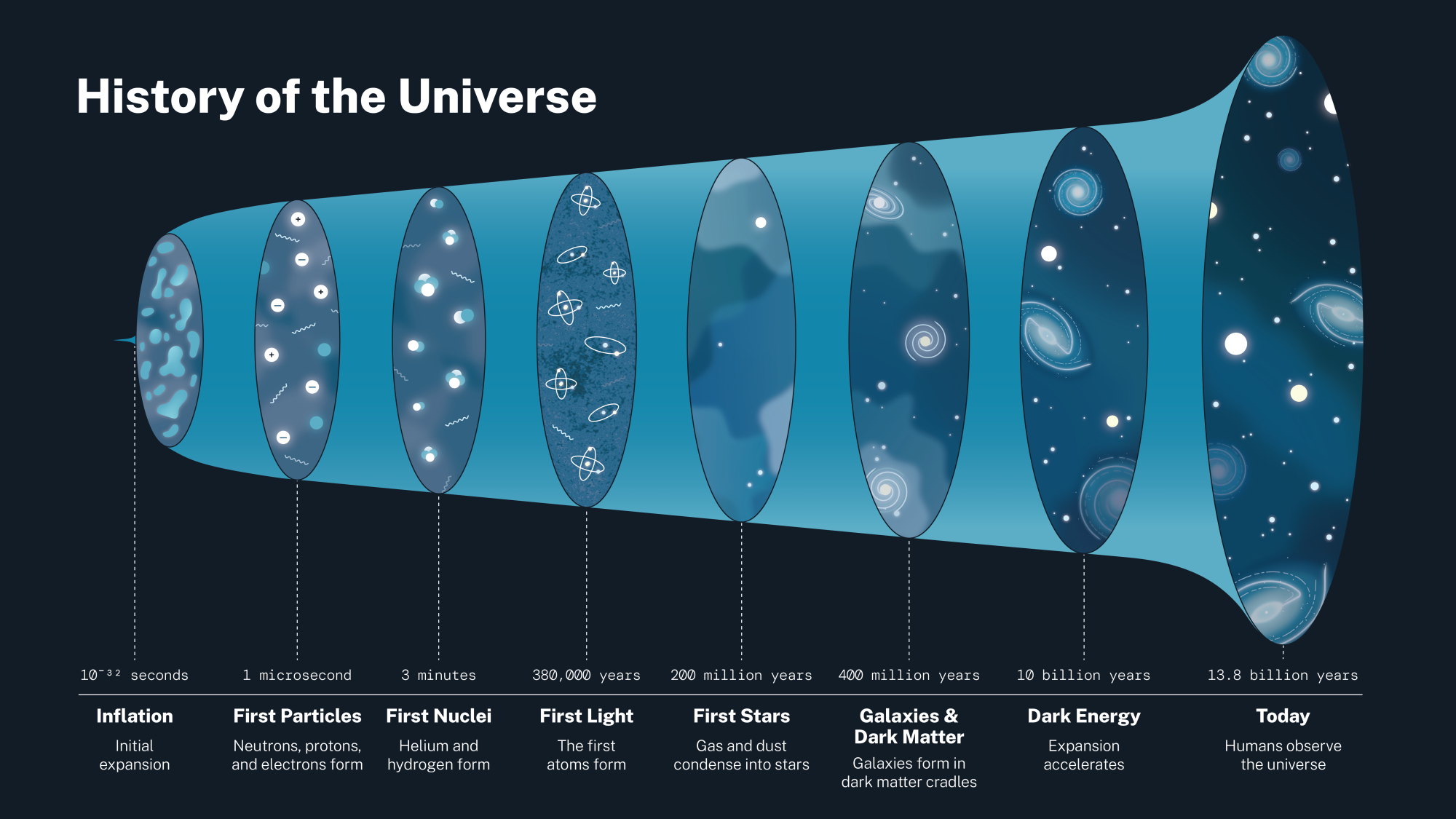
Now think about it, if all of the galaxies are moving farther apart then in the past they must have been closer together. The farther in the past the closer the galaxies were until a some time, billions of years ago all of the galaxies, and whatever else there is in the Universe, was all concentrated in space and exploded outward, hence ‘The Big Bang’. When I was young back in the 1960s it was thought that the Big Bang had occurred about 7.5 billion years ago but as astronomers made better measurements they revised their estimate to about 13.5 billion years ago and that value has been stable now for about 40 years.
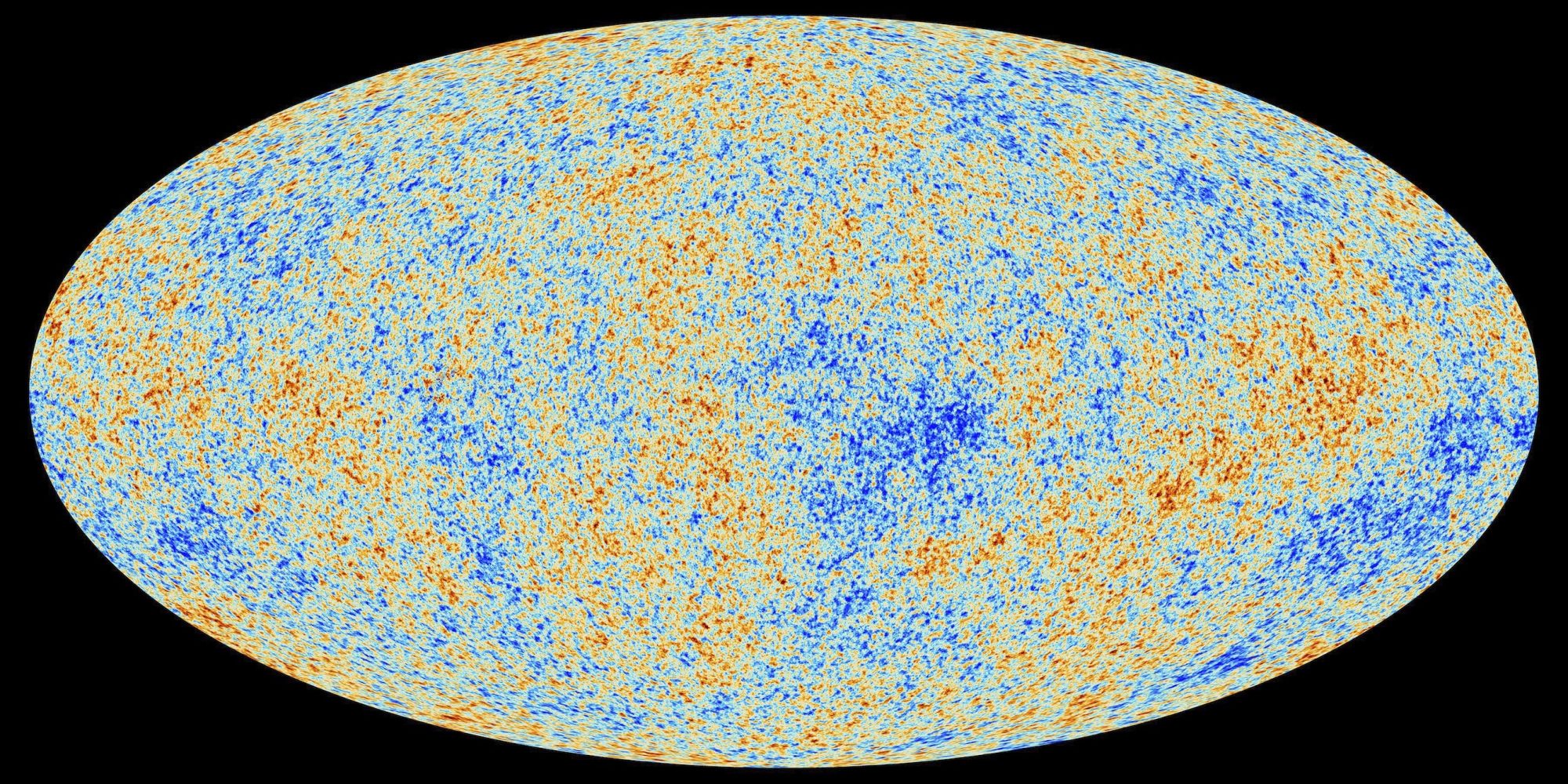
Then, in the 1950s physicists realized that the original big bang must have been so hot, billions of degrees, that there must still be some leftover heat from that ultimate explosion. (Think about it, you roast a chicken for dinner one night and even if you turn off the oven when the chicken is cooked it still feels a little warm after you finish eating dinner!) That leftover heat, called the Cosmic Microwave Background (CMB) was discovered by accident in 1965 and has been intensely studied ever since.
So, was the Big Bang the moment of creation itself? Was there nothing before the Big Bang and then suddenly there was everything? Well as you might guess scientists really don’t like the idea of miracles so they immediately began thinking about what kind of Universe could have existed before, and leading to, the Big Bang. The simplest idea is that before the expanding Universe there was a contracting Universe, a Big Crunch in other words where the galaxies hurtled towards each other collapsing into a single object of extreme density, pressure and temperature that then rebounded as the Big Bang.
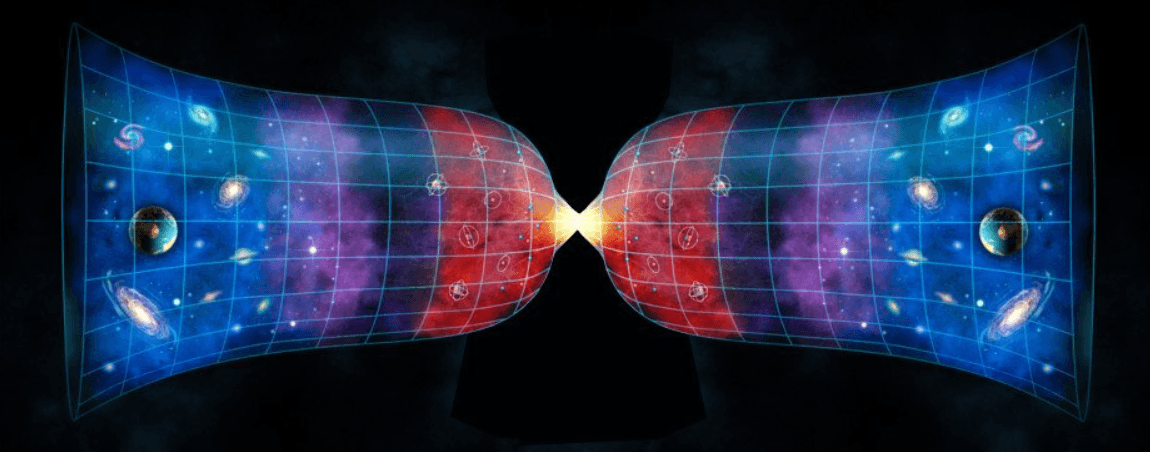
Another interesting model suggested that there was no actual moment of the Big Bang but rather the Universe just keeps getting smaller and smaller, and denser and hotter as you go further back in time without it ever reaching zero in size or infinity in density and temperature. In this scenario what we see as the CMB is the time when the Universe became large enough and cool enough that it was no longer incandescent.
In either case the force of gravity was assumed to be causing the rate of expansion to slow down, and the question was whether or not gravity was strong enough to eventually bring the expansion to a halt. That would then begin a contraction that would inevitably lead to another Big Crunch. Or was the expansion fast enough so that the Universe had ‘escape velocity’ and the expansion would go on forever until all of the galaxies were so far apart as to be alone, with stars that had used up all their nuclear fuel. In other words a cold, dead, empty Universe.
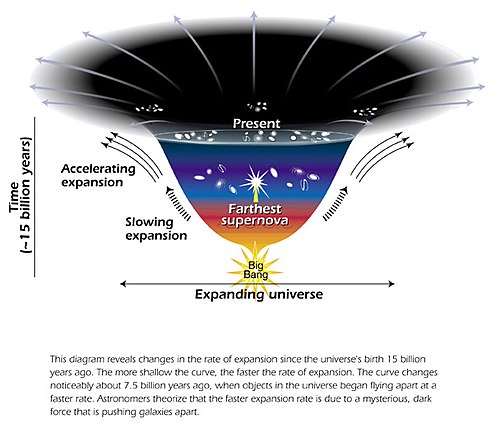
In the 1990s two teams of astronomers decided to measure just how much the expansion was slowing down due to gravity. What they discovered astounded the world because in fact the expansion was accelerating, some unknown force, which was quickly called ‘Dark Energy’ was making the Universe fly apart faster.
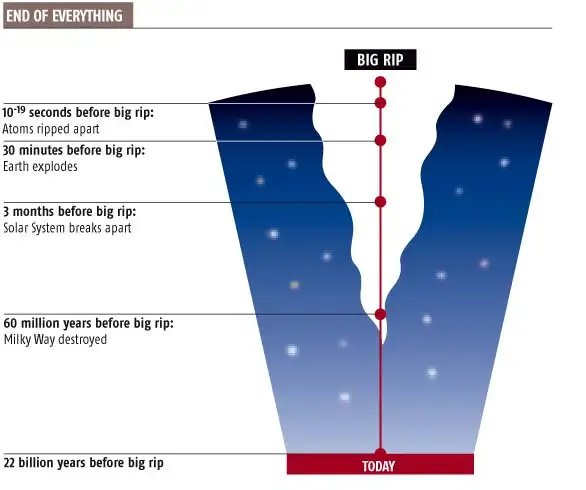
In fact Einstein had predicted just such a thing. In his equations for General Relativity there was a place for a constant that would produce a kind of repulsive form of gravity and so following Einstein cosmologists then began adding his constant λ to their equations. Was Dark Energy a constant however, or did it change with time? If Dark Energy got stronger with time the entire Universe could get caught in a ‘Big Rip’ where eventually every particle would be an infinite distance from any other particle. Or, if Dark Energy was getting weaker with time then there was still a chance that the expansion of the Universe could come to a halt and start a contraction.
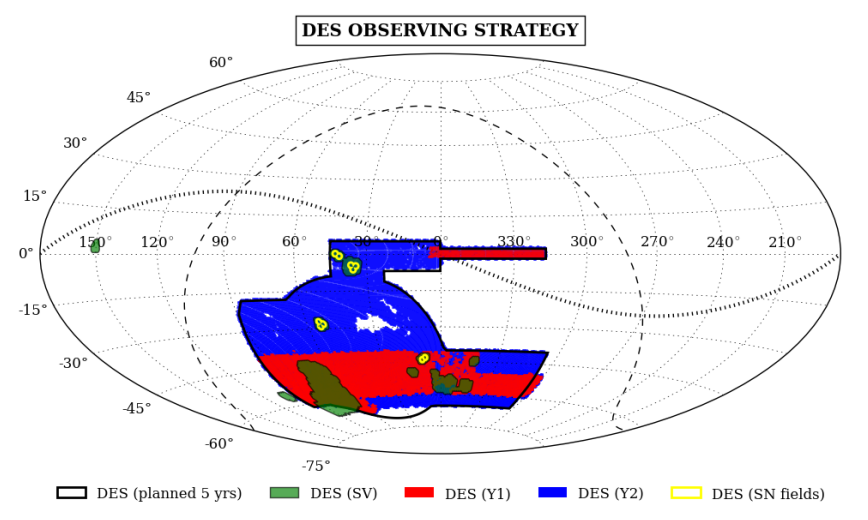
The Dark Energy Survey (DES) is searching for just that answer. A collaboration of over a hundred astronomers from ninety different institutions DES has spent the last five years using the technique that originally discovered Dark Energy to attempt to measure its value at different periods of the Universe. The release of their full data has not resolved the problem for while the best fit to their findings is a Dark Energy that is growing weaker with time a purely constant Dark Energy cannot be ruler out either. As often happens in astronomy more data is needed to make a final judgment.
That’s kind of the state of our knowledge at present. In an upcoming post I’ll try to describe some of the wild ideas that are being considered for modeling the Big Bang.