A Recent Paper on Cosmology, the study of the Universe as a whole, has asserted that the Universe has passed an Inflection Point where Dark Energy has become weaker than gravity and the Universe is beginning to Decelerate.

I’ll begin today’s post by reviewing out current model of the Universe. About 13.5 Billion years ago our Universe underwent a ‘Big Bang’, an explosion of unimaginable energy and pressure. This explosion caused the entire Universe to expand rapidly as time passed but also caused it to cool until atoms could form. We can still see the ‘fossil’ evidence of this time in the Cosmic Microwave Background (CMB).
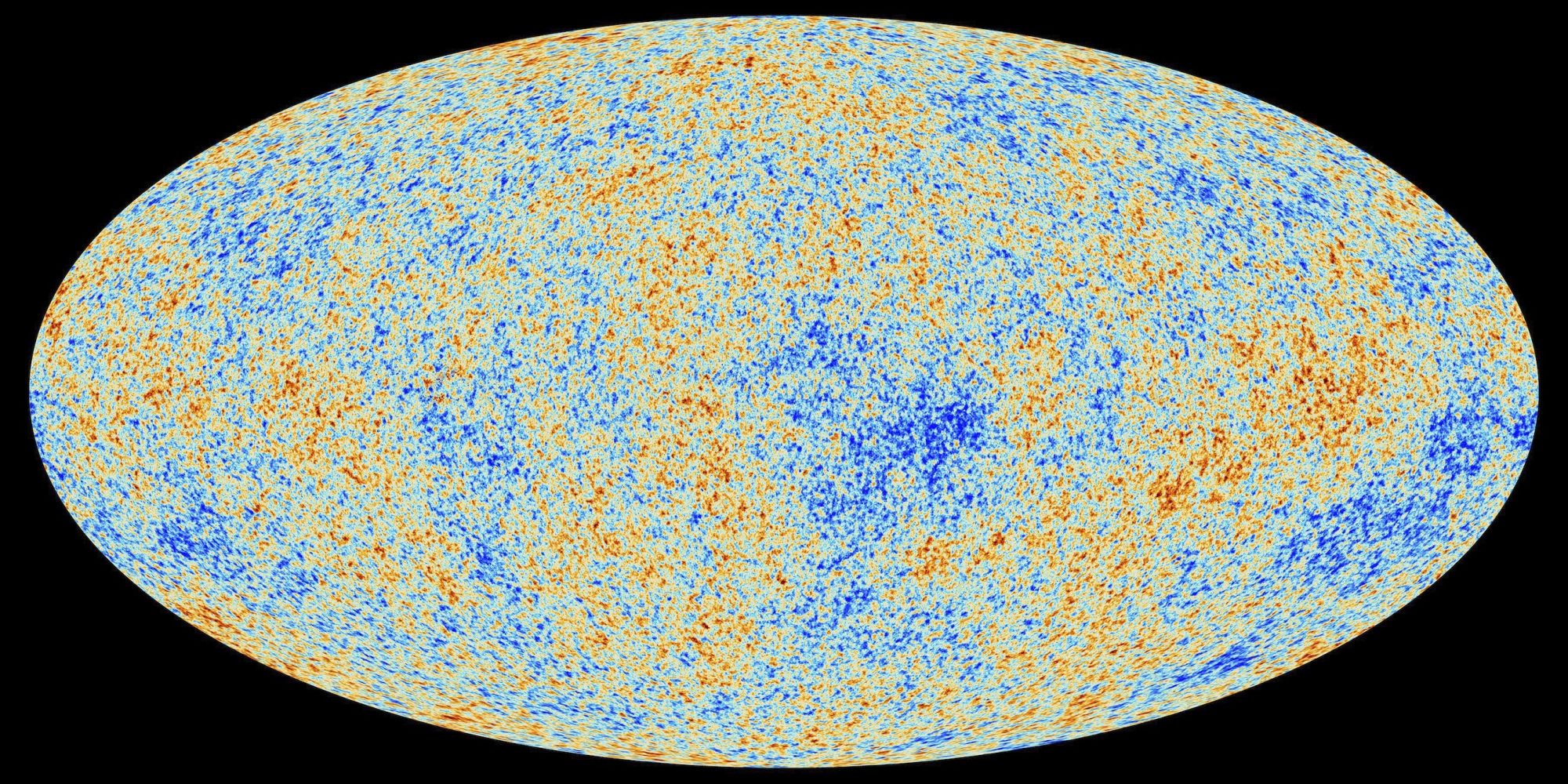
The Cosmic Microwave Background (CMB) as seen by the Planck Satellite. This is the ‘fossil’ light left over from about 370,000 years after the Big Bang. (Credit: Wikipedia)

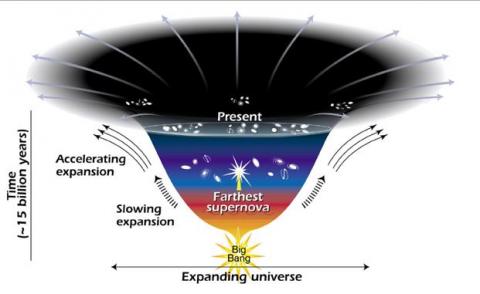
After about 500 million or so years gravity caused the gasses of the early Universe to begin to clump together, forming the first stars and galaxies. Gravity also should have made the general expansion of the Universe slow down but something that we call ‘Dark Energy’ is actually making the expansion accelerate. Discovered in the 1990s we still know very little about dark energy even after almost 30 years of intense study.

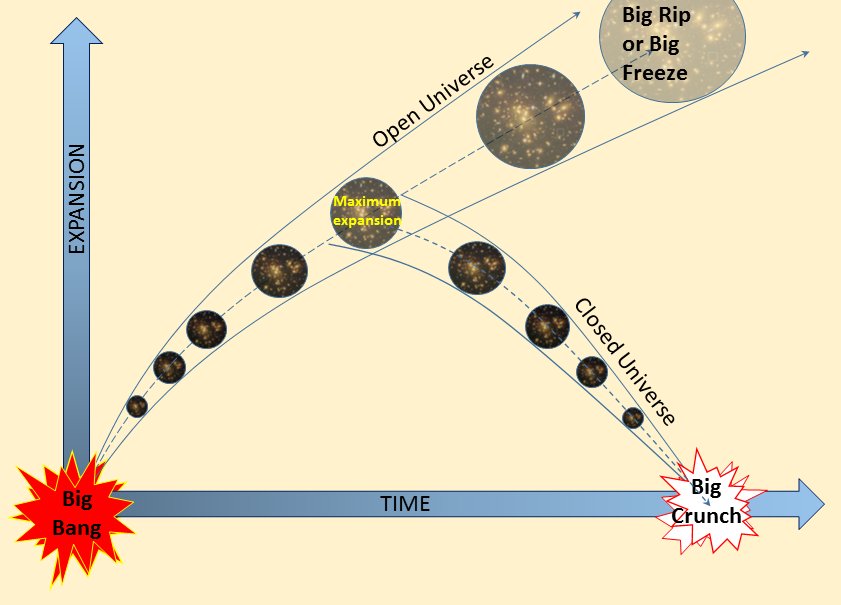
Back in the 1990s astronomers all thought that the ultimate fate of our Universe would be one of the three scenarios on the left. Either gravity would cause the expansion to stop and then begin a contraction phase leading to a ‘Big Crunch’, far left. Or gravity was too weak to stop the expansion and the Universe would expand forever, third from left. The second from the left is a scenario where gravity and the expansion are exactly balanced. When astronomers tried to decide which scenario was correct they found that the expansion was actually increasing, far right. We still have little knowledge of what is causing the acceleration, so we call it ‘Dark Energy’. (Credit: LSST.org)

I’m going to have to get a little technical here about how astronomers actually measure whether the Universe’s expansion is decelerating or accelerating. The whole idea of the Big Bang began when Cark Hubble first found that, except for a few really close galaxies, the light from all of the galaxies was red shifted, meaning that they were moving away from our galaxy. At the same time he discovered that the further away a galaxy was the faster it was receding. Hubble expressed this as a simple equation.

V=HoD
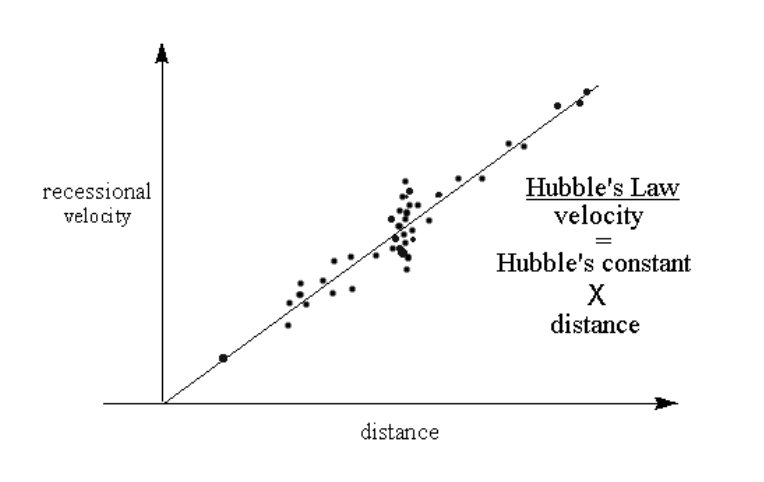
Some of Hubble’s actual data for his ‘Law’ about the expansion of the Universe. (Credit: Curious STEM)

Here D is the distance to a galaxy, V is the velocity that galaxy is moving away from us and Ho is a constant called Hubble’s constant. Now astronomers realized that if gravity were slowing the expansion of the Universe, then Ho would not be a constant but rather be getting smaller as the Universe aged.

Before Newton’s law of gravity people thought that gravity only affected things here on Earth, that the heavens obeyed different rules. It was Newton who realized that gravity is everywhere and affects everything, even the expansion of the Universe. (Credit: BBC)

It wasn’t until the 1990s that astronomers developed a technique to measure any change in Ho. Astrophysicists studying Type 1a supernova calculated that all such supernova should explode with the same amount of energy, should shine with the same absolute brightness. So if a Type 1a supernova appeared bright that meant the galaxy it was in was fairly close to our Milky Way while if the Type 1a supernova appeared dim it meant that the host galaxy was farther away. Astronomers call such objects ‘Standard Candles’ and can use them to measure the distance to objects in the Universe.
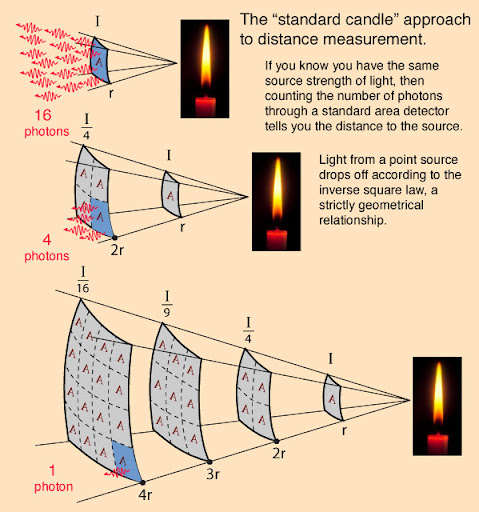
Astronomers are always searching for what they call ‘Standard Candles’ that is sources of light far away in space whose absolute brightness they know somehow and whose apparent brightness they can measure. A simple calculation will then tell them just how far away that candle is! (Credit: hyperphysics.phy-astr.gsu.edu)

So using Type 1a supernova to measure the distance, and then using redshift to measure velocities they could determine whether Ho was getting smaller. What they found was that Ho was actually getting bigger, that something was pushing the Universe to expand faster, something they called ‘Dark Energy’.
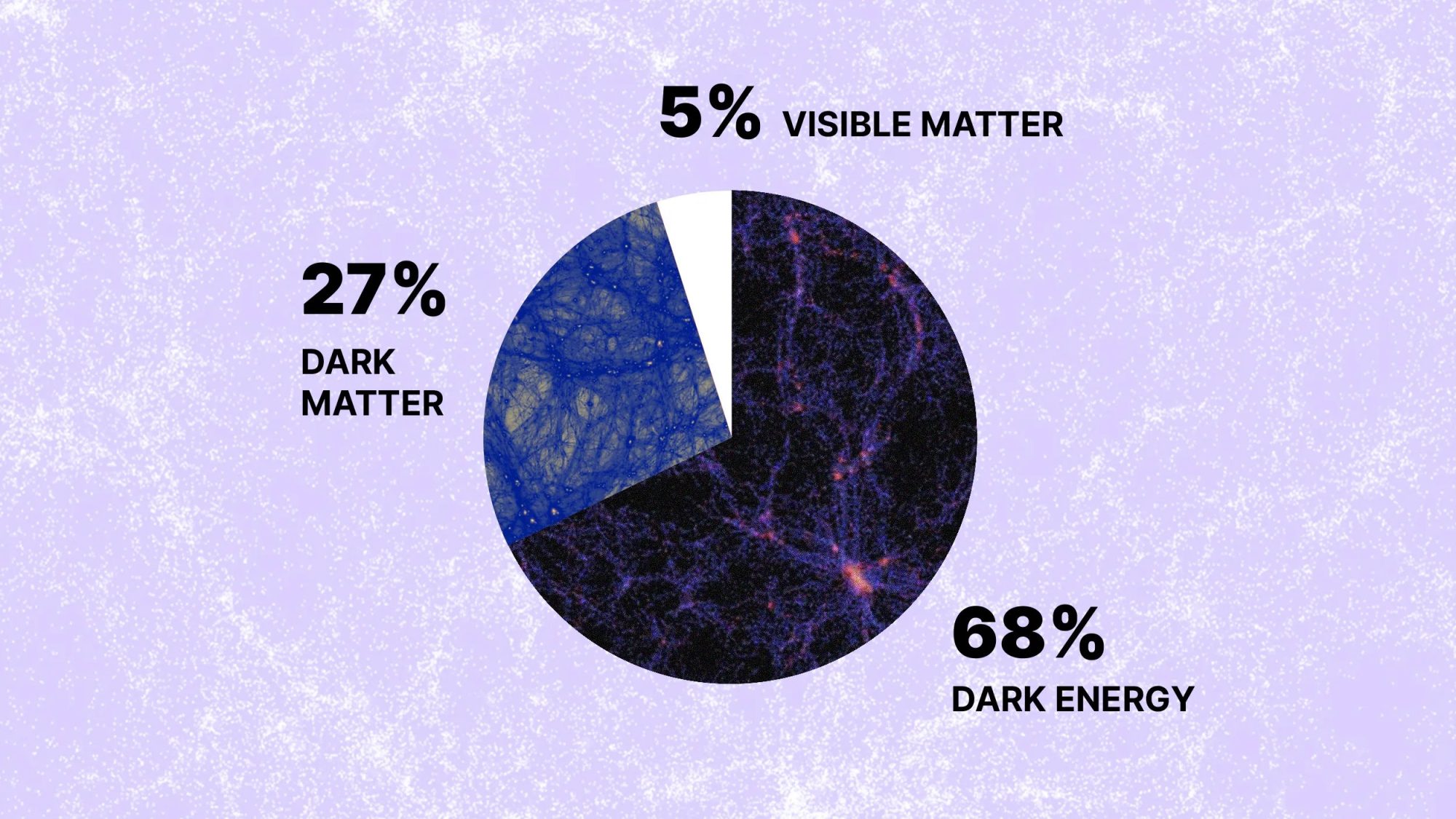
Astronomers calculate that about two-thirds of all the energy in the entire Universe is ‘Dark Energy’ about which we know almost nothing! (Credit: Big Think)

As I said earlier the standard model of the Universe considers Dark Energy to be the Cosmological Constant that made Einstein’s field equations complete, a property of space itself. Still cosmologists wanted to be sure and so they continued to gather supernova data in order to see if Dark energy did remain constant with time.
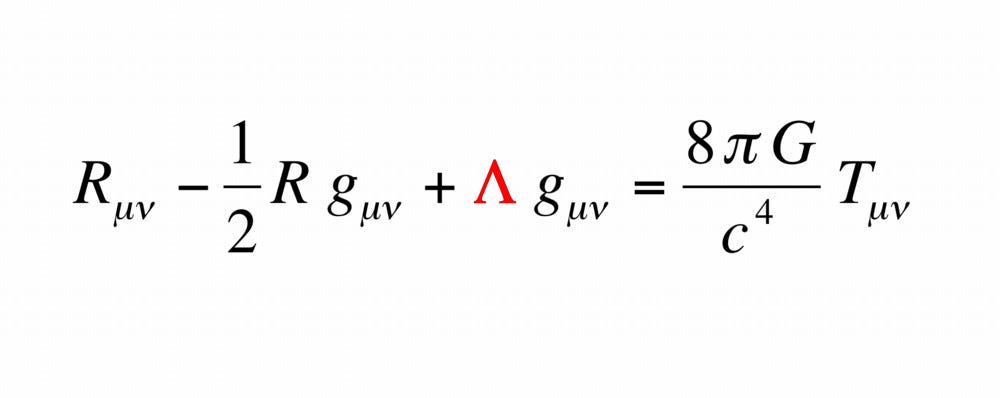
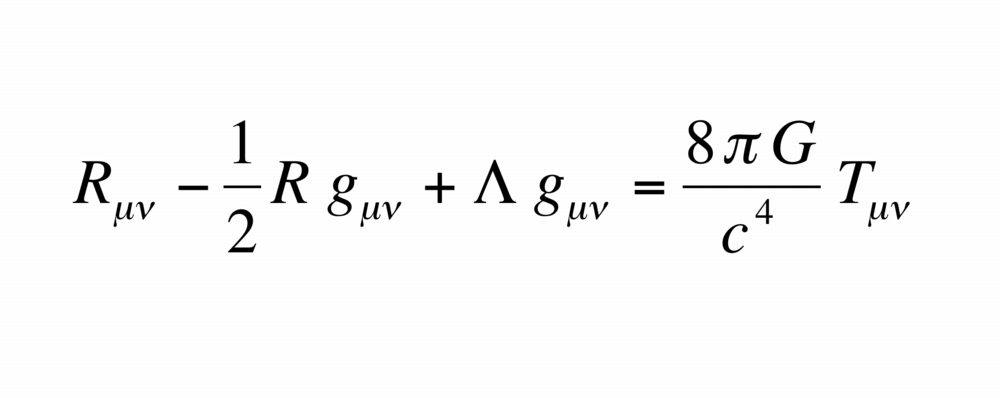
The full, tensor version of Einstein’s field equations for gravity. Mathematically the constant lambda has every right to appear, but its value had to be very small or it would be seen in the way the planets orbit our Sun. Einstein was glad to get rid of it but it would generate something like ‘Dark Energy’ so now its come back. The question is, is lambda really constant? (Credit: Medium)

In several of my past posts I have discussed recent evidence that Dark Energy is in fact dynamic, that it does change with time and that it has been growing steadily weaker as the Universe ages. Now a new paper published in the Monthly Notices of the Royal Astronomical Society by astrophysicists at the Department of Astronomy and Center for Galaxy Evolution Research at Yonsei University in Seoul, South Korea asserts that the technique used to measure Dark Energy needs a correction factor. When that correction is carried out it makes λ much weaker and in fact in just the last billion years or so the Universe has actually begun to decelerate.
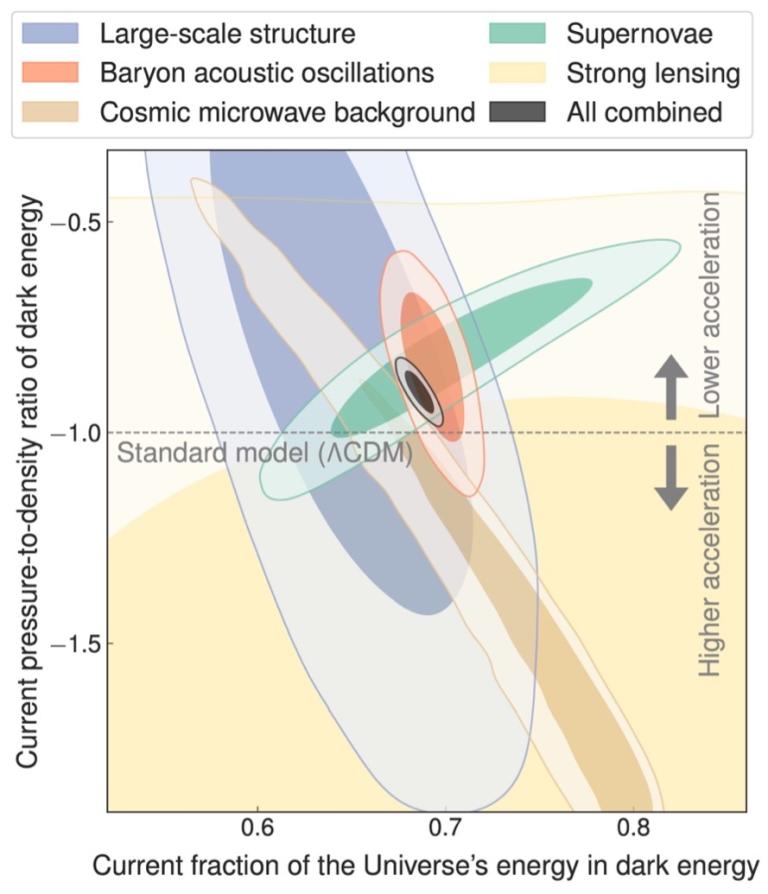
Over the last 20+ years astronomers have tried to study Dark Energy by many different techniques. A consensus is growing that Dark Energy is not constant but rather dynamic, changing with time and growing weaker! (Credit: UChicago News – University of Chicago)

What the researchers assert is that the brightness of a Type 1a supernova depends on the age of the white dwarf star that explodes. Taking this correction factor into account the supernova data becomes far more conclusive that dark energy is weakening and in fact agrees more closely with data based on analysis of the CMB. It also means that sometime in the last billion years dark energy became weaker than gravity and the Universe has in fact begun to decelerate.
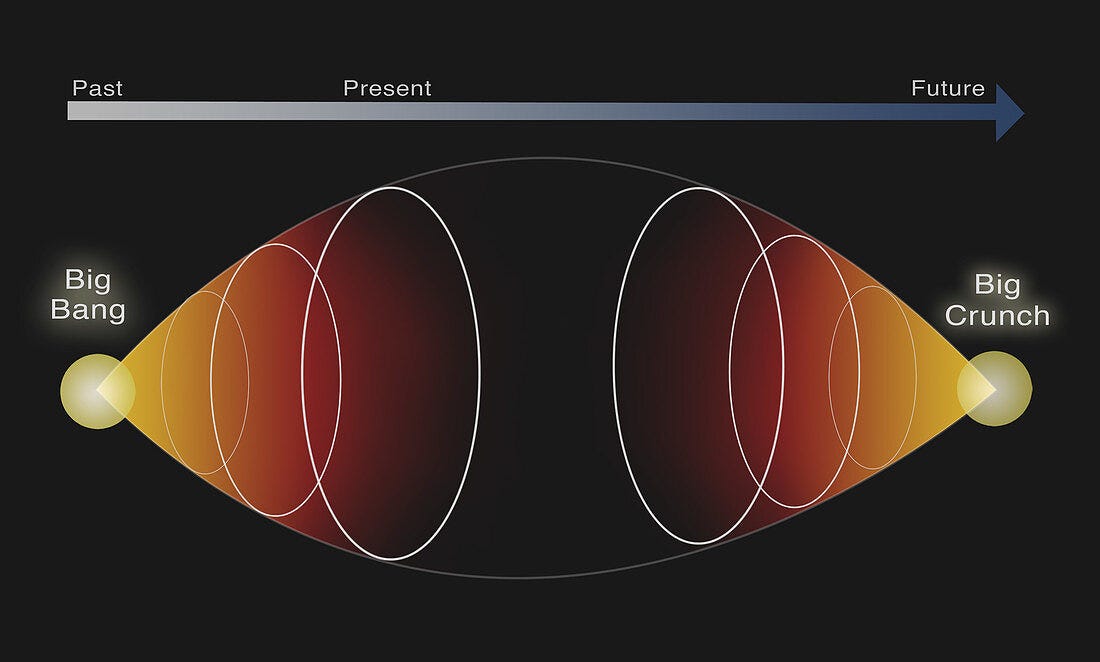
If Dark Energy is growing weaker, we may be headed toward a ‘Big Crunch’ where the entire Universe collapses into a singularity triggering another ‘Big Bang’. (Credit: Avi Loeb – Medium)

Now there are already criticisms of the paper, the researchers did not in fact measure the age of the star that goes nova, a rather impossible thing to do with all the billions of stars in other galaxies. Instead they measured the age of the galaxy and used that value as a proxy for the age of the star that went nova. Still the author’s new measurements of the change in dark energy do closely align with the analysis made from the CMB data.

Guessing someone’s age at a party may be fun but guessing the age of a star in a distant galaxy is a lot of hard work. (Credit: Amazon.com)

The eventual fate of the Universe itself depends on the nature of Dark Energy and cosmologists and astrophysicists are working hard to uncover its secrets.
With the Dark Energy Spectroscopic Instrument (DESI) astronomers and physicists hope to learn something about the nature of the mysterious Dark Energy.

If you ask any astronomer or physicist what is the biggest, the most critical question, the biggest mystery in science today they will immediately reply, “What is dark Energy?” You see our observations tell us that the Universe is expanding while our theories of Gravity tell us that the expansion should be slowing down. But instead what we see is that the expansion of the Universe is accelerating. Something, some pressure is pushing the Universe ever farther apart and that ‘Dark Energy’ actually accounts for some 80-85% of all the energy in the Universe.

After the Big Bang Gravity should have caused the expansion of the Universe to at least slow down but instead something is causing to accelerate! Dark Energy! (Credit: NASA Science Mission Directorate)

The idea that we know so little about 80-85% of the Universe is more than just a bit embarrassing because since Dark Energy is the dominate part of the Universe it will obviously have the dominant effect to the eventual fate of the Universe. To understand why that is so I’m going to take a step back and review the history of the ‘Big Bang Model’ of the Universe.

One hundred years ago astronomers thought that the Universe was pretty static, neither expanding nor contracting. Physicists however didn’t like that picture because without something acting to keep the galaxies apart the force of gravity should pull everything together into a ‘Big Crunch’. Everybody was relieved therefore when the astronomer Carl Hubble found that the galaxies were in fact moving away from each other, the Universe was expanding.

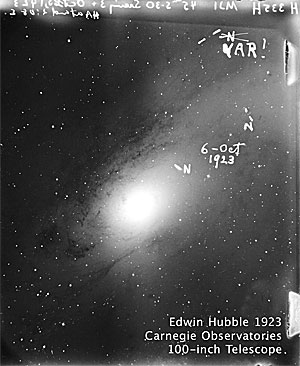
The Famous image of Andromeda taken by Carl Hubble that allowed him to measure the distance and proving Andromeda was another Galaxy. (Credit: Space and Astronomy News Daily)

This was the start of the Big Bang Model where billions of years ago an incredibly dense, hot Universe expanded rapidly, cooled and then formed the galaxies we see today. The question then became whether gravity was strong enough to eventually bring the expansion to a halt, or had the Universe reached ‘escape velocity’ and the expansion would go on forever. In the first case once the Universe stopped expanding gravity would begin to cause it to contract leading to a Big Crunch. This was a known as a closed Universe. The alternative was an open Universe that would fly apart forever.

The difference between an open and closed Universe id the first expands forever while the second ends in a Big Crunch. (Credit: Astronomy Today)

The measurements needed to determine which model was correct were very difficult to make, so difficult in fact that it wasn’t until the 1990s that everyone was shocked to discover that the Universe was actually expanding faster. Something was pushing it apart and for lack of a better name that something was called Dark Energy. So we then had the biggest problem in science, what is Dark Energy?

The first thing that scientists would like to learn about Dark Energy is whether or not it is even a constant force or does it’s strength change with time? You see when Einstein formulated the equation of Gravity in his theory of general relativity, see equation below; he realized that mathematically the equation could have a constant added to it. Einstein gave that constant the symbol λ, and he calculated that the effect of that constant would look a lot like the Dark Energy we now see.

Einstein’s full equation for gravity with the cosmological constant lambda. The left hand side is the geometry of the Universe while the right hand side is the energy of the Universe. (Credit: WordPress.com)

Now if Dark Energy is just this ‘cosmological constant’ as Einstein pictured it then the expansion of the Universe will continue forever. If the strength of Dark Energy varies however, maybe even reverses itself to an attraction, then the ultimate fate of the Universe is still unknown.

However the measurements needed to determine whether the strength of Dark Energy varies with time are far more difficult to make than the measurements that discovered it in the first place. Still, astronomers have learned quite a bit in the last 25 years and advances in technology have made their instruments vastly more precise and sophisticated. It is with this improved technology that the Dark Energy Spectroscopic Instrument or DESI has been designed and constructed.

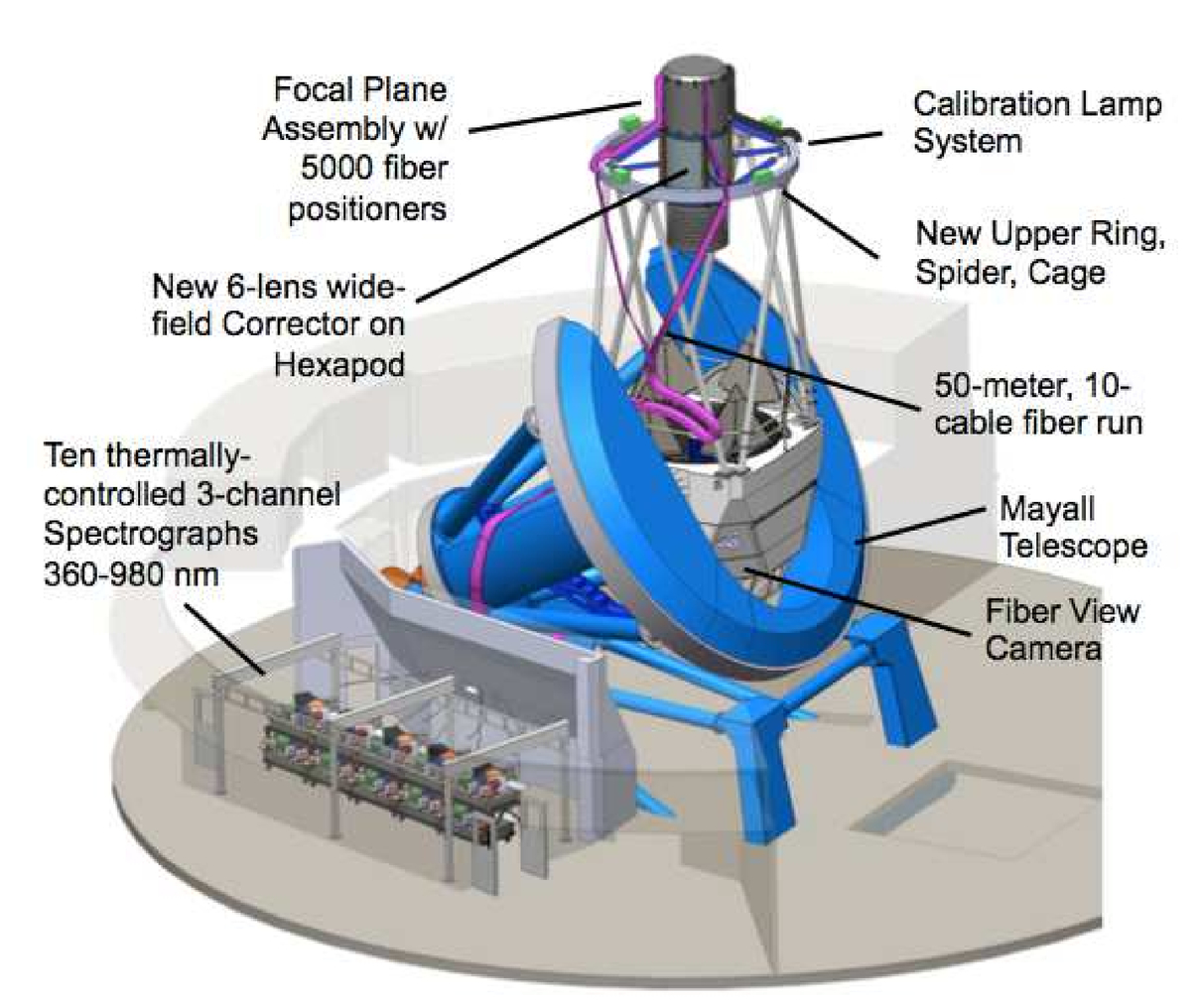
The setup of the Dark Energy Spectroscopic Instrument (DESI). New detectors and computer controlled fiber optics have been installed on the Mayall Telescope making it the most sensitive instrument for studying Dark Energy. (Credit: Spiedigitallibrary)

Retrofitted into the Mayall telescope at Kit Peak observatory outside of Tucson Arizona the DESI detector consists of a bundle of 5000 fiber optic cables, each with its own computer controlled positioning mechanism. The fiber optic cables lead to an array of 5000 spectrographs so that the combined telescope / detector will allow astronomers to accurately measure the position, magnitude and redshift of 5000 galaxies at a time. 

The DESI instrument, black object upper right, installed on the Mayall telescope. (Credit: Popular Mechanics)

First light for the DESI instrument came in September of 2019 and the ambitious five-year observation program is now well underway. Once completed the DESI will have obtained the position and redshift of 35 million galaxies allowing scientists to produce a 3D model of a large section of the Universe. This model will then provide the data needed to answer the question of whether the strength of Dark Energy has varied with time.

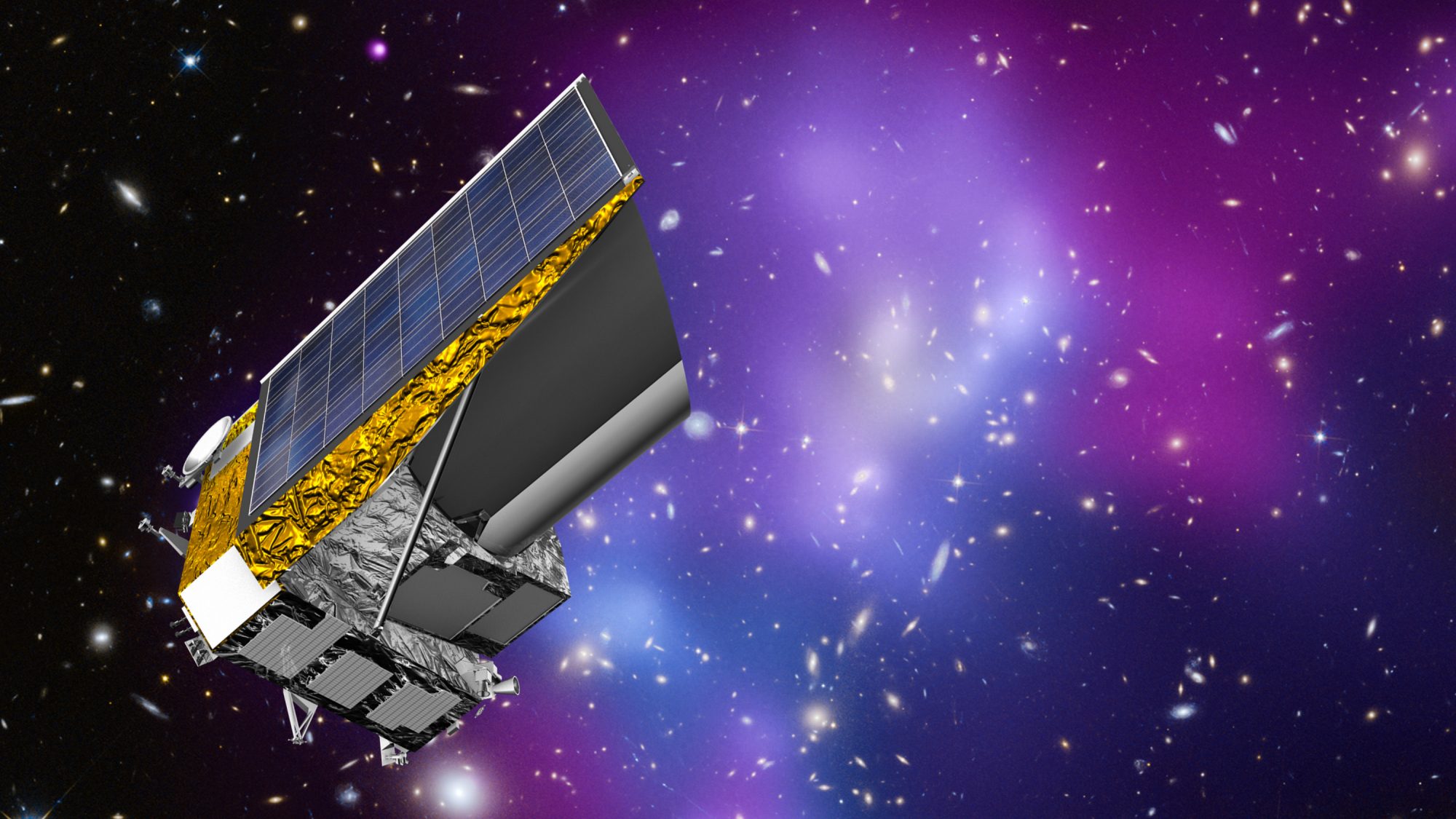
And there are other instruments that will soon be coming online that will compliment the observations of DESI. The 4MOST telescope at the European Southern Observatory is similar to DESI while the Euclid space telescope will also be observing galactic redshift versus distance from orbit.

The Euclid space telescope will also study the nature of Dark Energy. (Credit: Wikipedia)

 Now it is true that DESI will only tell physicists how Dark Energy changes with time nevertheless that information will be enough to enable them to eliminate many of the competing theories about its nature. So the theorists are anxiously awaiting the results of DESI and its companions, hoping that they give them direction in their effort to describe the entire Universe.

We’ve learned a great deal in the last 100 years about the structure and evolution of our Universe. I’ve little doubt that the next 100 years will bring just as many exciting discoveries.