Regular readers of this blog will have noticed that I have a deep interest in particle physics, also called high-energy physics, and in particular the so-called ‘ghost particle’ of the atom, the neutrino. Well after all my degrees are in physics and studying how the most elementary particles that exist interact is certainly the most basic way to understand how the Universe itself works. Also, my grad school advisor’s own research concerned neutrinos.
Neutrinos are a hot topic right now and a soon to be published paper is going to turn the temperature way up. The MiniBooNE experiment, which I discussed in some detail in my post of 2Dec2017, is detecting more neutrinos that calculations predict that it should and one possible explanation for the excess would be the existence of a fourth type of neutrino, a sterile neutrino. MiniBooNE is a cooperative experiment at Fermilab outside of Chicago, which produces the neutrinos the MiniBooNE detector. The image below shows the layout of MiniBooNE.

O’k a little background first describing the fermion or matter side of the standard model of elementary particles. Since the 1960s physicists have known that all of the matter we see around us, all of the atoms are built from four different particles. There is a pair of quarks called up and down who themselves make up the familiar protons and neutrons in the atom’s nucleus. There’s also a pair of leptons, the electron and the neutrino but while the electron orbits around the nucleus the neutrino is a ‘ghost particle’, rarely interacting with other particles.
If you think that sounds weird it gets worse. In the extremely high-energy collisions we generate in our modern atom smashers we have found that each of those four particles has two heavier, more massive cousins. The cousins of the up quark for example are called the charm and top quarks. The charm and top are identical to the up in every way except being more massive. They have the same electric charge, the same spin, the same weak charge, and same colour charge.
Similarly the down quark has two cousins named strange and bottom while the electron’s cousins are the muon and tau. Why these heavier cousins should even exist we have no idea but they certainly do.
There are three neutrinos as well but they simply called the electron-neutrino, the muon-neutrino and the tau-neutrino because they have the have the bazaar ability to oscillate from one type into another. One of the first attempts to study this oscillation property was called the Liquid Scintillator Neutrino Detector (LSND) at the Los Alamos back in the 1990’s. When the LSND found a surprising excess in the number of neutrinos some theoretical physicists suggested the existence of a fourth kind of neutrino, a sterile neutrino that would interact even less than normal ‘active’ neutrinos but which would oscillate like the others, in other words after a period of time it would become one of the other types. (I know how crazy that all sounds and I will tell you the math is almost easier to understand than the description!)
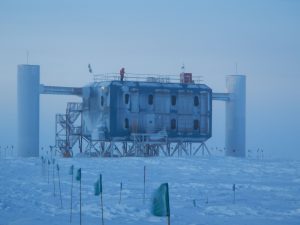
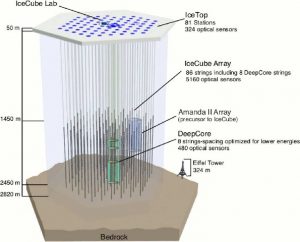
Other experiments quickly tries to find additional evidence of sterile neutrinos but failed. Both the Underground Oscillation Project with Emulsion-Tracking Apparatus Experiment in Switzerland and the Ice Cube Neutrino Observatory failed to discovery any hint of sterile neutrinos in their data. Physicists began to believe that there must have been some problem with the LSND data or its analysis. The Images below show the Ice Cube Neutrino Observatory in Antarctica.
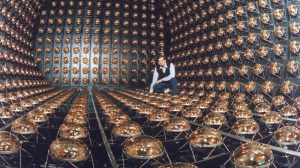
But now MiniBooNE has found the same signature of sterile neutrinos as the LSND had making physicists scratch their heads and wonder, what’s going on here? Perhaps one clue is that both LSND and MiniBooNE employ photomultiplier tubes to detect the energy released by a neutrino interacting with another particle while Ice Cube and the Underground Oscillation Project use other techniques. But whether the photomultiplier tubes are enabling the detection of sterile neutrinos, or are causing a false signal that is being interpreted as sterile neutrinos is as yet completely unknown. The image below shows the photomultiplier Tube array in the LSND. When in use the chamber is filled with water for the neutrinos to interact with.
Neutrinos have been leading physicists on both an exciting and yet very twisted journey ever since Wolfgang Pauli first predicted their existence back in the 1930s. I’m certain that there are a few more twists still to come.
Thank you for your blog post.Really thank you! Awesome.
It works quite well for me
Thanks for the comment. Works for me too!
Bob L
It works really well for me
Thanks for the comment. Hope to see you come back real soon!
Bob L
I every time spent my half an hour to read this webpage’s
content all the time along with a mug of coffee.
Wow, superb blog layout! How long have you been blogging for?
you make blogging look easy. The overall look of your site is magnificent,
let alone the content!
What i don’t understood is in fact how you’re
no longer really much more neatly-appreciated than you may be now.
You’re very intelligent. You realize therefore considerably on the
subject of this topic, produced me individually believe it from a lot of
numerous angles. Its like women and men aren’t involved except it is one thing to do with Woman gaga!
Your individual stuffs nice. Always care for it up!
Thanks for the comment and come back soon!
Bob L
I like the valuable information you provide in your articles.
I’ll bookmark your blog and check again here frequently.
I am quite sure I’ll learn lots of new stuff right here!
Best of luck for the next!
Thanks for the comment and come back soon!
Bob L
Aw, this was an exceptionally nice post. Spending some time
and actual effort to generate a very good article… but
what can I say… I put things off a whole lot and don’t seem to get nearly anything
done.
Thanks for the comment and come back soon!
Bob L
I know this website presents quality dependent articles or reviews and extra stuff, is there any other site which gives such stuff in quality?
Thanks for the comment and come back soon!
Bob L