The popular concept of a caveman, you know, an ignorant brute who carried a club and who solved every problem by hitting something with it has been around now since the first Neanderthal skeletons were discovered back in 1856. The more we learn about our Stone Age ancestors however the less brutish and ignorant they appear. In this post I’ll be discussing a couple of recent discoveries that add further evidence showing just how intelligent ‘Cave Men’ could be. As usual I will begin with the oldest study and go forward in time.
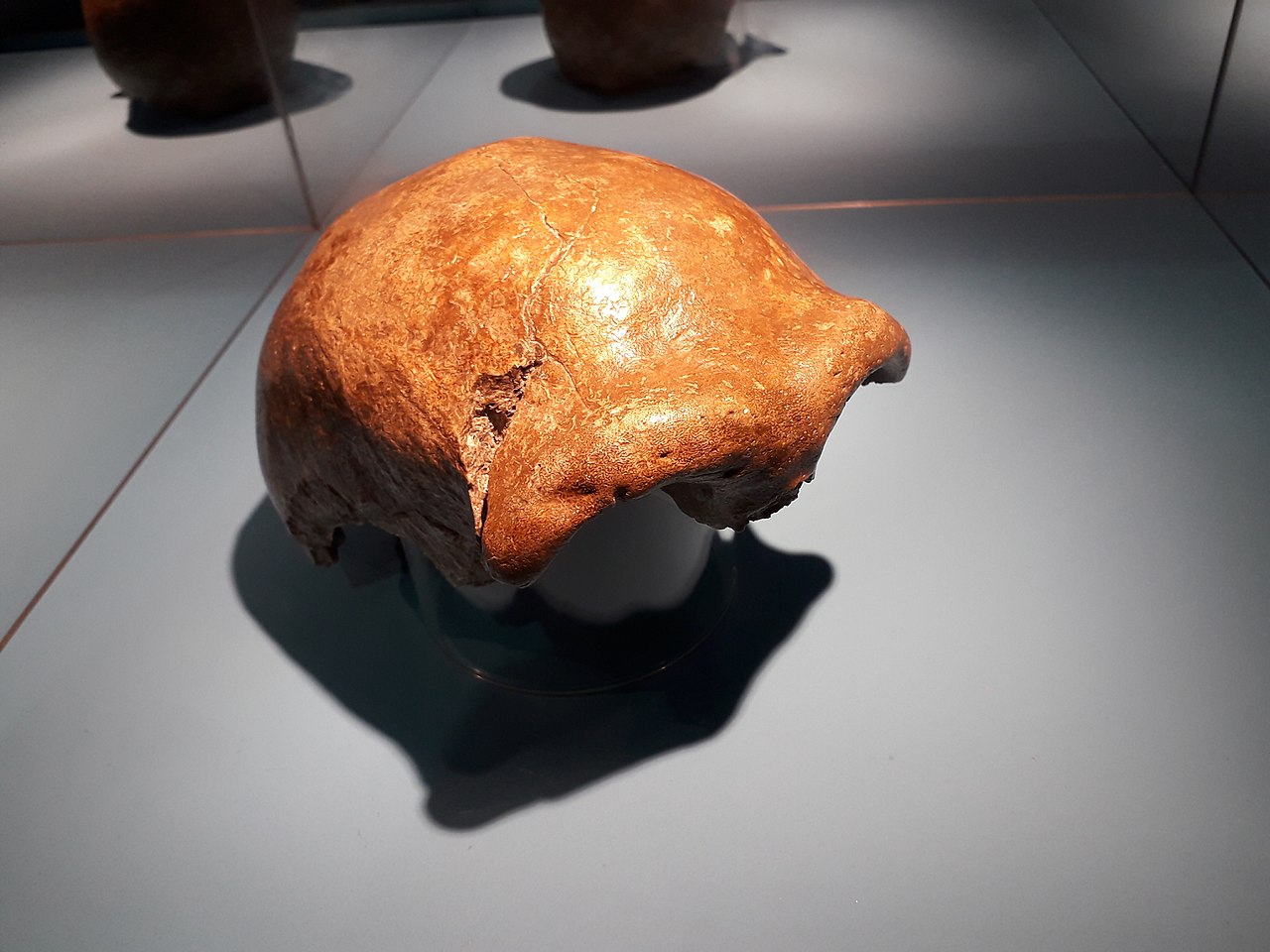
Neanderthal 1, the type specimen of the species is a skull cap that clearly shows the strong brow ridges above the eyes, a classic characteristic of Neanderthals. (Credit: Eunostos)
Just when did we humans begin to make tools, whether they be made from stone, wood or bone doesn’t matter, is a very controversial subject. The fact that even our relatives the chimpanzees use several different kinds of tolls indicates that our ancestors might have been using tools as long ago as five million years or more. Of course, using tools is a very different thing from making tools.
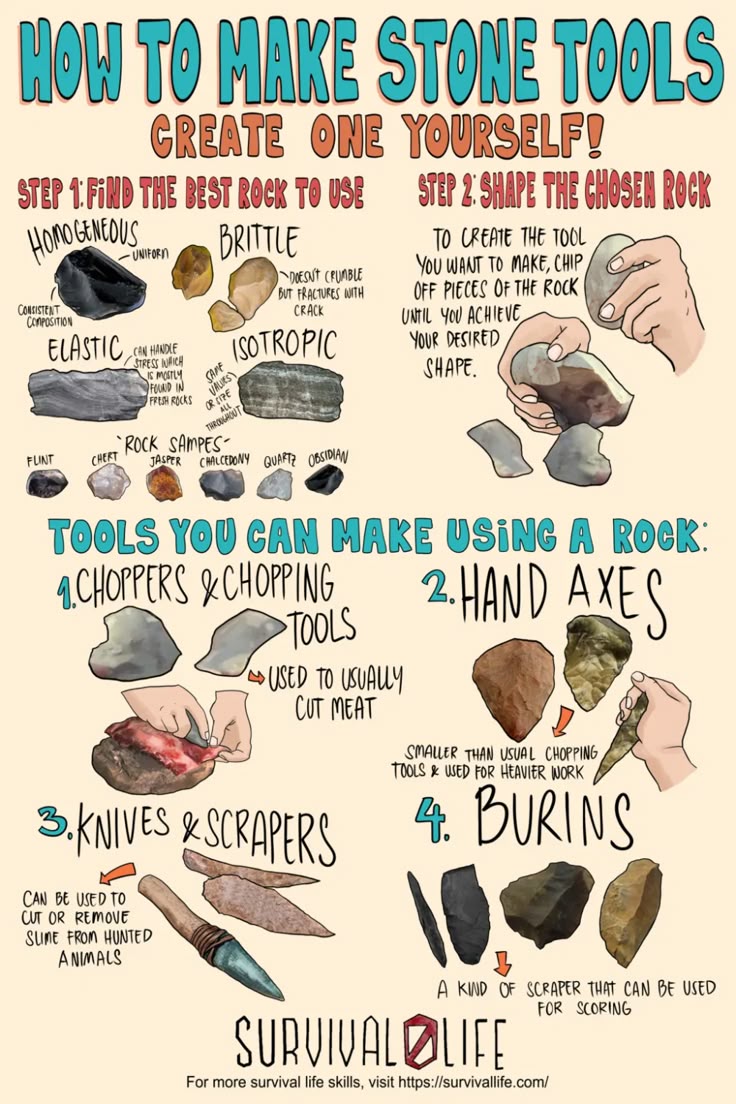
Chimpanzees have been known to pick up a stone and use it to break open a nut or similar food item. That’s a lot different from making stone tools however. (Credit: The New York Times)Eventually however, our ancestors learned how to manufacture a wide variety of stone tools. (Credit: Pinterest)
Picking up a rock to smash open a walnut takes a lot less thought than shaping that rock to have both an easy handgrip and a flat surface to crush the shell without damaging the nut inside. At the same time however, it is often difficult for an archaeologist to look at a rock today and tell whether it had been modified to become a tool a million or more years ago.
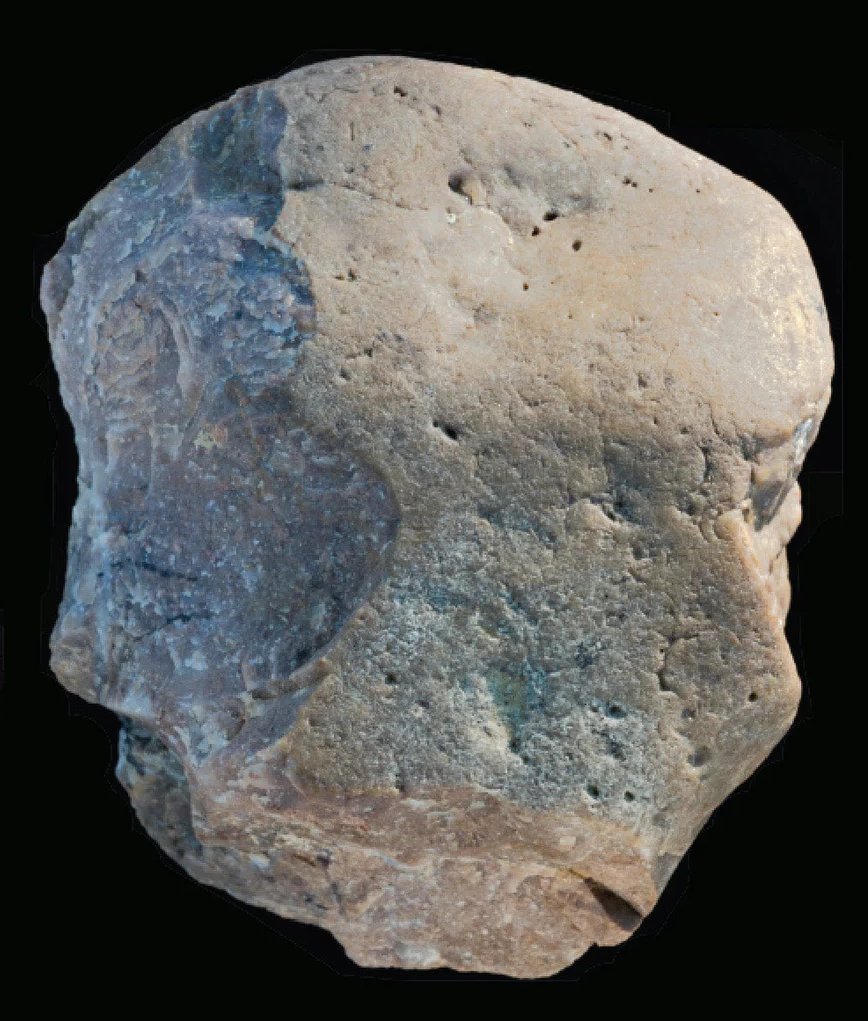
Is this a stone tool or just a stone? Sometimes even an expert has difficulty telling the difference. (Credit: The Guardian)
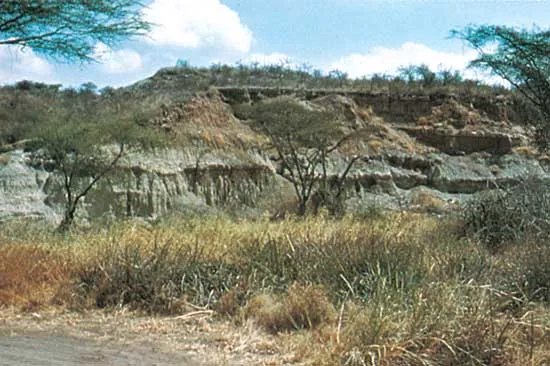
Now a paper published in the journal Nature has provided evidence that not only were humans making tools one and a half million years ago but that they were manufacturing tools at ‘factory’ sites according to a ‘standardized’ design. The site in question is at Olduvai Gorge in Tanzania the famous place where Louis Leakey discovered what is still considered to be the oldest species in our genus, Homo habilis.
Olduvai Gorge in Tanzania. It was here in the 1950s and 60s that the first evidence for our earliest human ancestor Homo habilis was unearthed. (Credit: Britannica)
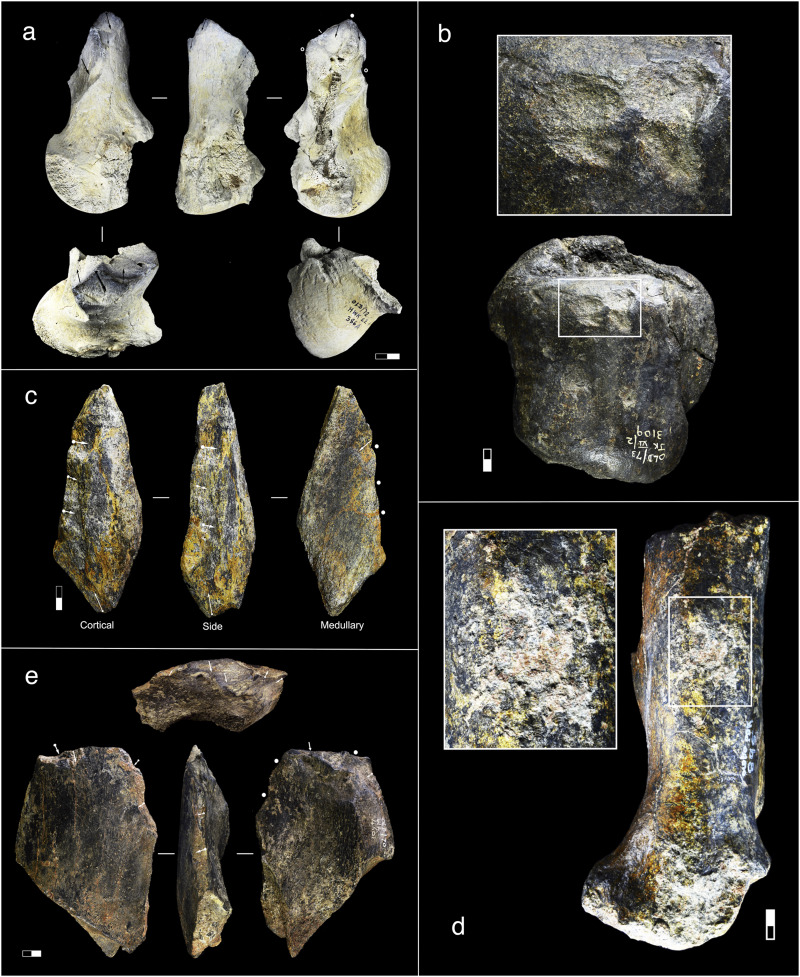
What the researchers from CNRS and the l’Université de Bordeaux discovered at Olduvai were 27 tools made from both the bones of hippopotamus’ and elephants all of which had been modified in a similar ‘standardized’ way. Prior to the discovery at Olduvai the earliest known ‘manufacturing site’ for tools was dated at just a half a million years old so the finds indicate that humans were capable of organizing and planning complex tasks far earlier than had previously been known.
Some of the bone tools found at Olduvai Gorge. (Credit: ScienceDirect.com)
And once our ancestors began to ‘manufacture’ goods in quantity at specific sites they then had to transport those goods to where they used them. One problem modern archaeologists have in trying to understand early transportation technology is that any ancient vehicle would have been composed of wood, wood that usually has decayed away a long time ago.
Everybody knows about the stone circles of the British Isles like Stonehenge but few people know that those ancient Britons also made a large number of wooden circles as well. The problem is that the wood has decayed over the centuries and the only evidence we have of the wooden circles are the post holes left in the ground. (Credit: Wikipedia)
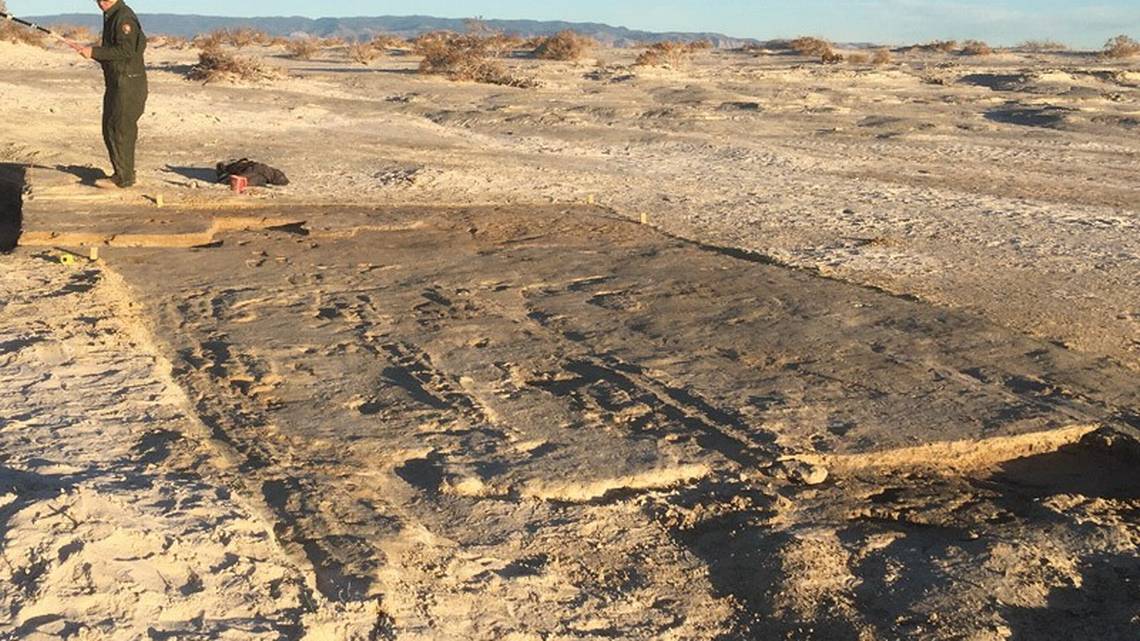
A new discovery in the desert of White Sands, New Mexico however had shown that even without the vehicles themselves we can still learn a lot about the ways that our ancestors transported their goods thousands of years ago. Drag marks in the same sediment as, and intermingling with human footprints have been unearthed in 20,000-year-old dried mud. The drag marks are of two kinds, either a single line furrow with footprints on both sides or two lines in parallel with footprints usually inside the lines.
A section of the ‘fossilized’ track marks made nearly 20,000 years in White Sands National Park. (Credit: Sacramento Bee)
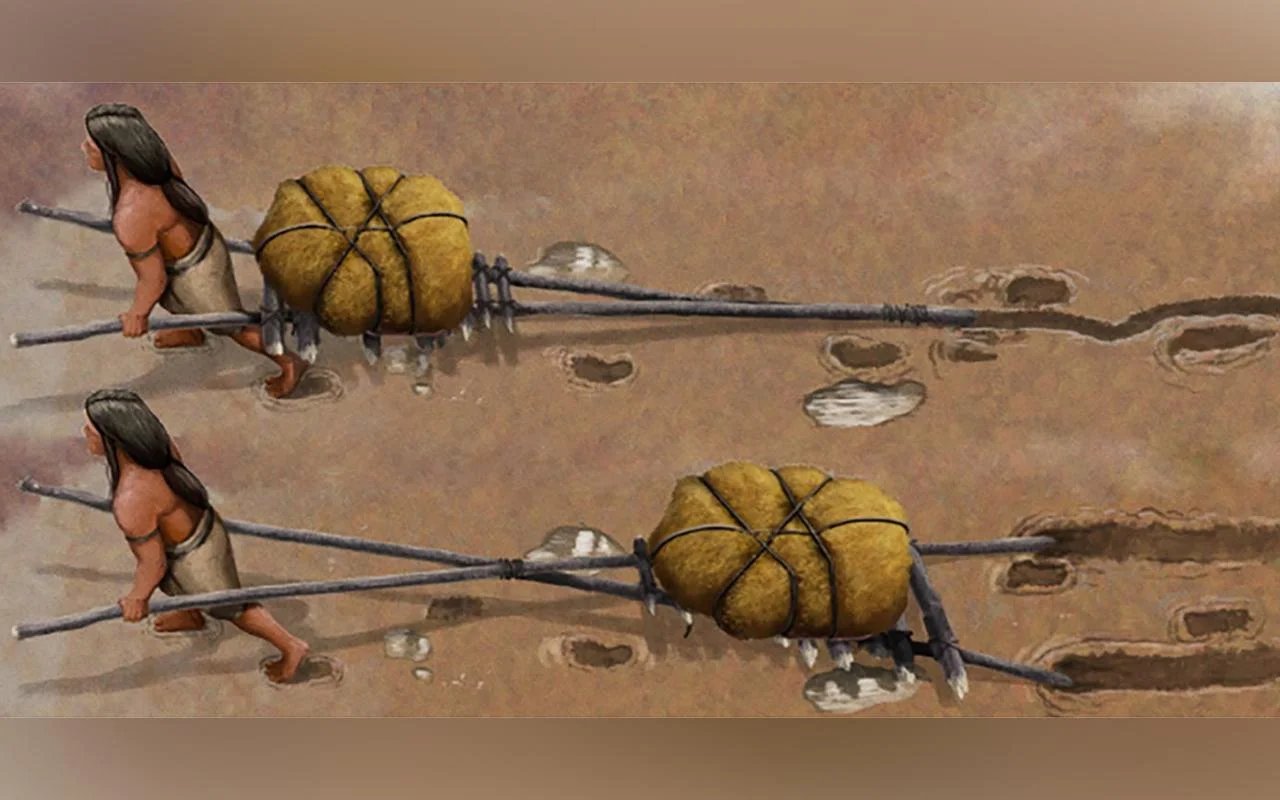
The researchers from Bournemouth University in the UK who discovered the tracks think that the lines were made by a type of unwheeled vehicle known as a travois, basically wooden poles tied together to form a ‘Y’ shape, the single line, or ‘X’ shape, the parallel lines. The goods that were to be carried were then secured on top of the poles and the whole vehicle dragged along the ground. For a culture that hasn’t invented the wheel yet that’s about as good a transportation technology as you can get.
The track marks made at White Sands came from two different types of vehicles. The single line was made by a ‘Y’ shaped wooden vehicle (top) while the parallel tracks were made by an ‘X’ shaped wooden contrivance (bottom). (Credit: Archaeology News)
Alongside the footprints of the adults who were presumed to be dragging the travois the archaeologists found the footprints of children indicating that these were entire family groups on the move. Some of the drag marks are as long as 50m and the fact that there were no animal footprints indicates that the travois were in use before the people of North America had domesticated animals. Thousands of years later the people of North America were known to use dogs to drag their travois. Even back in the Stone Age our ancestors were thinking, trying different techniques in order to make their lives better. They passed that wisdom on to their descendants, who in the long run passed it on to us.
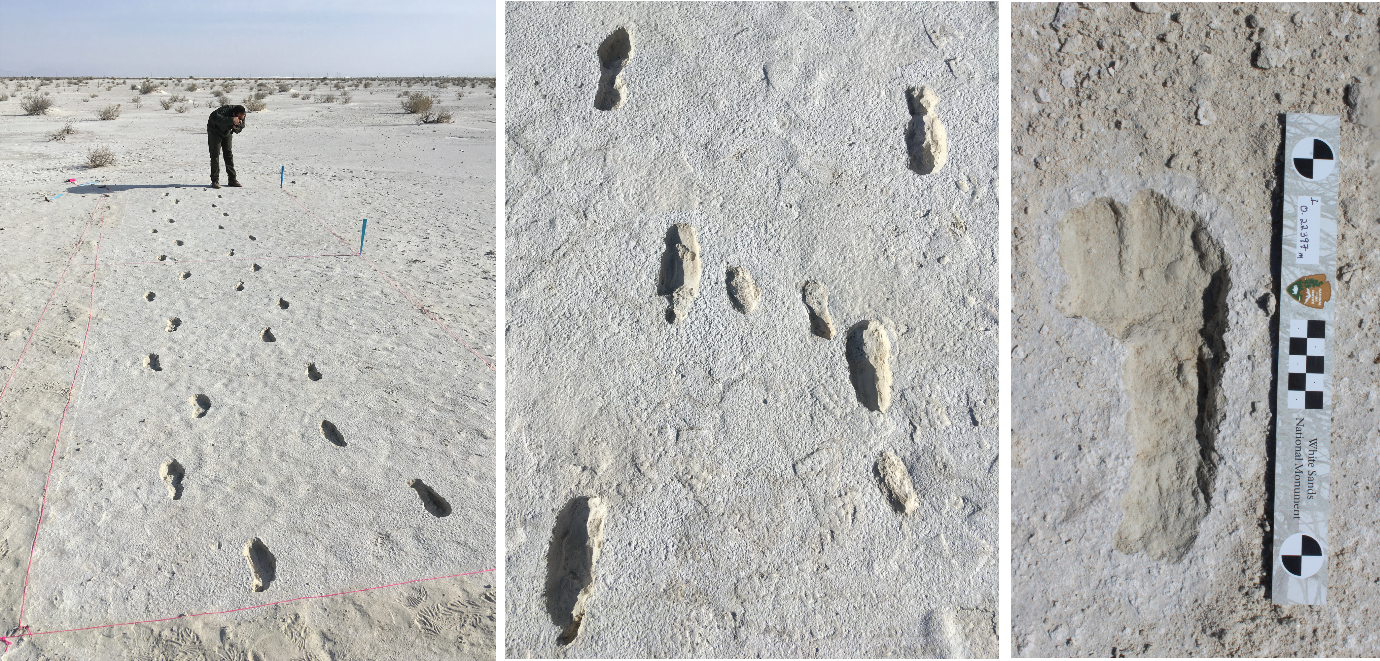
Some of the footprints made at White Sands thousands of years ago. In the middle picture you can see how there are two different sizes of prints indicating that children walked along with their parents, just like we do today! (Credit: National Park Service)
We are all aware of how important the stock market is to our nation’s economy as a whole. At the same time we all have some notion of the markets as being those places where ‘shares’ in the big corporations that make up so much of the economy are bought and sold. Few of us however have more than vague idea of many of the various terms that get mentioned every time the stock market is discussed. Often, the many terms that economists and financial experts use seems like words from a foreign language.
Economists and Market Analysts have their own special language and if you want to understand what’s happening in our economy you need at least some familiarity with the terms they use! (Credit: Investments IQ)
So, in this post I’m going to try to explain some of those terms in simple enough language so that hopefully those of you out there who aren’t finance types can understand the ups and downs and ins and outs of the market. I think I’ll start with an example that’s easy to understand, a privately owned small business.
The majority of our economy still consists of small, privately owned businesses. However small shops and markets like this one can get swamped by economic downturns caused by the big corporations. (Credit: Common Edge)
Consider a barbershop or beauty shop, such a small business is almost certainly owned by a single person, the head barber or beautician. Now the shop may have a few employees as well, but they get paid a flat salary. Whatever profits the business makes go to the owner alone, along with all of the losses if there are any. Now owning a small business is complicated enough, usually the owner had to take out a bank loan to start the business, and there are always things like insurance, legal permits and so on. However, a small business, owned by a single person at least doesn’t have to worry about the price of any stock in that business.
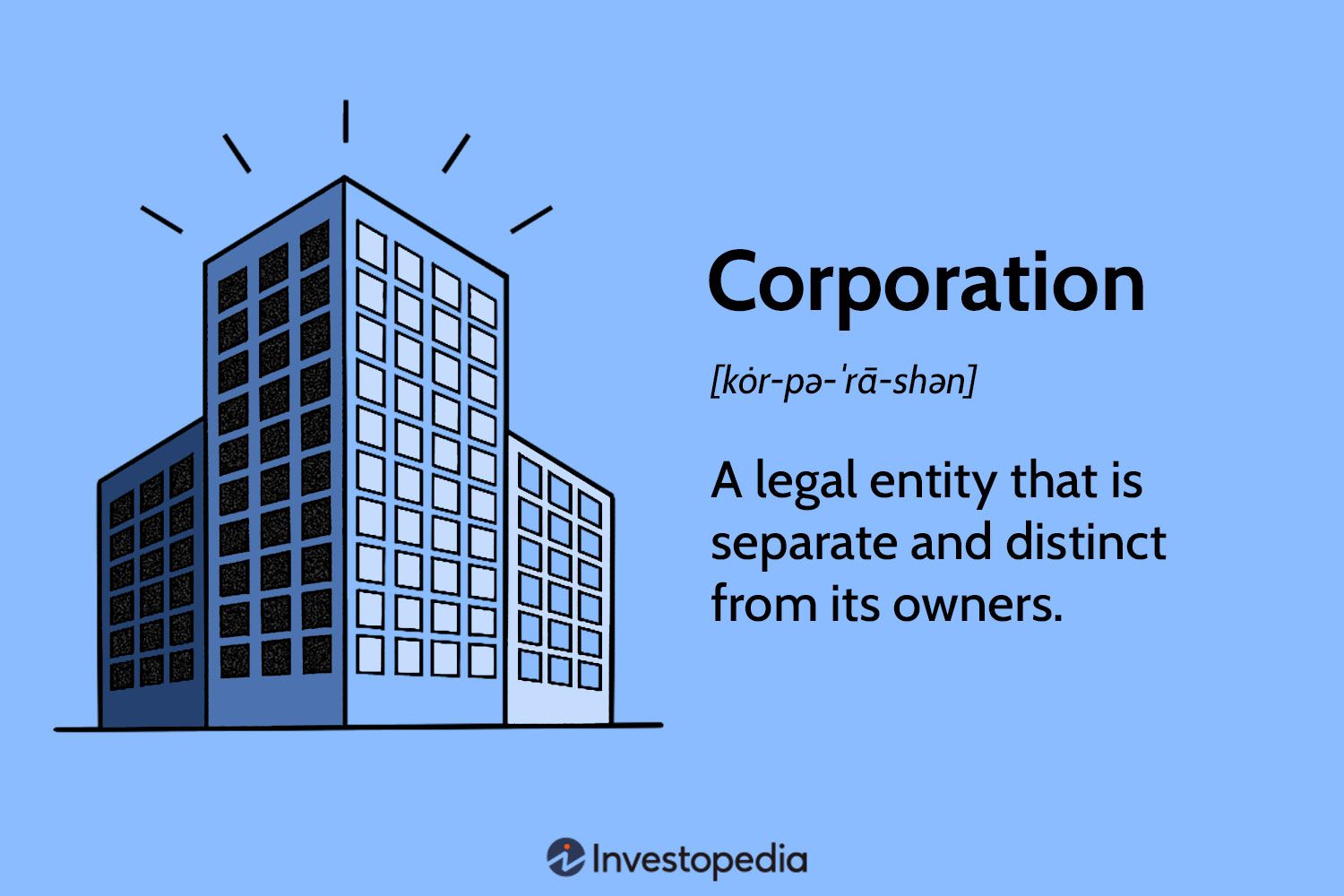
Mitt Romney got into trouble but stating that “Corporations are people too!”, but it is true that corporations do have many of the same legal rights that you and I have! (Credit: Investopedia)
That’s a small business; a larger business or company may decide to register itself as a ‘Corporation’, which strictly speaking can be any group that is legally allowed to act as a single entity. In business terms when a group of people called ‘Investors’ come together to form a company they will incorporate that company. If the investors each contribute equally to the formation of the corporation then they will each receive an equal share of whatever profits the corporation makes.
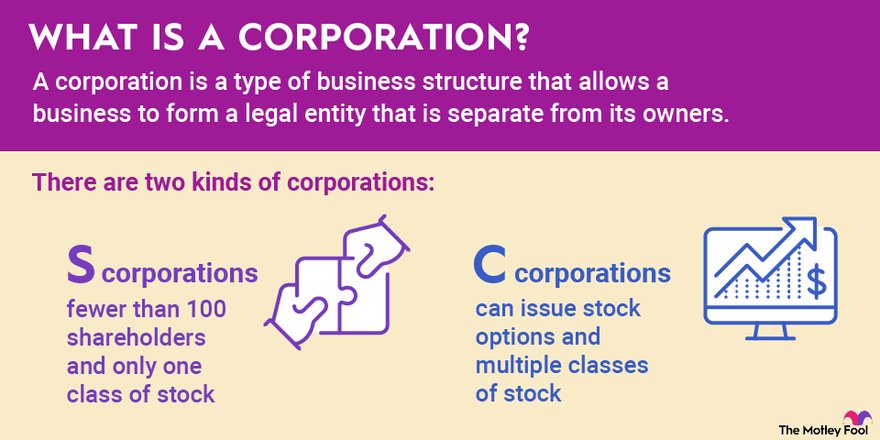
Small corporations can register as ‘S’ corporations while larger firms prefer to register as ‘C’ corporations. (Credit: The Motley Fool)
Oftentimes however the investors do not contribute equally to the new corporation. In that case the corporation may issue ‘Stocks’ that represent a certain share of the total value of the company. For example if the corporation issues 100 shares of stock then each share of the stock is worth 1% of the total value of the company and each share will receive 1% of the profit. (Usually a corporation issues a lot more shares of stock than that, often millions of shares.) The investors now become ‘Shareholders’ with each receiving a number of shares proportional to their investment.
The most often traded type of corporate stock is known as common stock. Buying a share of common stock is actually buying a portion of the company that issued the stock. (Credit: Investopedia)
Now the whole purpose of forming a corporation of course is to make money, and the total sum of all of the money that a company makes is formally called its ‘Revenue’. ‘Expenses’, on the other hand are the costs that any company must pay in order to do business, expenses include but are not limited to paying employees, purchasing materials, paying for utilities like electricity and water, rent for buildings or building maintenance.
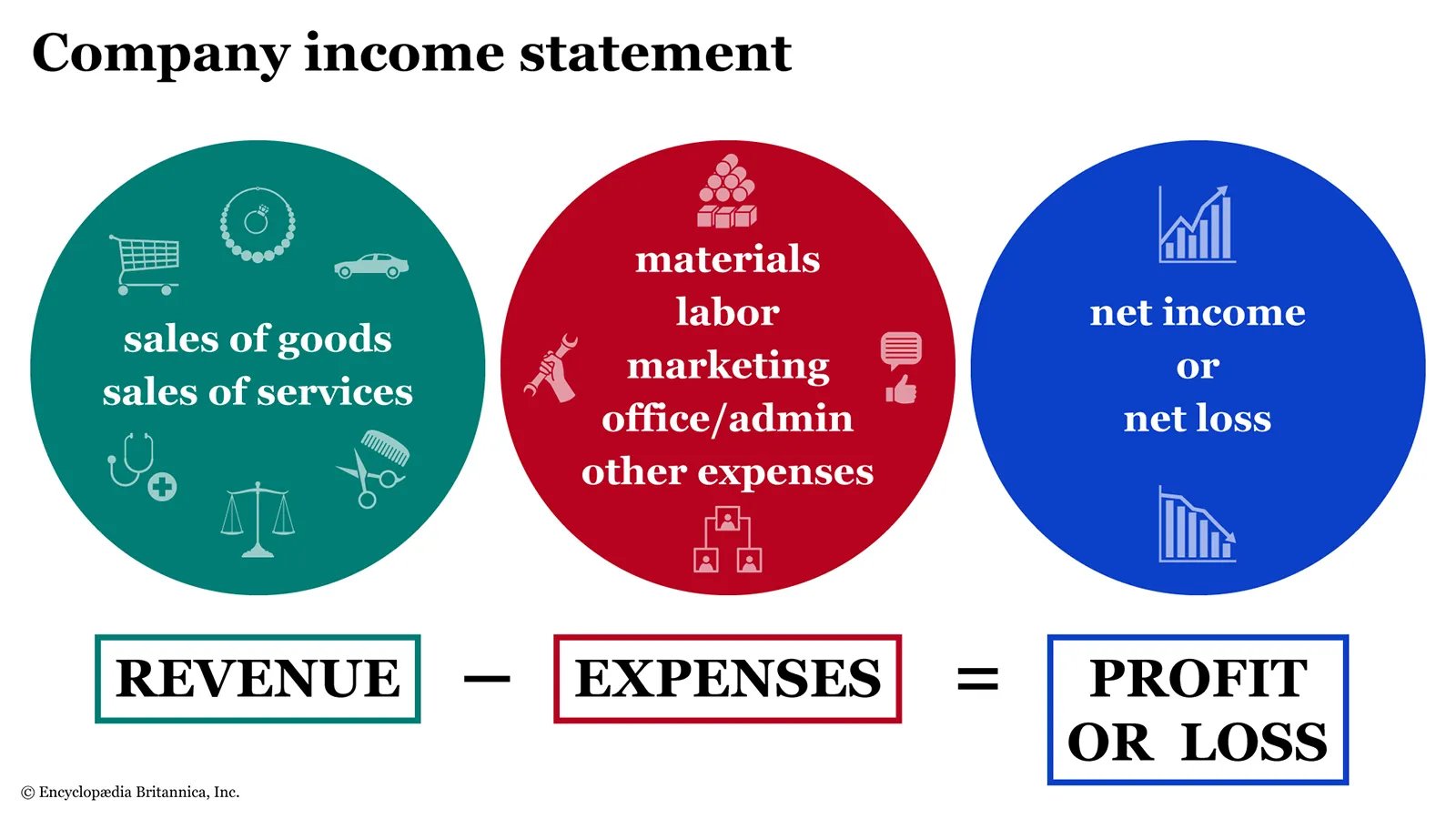
Pretty much says it all. Whatever money a company makes minus the costs of doing business is the profit that shareholders receive, if there is any profit. (Credit: Britannica)
Revenue minus expenses is the ‘Profit’ that company makes, unless of course expenses are larger than revenue in which case the company has suffered a ‘Loss’. Whatever profit a company makes is then divided amongst the shareholders on an equal basis for every share, this is known as either a ‘Dividend’ or “Earnings per Share’ (EPS). Dividends can be issued by a company on an annual, semi-annual, quarterly or even monthly basis. Which depends on the company.
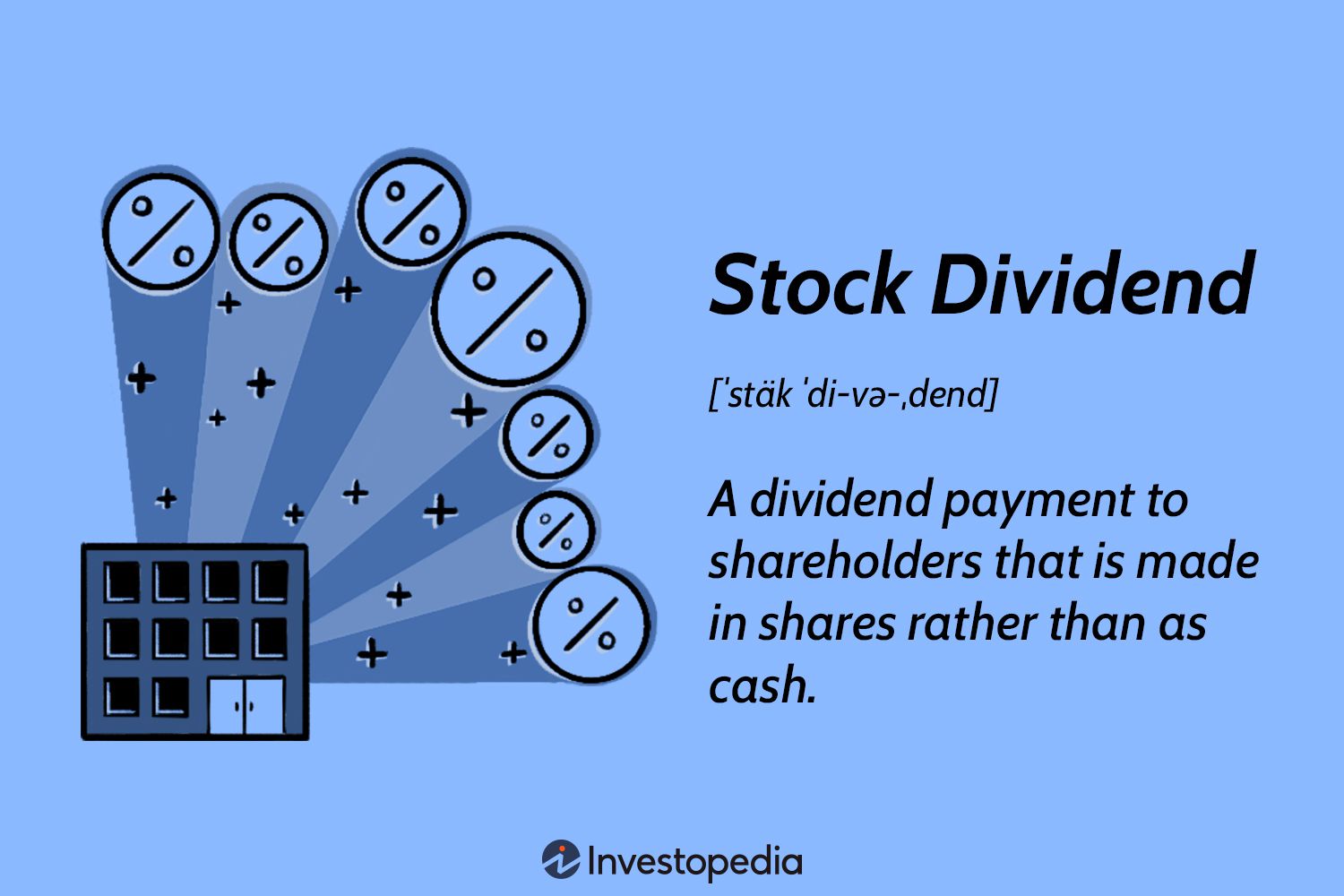
Investors can sometimes arrange for their share of the profits, their dividends to get paid in more shares of the company’s stock! (Credit: Investopedia)
Obviously, the value of a share of stock depends greatly on the size of the dividend the company pays for each share of its stock, everything else being equal a stock that pays a dividend of $10 per share per year is worth ten times more than a stock that pays a dividend of $1 per share per year. Another important quantity that financial experts often use is known as the ‘Price per Earnings Ratio’ or P/E. This is simply the price of a single share of stock divided by the total dividends earned by that share over a year. What P/E works out to be then is the number of years you would have to own a share of that stock in order for its dividends to cover the cost of having bought the stock in the first place. Obviously the lower the P/E of a stock the less time it takes for the dividends to pay for the stock and therefore the more valuable the stock is.
When you are looking to buy a stock, you want the P/E ratio to be small so that you get big earnings for the price you paid for the stock! (Credit: The Motley Fool)
O’k, so now let’s say that one of the stockholders in a company wants to sell their stock, or someone who is not a stockholder in a company wants to become one. We all know that the buying and selling of shares of stock has become an enormous business in itself and takes place at ‘Stock Markets’ or ‘Stock Exchanges’. The oldest stock market in the Unites States is actually the Philadelphia Stock Exchange, which first began trading in 1790 but of course the largest exchange in the entire world is the New York Stock Exchange, which first began trading in 1792 and which today lists 2,132 companies whose stock can be bought or sold there.
The New York Stock Exchange in all its glory. Time is money so the buying and selling of stocks is carried out at a frantic pace. (Credit: Bloomberg.com)
As in any marketplace the prices of stocks at an exchange can go up or down depending on supply and demand. I said above that the size of a stock’s dividend is the primary thing that determines a stock’s price but investors can also speculate that in the future a company is going to do better, or worse and that speculation can drive a stock’s price up or down, as can opinions about the overall health of the US economy.
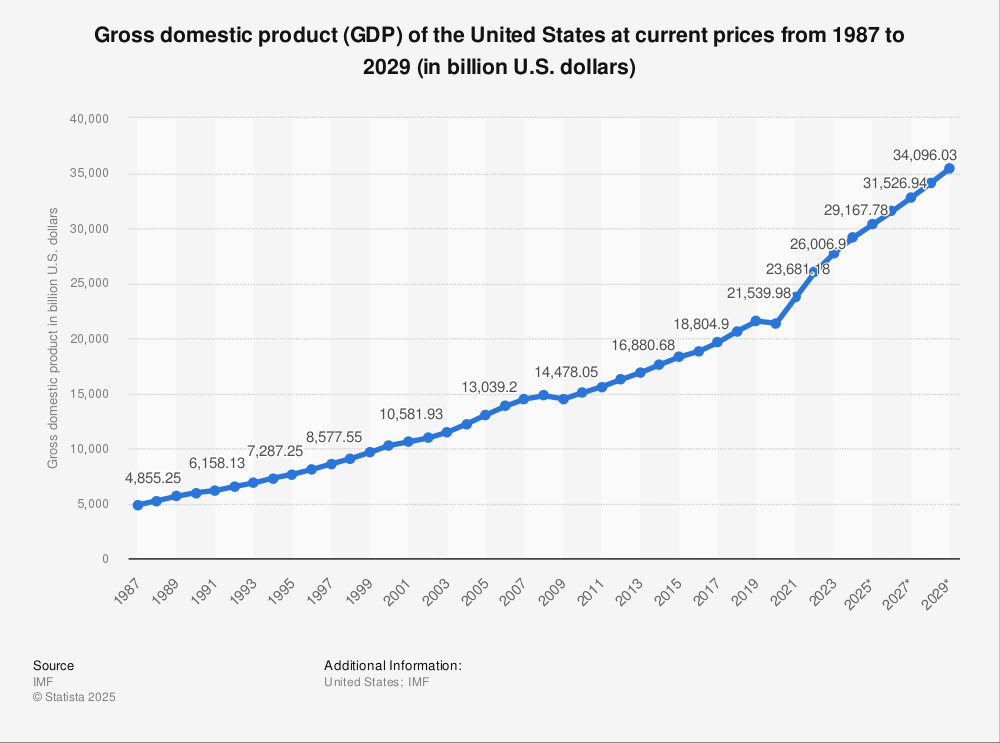
An increasing Gross Domestic Product (GDP) means that the economic health of the country is good. In these times you would expect stock prices to rise as investors try to profit from the increase in overall wealth. (Credit: Statista)
Once a company’s stock is listed on an exchange is becomes possible to calculate the total value of that company, a quantity known as ‘Market Capitalization’ or Market Cap. Market Cap is simply the current price of a share or the company’s stock multiplied by the total number of shares the company has issued. For example assume a company has issued 100 million shares of stock and at the end of a trading session the price per share is $10, in that case the total value of that company is considered to be $1 billion dollars.
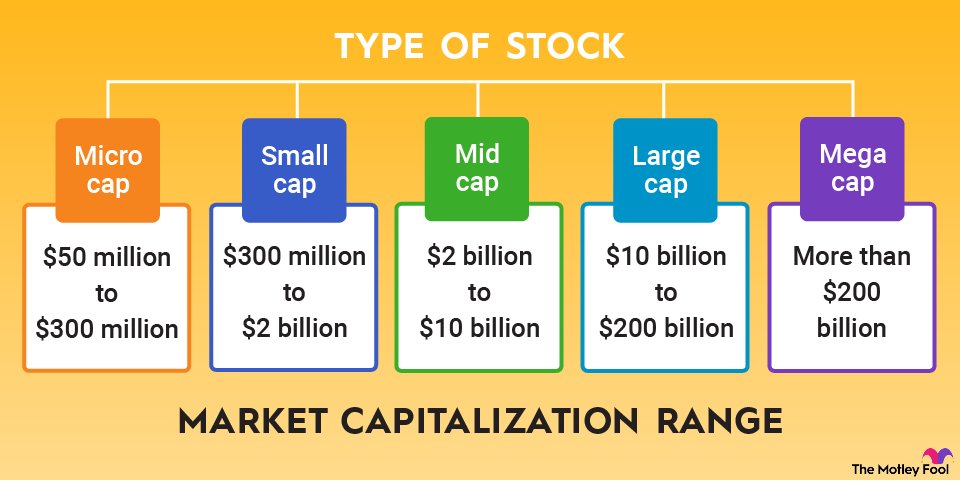
Companies come in all sizes so Wall Street has invented names that relate to a firm’s Market Cap. (Credit: The Motley Fool)
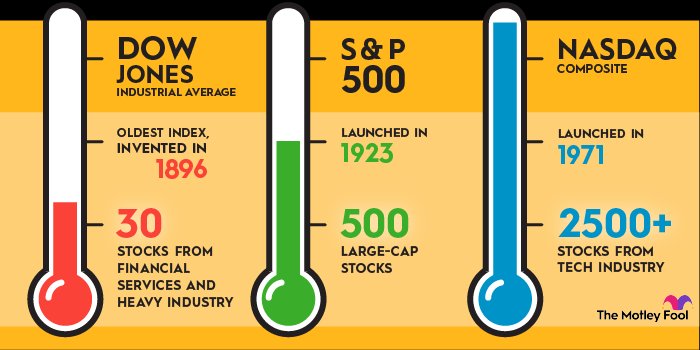
Now with over two thousand of our country’s biggest companies being traded every day the performance of the New York Stock Exchange, NYSE, is an important measure of just how the United States economy is doing as a whole. The problem is that measuring the daily performance of over 2,000 stocks, some of which will go up and some of which will go down is not an easy thing to calculate, especially back in the days before electronic computers. That’s why a number of different ‘Averages’ were developed, the best known of which is the ‘Dow Jones Industrial Average’ or simply the Dow. Begun in 1896 the Dow is an average of the stock value of thirty of the biggest companies in the US, known as Dow components, but spread over number of different industries. In other words the Dow is not just the 30 biggest companies, it’s the biggest financial services companies like J.P. Morgan Chase and Goldman Sacks along with the biggest retailers like Walmart and Amazon plus the biggest information services like Apple and IBM. By spreading its components over different industries the Dow became a quick peak at the entire US economy and since it only had 30 companies it could be calculated on a daily basis.
The three main indexes for understanding the health of the financial markets as a whole are the Dow Jones, The S&P 500, and the NASDAQ. (Credit: The Motley Fool)
With the advent of modern computers it has become possible to calculate the Dow average almost instantaneously, and there are now other averages as well including the ‘Standard and Poor’s 500’ S&P 500 which is the 500 biggest companies in the NYSE along with the NASDAQ 100 which is the 100 biggest companies on the NASDAQ stock exchange. In fact our new ability to monitor thousands of stocks moment by moment has only increased the volatility of stock prices allowing speculators to drive prices up or down so that they can make a quick profit.
At stock exchanges nowadays there are more computers than traders as keeping up with stock prices is something only a computer can handle. (Credit: Investopedia)
There has always been an aspect of gambling to any commodities market, including the stock market. There are always investors who think they have some inside information that allows them to pick short-term winners and losers causing market fluctuations that can hurt the long-term strength of an economy. Maybe it’s just my opinion but while investing in stocks is good for the economy, it does enable companies to secure the money they need to grow after all, turning the markets into casinos with winners and losers is not in anybody’s interest.
Compare this image of a casino floor to that of the stock exchange above. As far as I’m concerned the gambling aspect of stock markets hurts our economy. (Credit: Century Casinos)
And I think I’ll let it go at that. If there’s anyone who thinks I made this brief outline of what the many terms associated with the stock market mean either too simple, or too complicated well I tried my best. Hopefully a few people out there learned something, and that was my intent.
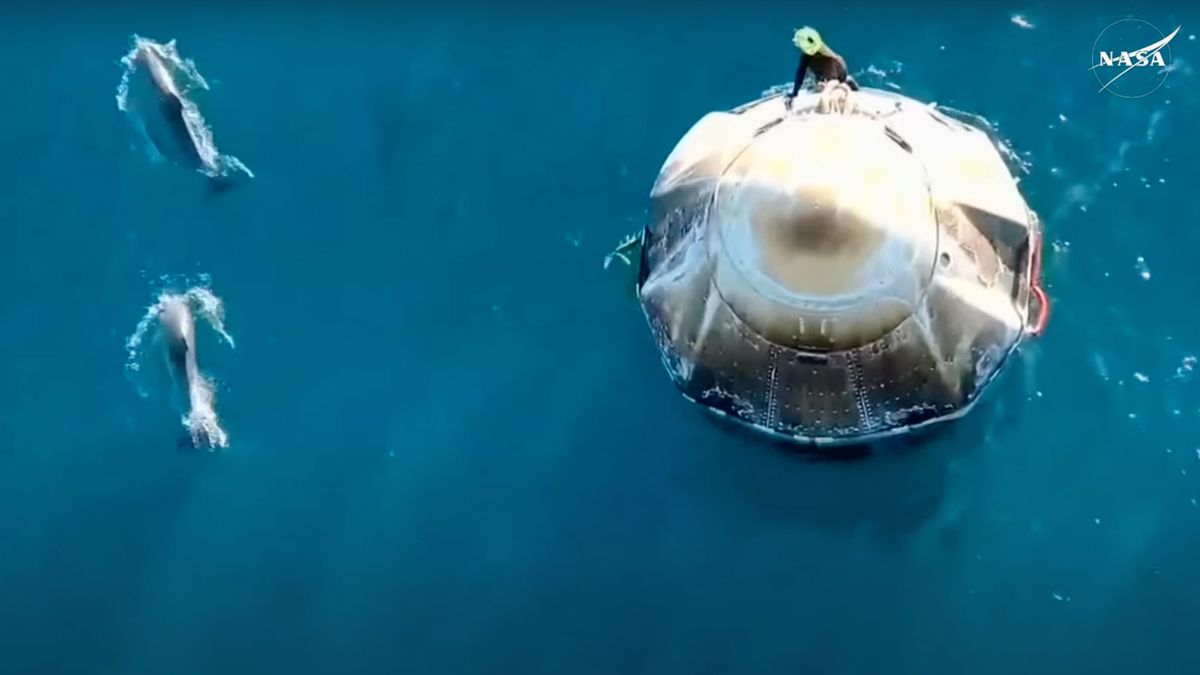
On Tuesday the 18th of March a Space X Dragon capsule returned to Earth carrying the four Crew 9 astronauts completing their mission at the International Space Station (ISS). Those astronauts had two days earlier been relieved at the ISS by four Crew 10 astronauts who will now crew the station until at least July.
When the Crew 9 astronauts, including the Starliner crew, splashed down in the Gulf of Mexico their welcoming committee included a pod of Dolphins! (Credit: Space.com)
In many ways the splashdown of the Dragon capsule in the Gulf of Mexico off the coast of Florida represented just another routine crew transfer for Space X. The long saga of Crew 9 however was anything but routine, for two of the astronauts returning to Earth were originally the crew of Boeing’s Starliner capsule on its first manned mission to the ISS. The Starliner crew only became a part of Crew 9 when NASA decided they did not trust Starliner to safely bring them back home.
The Starliner Crew of Suni Williams (l) and Butch Wilmore (r) got to spend a lot more time in space then they had originally expected. (Credit: Newsweek)
It’s a long story that I’ve already discussed in several past posts, see my posts of 20 July 2024 and 31 August 2024. In brief astronauts Suni Williams and Butch Wilmore were assigned by NASA as the test pilots for Boeing’s Starliner capsule which was intended to both compliment and compete with Space X’s Dragon capsule in transferring astronauts to and from the ISS. After many years of technical problems and delay the Crew Flight Test (CFT) was finally launched on the fifth of June 2024 and reached the ISS after more problems while in orbit.
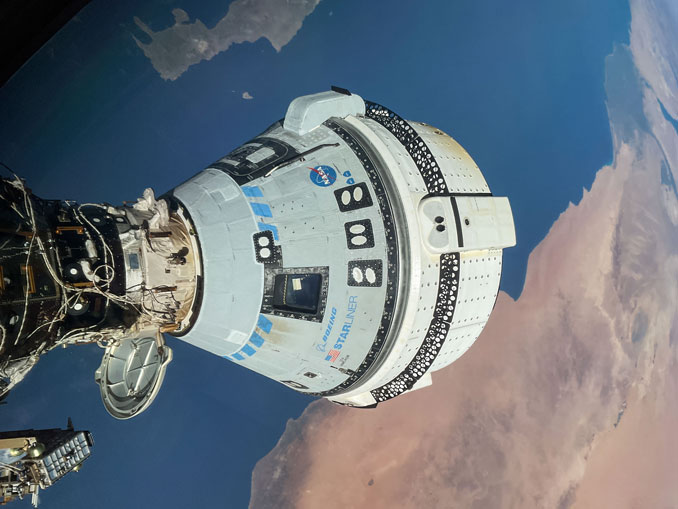
Boeing’s Starliner capsule docked at the ISS. Turns out that the crew completely lost control of the spacecraft for several seconds just prior to docking, a very dangerous turn of events that could have caused a real disaster! (Credit: Spaceflight Now)
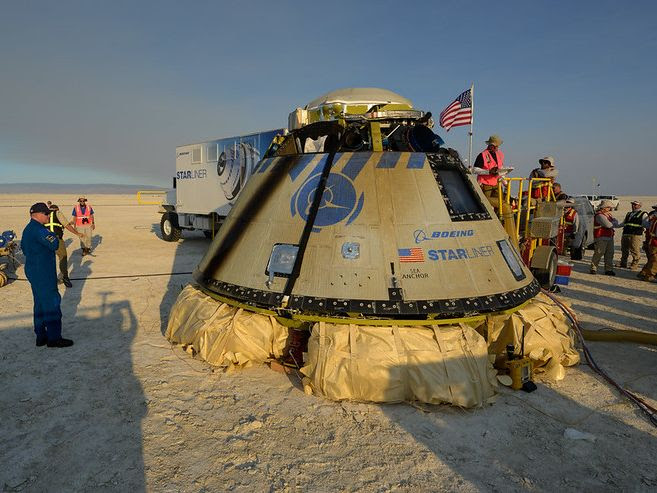
Astronauts Williams and Wilmore were only supposed to remain on the ISS for eight days but NASA engineers spent more than a month trying to understand and fix the problems with Starliner’s thrusters. In the end it was decided that Starliner was too untrustworthy to risk returning from orbit with astronauts aboard so the Starliner capsule was brought back unmanned.
In the end NASA ordered that Starliner be returned to Earth unmanned. It turned out to be the most successful part of the mission. (Credit: HamletHub)
A special rescue mission using a Space X Dragon capsule was considered but in the end NASA decided to send the next scheduled crew transfer mission, Crew 9, with only two rather than the usual four astronauts. Williams and Wilmore then became the other two Crew 9 astronauts and would return to Earth when Crew 9 was relieved by Crew 10. In all, the eight-day mission for Williams and Wilmore turned into a nine month mission.
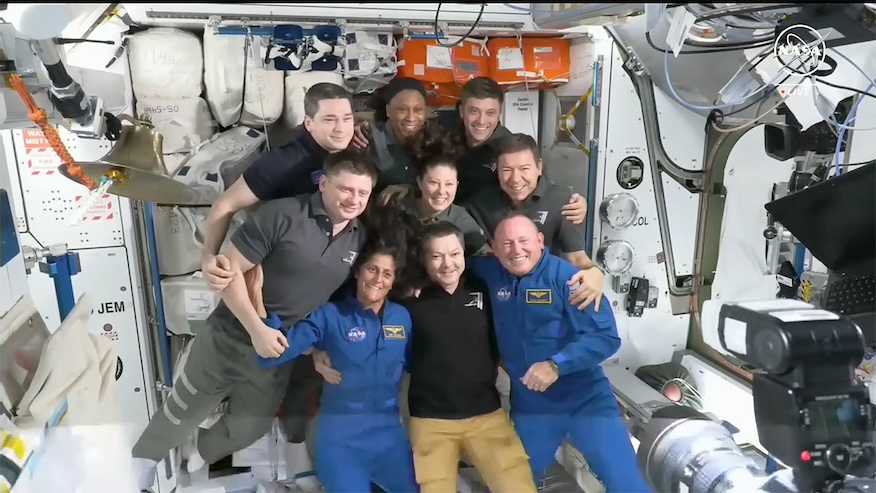
The Starliner crew, in blue uniform, with the regular crew of the ISS with whom they’d spend the next nine months. (Credit: Spaceflight Now)
So with Williams and Wilmore now safely back on Terra Firma the question for NASA is, what to do with Starliner. Boeing has yet to demonstrate that the eight billion dollar capsule can complete a mission without problems. To make matters worse for Boeing the ISS is scheduled to be de-orbited in five years so there are a maximum of about eleven regular crew transfer missions left for Starliner to take part in.
NASA has hired Space X to modify one of their Dragon capsules as a re-entry module to bring the ISS down into the middle of the Pacific Ocean in 2030. That re-entry would be something to see! (Credit: YouTube)
Currently NASA is considering their options. At a briefing on March 9th, shortly before the launch of Crew 10, it was announced that Boeing and the space agency were “making good progress” and had resolved 70% of the issues that Starliner had developed during its CFT. If that is so it seems that another CFT is unlikely to be carried out before this time next year and even if everything in that test goes smoothly a regular crew transfer mission can hardly be set up before early 2027.
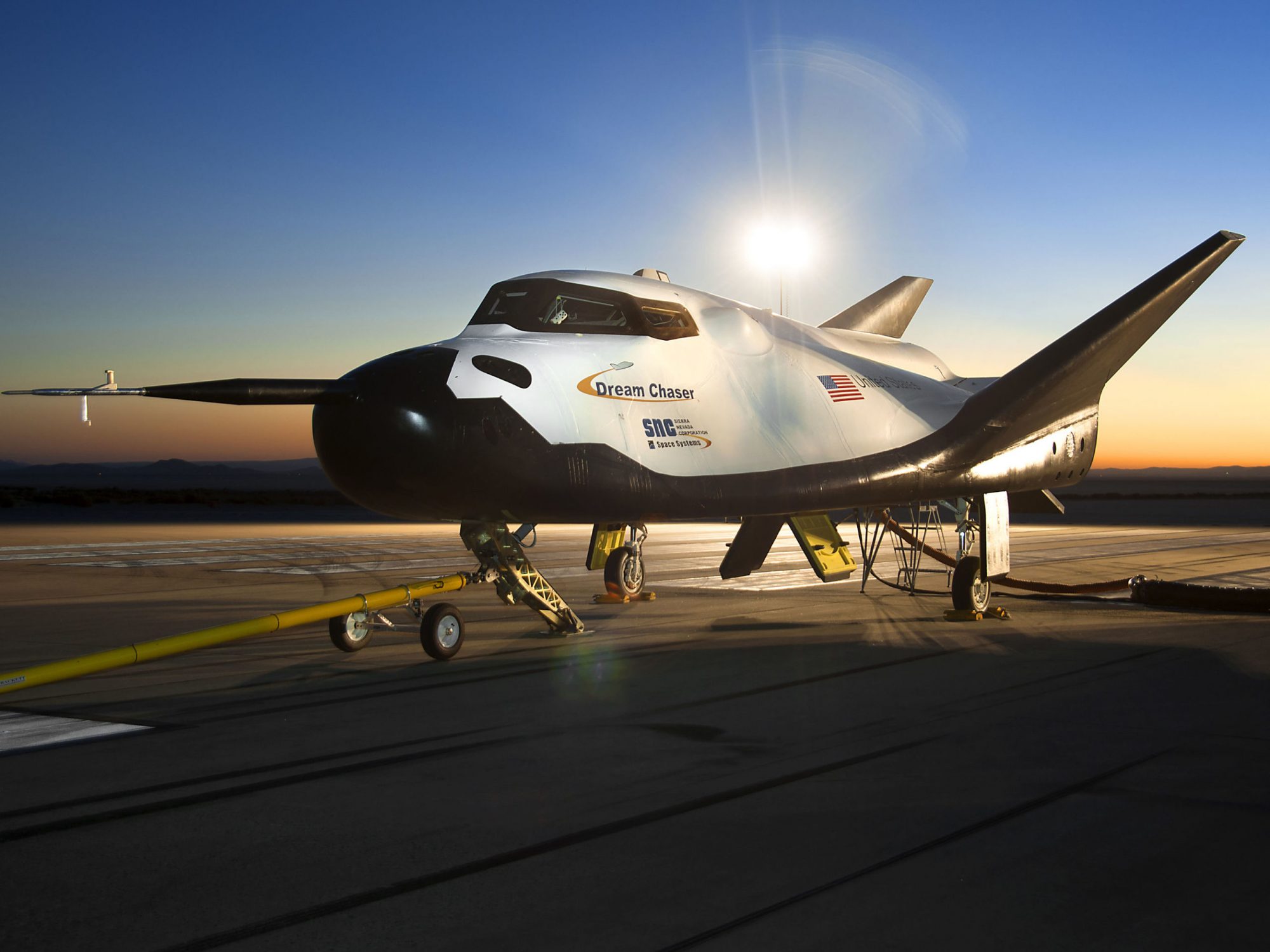
In addition to Space X’s successful Dragon capsule Boeing is going to have to compete with Sierra Nevada’s Dream Chaser space plane. (Credit: Popular Mechanics)
There are even rumours coming from Boeing that the aerospace corporation might be considering giving up on Starliner. After all there is now little chance that Boeing can recoup the losses that they have incurred due to Starliner on a few missions to the ISS before it is de-orbited. Add to that the damage to Boeing’s reputation if there are any further problems with Starliner. At the same time however there are plans in the works for several commercial space stations to replace the ISS and Boeing would certainly like to use Starliner to secure a portion of the business of taking astronauts back and forth to them.
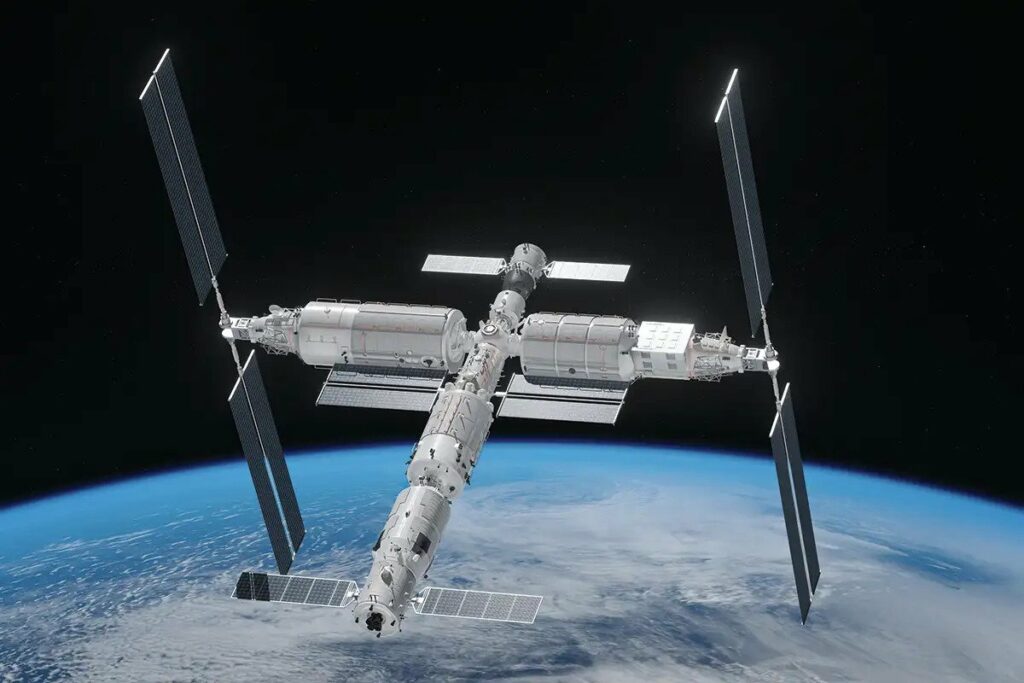
There are a lot of commercial space stations currently on the drawing board. How much of the business of keeping them manned and supplied Boeing’s Starliner will get is very much up in the air! (Credit: Universe Space Tech)
A few paragraphs above I mentioned that the current plan for the ISS is to de-orbit the aging space station in or around 2030. Space X has already been awarded the contract to modify the cargo version of their Dragon capsule to provide the necessary power to bring the ISS down for a landing in the middle of the Pacific Ocean. On February 21st however Space X’s CEO Elon Musk announced that in his opinion that the ISS should be brought down “as soon as possible”, within two years if not sooner. Musk’s claims that the ISS has served its purpose and is now taking money and resources away from his chief goal of reaching Mars. Musk has even argued that NASA should forget about the Artemis program’s goal of returning astronauts to the surface of the Moon, again with the intent of getting to Mars as quickly as possible.
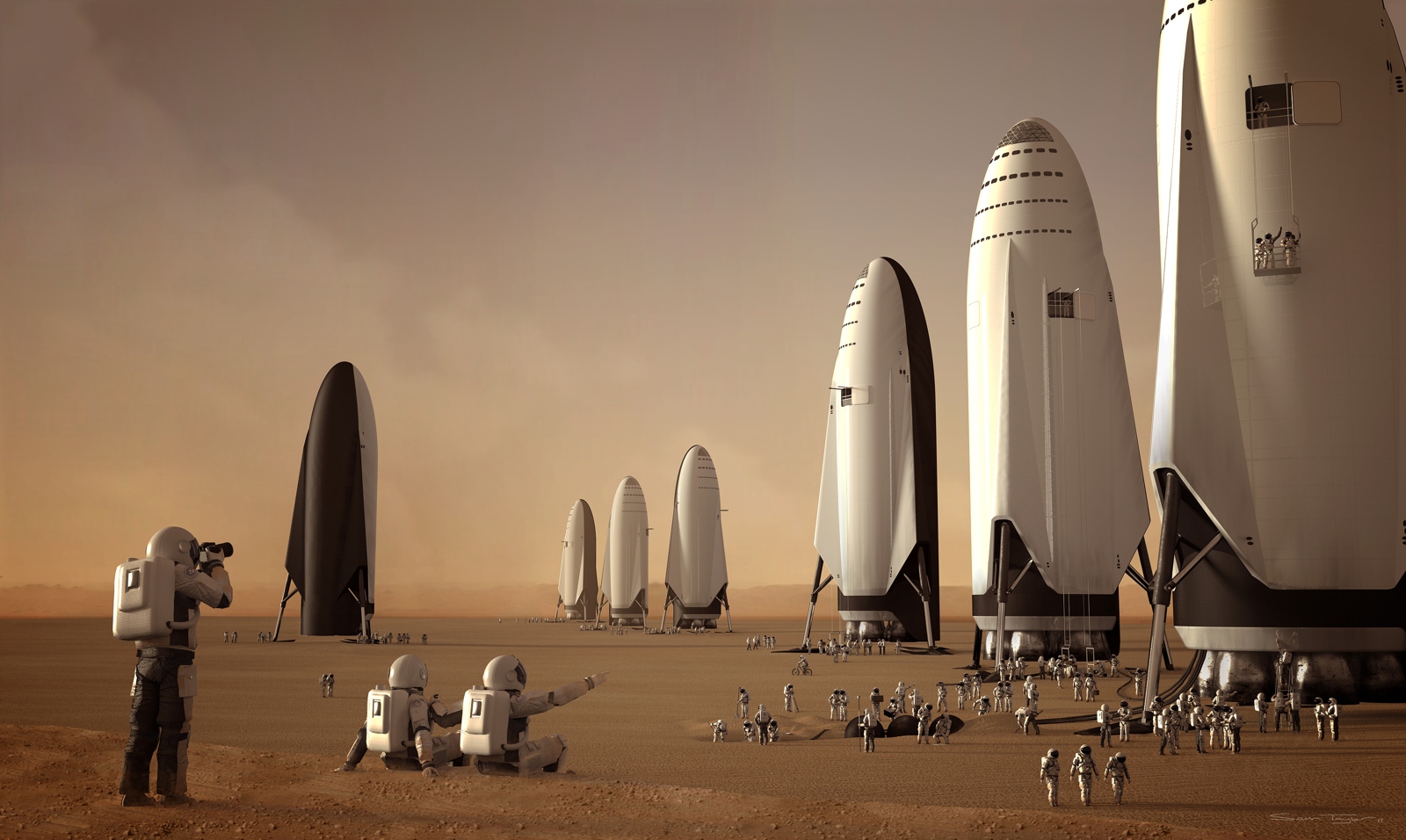
This is what Space X has really been aiming at all along, the colonization of Mars. Will NASA cancel its Artemis Lunar Program and endorse this vision? Only time will tell. (Credit: Human Mars)
NASA’s new director Jared Isaacman, who has ridden into space twice via commercial flights onboard Space X’s Dragon, also feels that the space agency needs to concentrate on a long term goal of Reaching Mars. Meanwhile Trump has publicly stated that although the idea of missions to the red planet “are of interest” they are not currently “a top priority”. Once again we see the possibility of a political change in Washington upending all of NASA’s long term goals, resulting in a waste of money, resources and worst of all time.
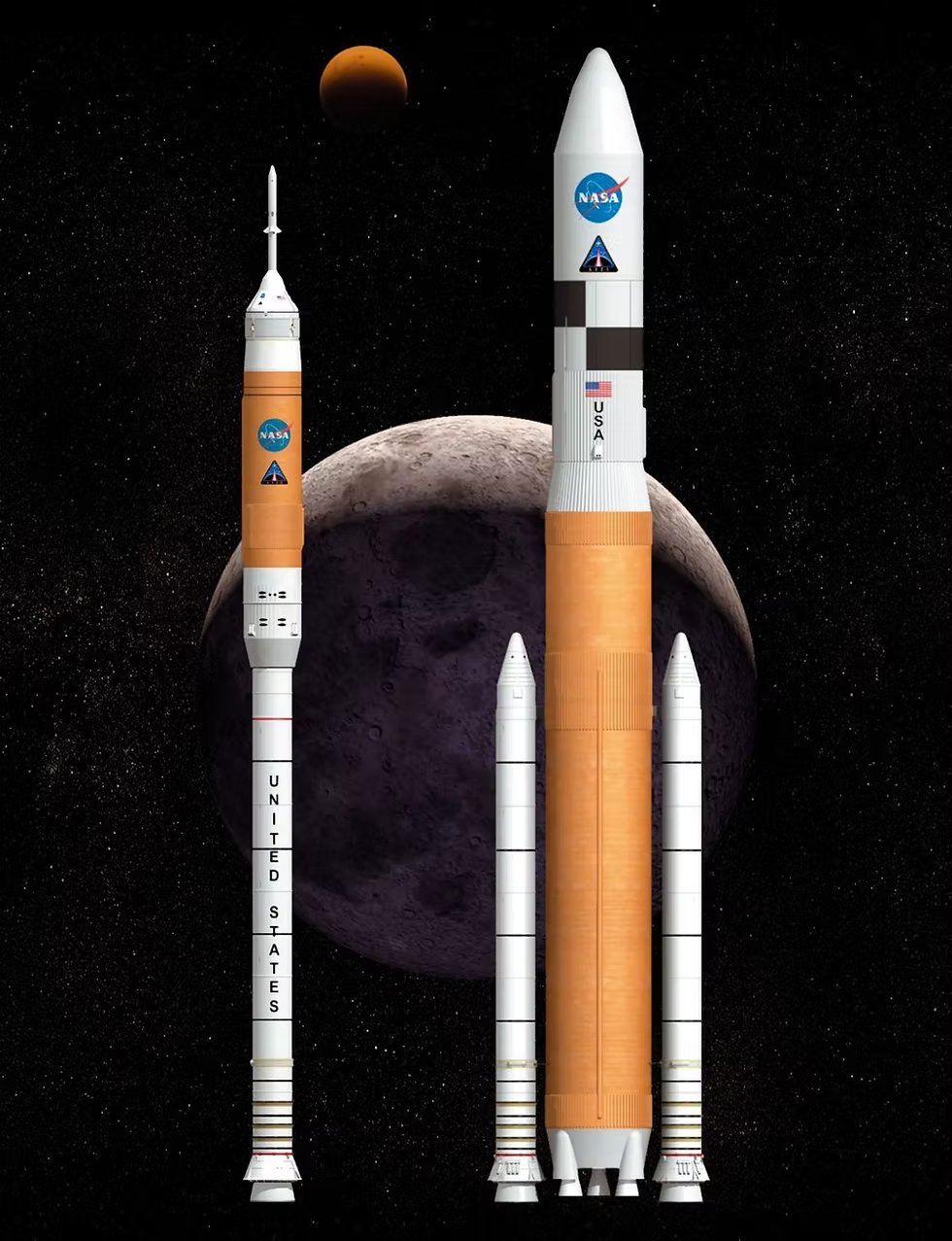
During the ‘W’ Bush Administration NASA began the ‘Constellation’ program for returning the US to the Moon. The whole thing got canceled by Obama after several billion dollars had been spent. Changing to a Mars mission now would waste even more money. (Credit: Spaceflight History)
And to top it off Space X has conducted another private space mission designated as Fram2. That mission was funded by Chun Wang a Chinese born cryptocurrency billionaire and the crew consisted of three of his friends, Eric Phillips of Australia, Jannicke Mikkelsen of Norway and Rabea Rogge of Germany. This latest billionaire joyride was distinguished by its planned orbital path, which will for the first time take astronauts over Earth’s polar regions. The mission launched on the first of April and successfully splashed down on the April fourth.
Launch of the Space X Fram2 Private space mission. (Credit: The Space Report)
This post turned out to be entirely about manned space flight but that doesn’t mean that there isn’t a lot going on with robotic space probes. Hopefully I’ll be able to catch up with them soon.
Over the past century it seems as though all of the big discoveries in Physics have come from either Relativity Theory or Quantum Mechanics. These two pillars of 20th century science are all about objects that are moving very, very fast, or are very, very small. Sometimes it seems as if the old Physics of Isaac Newton has little left to teach us, as if we’ve learned everything there is to know about the behaviour of objects in our everyday world. In this post however I’ll be discussing two recent studies that show how much we still have to learn from classical physics about the ways objects in our everyday life behave.
In Today’s World it is really necessary for everyone to have some understanding of the two Scientific Revolutions that shaped the 20th Century! (Credit: Amazon.com)
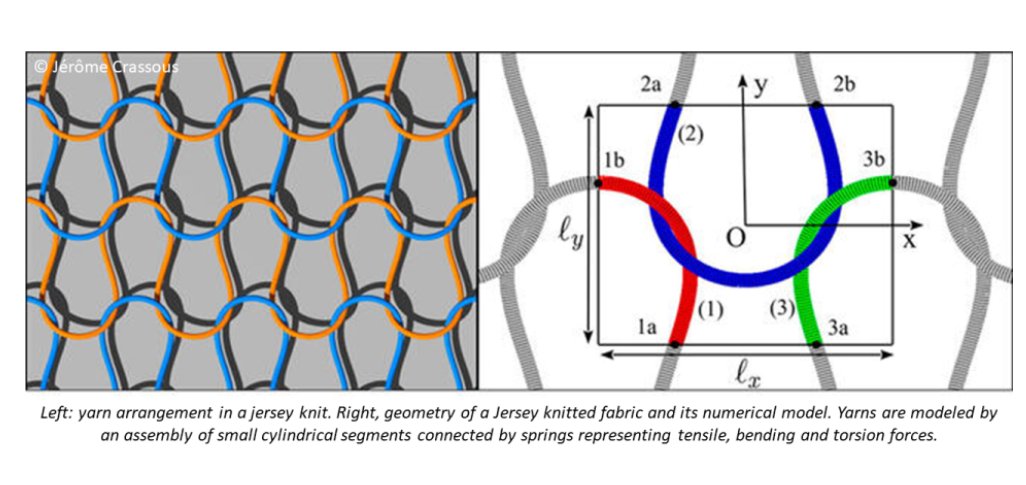
The first paper I’ll be discussing comes from researchers at the University of Rennes and the University of Lyon, both in France along with Aoyama Gakuin University in Japan who examined the different shapes and forms that knitted fabrics can take on after being stretched and pulled. Specifically, the team used a common jersey knit stitch known as stockinette, which consists of interlocking loops of threads, to knit a piece of fabric with 70×70 stitches. See figure below. This piece of fabric was then placed on a specifically designed tensile mechanism that allowed the researchers to stretch, pull and twist the piece of fabric in a wide variety of different directions and strengths.
Familiar to anyone who knits the Stockinette stitch is one of the most common methods of turning a thread into a piece of fabric. (Credit: Gathered)
Now we all know that knits that are really pulled and stretched never quite return to their original shape, they become deformed. What the researchers did however was to measure the degree of deformation that resulted in their piece of fabric depending on the amount of stretching given to the fabric. Each of the resulting shapes that the piece of fabric took on after stretching and twisting the team designated as a ‘metastable shape’ and they categorized the many metastable shapes generated during their testing.
Quantitative definitions established by the researchers to study the deformation of knitted fabrics. (Credit: CNRS Le Journal)
At the same time the team ran a series of computer simulations that replicated the actual experimental results. One thing the computer simulations allowed the researchers to do that they couldn’t do experimentally was to reduce and even completely eliminate the effect of friction between the stitches of their piece of fabric. What the team discovered in these simulations was that, in the absence of friction the piece of fabric always returned to its original shape, regardless of the amount of stretching and twisting. Without friction there were no matastable shapes.
Some of the Data obtained by the researchers showed the relaxed states of their fabric after stretching. (Credit: Crassous, Poincloux and Steinberger)
Perhaps the research conducted by the team in France and Japan will help manufacturers develop clothing that does not lose it shape after being worn or washed, perhaps not. At least however you now know that friction is to blame when your favourite sweater gets deformed.
Personally, I think all sweaters are misshapen. They feel so uncomfortable I just can’t wear them at all! (Credit: iStock)
Another study dealt with a twist on the familiar phenomenon of how two or more objects moving a fluid, water or air, actually reduce the force of friction on each other. We’ve all seen how a flock of geese will fly in a ‘V’ shaped pattern. Well that’s because the lead goose’s motion sets up an flow of air called a bow wave that reduces friction to the two geese on either side of it and slightly behind, reducing the amount of energy they have to expend in flying. This reduction in friction continues right down the line so that the flock forms a ‘V’ shape in order to reduce the amount of energy they expend in flying. In water dolphins will often swim close the bow of a ship to take advantage of the same phenomenon, and many species of schooling fish arrange themselves for the same reason.
Geese always fly in a “V” formation because the air currents generated by the bird in front actually makes flying easier for the bird behind them. The bird in front gets relieved on a regular basis. (Credit: Online Training Courses)
Obviously this doesn’t work in a solid medium because solid objects simply cannot move through a solid medium. What about a granular medium however, where each individual grain may be solid but where thousands, if not millions of tiny grains can still in many ways behave like a fluid.
In many ways the grains of sand in an hourglass behave more like a thick liquid than solid objects. (Credit: Amazon.com)
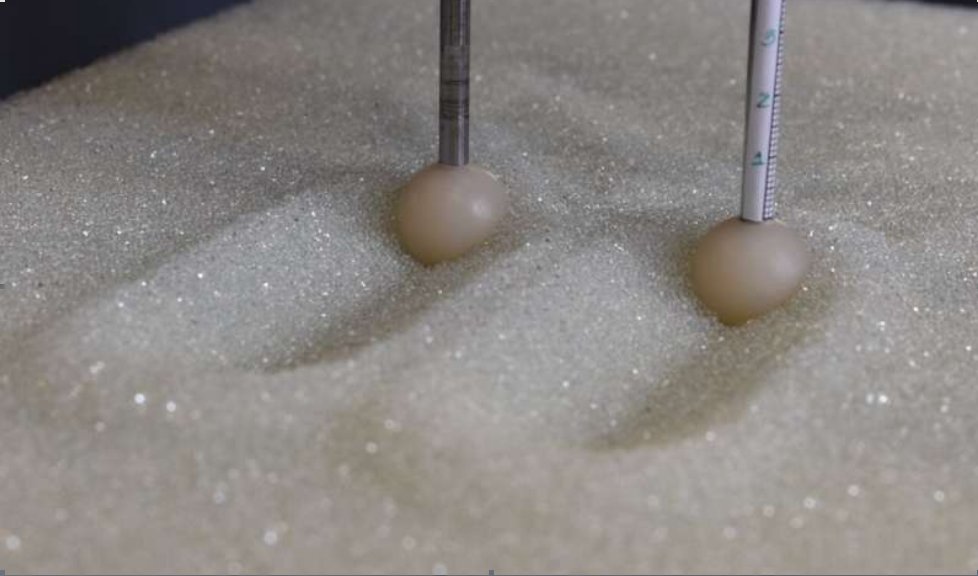
That’s what physicists at the University of Campinas in Brazil and the University of Paris-Saclay in France decided to study. The experimental setup the researchers employed consisted of a bed of glass beads, used in place of sand because of their uniformity, through which two steel balls called ‘intruders’ could be pulled in parallel. The researchers could vary both the distance between the intruders as well as their depth in the glass beads, riding the surface, just submerged or fully submerged etc.
During testing the steel balls were actually submerged in the sand but this is an image of the actual setup the scientists used to measure the effect of multiple objects moving through a granular media. (Credit: University of Paris-Saclay)
What the team discovered was that there was a significant reduction, nearly 30%, in the force of fiction on both balls when they were so close as to be almost touching. The cause of this reduction in friction the researchers attribute to the motion of one intruder breaking the force chains between the grains around the other intruder, and vice versa.
Just looking at all of the different shapes and sizes of sand grains it’s easy to understand where the friction caused by moving through sand comes from. (Credit: Vecteezy)
The researchers also believe that their findings may help to explain some well-known phenomenon in the natural world such as the digging of animal burrows and the growth of plant roots. In any case the results discovered by both teams of physicists clearly show that classical physics can still teach us a lot about the world around us.
There have been quite a few interesting stories about birds, both ancient and modern, these last few weeks so consider this post to be a combination of paleontology and nature news! As usual I will begin with the oldest species and work my way forward in time.
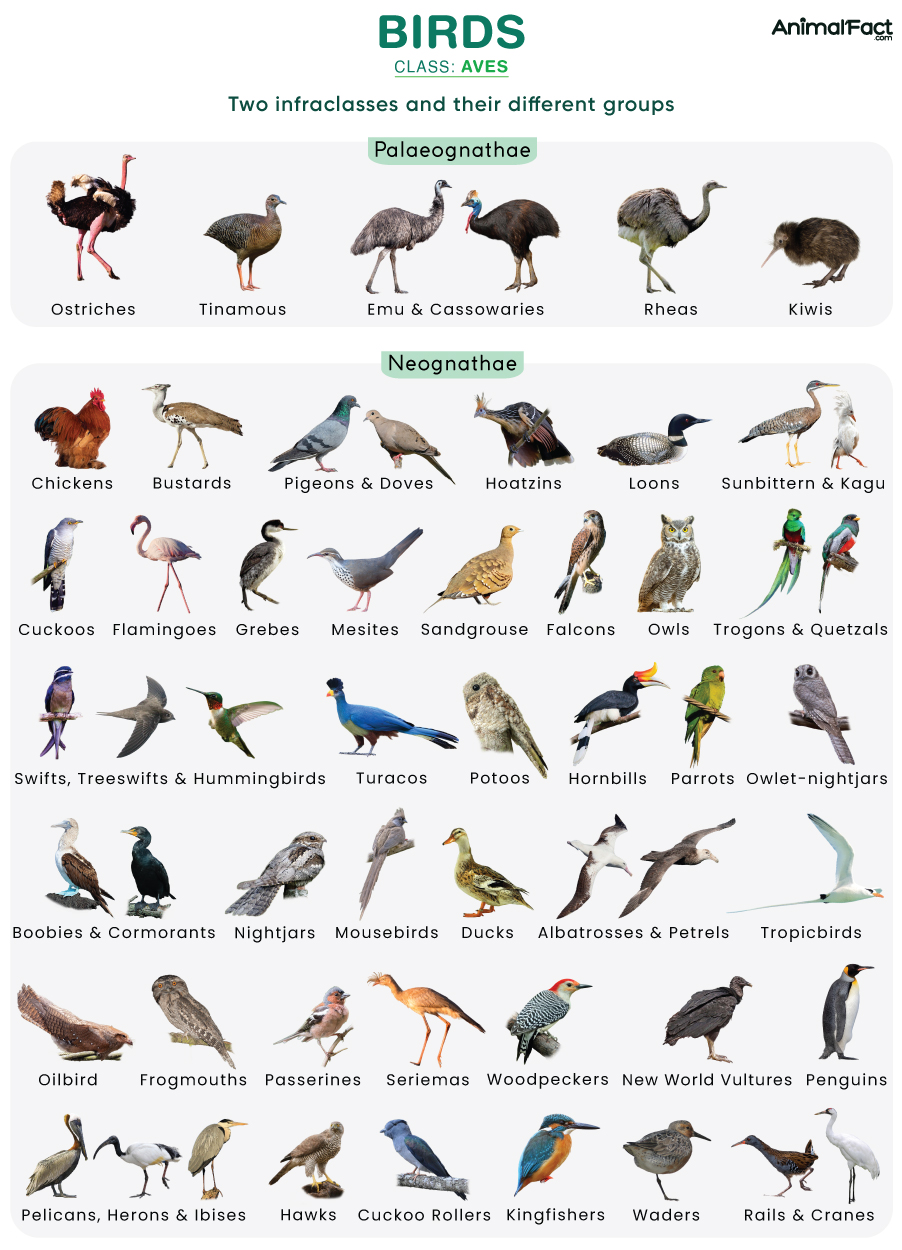
There are about 11,000 different species of bird in the world today. That’s about twice as many as there are mammals, and more than reptiles and amphibians combined! (Credit: AnimalFact.com)
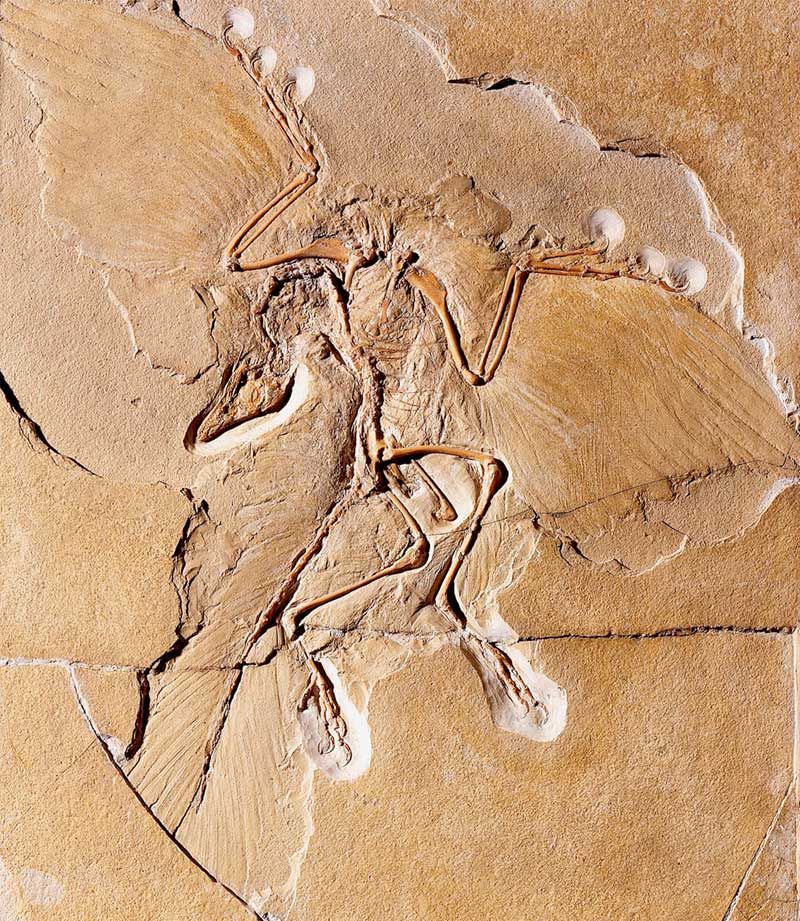
Ever since the first discovery of Archaeopteryx in 1861 most paleontologists have placed the evolution of birds from their dinosaur kin as having happened during the Jurassic period some 145-150 million years ago. A minority of paleontologists have disagreed however, Archaeopteryx, with its mouth full of teeth and a long bony tail is really a lot more like a dinosaur with feathers than a bird, and with no other recognized bird species in the Jurassic the initial evolution of the birds has remained controversial.
When this particular fossil was unearthed in 1861 it provided considerable evidence to Darwin’s ideas about evolution. Many other specimens of Archaeopteryx have also been discovered but this is the one that always gets shown in books and on TV. (Credit: Live Science)
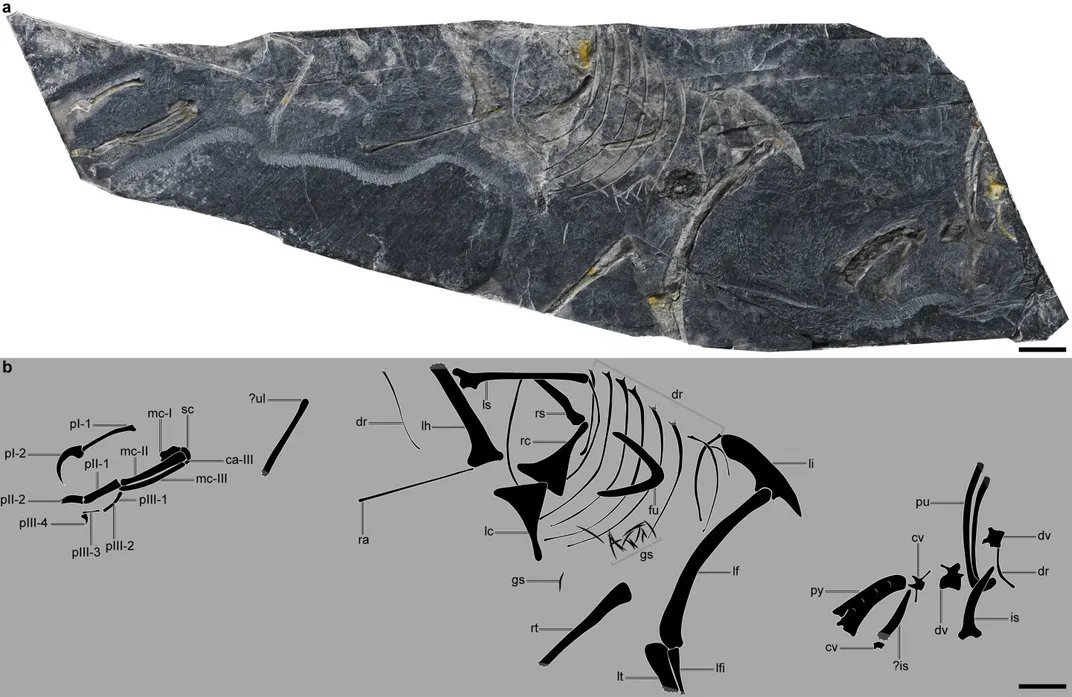
A recent fossil discovery from the southeastern Chinese province of Fujian may help to fill in some of the gaps however. In rocks dating back to 149 million years ago researchers from the Institute of Vertebrate Paleontology and Paleoanthropology (IVPP) of the Chinese Academy of Sciences have found a new species of Jurassic bird to complement Archaeopteryx. Their results have been published in the journal Nature.
The ‘Type Specimen’ of Baminornis zhenghensis with an artist’s drawing of the layout of the bones. B zhenghensis shows that even during the Jurassic period there was already considerable bird diversity. (Credit: Smithsonian Magazine)
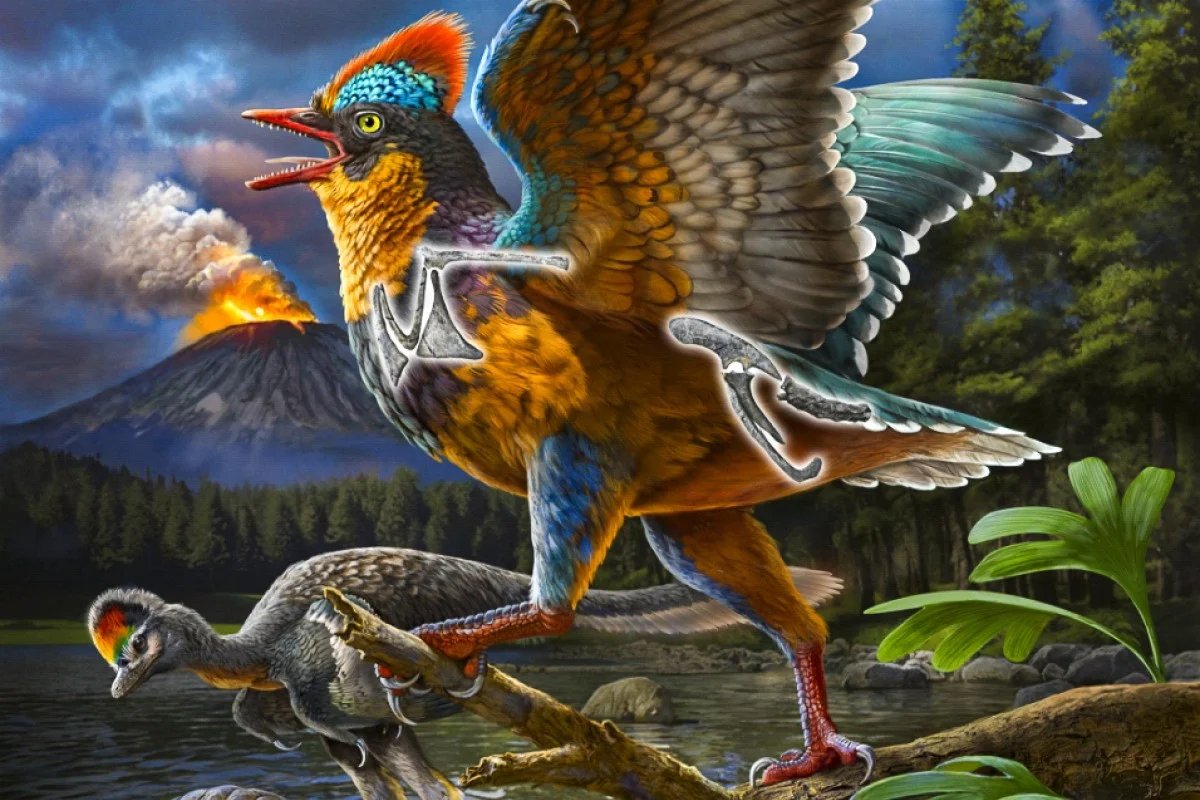
The find, which has been given the name Baminornis zhenghensis, consists of a bird like shoulder and pelvic bones along with a hand structure more dinosaur like than avian. Most importantly B zhenghensis possesses a short tail ending in a bony structure called a pygostyle that is a feature in some modern birds and is common among birds from the Cretaceous period that followed the Jurassic. In the analysis performed by lead author Wang Min and his colleagues B zhenghensis is considered to be a relative of archaeopteryx while at the same time having a closer relationship to the more modern birds of the later Cretaceous period.
Artist’s illustration of what B zhenghensis may have looked like. A combination of dinosaur and avian characteristics like Archaeopteryx, B zhenghensis represents a transition between two major animal groups. (Credit: South China Morning Post)
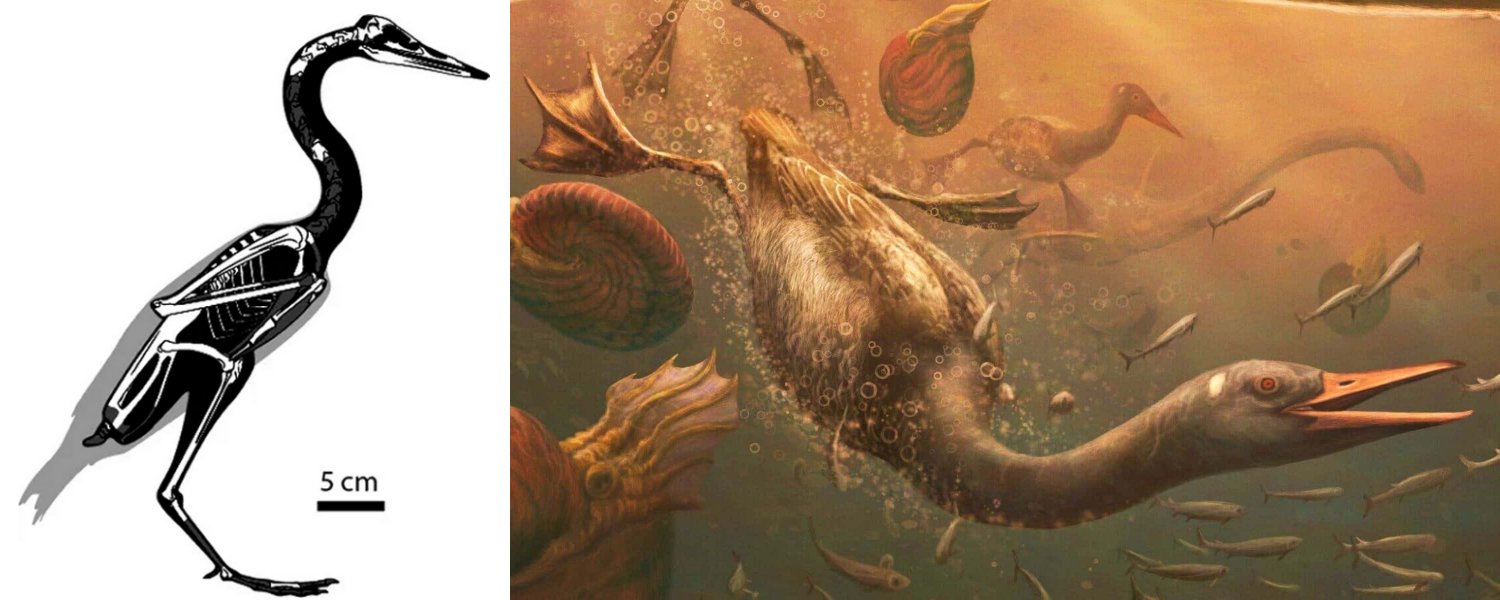
It was during the Cretaceous that the number of bird species grew considerably with recognizable types making their first appearance. In fact a fossil skull that was collected in Antarctica in 2011 has recently been analyzed and classified as a waterfowl, the ancestor of modern ducks and geese. Dated to 69 million years old the skull has been given the name Vegavis iaai. Like the researchers in China who discovered B zhenghensis, the paleontologists who discovered V iaai hope that their find will shed new light on bird evolution.
Skeletal remains of Vegavis iaai and and artist’s illustration of what the animal may have looked like. (Credit: Live Science / The Daily Galaxy)
So much for ancient, i.e. fossil birds now let’s move forward in time to the present because there’s some interesting news about a species of modern bird as well. We all know that many types of birds like to live in large groups that we’ve named flocks. Ducks and geese, pigeons, starlings and penguins are some of the many bird types that live in flocks while other types of birds like eagles, owls and blue jays prefer to just pair up and don’t really socialize that much with other members of their own kind.
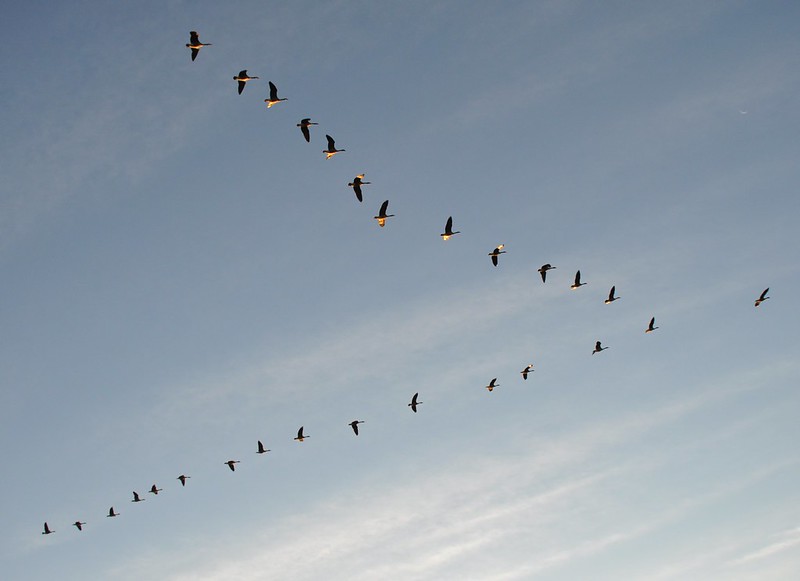
A large flock of geese flying in their usual ‘V’ formation. Each of the animals behind the leader gets a little boost in their flight by the winds created by the animal in front of them. The bird at the front gets replaced by another bird on a regular basis so he doesn’t have to do all of the work. (Credit: Birdnote)
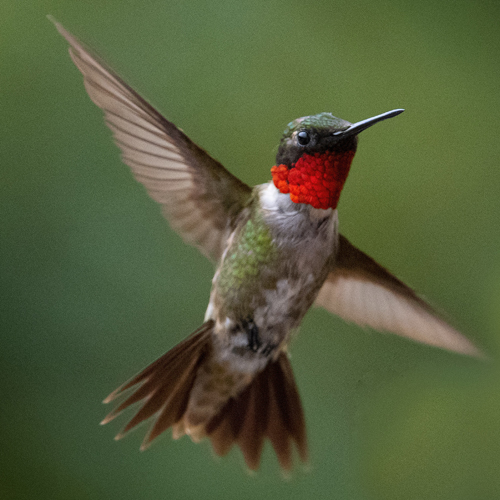
Hummingbirds as a group have never been observed to live in large groups. In fact, with the exception of their own mate, hummingbirds have a reputation for being extremely territorial and combative towards other members of their species. Until now that is.
Male Red Throated Hummingbird. As a group hummingbirds have never been known to live in groups, in fact they are usually very aggressive towards other members of their own species. (Credit: Metroparks Toledo)
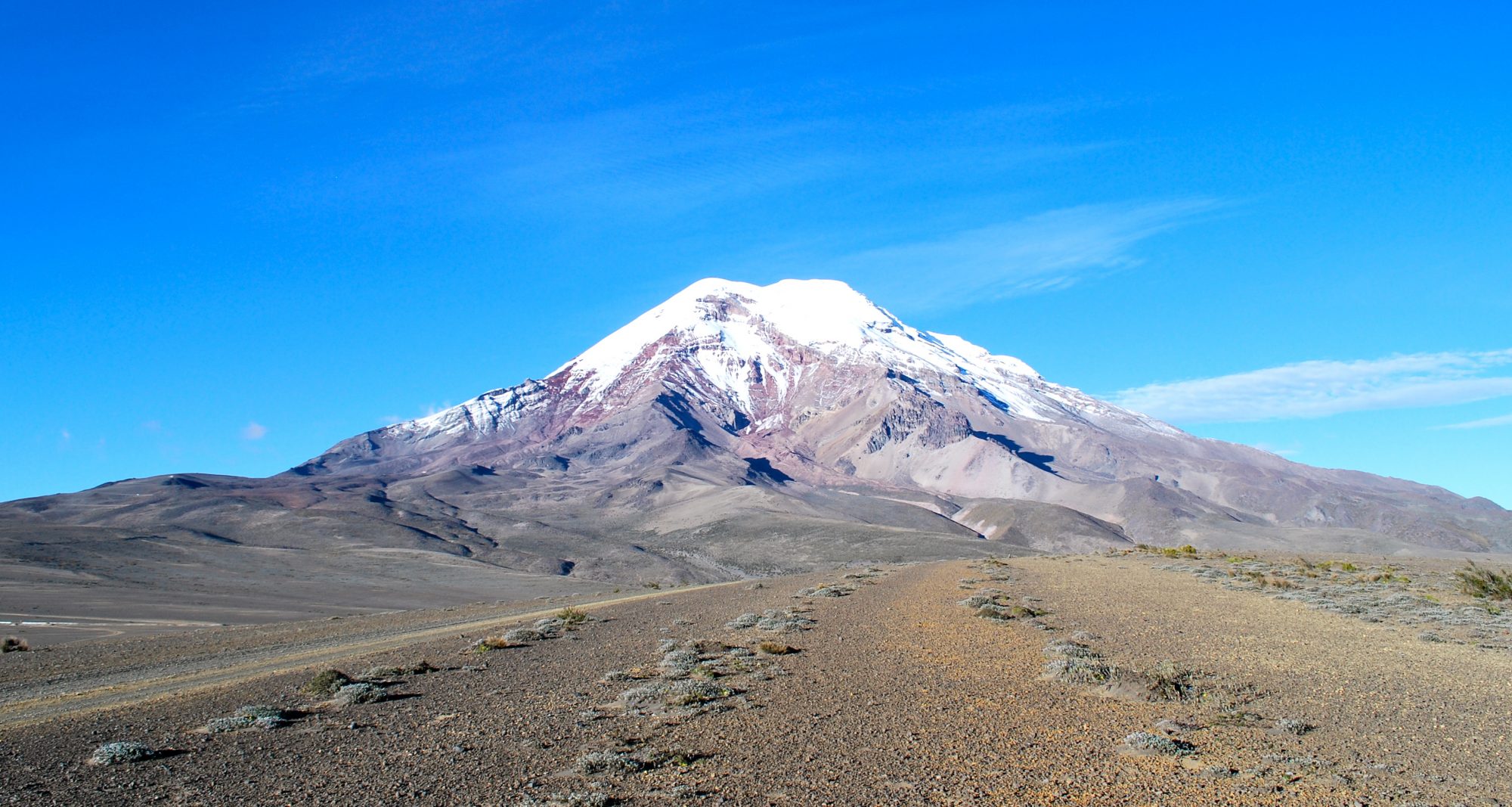
Recently an ornithologist and birding guide in the Andes of Ecuador named Gustavo Cañas-Valle happened upon a cave where he was astonished to find dozens of hummingbirds of the species Oreotrochilus chimborazo both nesting and roosting together. The cave was located on the slopes of the Chimborazo volcano at an altitude of more than 4,000 meters, an extreme environment for any species.
Lonely mountain peaks like Chimborazo are usually volcanoes. High in the Ecuadoran Andes Chimborazo is an extreme environment for any species. (Credit: Wikipedia)
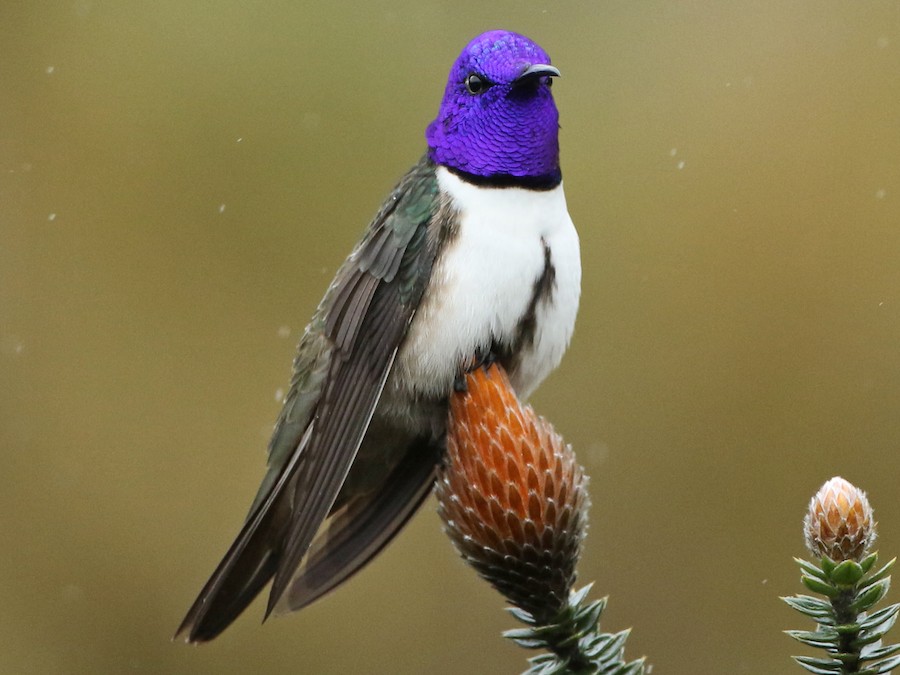
“I thought, this looks like a colony,” Mr. Cañas-Valle recounted. “They were like bees.” In all 23 adult birds along with four chicks were found to be living in that cave. Mr. Cañas-Valle’s discovery has now been published in the journal Ornithology in November of 2024 and is the first ever documented example of hummingbirds living communally but it wasn’t the last. Since his initial find Cañas-Valle has discovered another six caves where specimens of O chimborazo are living in groups, all at extreme altitudes.
Also known as the Ecuadoran Hillstar, Oreotrochilus chimborazo is another beautiful hummingbird and a resident of the high Andes mountains. (Credit: eBird)
The possibility that it is the extreme conditions where they live that has caused O chimborazo to begin living in groups has been suggested by some evolutionary biologists but at the same time they caution not to read too much into the current evidence. As yet there is no evidence of any kind of social behavior where the hummingbirds benefit from their neighbors in such ways as raising the alarum when predators are near or informing the rest of the flock when a food source is discovered. In other words, it appears that at present the birds are just tolerating the other members of their species around them rather than working together as a group.
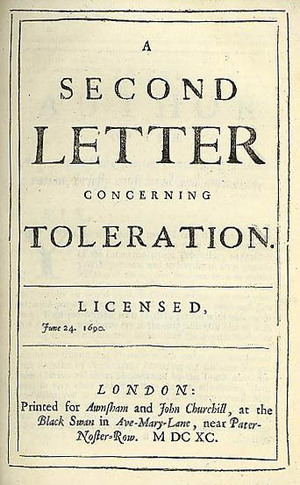
The Philosopher John Locke on Toleration. If nothing else just learning to tolerate each other means you won’t be wasting energy and resources in useless fighting. Unfortunately, some animals, guess who I’m talking about, haven’t evolved that far yet! (Credit: Online Library of Liberty)
In either case more research is needed, a closer, more long-term study of this ‘hive’ behavior. Cañas-Valle is convinced that there are other caves with humming birds, perhaps of other species, and the ornithologist is already planning on conducting some surveys.
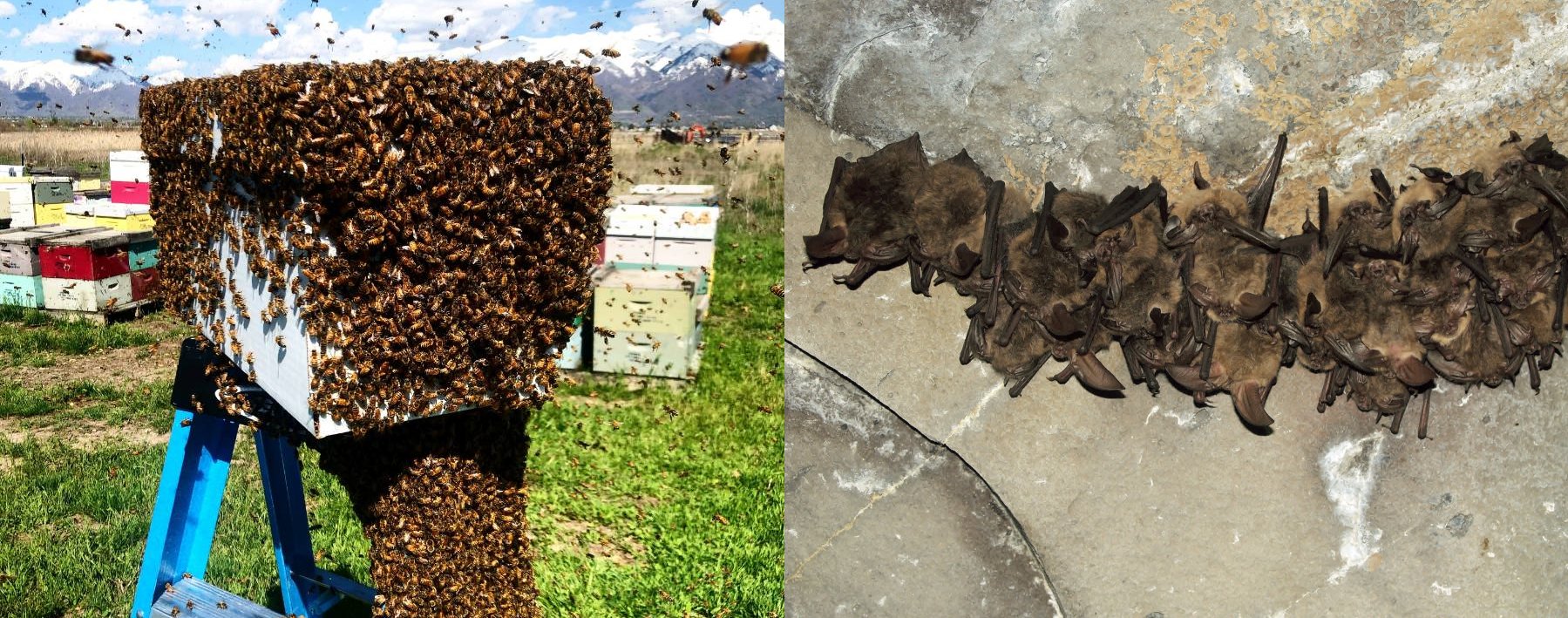
Bees in a hive actively cooperate with each other for the good of the hive as a whole. Bats on the other hand just kinda live in the same place and tolerate each other. Which behavior is true of O chimborazo has yet to be determined. (Credit: National Park Service / Beekeeping USU)
I look forward to seeing his results and I’ll be certain to let you know about them.
Most of us grow up with a pretty well defined idea of sex. Our mommies are women and our daddies are men and we were told which of the two we were. Later on, about age ten or so we learn the ‘facts of life’ where men have one kind of genitals so that they can ejaculate their sperm into a woman’s womb fertilizing her egg so that it can grow into a baby inside her. (Yea, I know that sounds childish but how would you describe sex in two sentences!) That’s why men and women mate and get married, so that they can raise a family.
Some people think that it’s really as simple as this, a mommy, a daddy and little children. The problems begin when they start trying to shoehorn everyone into this comfortable little ideal! (Credit: The Atlantic)
Things usually get a little more complicated in High School when we find out that there are some boys who like other boys and girls who like girls, that is gays and lesbians. (Full disclosure, I am completely hetero and probably even a bit homo-phobic.) At about the same we may learn that there are a few people who feel that they are ‘in the wrong body’, who dress like members of the opposite sex and who may even undergo medical treatments in order to become a member of the opposite sex, at least in the outward appearance of their genitalia. As a group, which may not actually be a valid thing to do, these people are sometimes referred to as ‘sexually non-traditional’.
O’k it’s really not as simple as this but when you get right down to it, maybe it should be! (Credit: Reddit)
One of the most important questions about people who do not fit into the comfortable idea of two separate sexes is, just how many such people are there, what percentage of our society is sexually non-traditional and of what forms? We really don’t have a good idea of the numbers because the whole subject of sex outside of a male-female ideal was taboo for more than a thousand years, and still is in many parts of the world. Even today many gays and lesbians, to say nothing of trans-sexuals, prefer to keep their sexual orientations private.
Back when I was young we estimated that 5% of people were gay, we didn’t use LGBT+ then. Notice how the numbers are going up as being gay becomes more acceptable. (Credit: Statista)
They have good reason to do so; in the Presidential election of last year Trump and his right wing allies went out of their way to demonize trans-sexuals as a way to use the fear of those who are different in order to get votes. In particular the issue of whether ‘men’, that is males who are transitioning to female, should be allowed to use woman’s bathrooms or play on girls’ sports teams in school was made into a big campaign issue.
There was a time when Trump was actually supportive of LGBT+ rights, no more. (Credit: GLAAD)He didn’t succeed on day one, but he is certainly working on it! (Credit: Instagram)
Since taking office Trump has issued several executive orders removing all trans-girls from federal prisons for woman and putting them in men’s prisons, discharging all transitioning people from the military while at the same time threatening to take all federal funds away from schools that allow trans-girls to play on girls’ sports teams. He has even loudly proclaimed that as far as the federal government is concerned there are only two sexes, so that legally the trans-sexuals simply don’t exist. Where exactly that policy this leaves gays and lesbians isn’t really clear just yet, but it can’t be good for them.
Opponents argue that trans women competing in girls’ sports is unfair but are they simple using the issue as a chance to hurt people whose behaviour they don’t approve of. (Credit: Inside Higher Ed)
So just what is the science, what exactly is going on here? Why don’t we just have two sexes, after all that’s how babies are born and isn’t the whole purpose of sex just reproduction? You might think that since evolution ‘weeds out’ the genes of those who don’t reproduce that non-traditional sex of any kind would have gone extinct millions of years ago.
Since we pass on our characteristics to our children, and gay sex doesn’t produce children how are gay characteristics passed on? (Credit: SlidePlayer)
It not that simple! Men and woman are still the same species and it is actually easy to find pieces of one sex on members of the other. Take men’s nipples on their breasts for example, we all know that the nipples are where a woman feeds her baby with milk from her mammary glands but men don’t have mammary glands so why do we still have nipples?
Another good question is why do men have nipples since they don’t have mammary glands? In many ways the differences between men and woman are constrained by the way DNA works and by the fact that in so many ways both sexes are actually the same, just people. (Credit:
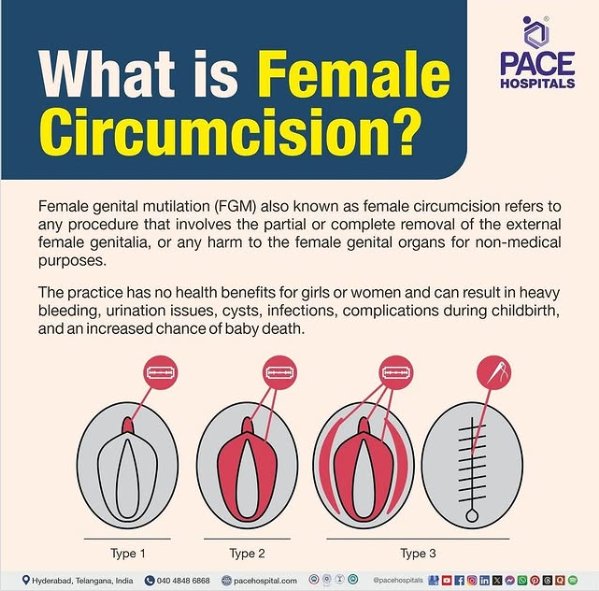
The same can be said for a woman’s clitoris, it may be a woman’s main erogenous zone but it’s not actually needed for reproduction. In fact some societies practice female circumcision where a girl’s clitoris is removed so she can’t enjoy sex. As horrible as that sounds it doesn’t stop her from bearing children. So why does a woman even have a clitoris?
Also known as Female Genital Mutilation the practice of removing a woman’s clitoris is nevertheless still widely practiced in many countries. (Credit: Instagram)
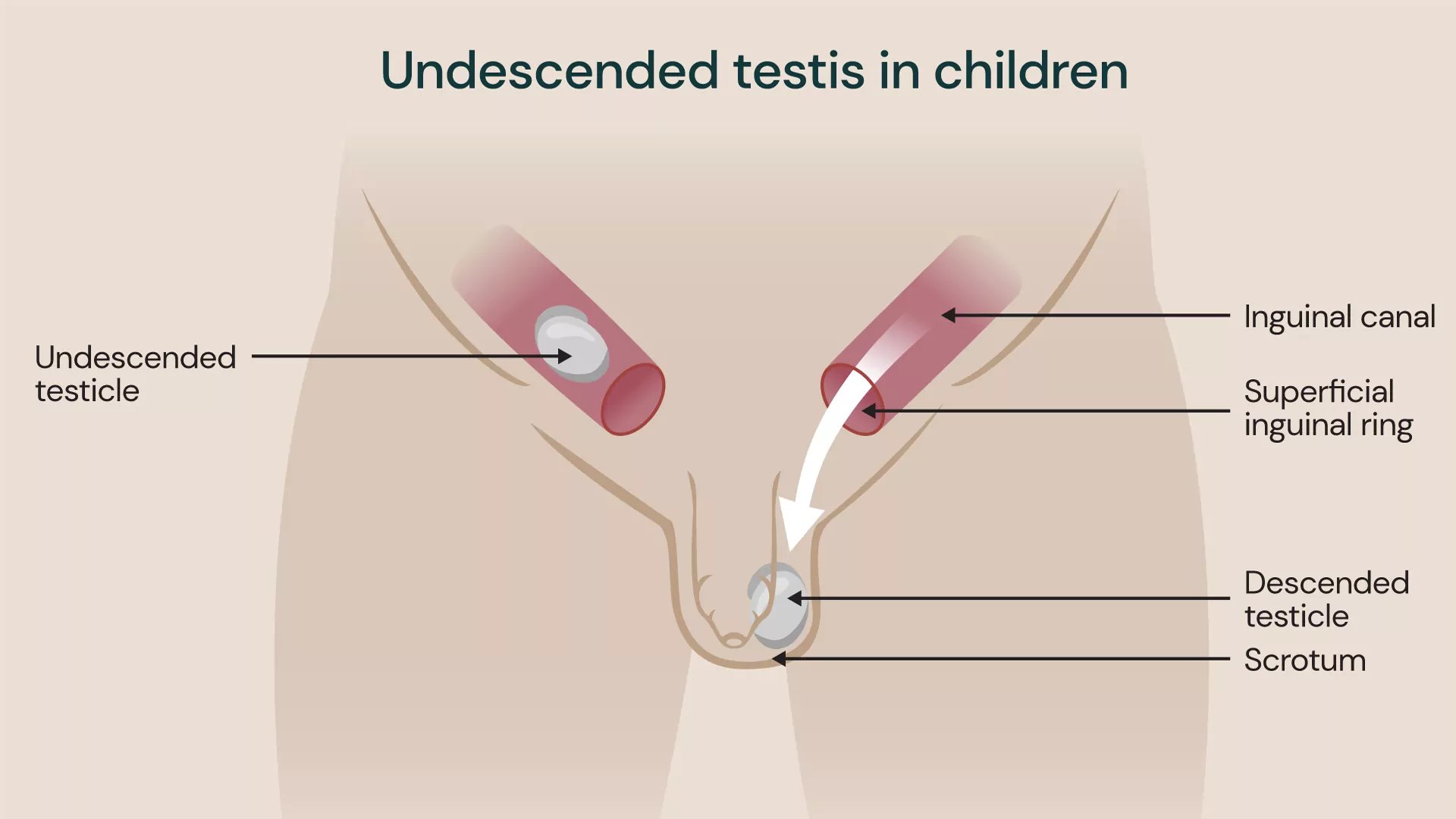
And that’s for normal, sexually traditional adults, after puberty has caused the development of secondary sex characteristics! For babies at birth figuring out who’s a boy and who’s a girl isn’t always that easy. For example the testicles of a boy usually only ‘pop out’ of their body just a day or two before they are born. On a rare occasion they haven’t popped out yet and a baby boy without testicles along with a smaller than average penis looks a lot like a baby girl.
One out of every 25 baby boys are born with an undescended testicle. They are fully boys but at birth may not look all that different from a girl! (Credit: Guy’s and St. Thomas; Specilaist Care)
In fact while once again exact statistics are hard to come by, somewhere between 1 in 2,000 to 1 in 5,000 babies are born who are considered to have ambiguous genitalia, in other words the doctor delivering the child literally can’t tell if it’s a boy or a girl. So if we as a society are going to base a person’s entire life on what that doctor thinks while taking one look at you, we’ll be screwing up a lot of people’s future lives.
Are these babies boys or girls? If you’re going to determine a person’s entire future based on what they look like at birth you’re going to fuck up a lot of people’s lives! (Credit: Nature)
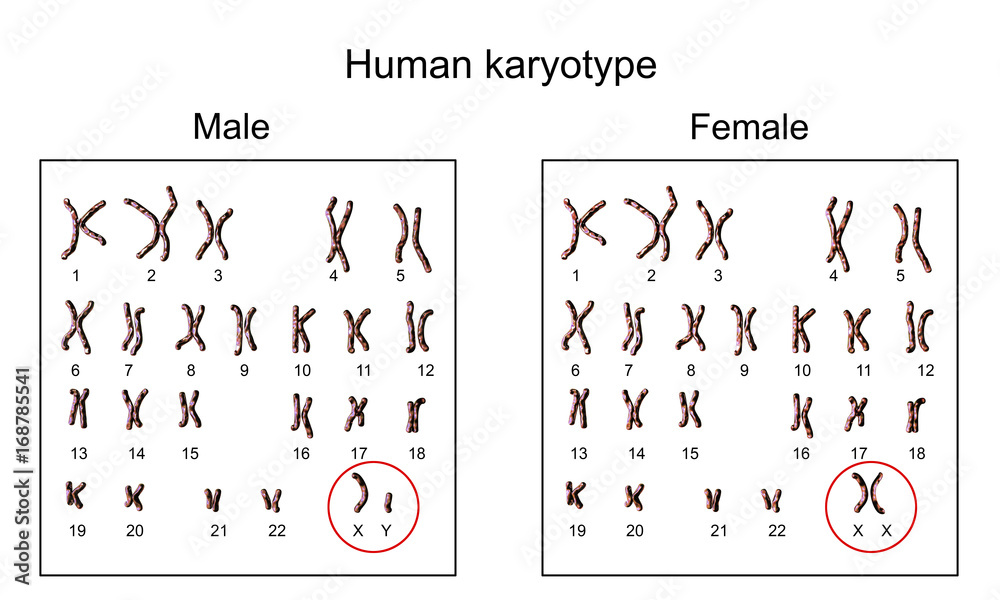
It gets even worse when we take a look inside our bodies. Let’s start with our genes ’cause that’s where our sex is determined after all. We all remember from high school that we humans have 23 pairs of chromosomes and we get one of each pair from our father and one of each pair from our mother. Now one of the 23 pairs are know as the sex chromosomes, girls have two X chromosomes while boys have one X chromosome and one Y chromosome. That means that it is actually your father’s genes that determine which sex you are because we always get an X from our mother but we can get either an X or a Y from our father.
Our human genes consist of 23 pairs of chromosomes but only one pair has anything to do with our sex! (Credit: Abposters.com)
That’s the way things usually work, but not always. In particular the sex cells from our parents, the sperm and egg, can occasionally have more than one each of a chromosome pair causing the fertilized egg, and all of a person’s cells from that point on to have three or even four of what should be a pair of chromosomes. Many genetic disorders are associated with this condition on different chromosome pairs, for example a trisomy on the 21st pair of chromosomes is known to be the cause of Down’s syndrome.
Also known as trisomy 21, Down’s syndrome is caused by the 21st chromosome pair actually being a triplet! (Credit: Vocal Media / Bio Quick News)
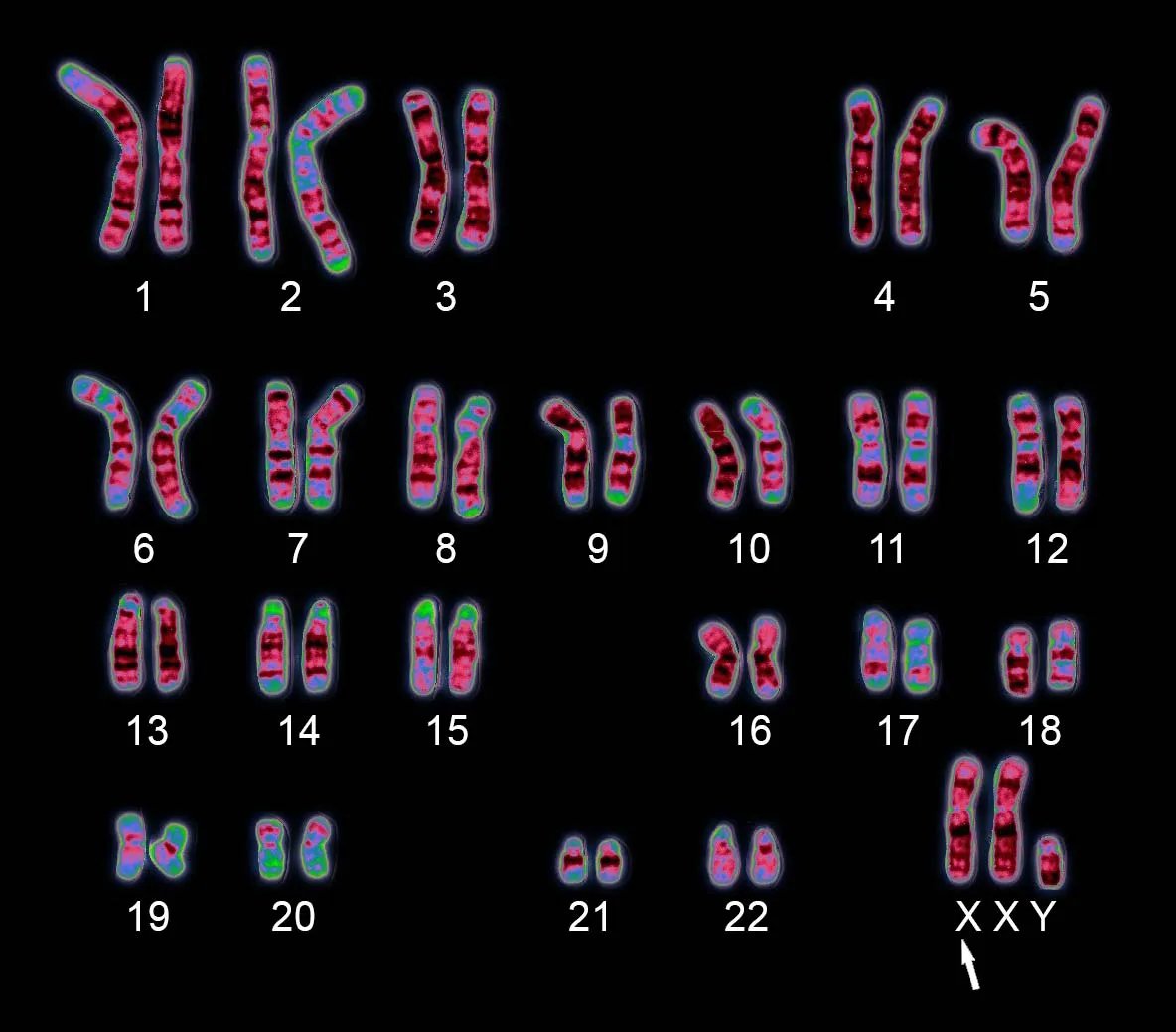
If such a trisomy occurs on the sex chromosomes then there are people with XXX, XXY, or XYY sex chromosomes. Estimates vary but in general one baby in approximately one thousand is born with such a trisomy and nearly all of them suffer from some genetic disorder regarding reproduction. Consider the XXY variant for example, the double X makes them a female but the Y makes them a male! This condition is known as Kleinfelter syndrome and while such a person usually looks male, penis and testicles, the produce no sperm so they cannot father children. A similar disorder is known as Androgen insensitivity where a person possesses testes that remain within the abdomen while the external genitalia resemble that of a female.
Here’s the genes of a person with two X chromosomes, making them a female but also a Y chromosome making them a male!!! An estimated one in five thousand people are born this way and they already suffer enough medical problems without society making things worse for them! (Credit: Britanica)
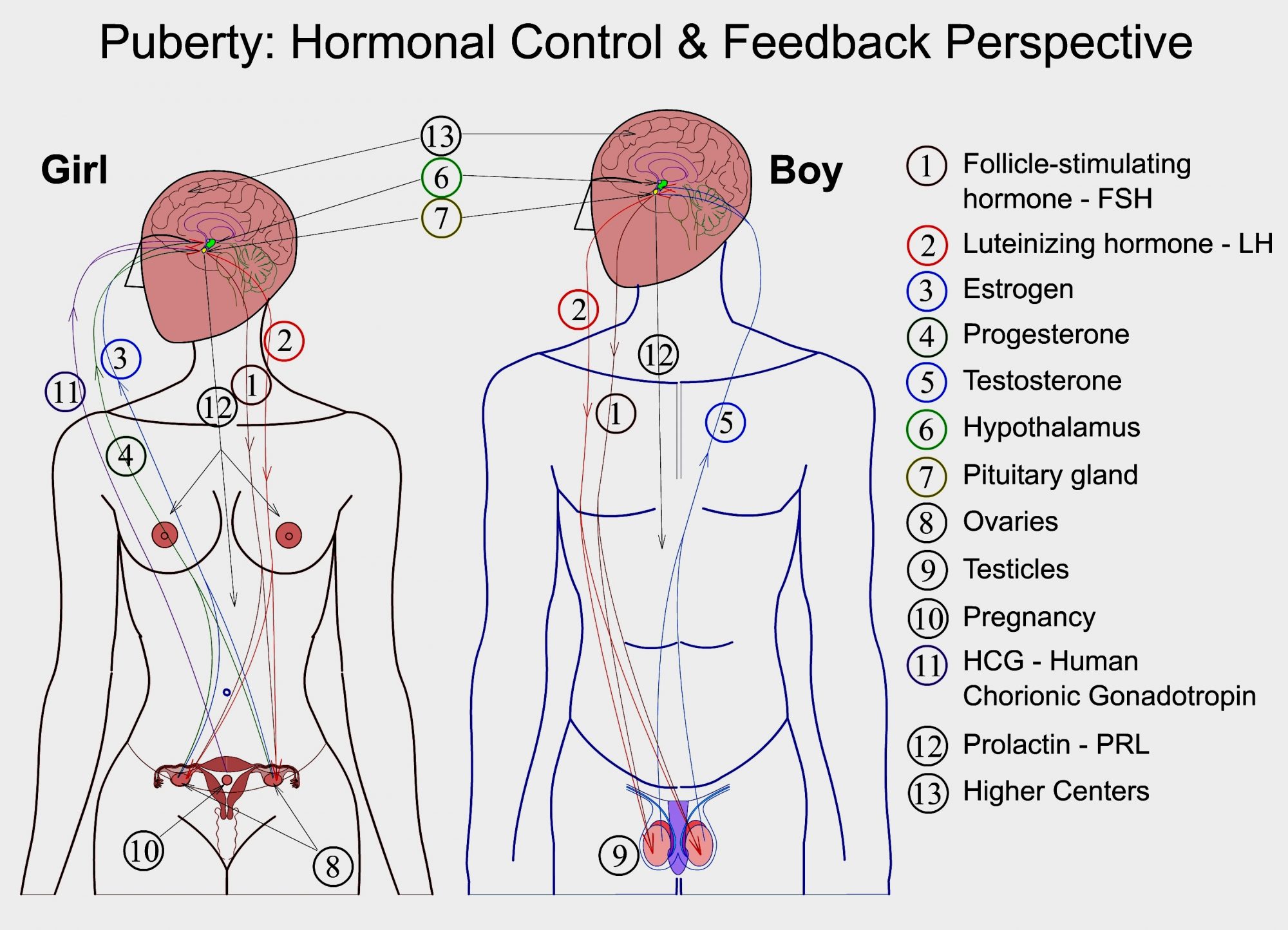
So things are already complicated right from the start at birth, and they get even more so during puberty. It’s at this time that a child starts to develop secondary sex characteristics, Mammary glands on girls, muscles and body hair on boys. More importantly however, it’s at this time that the development of sex cells, eggs and sperm begins. Of course it’s also the time that our bodies start producing the hormones, testosterone and estrogen that make boys sexually attracted to girls and girls to boys. Assuming that is, our bodies produce the right amount of the right hormone. If not the result can be a person whose body at birth is not the body they are becoming at puberty, in other words a person who feels that they are in the wrong body.
A lot is going on in our bodies during puberty, and again remember boys and girls really aren’t all that different. The idea that some people can have the genitals of one sex and the brain of the other just seems quite likely to me. Wikimedia Commons)
So as you can see the whole subject of sex is just far too complicated to be squeezed into a simple binary of ‘He-Men and Dainty Women’, or squeezed into a short blog post like this one. The most important thing to remember is that those people who are sexually non-traditional don’t choose to be so, with all of the oppression and discrimination that they have suffered over the centuries and continue to suffer today who would ever choose to go through that! Also, the fact that there are people whose sex doesn’t conform to simple binary notions doesn’t in any way harm those of us whose sex does!
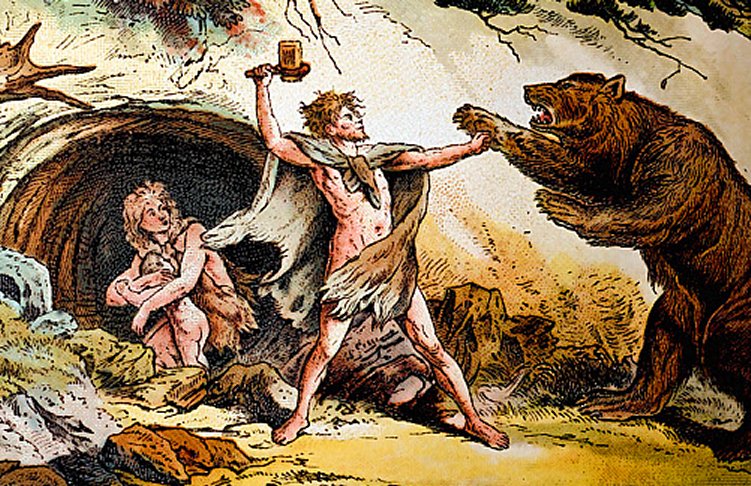
The idea that men are men and women are glad of it is every bit as primitive as these two are! (Credit: www.naturpl.com)
The only real binary is the choice that we as a society have, either we accept the sexually non-traditional and just let them live their lives as they choose. Or we violently oppress them, beat them back into the closet and continue to do so for all time so that we can pretend that they aren’t really there.
If you think about it the science of Paleontology is all about beginnings and endings. New species, new types of life forms evolve, survive for a time and then become extinct. Knowing when a species arises and when it dies out is as important for understanding its place in the history of life as is knowing what kind of creature it was.
There’s wisdom for you. It’s certainly true for the history of life here on Earth! (Credit: Reddit)
In this post I will be discussing two recent studies that illustrate a beginning and an ending not just for a single species but for many thousands of different types of animals. As always I’ll begin with the oldest story and work my way forward in time.
Like the time traveler in the H. G. Wells novel, I like to go forward in time! (Credit: IMDb)
I have several times mentioned the Cambrian Period as being that time in the history of life when animals developed ‘hard parts’, that is shells, exoskeletons or internal skeletons. To paleontologists this advance makes a world of difference because ‘hard parts’ fossilize much more often than does soft tissue. (In my collection I have thousands of shells, a couple hundred exoskeletons along with a handful of bones and teeth but only a very few traces of soft tissue.)
When most people think of fossils they almost immediately think of old bones. It’s true the hard parts of living creatures fossilize much better than the soft parts do so millions of years later we simply have a lot more of them! (Credit: BBC)
Because of this we have a much better idea of the evolution of life from the Cambrian Period onward than we have for the time before the Cambrian, known as the pre-Cambrian, the time before life had ‘hard parts’. In fact, for nearly a century there was no universally accepted evidence for life of any kind before the ‘Cambrian Explosion’ when dozens of different kinds of animals suddenly appeared. Charles Darwin even considered this abrupt appearance of arthropods, mollusks, brachiopods, worms, sponges and corals to be the greatest problem with his theory of natural selection.
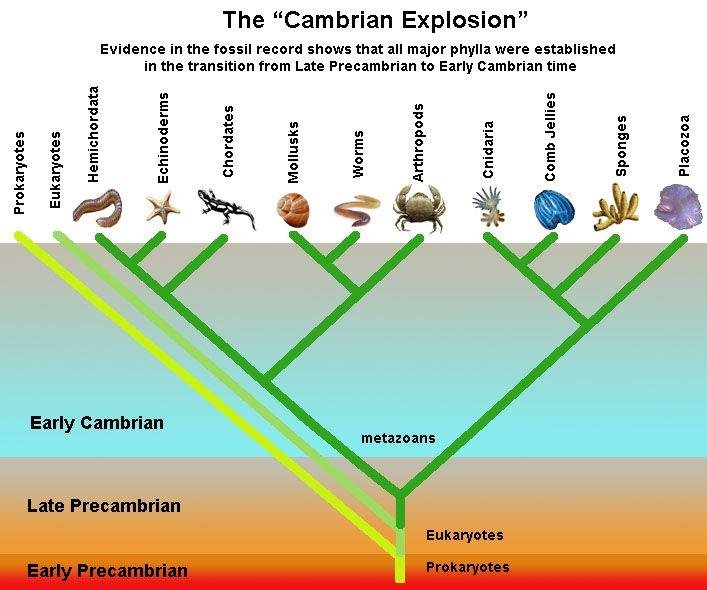
During the Cambrian period all of the major different types of animals have developed so if you want to find their common ancestor you have to go back to the pre-Cambrian. But fossils from that time are rare so paleontologists have great difficulty figuring out who’s related to who! (Credit: Research Gate)
So, if in the Cambrian period we already have arthropods, molluscs, and etc then a lot of evolution must already have happened in the pre-Cambrian and honestly paleontologists have had a very difficult time trying to work it out. Now a recent discovery in the outback of Australia, at the Nilpena Ediacara National Park will hopefully shine some light into the pre-Cambrian darkness.
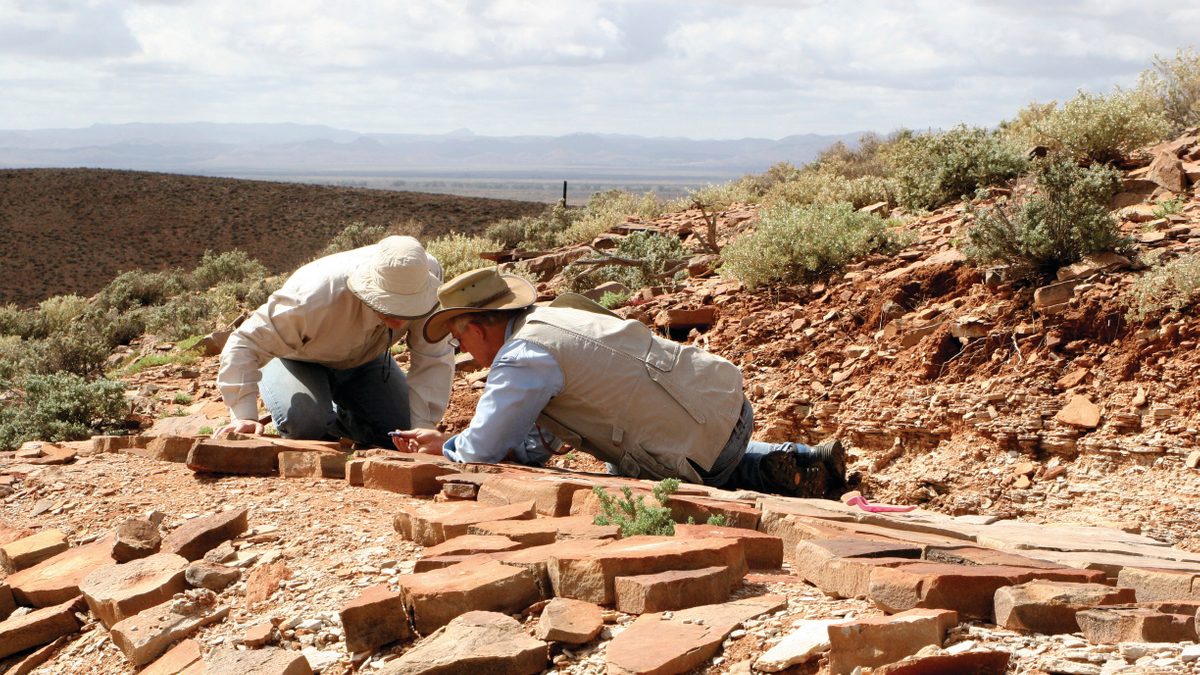
Paleontologists searching for fossils in the bedrock at Nilpena Ediacara National Park in Australia. Rocks from this site date to just before the Cambrian and fossil preservation is quite good so much of what we know about life before the Cambrian explosion comes from here. (Credit: National Parks and Wildlife Service of South Australia)
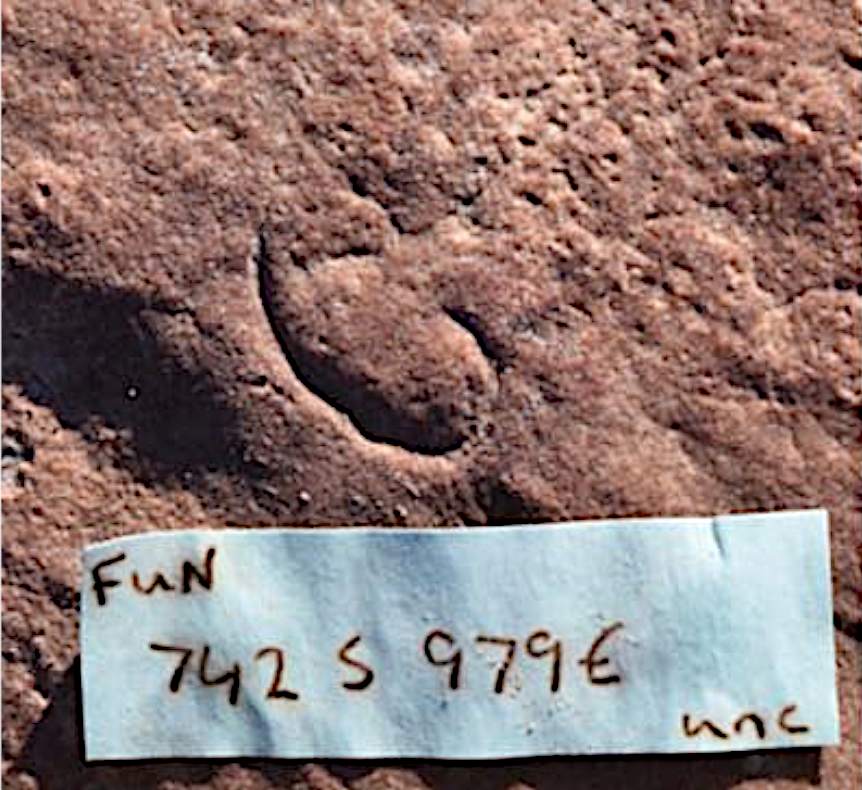
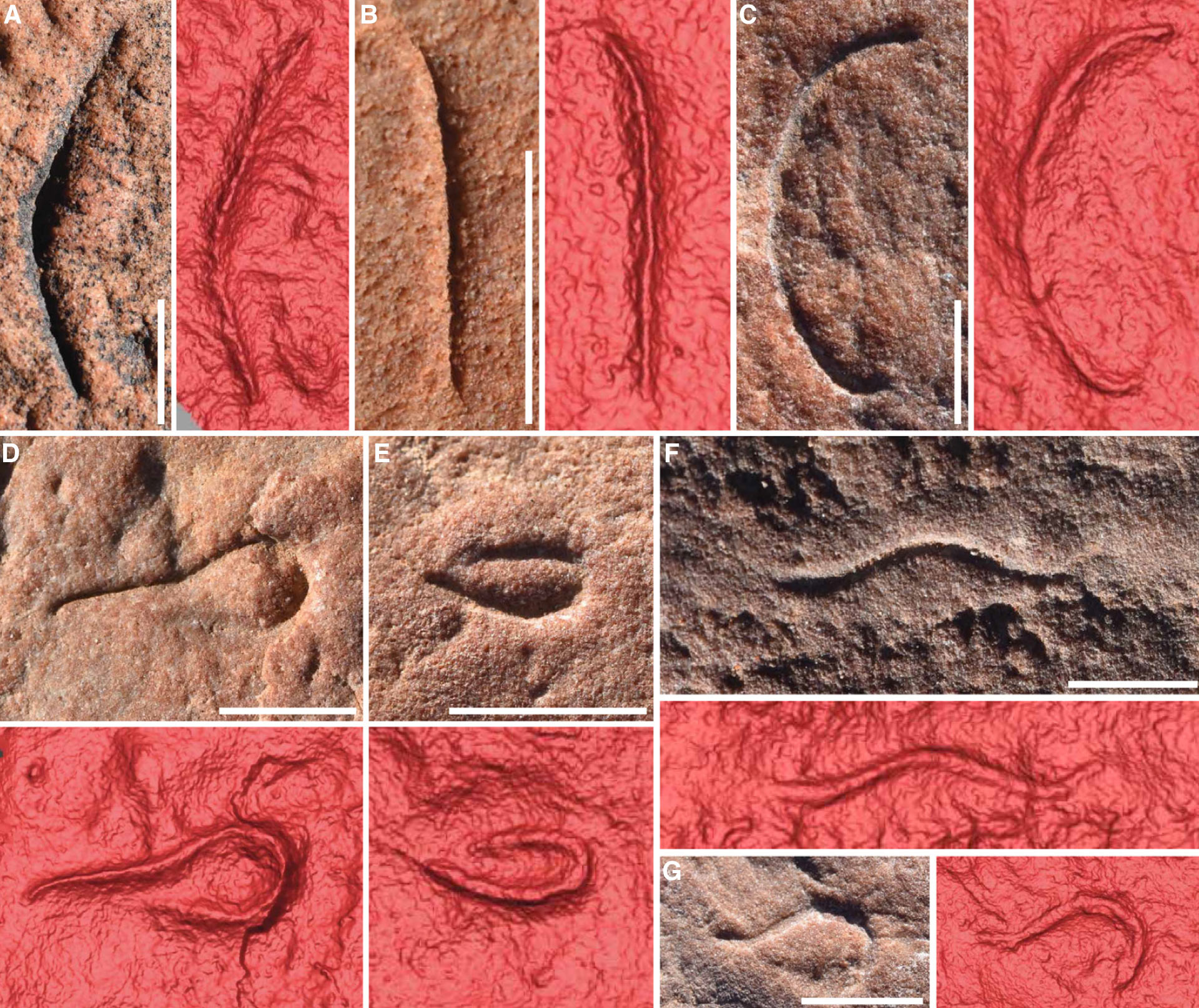
The fossil itself isn’t much to look at, a tiny worm-like animal no more than 2cm in length, see images below. However details of the fossil, which has been given the name Uncus dzaugisi, show that it belongs to the super-phyla known as Ecdysozoan, a grouping of many animal types such as the arthropods, nematodes, tardigradas and priapulida.
It may not look like much but this little critter is an ancestor to many of the species of animals that live here on Earth today! (Credit: InScience)
What all of these different phyla have in common is a recognizable body length to width ratio that indicates mobility in a definite forward direction, a hard cuticle covering made of organic material, in other words an exo-skeleton not a shell, as well as organs for internal fertilization. Nearly half of all known species, both living and in the fossil record share these qualities. That’s what makes Uncus dzaugisi such an exciting find, it is the earliest fossil specimen ever found that shows clear evidence of all of those characteristics, proving that the Ecdysozoan did exist in pre-Cambrian times.
Uncus dzaugisi must have been a fairly common species back in the pre-Cambrian. (Credit: Sci.News)
Australia’s Nilpena Ediacara National Park has long been known as the location where the first pre-Cambrian fossils were discovered. Over one hundred different genera of creatures have been identified there thanks to the fine-grained sandstone that preserves details of the soft tissue. However, few of those animals bear any resemblance to the more familiar Cambrian species that followed. So paleontology has two big questions to answer, how did the creatures of the Cambrian evolve in the pre-Cambrian, and what happened to the majority of the creatures that lived during the pre-Cambrian. The answers to those questions can only be found by discovering more fossils like Uncus dzaugisi.
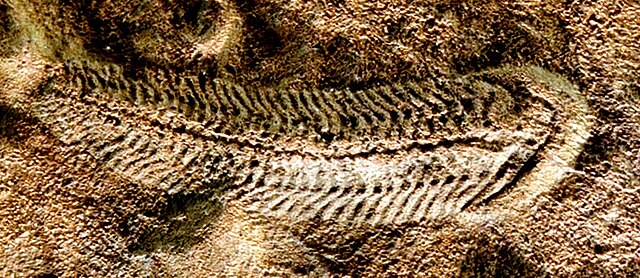
Another very interesting animal that was discovered at the Nilpena Ediacara National Park is Spriggina. Despite looking somewhat like the trilobites that dominated the Cambrian period paleontologists think that Spriggina left no descendants but went extinct like most of the creatures of the pre-Cambrian. (Credit: Wikiwand)
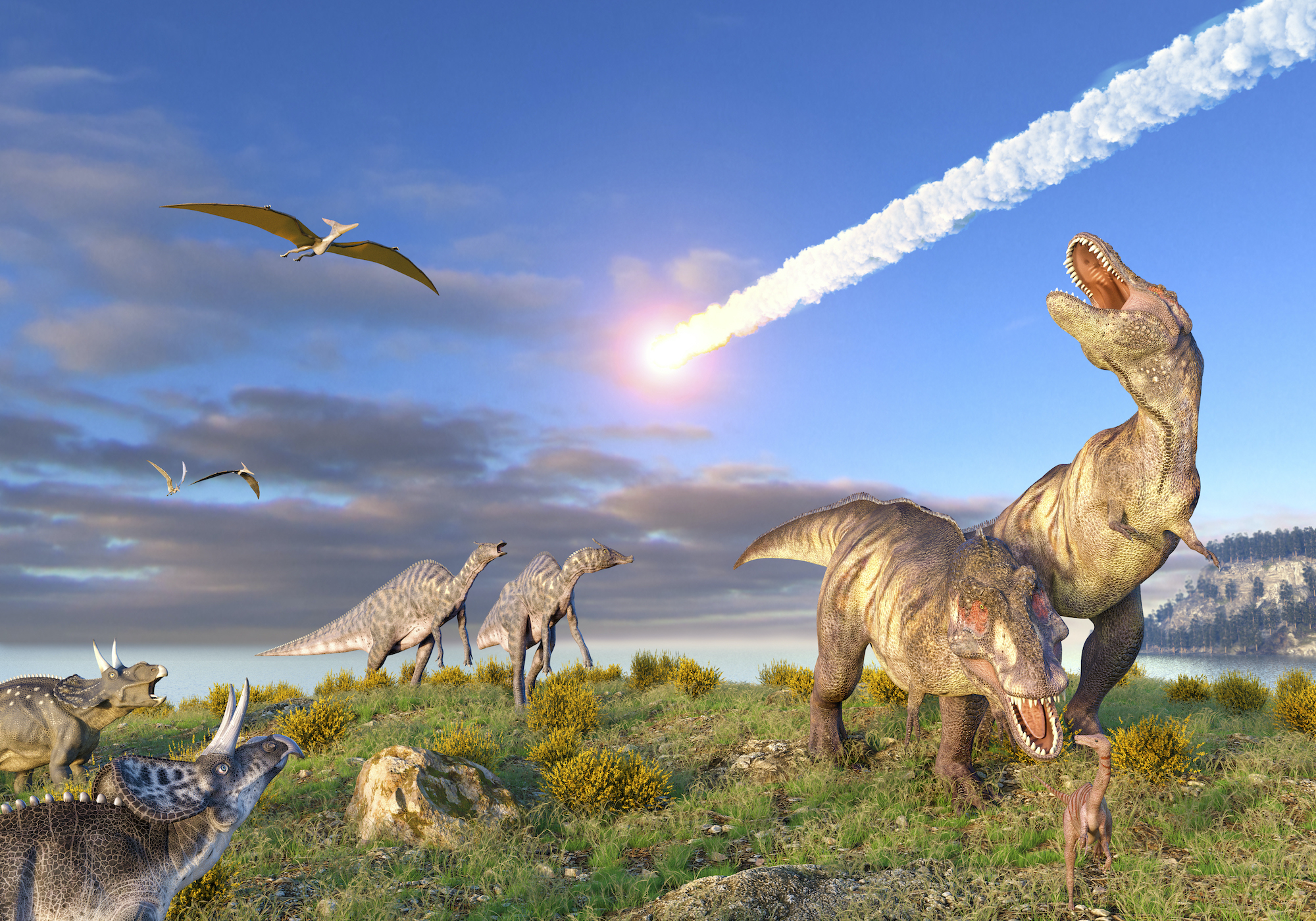
If Uncus dzaugisi represents the beginning for of the many species of the Ecdysozoan then the extinction of the dinosaurs must represent the best-known ending for thousands of species. For the last fifty years the prevailing theory about what caused the mass extinction 66 million years ago has been that an asteroid some ten kilometers in diameter struck our planet in the Yucatan peninsula. That collision not only killed every living thing for thousands of kilometers but it also ejected billions of Tonnes of material into the atmosphere blocking out the Sun’s light for several years and spreading the destruction worldwide. The evidence for this cosmic catastrophe can be found as a thin layer of debris spread around the world.
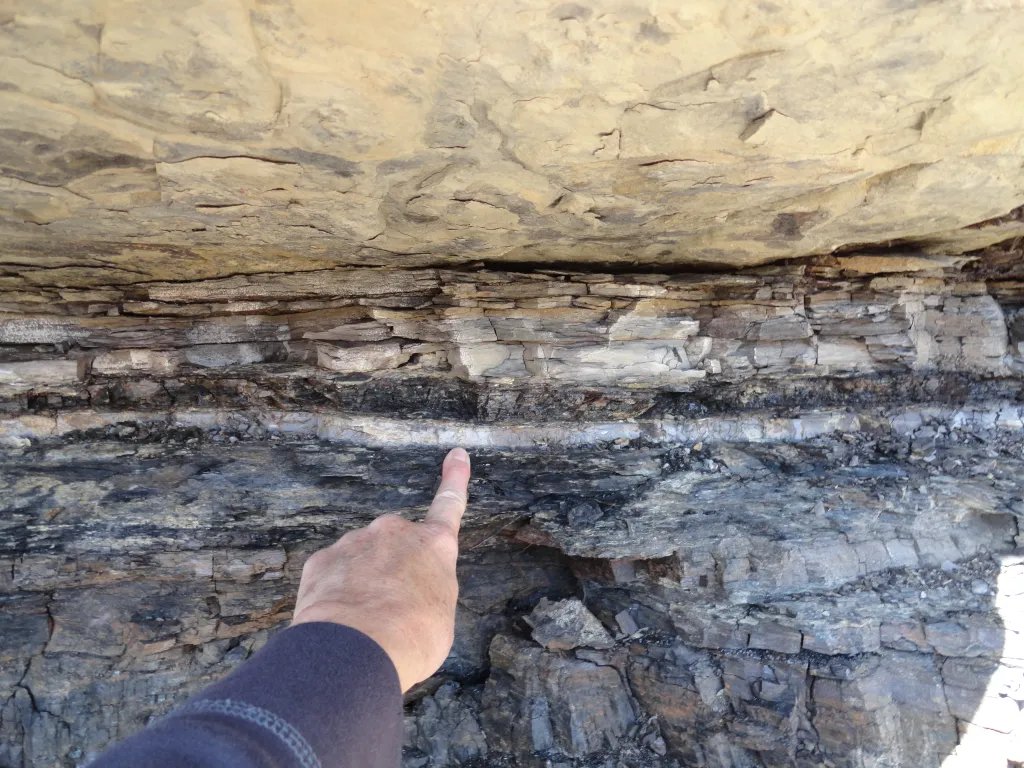
The Cretaceous-Tertiary or K-T boundary. This thin layer of rock consists of debris that spread all over the world from the asteroid impact that killed the dinosaurs. That layer has been found all over the world wherever rocks of that age are exposed. Below that layer, dinosaurs, above it, no dinosaurs! (Credit: Conan City Daily Record)
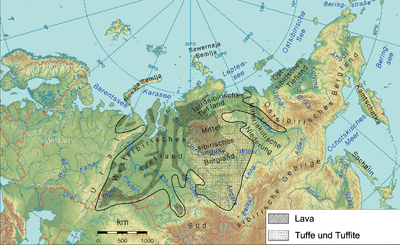
Not all geologists and paleontologists have been convinced however. You see the debris from a massive volcanic eruption looks pretty much the same as that from a collision with an asteroid. In fact it is pretty well established that the mass extinction at the end of the Permian period 250 million years ago was caused by thousands of years of extensive volcanic eruptions in what is now Siberia. Many scientists suggested that, while the asteroid strike undoubtedly did occur, volcanic activity may have contributed to, if not actually caused the extinction of the dinosaurs.
250 Million years ago a large section of Russia experienced an enormous amount of volcanic activity. Known today as the Siberian Traps those volcanic eruptions caused the largest of all extinction events, even worse than the asteroid that killed the dinosaurs. (Credit: Wikipedia)
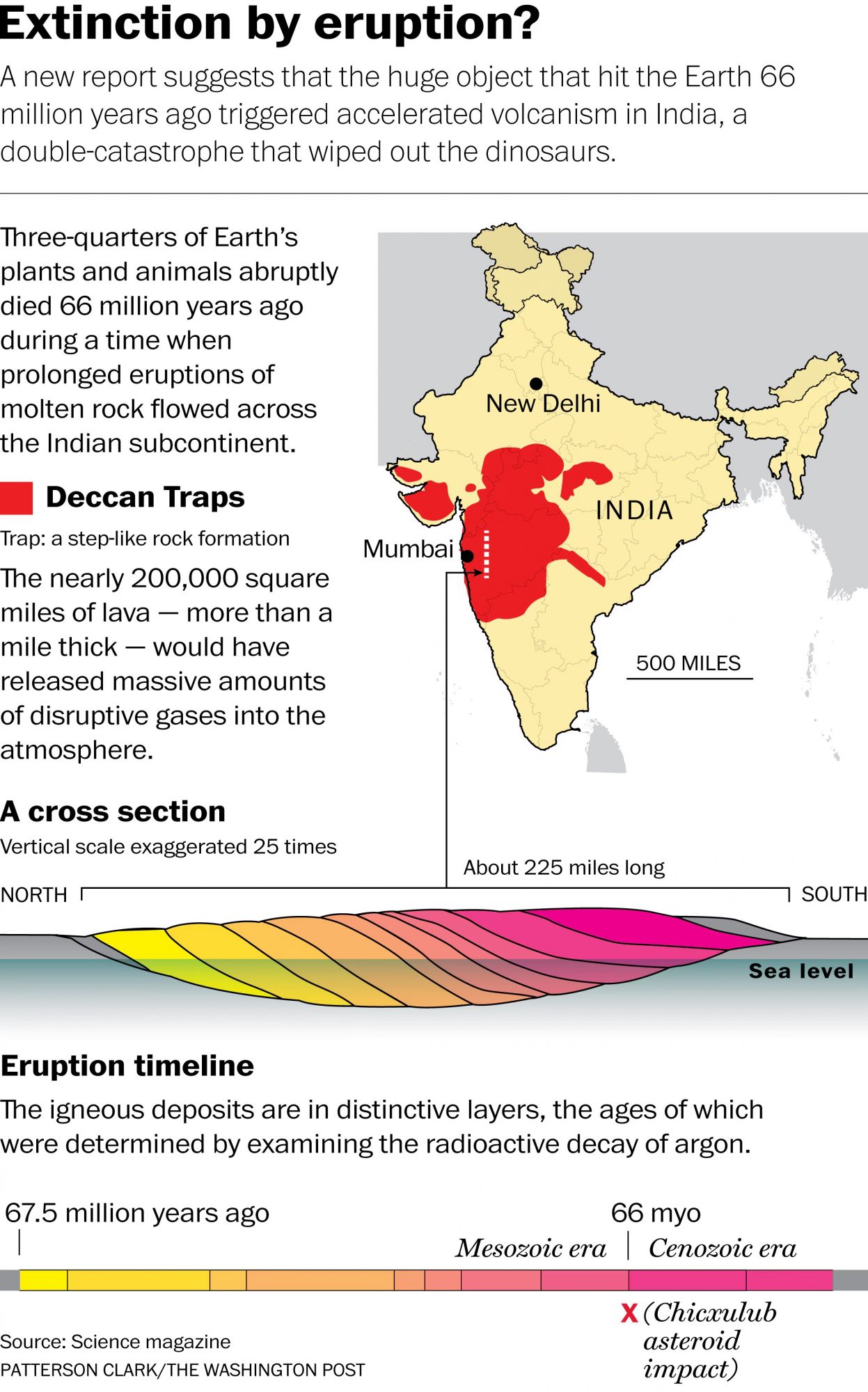
In fact there is considerable evidence for just such volcanism on the Indian sub-continent that has been estimated to be at almost the same time as the asteroid strike. So for the last decade or so the questions have been, how close in time were the two cataclysms, and how extensive was the destruction caused by the Indian volcanoes.
Known as the Deccan Traps the volcanoes of India are considered by many geologists to have contributed to the extinction of the dinosaurs. (Credit: The Washington Post)
Now a new paper from paleo-climatologists at Utrecht University and the University of Manchester has eliminated volcanoes as a possible cause for the dinosaur extinction. What the researchers did was to examine samples from multiple levels in fossilized peat bogs found in the western United States in order to develop a detailed timeline of global temperatures in the millennia both prior to and after the asteroid strike.
Just like today during the Cretaceous period swampy areas developed into peat bogs that fossilized and by examining those layers modern paleontologists can actually determine the average temperature of the region during that time. (Credit: Natural History Museum)
As reported in their paper, which was published in the journal Science Advances, the volcanic activity in India occurred approximately 30,000 years before the asteroid. While the effect of the gasses from the volcanoes did cause the planet’s temperature to drop by some 5ºC by 10,000 years later the Earth’s temperature had returned to its value from before the eruptions. That was fully 20,000 years before the asteroid would strike. The paleontologists therefore concluded that the volcanic activity in India had minimal if any effect on the extinction of the dinosaurs.
So it looks like it was the asteroid alone that killed off the dinosaurs. Talk about going out with a bang! (Credit: BBC Wildlife Magazine)
This means that the data gathered by the researchers in Utrecht and Manchester pretty much seals the deal, the dinosaurs, and many other species were driven to extinction when a piece of the sky fell upon the ground. Of course, if it weren’t for that asteroid, we wouldn’t be here. It was just a stroke of luck that our ancestors survived while the dinosaurs all died.
There’s still a chance that asteroid 2024 YR4 will hit Earth in 2032 but, in any case sooner or later one is gonna hit us! (Credit: NASA Science)
Over the last 400 years or so the Universe as we know it has grown in size literally beyond all human imagination. Where once humans believed that the Earth was the center of all things we now know that it is but a speck of dust, insignificant when compared to the innumerable stars, galaxies, supermassive blacks holes and other objects we still know nothing about. In this post I’ll be discussing a galaxy more than half a billion light years distance along with a asteroid that’s coming so close it may reach out and touch us!
The Hubble ‘Deep Field’ image taken in 1995 revealed an almost endless Universe of galaxy upon galaxy. (Credit: Wikipedia)
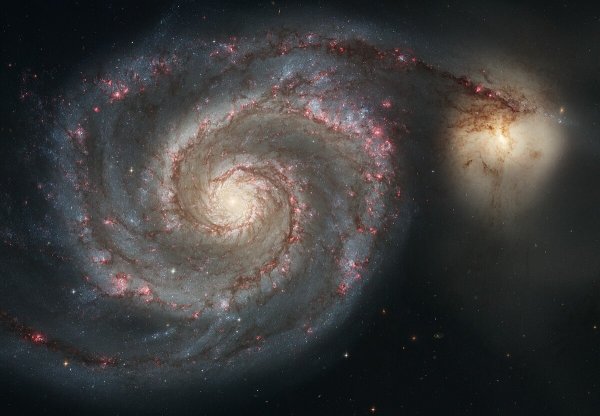
Of the billions of galaxies in the known Universe one of the most common types are spiral galaxies, that is galaxies with recognizable arms that curl around the galaxy’s center as they expand outward from it. Now you would be forgiven for thinking that the direction of the curl of the arms must be the direction that all of the stars in the galaxy orbit around the center. Take a look at the image of the famous Whirlpool galaxy (M51) below, doesn’t it appear as if the entire galaxy is rotating in an anti-clockwise direction?
The Whirlpool galaxy M51. (Credit: Wikipedia)
In fact the direction that the spiral arms seem to rotate and the direction that the stars in the galaxy actually do rotate have nothing to do with each other. It was back in the 1960s that two astrophysicists, C. C. Lin and Frank Shu realized that spiral arms were really density waves propagating through the body of the galaxy, more like ripples on the surface of a lake than any actual, permanent structure. The reason why the spiral arms are so visible is that as the density waves move they trigger intense star formation and what we see from millions of light years away are the hot, bright young stars that have just been formed in the arms.
Ripples on a lake spreading outward after an object has fallen into the water. The Spiral Arms we see in many galaxies are actually similar to these waves only on a tremendously larger scale. (Credit: Getty Images)
So if the spiral arms are ripples flowing through a galaxy then what caused the ripples? Well, if you look again at the image of the Whirlpool galaxy you can see the dense ‘blob’ on the far right at the end of one spiral arm. That blob is actually a dwarf galaxy that collided with the main Whirlpool millions of years ago. If you like the small galaxy rang the Whirlpool like a gong and the spiral arms are caused by the Whirlpool ringing! Big galaxies like our own Milky Way and Andromeda often collide with or in some cases capture dwarf galaxies, which is why we see so many spiral galaxies.
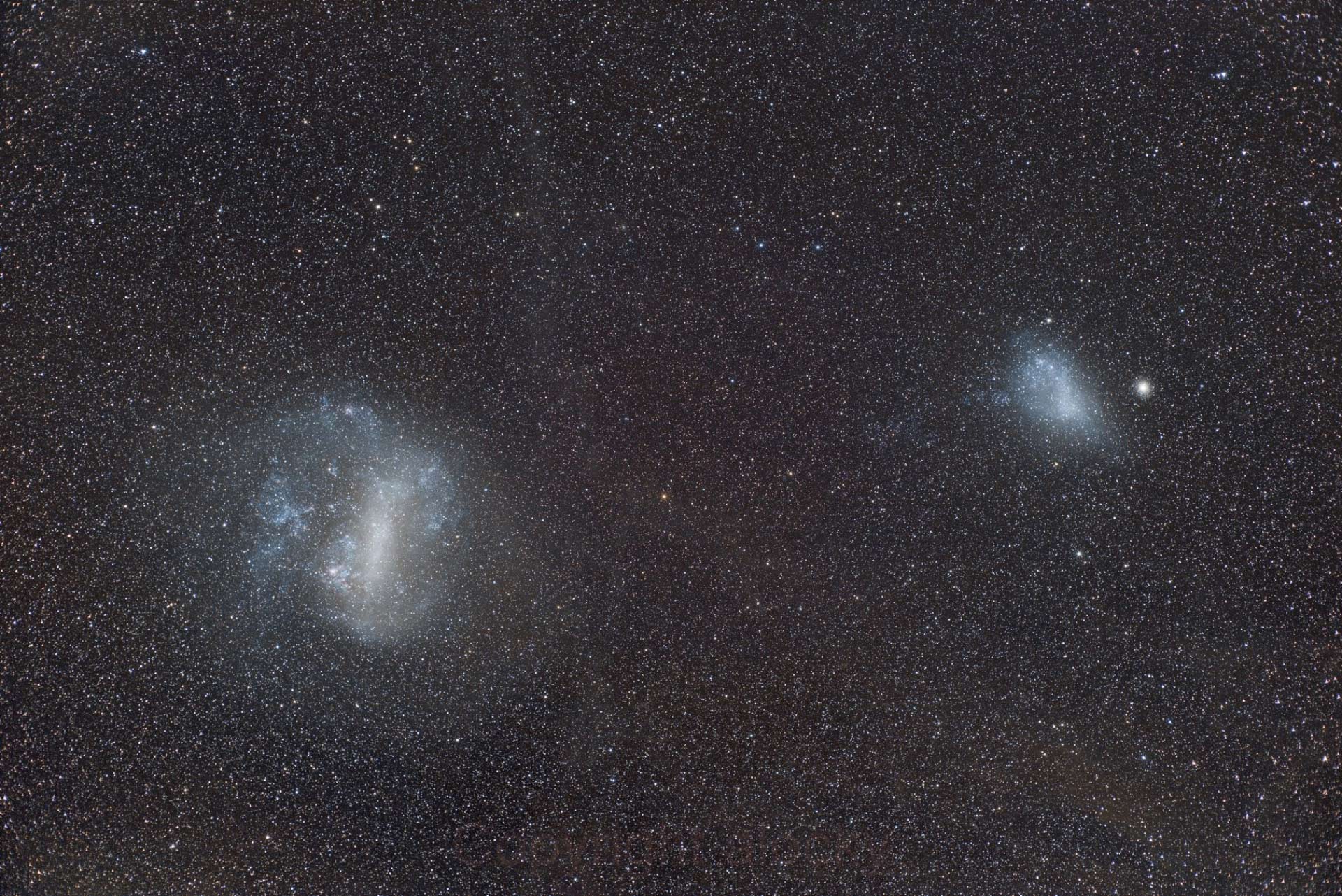
The Large (l) and Small (r) Magellanic clouds, that can only be seen in the southern hemisphere, are actually two small galaxies that have been captured by and are orbiting our Milky Way Galaxy. (Credit)
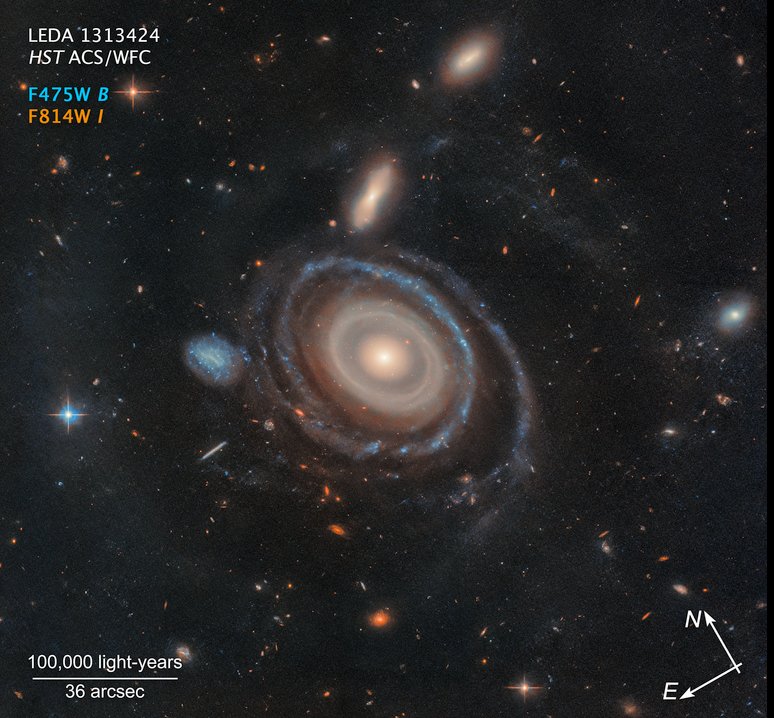
Recently astronomers at Yale University in the US along with the University of Toronto and Swinburne University in Australia have identified a galaxy that really takes spiral arms to a whole new level, see image below. Searching through images taken by the Hubble space telescope they came across a galaxy that has been designated as LEDA 1313424 in which they identified eight separate rings, giving the galaxy its popular name of ‘The Bullseye’. Follow up observations with the Keck telescope in Hawaii even found another ring, making a total of nine rings, six more than any other galaxy has ever been found to possess.
Hubble image of galaxy LEDA 1313424 showing its many rings. This galaxy really does look like ripples spreading out over the surface of a lake. (Credit: Hubble Site)
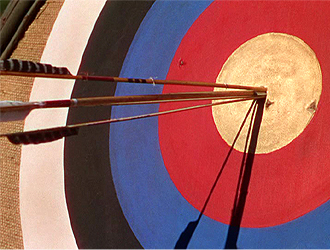
Now LEDA 1313424 is a really big galaxy, estimated at 250,000 light years across, that’s two and a half times the size of our Milky Way. And the astronomers succeeded in identifying the dwarf galaxy that caused all of the rings, the blue blob to the center left of LEDA 1313424 in the image. In order to have produced so many rings the dwarf galaxy must have passed right through the very center an estimated 50 million years ago. As I mentioned above collisions between galaxies are rather common throughout the Universe but for one galaxy to pass right through the center of a big galaxy is really hitting a Bullseye!
When Errol Flynn playing Robin Hood split the bad guy’s arrow with his it was just Hollywood trickery. But the dwarf galaxy that hit LEDA 1313424 had to make almost as precise a shot. (Credit: The Errol Flynn Blog)
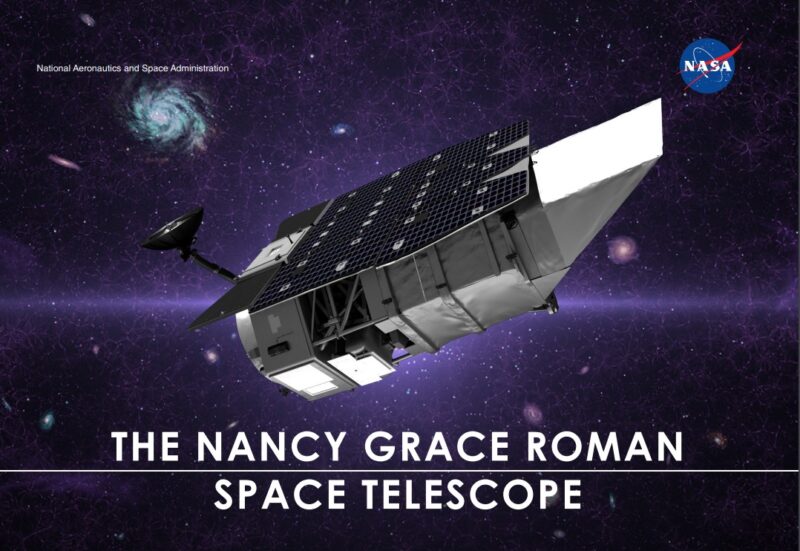
What’s more the rings around LEDA 1313424 fit in very nicely with the accepted models of density waves generated by galaxy collisions for a shot right through the center of a big galaxy like the Bullseye. And while the Bullseye may have been a chance discovery astronomers hope to find even more examples of multi-ringed galaxies once NASA’s new Nancy Grace Roman Space Telescope begins operation.
Once in orbit the Nancy Grace Roman Space Telescope will study millions of galaxies to learn the secrets of how they form and behave. The telescope is named for the astronomer who first proposed and for many years championed the Hubble space telescope. (Credit: Earth Sky)
At a distance of half a billion light years and a size two and a half times that of our Milky Way, LEDA 1313424 is an example of some of the biggest things in the Universe. Asteroid 2024 YR4 on the other hand is one of the smallest celestial objects, as well as one of the closest, in fact in about seven years 2024 YR may get too close.
It doesn’t look like much in this image but like all Near Earth Objects (NEOs) 2024 YR4 could cause a lot of destruction if it ever collided with Earth. (Credit: News Scientist)
Discovered on the 27th of December in 2024 asteroid 2024 YR4 was already moving further away from Earth meaning that astronomers had only a short time to make observations before the asteroid faded from view. Those observations however indicated that the asteroid had about a 1% chance of striking the Earth on the 22nd of December in the year 2032, seven years from now.
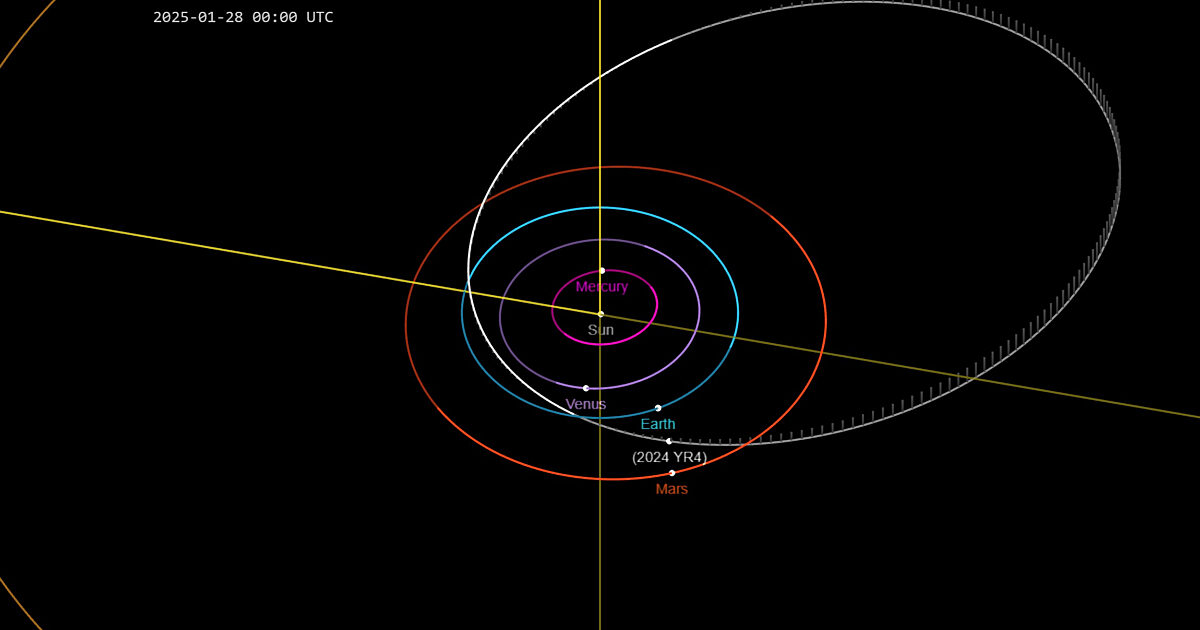
The orbit of 2024 YR4 (elongated ellipse) takes it way out beyond Mars but also brings it within Earth’s orbit. It may take millions of years but with an orbit like that it likely will hit our planet some day! (Credit: The Planetary Society)
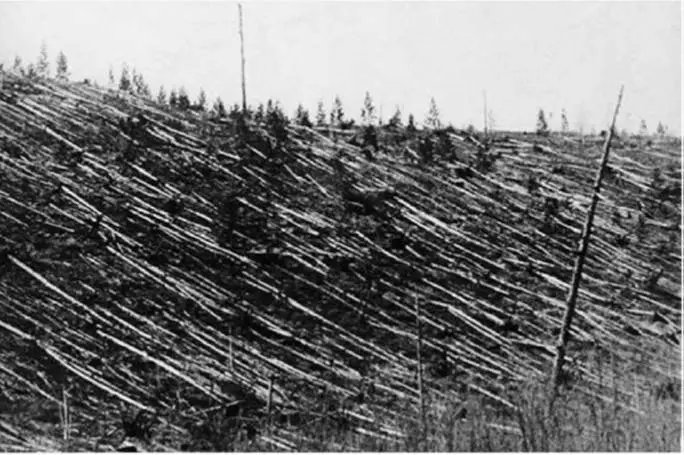
Of course rocks from outer space fall onto our planet every day, most being only the size of grains of sand that burn up in the atmosphere as meteors. Bigger chunks of space rock also collide with Earth once or twice a century. On June 30th of 1908 an asteroid estimated to be about 100m in diameter exploded over the Tunguska region of Siberia and just 12 years ago on the 15th of February in 2013 a smaller one, less than 20m in diameter exploded over the Russian city of Chelyabinsk. In each of these incidents humanity got lucky and the asteroid struck a sparsely populated region so that only a small number of people were killed or injured.
Flattened trees caused by the explosion of the Tunguska asteroid in 1908. If that asteroid, or one like it was to hit a modern, heavily populated city it could kill millions of people. (Credit: NASA)
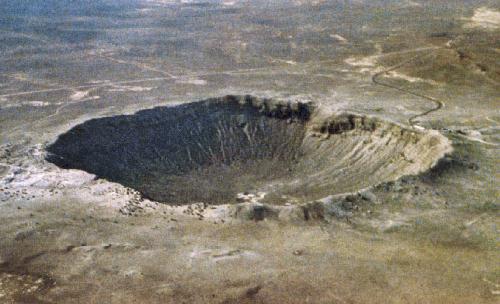
2024 YR is estimated to be between 50 and 100m in diameter meaning that it could be as large as the Tunguska asteroid and therefore potentially devastating if it should strike a heavily populated area. Another factor we don’t know about 2024 YR4 is what it is made of. Asteroids come in two basic types, piles of rocky rubble and solid Iron-Nickel. The iron-nickel ones usually survive to strike the Earth’s surface, forming a crater like the one in Arizona while the rocky, rubble ones usually explode in the atmosphere like the one over Chelyabinsk. The crater in Arizona is almost 2 kilometers across and an asteroid like that could easily destroy a large city, killing millions. The rocky-rubble ones aren’t much better, the Tunguska asteroid devastated an area of 2,200 square kilometers, again the size of a large city.
About 50,000 years old, Meteor Crater in Arizona is more than a kilometer across. Just imagine the destruction that space rock could cause today! (Credit: Grand Canyon Explorer)
And things are actually getting worse, looking through past images from the Catalina Sky Survey asteroid hunter David Rankin found old observations of 2024 YR4 and adding that data to the observations made in December the odds of the asteroid striking Earth is now estimated to be 3.1%, more than double the previous estimate.
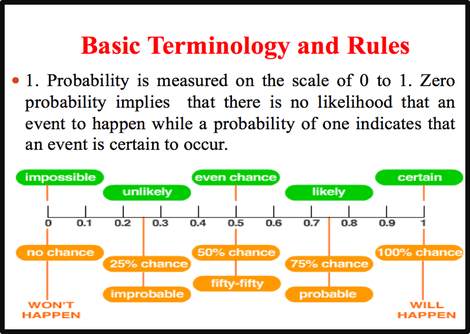
Even at its worst the chance of 2024 YR4 was far to the left, very unlikely. Still the odds are very likely that another space rock will hit us someday. (Credit: About)
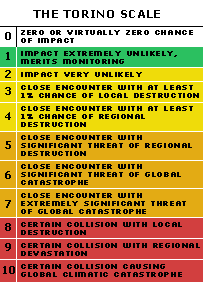
2024 YR4 is now rated as being a level 3 on the Torino scale that NASA uses to rank threats from asteroids. Because of the possible threat the space agency has even decided to take some valuable time on the James Webb Space Telescope to try and find 2024 YR4 again and get more precise estimates on its orbit. If that doesn’t work the asteroid will pass by our planet again in December of 2028 and very precise measurements of it motion can be made then. (The latest set of calculations now puts the risk from 2024 YR4 at less than 1% but interestingly it has about the same chance of hitting the Moon in 2032)
NASA has developed a scale, the Torino Scale, to quantify the threat from NEOs. 2024 YR4 reached level 3 but is now considered to be a level 1. (Credit: BBC News)
And if it turns out that 2024 YR4 is going to collide with the Earth, remember that we have already tested an asteroid defense system. That occurred when the DART space probe slammed into the asteroid Dimorphos on the 26th of September in 2022; see my post of 8 October 2022. Who knows, maybe the next test will actually be for real.
Some of my more attentive readers may have noticed that in the last couple of years I’ve been reading and reviewing quite a few books that deal with how our country got into its current political mess, about how the people of the United States became so divided and distrustful of each other. The return of Donald Trump to a second term as President has only confirmed in me the idea that our experiment in democracy and a multi-racial, multi-cultural society has taken a wrong turn somewhere. In the United States today it just seems to me that the credo of ‘Every man for himself’ is dominant and that money, as much and as quickly as possible, is the only measure of success.
Cover Art for ‘The Longest Con’ along with Author Joe Conason. (Credit: Seminary Co-Op Bookstores)
‘The Longest Con’ by journalist Joe Conason is another such book and in many ways the worst. I don’t mean that the book is bad, far from it. No, what I mean is that ‘The Longest Con’ details some of the worst kinds of human behavior that have been committed over the last eighty or so years, all in the name of good, wholesome, conservative American values. ‘The Longest Con’ is the story of ‘How Grifters, Swindlers and Frauds Hijacked American Conservatism’ to quote the book’s subtitle.
I guess that pretty much sums it up. A Swindler is a thief who uses lies instead of a gun to rob you. (Credit: YouTube)
The author Mr. Conason begins by first describing what could be termed the ‘type specimen’ of the kind of fake ‘ultra-American’ fraudster that he claims has taken over conservatism and the Republican party, Roy Cohn. Cohn is best known as the lawyer who worked with Senator Joseph McCarthy to discover hidden communists inside the US State Department. Publicly Cohn portrayed himself as a patriotic American trying to protect his country from ‘red infiltrators’. In reality however Cohn and McCarthy never succeeded in finding a single communist. They just used false accusations, hate mongering and scare-tactics to ruin the reputations of a lot of decent people, both in and out of government, all while lining their own pockets at taxpayer’s expense.
Roy Cohn (r) first became a public figure as a hatchet man for Senator Joe McCarthy (l). The two of them destroyed the reputations on numerous innocent people by just making accusations without any evidence. Sounds a lot like what’s going on in this country today! (Credit: Free Speech Center MTSU)
After McCarthy’s downfall Cohn returned to private practice in New York where he continued his heavy handed methods of always attacking, using any kind of dirt against opponents, even if it wasn’t true, all while claiming he was the one being treated unfairly. Towards the end of his life Cohn would become a mentor in bad behavior to a young Donald Trump, who has surpassed his teacher in climbing to the top by whatever means was necessary.
Towards the end of his life Cohn (l) became a mentor in lies and frauds to a young Donald Trump (r). (Credit: BBC)
One other facet of Cohn’s life is worth mentioning because it is a trait that many other frauds within the conservative movement have also been guilty of. One of the most vicious attacks that Cohn used against his enemies was to accuse them of sexual depravity, especially homosexuality. The irony is that it was Cohn himself who was gay. Following in Cohn’s lead since then many other conservative rabble-rousers have charged liberals with sexual misconduct only to be later revealed as the true perverts.
Another right-wing Republican who raged against Gays while concealing his own sexual crimes was Dennis Hastert whom the republicans made Speaker of the House. (Credit: Open Secrets)
‘The Longest Con’ then goes on to detail the many, many scams and frauds that have been perpetrated by right wing organizations whether they be political, like the John Birch Society or Evangelical Christian such as the Praise The Lord TV network. The list of individuals and groups who have swindled the American public in the name of conservatism is almost endless. ‘The Longest Con’ covers them all right up to the recent ‘Tea Party’ movement and of course our Fraudster in Chief Donald Trump.
John Birch was an agent of the Office of Strategic Services (OSS) the forerunner of the CIA who was killed in China during WW2, no one knows how. The John Birch Society considered him to be the first casualty of WW3 and that’s how they got their name. Like McCarthy and Cohn, the Birchers accused anyone and everyone while never providing any evidence, and made a lot of money doing it! (Credit: Financial Times)
Throughout ‘The Longest Con’ the techniques that the fraudsters use are described at length. Mostly the swindler sets up a fake charity, so that they can claim tax-exempt status. Then solicitations are sent out to conservatives around the country, either by mail or on the TV or nowadays through the Internet. So far it sounds just like any charity doesn’t it, but what happens then is that nearly all of the money taken in goes to salaries or expenses for the fraudster and their friends and family. Whatever money remains then goes for further fundraising while next to nothing goes to any actual charitable work.
Legitimate charities get most of the money they raise by direct appeals to the public, often by mail. The same is true for the fraudsters.
The worst part is that since these cons claim to be charities, law enforcement is often reluctant to investigate, let alone prosecute them. Even when the fraud is revealed the perpetrator(s) are generally only sentenced to a small fine and are soon free to start yet another con job.
There are thousands of fraudulent charities out there trying to take your money by simply lying to you. Learn how to protect yourself from such scammers. (Credit: Community Tax)
By the end of ‘The Longest Con’ the endless list of grifts and swindles actually becomes depressing, it’s becomes hard to imagine that so many people could be so corrupt. That’s one problem with ‘The Longest Con’ although I suppose it’s unfair to blame Mr. Conason for all of the con men we have in this country.
An Argument is one thing but today it seems as though all we do is yell and curse one another! (Credit: M-L-M Mayhem)
Another problem is that quite often Mr. Conason becomes a bit too polemic in his descriptions of the bad guys, often referring to them as “ostentatiously pious” or describing their actions as “deep fakery” for example. The use of such invective may be warranted but still it takes away from the objectivity in ‘The Longest Con’. So I do recommend ‘The Longest Con’, our country has gotten itself in a sorry state and Mr. Conason does a very good job of describing how we got here, and the sort of people who are pushing us ever further into the gutter.
It seems as though every time that astronomers build a new instrument, one that’s bigger, or more precise or one that looks at the sky above in a different way the discoveries made by that instrument challenge if not actually break existing theories about the Universe. It all started when Galileo first pointed his primitive telescope skyward and saw the moons of Jupiter, spots on the Sun, the phases of Venus and saw that the Milky Way was actually composed of thousands, millions of stars. As optical telescopes got bigger and bigger they saw more things like nebula and star clusters. Then, when astronomers added spectrographs to their telescopes they were able to discover what elements the stars were made of.
Two Telescope made by Galileo. With these instruments Galileo began the revolution in our understanding of the Universe that continues to this day! (Credit: Britannica)
In the 20th century radio telescopes discovered objects like pulsars and quasars while X-ray telescopes discovered black holes. With each new technological advance in the astronomer’s instruments came a better understanding of the Universe even if that meant tossing aside some older, well established ideas.
Today we build large arrays of radio telescopes in order to get an even clearer view of what lies out there! (Credit: PrimalLuceLab)
Observations by the James Webb Space Telescope (JWST) began to astound astronomers within weeks of its beginning operation in 2022. You see, the JWST was designed primarily to study the early Universe, around a billion years after the Big Bang. If you’re wondering how a telescope can see into the past remember that since the speed of light is a finite 300,000 kilometers per second all you have to do is look at something billions of light years away and you’ll be seeing it as it was billions of years ago.
In operation less than three years the James Webb Space Telescope (JWST) has already shaken up many of our theories about the early Universe. (Credit: European Space Agency)
But you better have a big telescope, and you better put that telescope in space so it can just stare at the object you’re observing for hours or days or longer to gather enough light. Oh, and since the entire Universe is expanding the Doppler effect is going to cause that light from billions of years ago to be shifted to longer wavelengths, you’ll have to build your telescope to see in the infrared. That means you’ll have to get it away from any heat sources like the Sun and Earth, which is why the JWST was placed at the Lagrangian (L1) point in the Earth’s shadow but a million kilometers from our planet.
The five Lagrangian points are the only exact solutions to the ‘Three Body Problem’ in celestial mechanics. Only L4 and L5 are really stable but the JWST is located at Earth’s L1 point where it only requires occasional adjustments to its orbit. (Credit: Australian Space Academy)
So as I said, JWST was primarily designed to study the Universe only a billion or so years after the big bang and those were some of the first images it took. Astronomers were interested in that period because they theorized that was the time that the first stars began to shine, that the first galaxies began to form. (See my post of 6 July 2024.)
Just a few years ago this was our best idea of the evolution of the Universe. After the big bang cooled off there was a period called the dark ages that lasted until about 400 million years after the big bang when the first stars began to shine. The first galaxies formed not long after that. The JWST has already forced us to make some changes to that timetable. (Credit: NASA Science)
One question that it was hoped that the JWST could answer dealt with the supermassive black holes that astronomers are now convinced lie at the heart of every galaxy, at least every big one. Simply put, the question was, which came first? Did galaxies form supermassive black holes in their centers, or do supermassive black holes form galaxies around them? Obviously any theory of how galaxies form needs to know that.
The first ever image of a supermassive black hole in the center of the galaxy M87. What you actually see here is not the hole itself but the ring of material that is falling into the hole and heating up so that it shines! (Credit: Wikipedia)
What the JWST did in fact see when it made its first observations were a large number of what astronomers named ‘Little Red Dots’, that is small but rather bright galaxies with a reddish glow to them. By their brightness the red dots appeared to contain millions of bright stars and some of them were found to have existed less than half a billion years after the big bang, a time so early that according to most theories of galaxy formation no such well developed galaxies should exist. That was why there were so many news articles about JWST having ‘Broken Cosmology’.
Some of the ‘Little Red Dots’ observed by the JWST. These ‘proto-galaxies’ appear to have formed much earlier than cosmologists expected. (Credit: Space.com)
That was about two years ago and since then the JWST has both discovered a lot more ‘Little Red Dots’ and made much more detailed and precise measurements of some of them. Now a team of astronomers headed by Dale Kocevski of Colby College has announced results of their survey of the red dots at a conference of the American Astronomical Society that was held in Maryland the second week in January.
The recent 245th meeting of the American Astronomical Society must have been a fun party!!!! (Credit: Threads)
What the astronomers found was that the better observations of the red dots all showed light signatures indicating that much of their light came from hot gasses spiraling into a growing black hole. So the reason the red dots were so bright wasn’t because they had millions of stars but because they had the beginnings of a Quasar, a feeding black hole in their center. The JWST observations don’t break current theories of cosmology but those theories are certainly going to have to be modified.
Six Quasars as seen in an optical telescope. Today we know that these objects are galaxies with a feeding supermassive black hole at their center that is giving off so much light that it is outshining the entire galaxy around it. (Credit: Britannica)
The case isn’t closed yet however, because about a billion years after the big bang all of the red dots seem to disappear. Dr. Kocevski and the other astronomers in the team think that, as the black hole forms a galaxy around it will start to take on the appearance of a more ‘normal’ active galactic nuclei (AGN).
Quasars are often also referred to as ‘Active Galactic Nuclei’ (AGN). The question for astronomers is how did the ‘Little Red Dots’ evolve into AGN? (Credit: Medium)
So it seems that the JWST has given us the answer to our question about which came first: galaxies or the supermassive black holes inside them. The ‘Little Red Dots’ are black holes that serve as the seeds of galaxy formation. But like every other scientific answer this one breeds another question; where do the black holes that form the ‘Little Red Dots’ come from?