Everyday Physics: Electrical Coronae on Tree Leaves during a Thunderstorm and the screeching sound Cellophane tapes makes when you pull it. 

The science of physics is usually thought to be concerned with the study of strange, esoteric objects that are either very small, like sub-atomic particles, or very large, like black holes and the Universe itself. It didn’t use to be that way, back in the 18th century physicists put their efforts into investigating the behaviour of everyday phenomenon like the trajectories that cannon balls followed through the air or the swinging motion of pendulums.
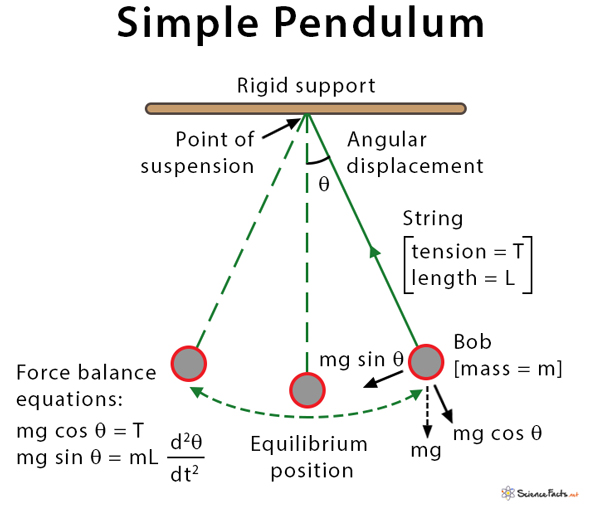
It was Galileo who first described the mathematics of how a pendulum worked! (Credit: Science Facts)

Even today there are physicists who are using modern instruments to actively study the behaviour of commonplace objects under unusual circumstances or during very short periods of time. I have posted about these studies several times before, see my posts of 30 March 2024 and 5 April 2025. In this post I’ll be reviewing studies about what happens to the leaves of trees during a thunderstorm and why cellophane tape makes that loud screeching sound when you pull it off of its roll.
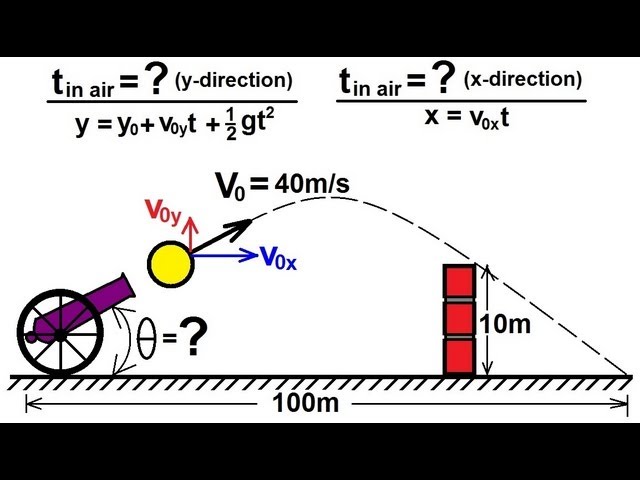
Another important problem that was solved in the early days of Physics was the path, or trajectory that a projectile took when fired from a cannon. (Credit: YouTube)

I’ll start with tree limbs during a thunderstorm. We’re all familiar with the story of how Ben Franklin demonstrated that lightning is really a massive discharge of static electricity that builds up during a severe storm. He did this by flying a kite during a thunderstorm and using the kite’s cord to capture some of the static charge onto a key.
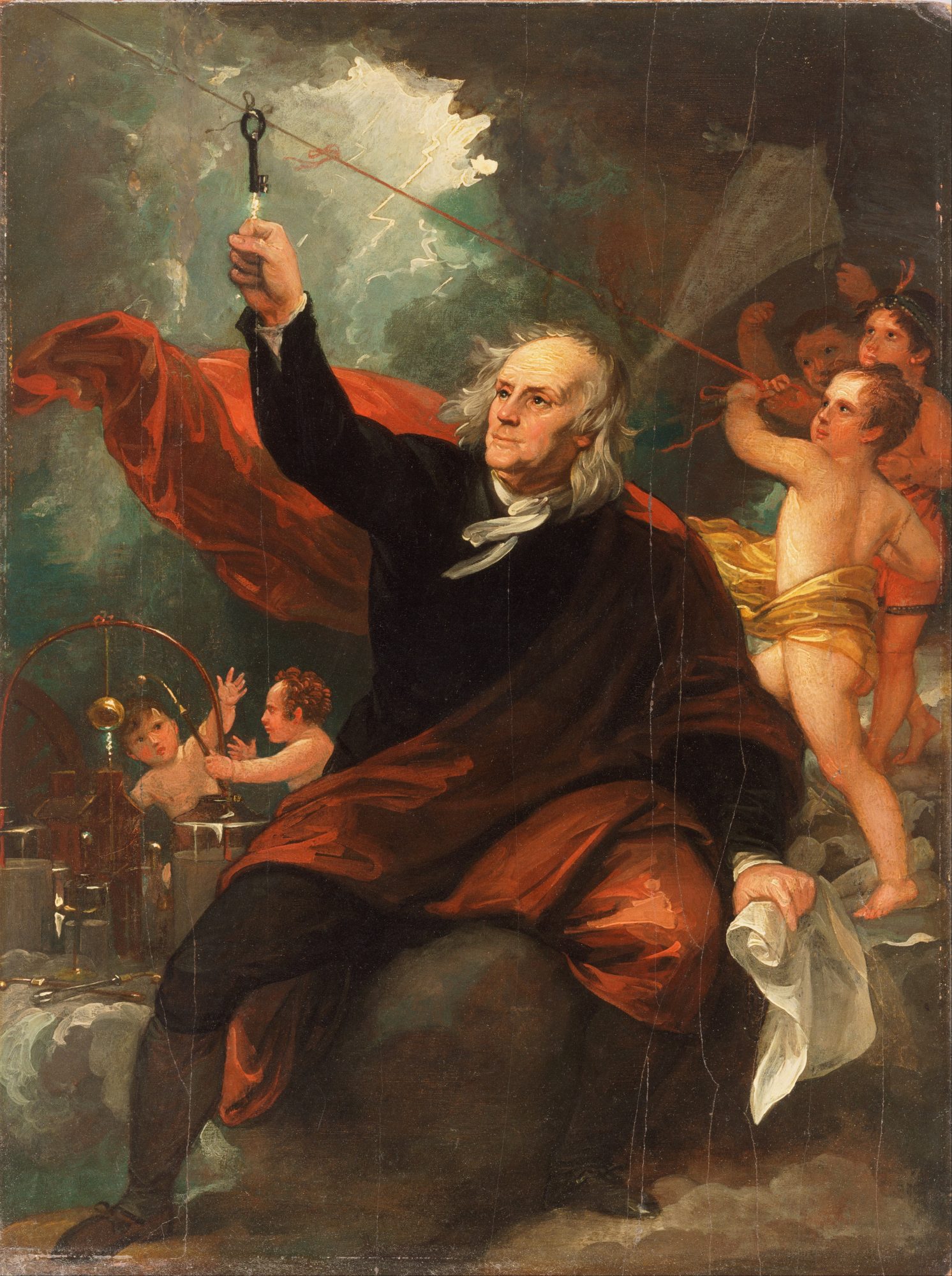
It was just a couple of miles from my house that Ben Franklin really did fly a kite to demonstrate that lightning was just static electricity! The cherubs shown here were not actual witnesses to the experiment; they were added later by artist Benjamin West. (Credit: Wikipedia)

Franklin was also one of the key proponents of the Two-Fluid theory, which is the idea that there were two forms of electricity, which he called ‘positive and negative’. Both these types of electricity were thought to be contained in many, today we know all objects.
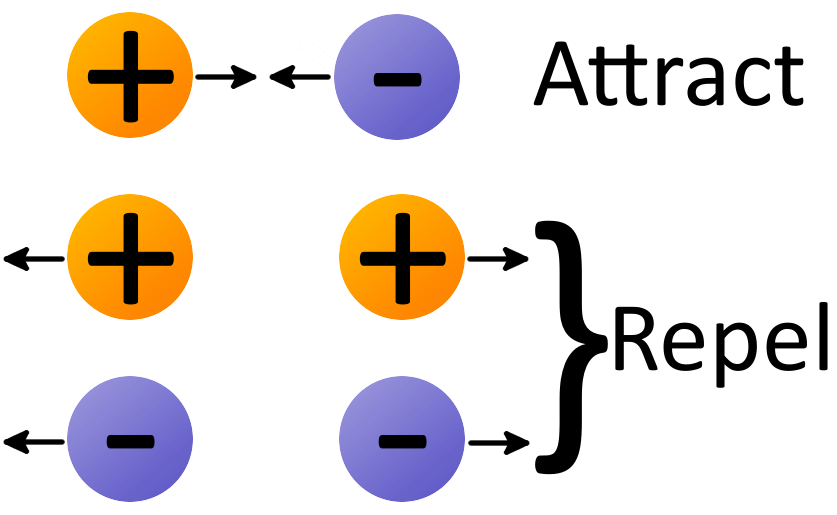
The electric field is composed of two kinds of ‘charge’, called by Ben Franklin ‘Positive’ and ‘Negative’. Opposite charges attract each other while similar charges repel each other. (Credit: SparkFun Learn)

Scientists like Franklin were experimenting with electricity and discovering that similarly charged objects, both positive or both negative would repel each other while oppositely charged objects, one positive one negative, would attract each other. Franklin also argued that when you had an equal amount of positive and negative charge in an object the charges would cancel each other out and that object would be neutral.
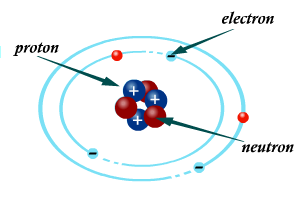
In an atom the Electrons are negatively charged while the Protons are positively charged. A normal atom has equal numbers of both, so it is uncharged or neutral! (Credit: SCE Kids)

Rubbing two different objects against each other is what causes an imbalance in the electric charges. The classic example of this is amber and rabbit fur with the amber picking up a negative charge while the fur becomes positively charged. The Greek word for amber is Electra and that is how we get the word electricity. By the way Franklin could just as easily have called the amber positive and the fur negative, it made no difference to him although if he had done so today we would have to reverse the names of the sub-atomic particles electron and proton!
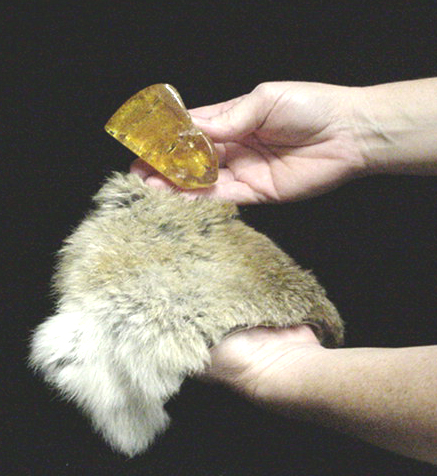
We’re all familiar with static electricity but the classic version first mentioned by the Greeks is rubbing a piece of amber with rabbit fur. By the way the Greek word for amber is Electra, which is where we get the term electricity! (Credit: sites.physics.unt.edu)

Getting back to what happens during a thunderstorm where the air masses are moving against each other and having different humilities. This movement generates huge amounts of electric charge, which is usually discharged by cloud to cloud lightning. Sometimes however a charged mass of air will generate an opposite charge to build up in the ground beneath it and if the buildup is enough you can get cloud to ground lightning, which often causes fires or other kinds of damage.
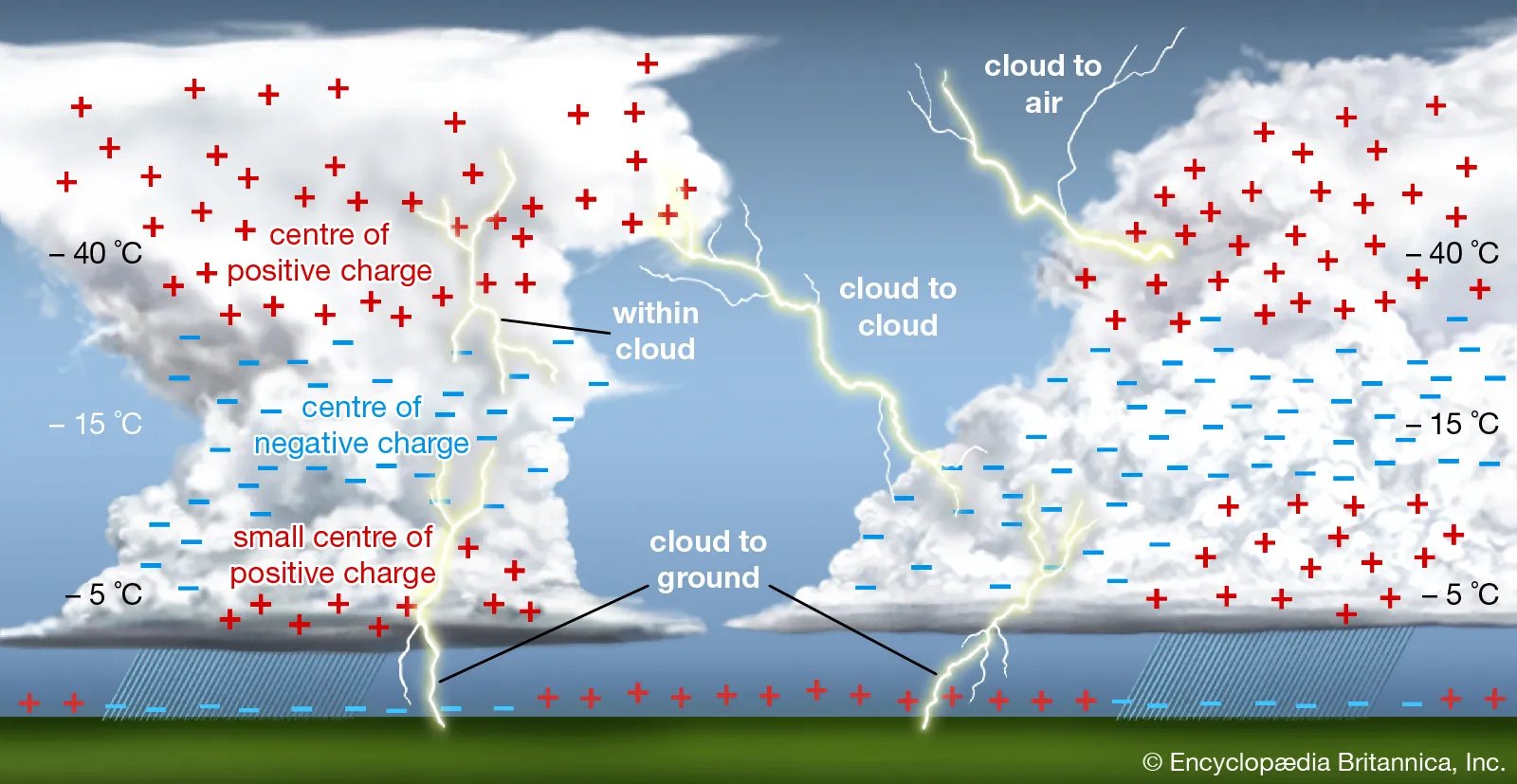
Rapid movements of humid air cause huge amounts of static electricity to build up causing several types of lightning to occur. Cloud to cloud is the most common but cloud to ground is the most destructive! (Credit: Britannica)

Even when there isn’t cloud to ground lightning you can still often get a charge to build up in the ground during a thunderstorm and therefore a charge to build up in anything on the ground. This is especially true of trees, because they are taller and therefore closer to the charge in the air, opposites attract remember.
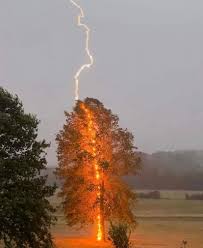
Tall trees provide a path for electricity to go to ground so trees are often struck by lightning during thunderstorms! (Credit: Facebook)

Electricity has another interesting aspect, it likes to collect near points in objects, like the needles of pine trees or the pointy ends of leaves in oak or maple trees. It has long been conjectured that this build up of charge, known as a coronae, should occur on tree leaves, especially leaves near the tree-top. The light from such coronae however is so weak that no one had ever seen it.
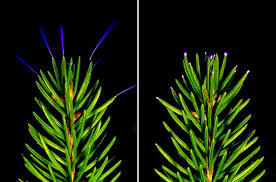
It has long been thought that individual leaves on trees should display coronae during thunderstorms, but the effect was so weak no one was able to actually film it, until now! (Credit: Science)

Until now that is. A research team from Penn State University led by meteorologist Patrick McFarland has put together an observational setup in a 2013 Toyota Sienna and has traveled from Florida to Pennsylvania confirming that many different species of trees do have electric buildup in their leaves during a thunderstorm. The equipment assembled included a portable weather station, an electric field detector, a laser rangefinder and an ultra-violet (UV) camera with a periscope lens.

Penn State researcher Patrick McFarland and his equipment. (Credit: Instagram)

Even as the team watched the live picture on the UV camera it was hard to see anything happening. On their first attempt the coronae were only discovered later when they reviewed their results and detected 41 coronae appearing on tree leaves during a 90 minute thunderstorm. The glows usually lasted only about 3 seconds and were often observed to dance from leaf to leaf.
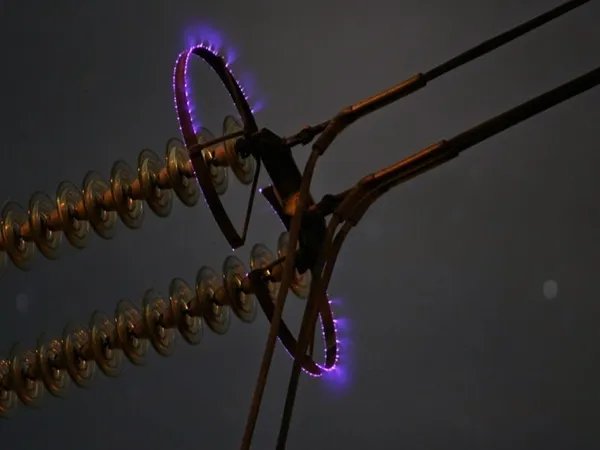
Coronae discharges are quite common during thunderstorms on high voltage electrical cabling. (Credit: Nooa Electric)

The meteorologists speculate that these coronae occur on trees frequently and could involve thousands of trees during severe weather events. According to McFarland, “With superhuman vision I believe you’d see this swath of glow on the top of every tree under the thunderstorm.”

Meanwhile at King Abdullah University of Science and Technology in Saudi Arabia, a team of researchers led by Professor Sigurdur Thoroddsen has been investigating another strange phenomenon that everyone of us is familiar with, the loud screech that happens when we pull a piece of cellophane tape off of its roll. We’ve all heard that sound, but it all happens so fast that we don’t really understand what’s actually causing it.

Many people refer to any kind of cellophane tape as ‘Scotch Tape’ but in fact that is a single brand of adhesive tape! (Credit: Office Depot)

The physicists set up an experimental apparatus consisting of a pair of high speed cameras along with a synchronized sound recording apparatus. The first camera was pointed at the underside of the cellophane tape as it was being pulled. The second camera took a side view but it used a technique known as schlieren imaging to record tiny deflections in light rays caused by density changes in the air. This is the technique often used to photograph the shockwaves radiating out from explosions.
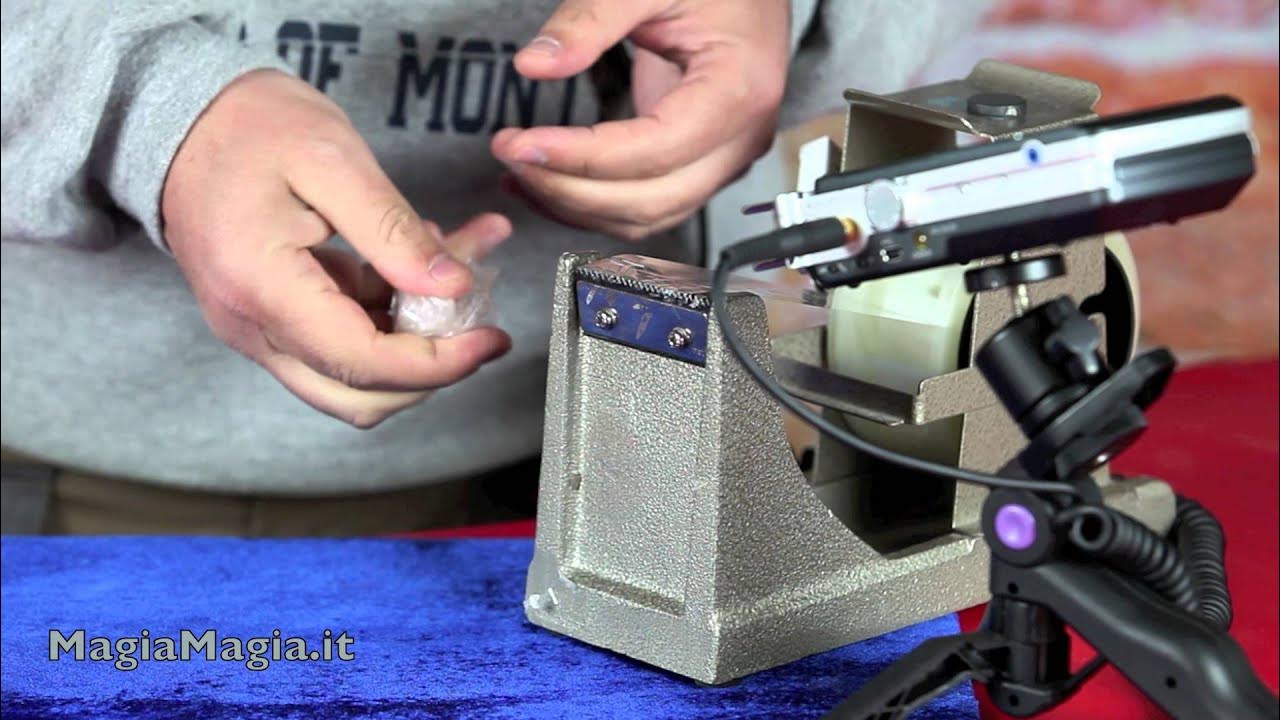
The experimental setup used to examine the screeching sound made when cellophane tape is pulled off of a roll. (Credit: YouTube)

What the researchers found was that the tape separated in a large series of slip-stick events. That is, a tiny area of tape, say a square micrometer, peals off the roll so quickly that parts of it actually exceed the speed of sound, causing a tiny sonic boom. Once that small piece breaks away the whole process comes to a halt for less than a microsecond before it is repeated with the next tiny area of tape. Hundreds if not thousands of such events take place in less than a second resulting in the unmistakable sound of cellophane tape being pulled off of a roll.
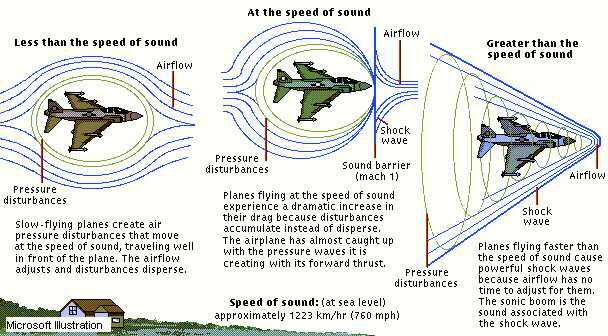
Moving faster than the speed of sound causes a pressure wave to build up around the moving object. This pressure wave is called a sonic boom. This sound is normally associated with jet aircraft, but it can be caused by any object, even tiny pieces of cellophane tape. (Credit: Physics Stack Exchange)

So you see that not all physicists are working with atom-smashers or cosmic-ray telescopes trying to discover the ultimate nature of reality. Some are still working to try an understand the behaviour of the everyday objects around us. 

Two Studies in Physics that Illustrate how Classical Mechanics still has a lot of things to Teach Us. 

Over the past century it seems as though all of the big discoveries in Physics have come from either Relativity Theory or Quantum Mechanics. These two pillars of 20th century science are all about objects that are moving very, very fast, or are very, very small.  Sometimes it seems as if the old Physics of Isaac Newton has little left to teach us, as if we’ve learned everything there is to know about the behaviour of objects in our everyday world. In this post however I’ll be discussing two recent studies that show how much we still have to learn from classical physics about the ways objects in our everyday life behave.

In Today’s World it is really necessary for everyone to have some understanding of the two Scientific Revolutions that shaped the 20th Century! (Credit: Amazon.com)

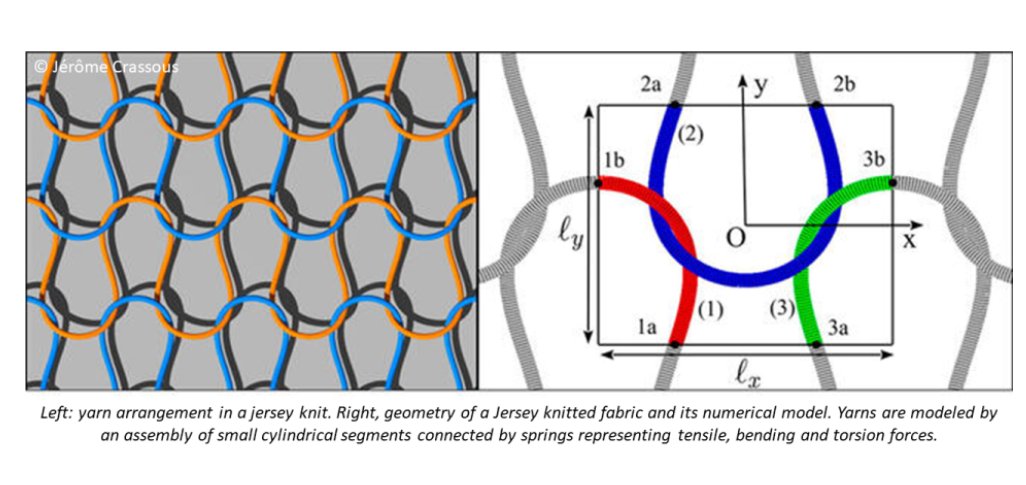
The first paper I’ll be discussing comes from researchers at the University of Rennes and the University of Lyon, both in France along with Aoyama Gakuin University in Japan who examined the different shapes and forms that knitted fabrics can take on after being stretched and pulled. Specifically, the team used a common jersey knit stitch known as stockinette, which consists of interlocking loops of threads, to knit a piece of fabric with 70×70 stitches. See figure below. This piece of fabric was then placed on a specifically designed tensile mechanism that allowed the researchers to stretch, pull and twist the piece of fabric in a wide variety of different directions and strengths.

Familiar to anyone who knits the Stockinette stitch is one of the most common methods of turning a thread into a piece of fabric. (Credit: Gathered)

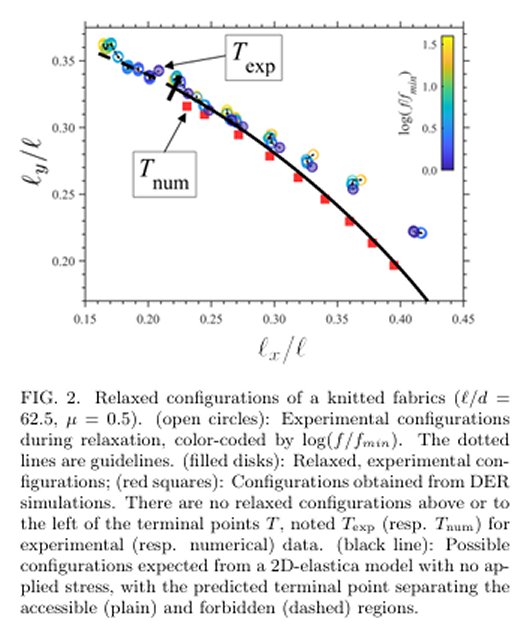
Now we all know that knits that are really pulled and stretched never quite return to their original shape, they become deformed. What the researchers did however was to measure the degree of deformation that resulted in their piece of fabric depending on the amount of stretching given to the fabric. Each of the resulting shapes that the piece of fabric took on after stretching and twisting the team designated as a ‘metastable shape’ and they categorized the many metastable shapes generated during their testing.

Quantitative definitions established by the researchers to study the deformation of knitted fabrics. (Credit: CNRS Le Journal)

At the same time the team ran a series of computer simulations that replicated the actual experimental results. One thing the computer simulations allowed the researchers to do that they couldn’t do experimentally was to reduce and even completely eliminate the effect of friction between the stitches of their piece of fabric. What the team discovered in these simulations was that, in the absence of friction the piece of fabric always returned to its original shape, regardless of the amount of stretching and twisting. Without friction there were no matastable shapes.

Some of the Data obtained by the researchers showed the relaxed states of their fabric after stretching. (Credit: Crassous, Poincloux and Steinberger)

Perhaps the research conducted by the team in France and Japan will help manufacturers develop clothing that does not lose it shape after being worn or washed, perhaps not. At least however you now know that friction is to blame when your favourite sweater gets deformed.

Personally, I think all sweaters are misshapen. They feel so uncomfortable I just can’t wear them at all! (Credit: iStock)

Another study dealt with a twist on the familiar phenomenon of how two or more objects moving a fluid, water or air, actually reduce the force of friction on each other. We’ve all seen how a flock of geese will fly in a ‘V’ shaped pattern. Well that’s because the lead goose’s motion sets up an flow of air called a bow wave that reduces friction to the two geese on either side of it and slightly behind, reducing the amount of energy they have to expend in flying. This reduction in friction continues right down the line so that the flock forms a ‘V’ shape in order to reduce the amount of energy they expend in flying. In water dolphins will often swim close the bow of a ship to take advantage of the same phenomenon, and many species of schooling fish arrange themselves for the same reason.

Geese always fly in a “V” formation because the air currents generated by the bird in front actually makes flying easier for the bird behind them. The bird in front gets relieved on a regular basis. (Credit: Online Training Courses)

Obviously this doesn’t work in a solid medium because solid objects simply cannot move through a solid medium. What about a granular medium however, where each individual grain may be solid but where thousands, if not millions of tiny grains can still in many ways behave like a fluid.

In many ways the grains of sand in an hourglass behave more like a thick liquid than solid objects. (Credit: Amazon.com)

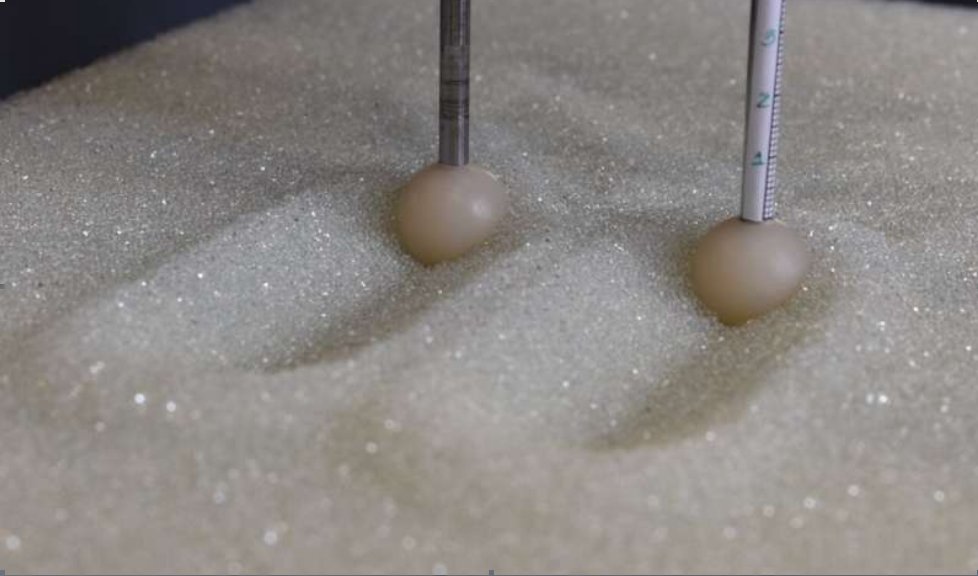
That’s what physicists at the University of Campinas in Brazil and the University of Paris-Saclay in France decided to study. The experimental setup the researchers employed consisted of a bed of glass beads, used in place of sand because of their uniformity, through which two steel balls called ‘intruders’ could be pulled in parallel. The researchers could vary both the distance between the intruders as well as their depth in the glass beads, riding the surface, just submerged or fully submerged etc.

During testing the steel balls were actually submerged in the sand but this is an image of the actual setup the scientists used to measure the effect of multiple objects moving through a granular media. (Credit: University of Paris-Saclay)

What the team discovered was that there was a significant reduction, nearly 30%, in the force of fiction on both balls when they were so close as to be almost touching. The cause of this reduction in friction the researchers attribute to the motion of one intruder breaking the force chains between the grains around the other intruder, and vice versa.

Just looking at all of the different shapes and sizes of sand grains it’s easy to understand where the friction caused by moving through sand comes from. (Credit: Vecteezy)

The researchers also believe that their findings may help to explain some well-known phenomenon in the natural world such as the digging of animal burrows and the growth of plant roots. In any case the results discovered by both teams of physicists clearly show that classical physics can still teach us a lot about the world around us.