I’ve written several posts about the rapid advances that have been made recently in the field of robotic prosthesis for people who have either lost a limb or the use of their limbs. See posts of 14Aug2019, 23Feb2019, 17Feb2018 and 29Apl2017. I must admit however that the latest breakthrough has me simply stunned; a man who had lost all control of his four limbs has been able to walk again using a robotic exo-skeleton controlled by only his thoughts, and a highly advanced computer interface.
A Quadriplegic man has succeeded in walking using an exo-skeleton controlled by his thoughts. (Credit: The Independent)
The
research is taking place in France at Clinatec, the University of Grenoble’s
Center for Biomedical Research. The test subject, a 28-year-old man named
Thibault, is paralyzed from the shoulder down due to a severing of his spinal
column in a 12-meter fall from a balcony.
In order to read his thoughts a sensory device was implanted in each hemisphere of his skull between the skin and his brain. The two sensory discs were each 5 cm in diameter and contained 64 separate sensors. The electronic ‘brain waves’ generated by the sensorimotor cortex of the brain are captured by these sensors and fed into a computer. The computer then uses an algorithm to translate the brain impulses into commands for movements of the mechanical exo-skeleton.
Electronic sensors were implanted in Thibault’s skull, one for each hemisphere. (Credit: Clinatec Endowment Fund / AFP)
Needless to say it’s not really all that simple. In fact it took two years of trial and error in order for both Thibault to learn how to frame his thoughts correctly and to teach the computer algorithm to correctly translate those thoughts into the desired motion commands. Much of this practice was actually carried out in virtual reality with Thibault and the computer moving computer generated images of limbs.
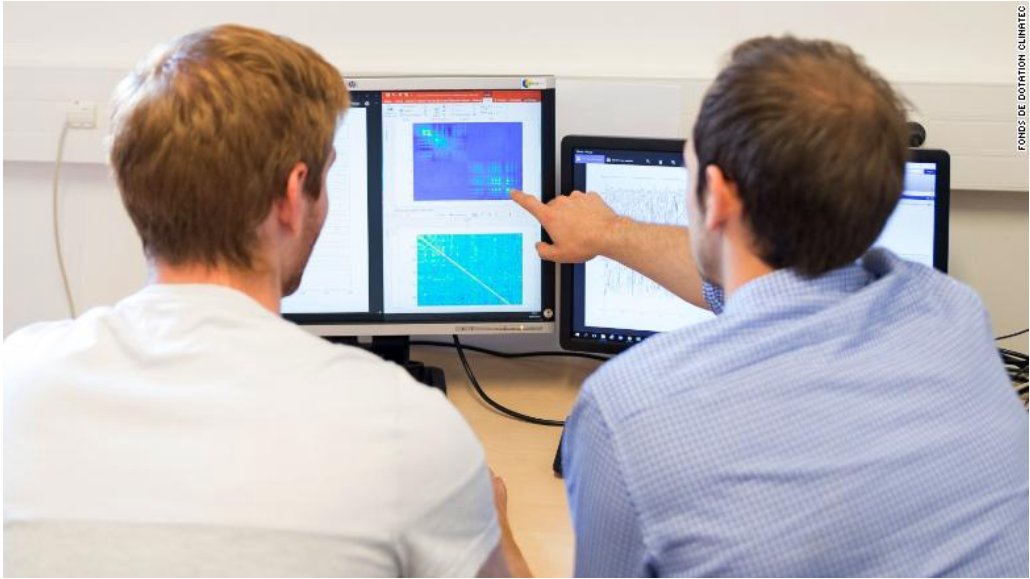
A computer algorithm translated Thibault’s brain waves into commands for the Exo-Skeleton. (Credit: Clinatec Endowment Fund)
For Simplicity and safety the testing and training of controlling the exo-skeleton was performed in virtual reality. (Credit: SHRM)
Once the researchers were confident enough they placed Thibault into the actual 65 kg exo-skeleton and studied him while he successfully walked a total of 145 meters. Since the researchers expected balance to be an issue the exo-skeleton was connected to a ceiling mounted harness that provided stability but all of the movements of the exo-skeleton were controlled by Thibault’s thoughts.
According
to Professor Stephan Chabardes, author of the study and a neurosurgeon at the
University’s hospital, “Our findings could move us a step closer to
helping tetraplegic patients to drive computers using brain signals alone,
perhaps starting with driving wheelchairs using brain activity instead of
joysticks and progressing to developing an exo-skeleton for increased
mobility.”
Research is continuing, the scientists hope that soon Thibault will be able to walk in the exo-skeleton without the ceiling harness in the next phase of the program. Also, three other patients have been recruited for further trials. Although the system is certainly not ready for general use the researchers hope that in time improvements will allow the exo-skeleton to become commercially available.
Before long the development of exo-skeletons may soon rival those imagined in Sci-Fi movies. (Credit: DudeWantThat)
The
development of the Grenoble exo-skeleton is another step in the direction of a
Human Machine Interface (HMI) that will allow humans to both control and receive
information from advanced mechanical and computer systems. Someday a fully
functioning HMI might blur the line ourselves and our creations.
It seems more and more as if Science Fiction is becoming dominated by the writing and publishing of series, trilogies in particular, as opposed to stand-alone novels. One of the latest of these series is by new author Brandon Q. Morris and concerns an expedition to the planet Saturn in order to investigate the possibility of life on its moon Enceladus.
Saturn’s Icy Moon Enceladus has jets of water streaming out of its south polar region. This means there must be some large body of liquid water beneath the ice covering. Could that liquid water support life??? (Credit: Spaceflight Insider)
One problem that arises with these series is that it can be quite easy to pick up the second or third story in the series and start reading without realizing that you’re starting in the middle of the story. I did that when I bought ‘The Titan Probe’. Two pages in and I recognized my error, put the book down and ordered ‘The Enceladus Mission’. Because of that mistake on my part however this book review will be a two for one, reviewing both “The Enceladus Mission’ and ‘The Titan Probe’.
Cover of ‘The Enceladus Mission’ by Brandon Q. Morris (Credit: Amazon.com)
Cover of ‘The Titan Probe’ by Brandon Q. Morris (Credit: Amazon.com)
‘The Enceladus Probe’ begins as the unmanned space probe ELF discovers clear evidence not just of organic compounds around Saturn’s moon but “the digestive byproducts of your space rat.” In other words the probe has found unmistakable evidence of life. The acronym ELF by the way stands for Enceladus Life Finder and is an actual proposed NASA mission to that moon of Saturn.
Brandon Morris uses a lot of acronyms in both ‘The Enceladus Mission’ and ‘The Titan Probe’ and for the most part I think that’s a good thing. This style of hard sci-fi has benefited from the success of Andy Weir’s ‘The Martian’ and appears to be growing more popular, witness the current movie ‘Ad Astra’.
Saturn’s moon Titan possesses a thicker atmosphere than Earth’s but if there is life on Titan it would be very different than life on Earth. (Credit: NASA)
In hard sci-fi novels hardware that already exists, is currently under development or at least is based on known science is employed as much as possible in illustrating the story. Personally I hope this trend toward hard sci-fi will continue. Of course it is possible to overdo the techno jargon, I mean is it really better to talk about an EMU, which means Extravehicular Mobility Unit, instead of just saying spacesuit!
Getting
back to the story, now that there is clear evidence of life on Enceladus the
nations of the world combine their resources to put together a manned mission
to “catch the little critter itself.” So begins the voyage of the
ILSE spacecraft, ILSE standing for International Life Search Expedition no
less.
The idea of the world’s space nations getting together is another common theme of hard sci-fi novels. In ‘The Martian’ for example a Chinese rocket is needed to resupply the Hermes spaceship as it goes to rescue Mark Watney who’s stranded on Mars. I guess the authors of these stories like to imagine how much more we could achieve in space if only we worked together.
The moral of the original ‘Star Trek’ Series was that by working together humanity could go on to explore the Universe! (Credit: Paramount)
Also
like ‘The Martian’ in both ‘The Enceladus Mission’ and “The Titan Probe’
the crew of the ILSE face several technical problems with equipment during
their mission that require all of their ingenuity and determination to
overcome. Once again this is a plot device that can be overused but Brandon
Morris does a good job of making each predicament seem different from the
others.
One plot device that was lacking in ‘The Martian’ but which Morris includes in both ‘The Enceladus Mission’ and ‘The Titan Probe’ is intelligent aliens. Now back in the ‘golden age’ of sci-fi, the days of H. G. Wells, Edgar Rice Burroughs and Ray Bradbury, Martians and Venusians were more common than interstellar aliens. But when the early space probes of the 1960s found Mars to be a cold desert and Venus to be an acidic furnace the aliens in sci-fi stories became exclusively interstellar. I have to say that it was nice to see a story with intelligent aliens who are native to our solar system for a change.
Back before we knew that Mars was a cold dry desert even Bugs Bunny got to meet a Martian! (Credit: Warner Brothers)
So
there you have a good idea of the sort of story you’ll find in both ‘The
Enceladus Mission’ and ‘The Titan Probe’. If you’re a fan of hard sci-fi, if
you liked ‘The Martian’ I think that you’ll enjoy both novels. By the way there
is a third installment in the voyage of the ILSE, ‘The Io Encounter’ which I
just received. I’ll tell you about it later.
It’s
that time of year again. The Nobel Committee has announced its choices for the
award that recognizes achievements in the fields of Physics, Chemistry and
Medicine (Physiology). Since my degree is in physics I think I’ll start with
the winners for Physics.
This years winners are being recognized for their work in revealing some of the details about the structure of this Universe in which we live. Three scientists, James Peebles along with Michel Mayor and Didier Queloz will share this year’s prize of 9 million Swedish krona or $910,000 dollars.
James Peebles, Michel Mayor and Didier Queloz were awarded the 2019 Nobel Prize in Physics for their work in Astrophysics. (Credit: Bloomberg)
Two of the physicists, Professor Michel Mayor of the University of Geneva along with Didier Queloz, who teaches at both the University of Geneva and Cambridge University were honoured for their discovery in 1995 of the first exoplanet orbiting a Sun like star. Today we know about the existence of thousands of exoplanets but it was Mayor and Queloz who used a technique called the Radial Velocity Method to discover an exoplanet orbiting the star 51 Pegasi, in the constellation of Pegasus.
Looking at the illustration below of a star and its planet both orbiting around their mutual center of gravity we see how the star is sometimes moving toward us and sometimes away from us. This tiny tug back and forth due to the gravity of the planet can be seen in a blue shift in the star’s light as it moves toward us and a red shift as it moves away. It was by detecting a repeating pattern of blue and red shifts in the light of the star 51 Pegasi having a period of 4.2 days that allowed Mayor and Queloz to announce their discovery.
An Illustration of the Radial Velocity Method for discovering exo-planets. (Credit: Johnan Jarnestad/ Swedish Academy of Science)
The
work of James Peebles of Princeton University, the Albert Einstein Professor of
Physics no less, deals with a topic a bit bigger and older than a mere planet,
the birth of the Universe itself. You see Peebles, working back in the 1970s,
was one of the leading scientists who put the Big Bang Theory on a solid
theoretical basis.
Doctor Peebles work dealt with probing the Cosmic Microwave Background (CMB) for clues about not only the conditions that prevailed in the Universe at the time of the Big Bang but also in the Universe as it is today. The cosmic Microwave Background is the tiny amount of heat left over from the Big Band that permeates the entire Universe and is almost, almost the same temperature everywhere and in every direction.
The Cosmic Microwave Background as seen by the Planck Satellite. The tiny differences in temperature seen here were predicted by James Peebles. (Credit: Universe Review.ca)
It
was Doctor Peebles who first predicted that tiny fluctuations in the CMB had to
be there. If the CMB was perfectly smooth he reasoned, then the Universe today
would also be perfectly smooth, instead of possessing all of the galaxies and
stars we see. In other words those tiny variations in temperature 13.8 billion
years ago were the seeds from which the structure of today’s Universe grew.
Further analysis of those variations also allowed Peebles to calculate the percentage of the energy of the Universe that today is composed of ordinary matter, the atoms and elementary particles we are familiar with, dark matter and even dark energy which are the subject of so much current research. When you consider how much of our knowledge of the early Universe is due to the work of James Peebles it’s no wonder he has finally received the Nobel Prize.
Since you’re reading this post right now there’s a good chance that you’re using either a smartphone, smartpad, or laptop computer. If so you might want to take a moment to thank the winners of this year’s Nobel Prize in Chemistry. You see the research for which M. Stanley Whittingham, John B Goodenough and Akira Yoshino will share their 7 million krona is the development of the Lithium-Ion batteries that today power our mobile world.
John B. Goodenough, M. Stanley Whittingham and Akira Yoshino received this years Nobel Prize in Chemistry. (Credit: Swedish Royal Academy of Science)
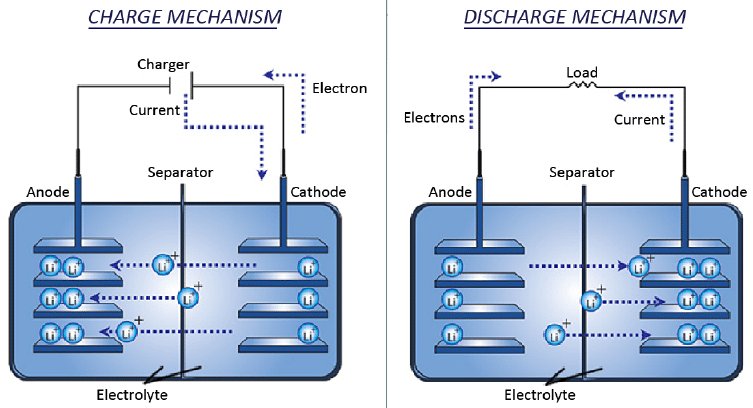
The development took quite a long time and there were more than a few problems along the way to overcome. It began in the 1970s when Stanley Whittingham discovered an energy rich material called titanium disulphide that he used as the cathode, the negative terminal in a battery with a metallic lithium anode as the positive terminal. Whittingham used lithium because of the metal’s ability to release large numbers of electrons.
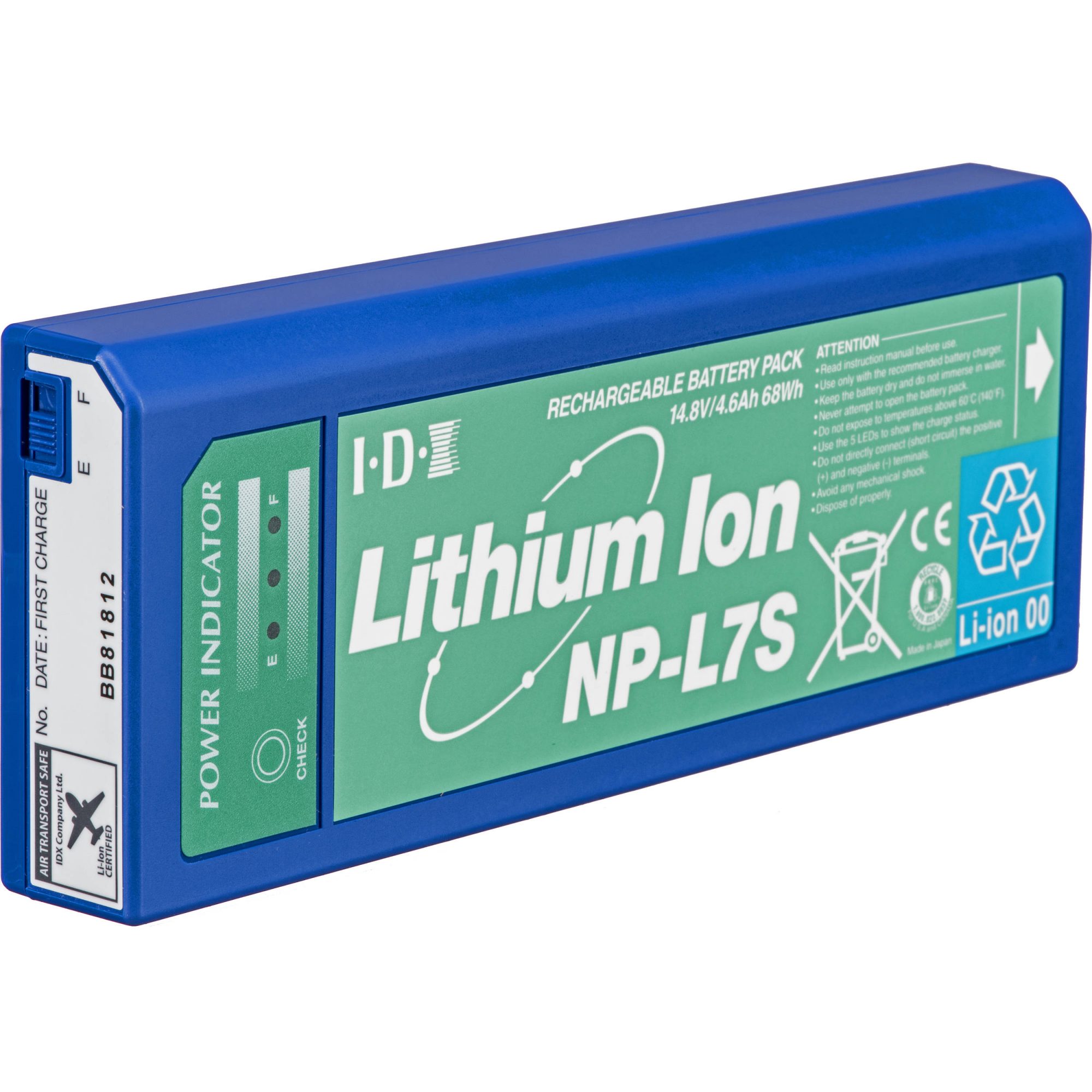
Lithium Ion Batteries are a fixture in our modern world. (Credit: B&H)
The problem with these early lithium batteries was that each time the battery was recharged there was an internal buildup of chemicals at each terminal. This buildup would continue until the two terminals actually touched each other inside the battery causing a short circuit that released all of the battery’s energy in seconds. The result of that short would be either a fire or even an explosion. Despite this danger lithium batteries were so powerful that they quickly found some limited applications.
The Charge and Discharge mechanisms of a Lithium Battery. (Credit: ResearchGate)
Then
in 1980 John B. Goodenough made lithium batteries even more powerful by
replacing the disulphide terminal with one composed of cobalt oxide that nearly
doubled the energy storage capability. Nevertheless the danger inherent in the
lithium battery still kept them from widespread use.
It wasn’t until 1985 that Akira Yoshino succeeded in replacing the metallic lithium with Lithium Cobalt Oxide (LiCoO2) alleviating the buildup of chemicals and making the new lithium ion battery safe enough for widespread use. Thanks to the efforts of these three dedicated scientists the development of the modern lithium ion battery is a case study in how engineering research is carried out, one step at a time. Certainly an achievement worthy of a Nobel Prize.
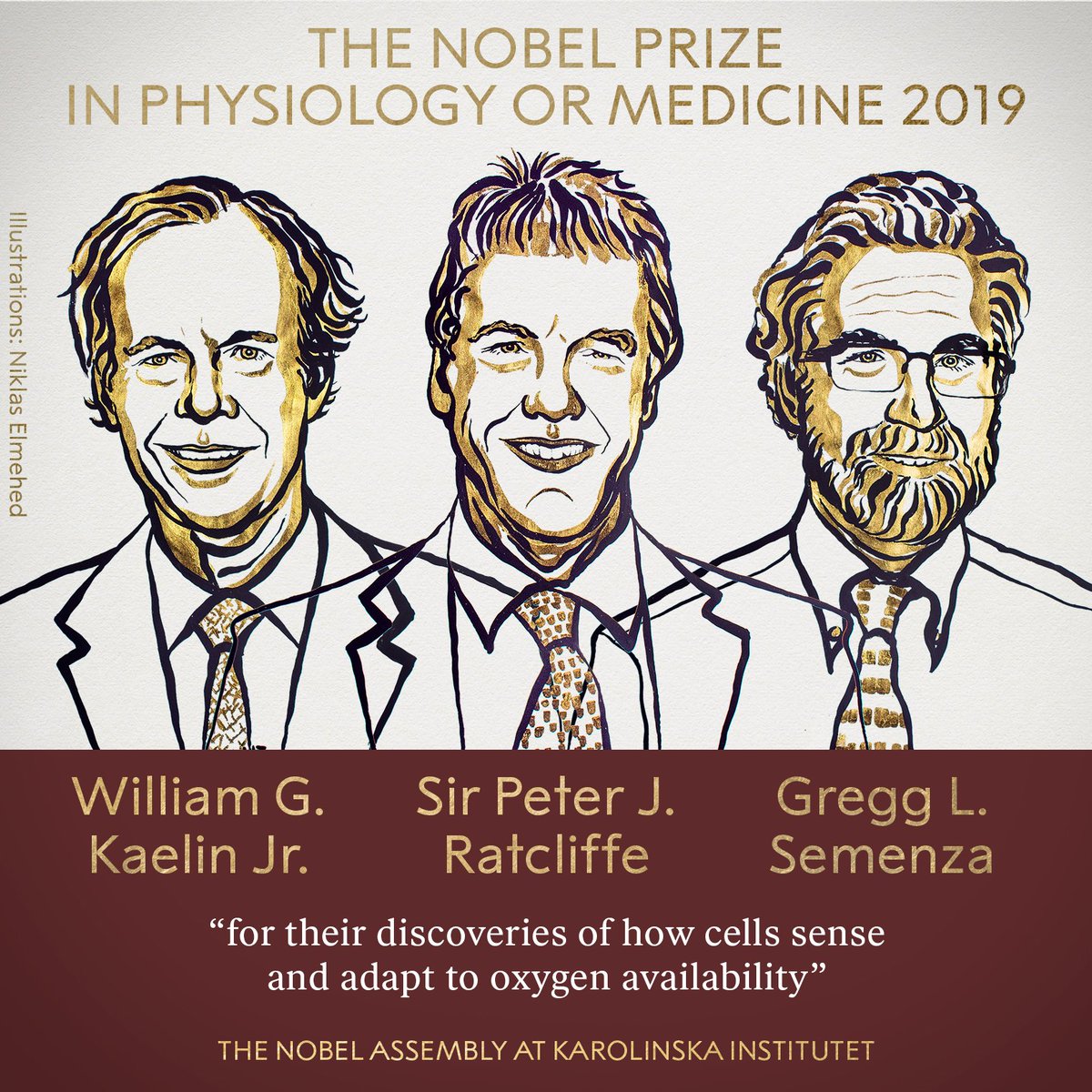
Also announced this week was the Nobel Prize in Medicine awarded to Doctors William G. Kaelin of Harvard University, Gregg L. Semenza of Johns Hopkins University along with Peter J. Ratcliffe of the Francis Crick Institute and Oxford University. The trio was recognized for their work in understanding how cells adjust their metabolism to match the availability of oxygen.
The 2019 Nobel Prize in Medicine was awarded to William G. Kaelin, Sir Peter J. Ratcliffe and Gregg L. Semenza. (Credit: Swedish Royal Academy of Science)
We
are all aware of just how necessary oxygen is for life; the cells of our body
will quickly begin to die without that gas. However cells can reduce the amount
of oxygen they require whenever oxygen levels become lower. Our bodies
experience such reduced oxygen levels during many activities such as swimming
or other exercise, or while at high altitude.
More importantly however many people experience low oxygen levels for long periods of time due to lung or heart disease or anemia. In fact the knowledge gained by Doctors Kaelin, Semenza and Ratcliffe is already being put to use to develop drugs that will help patients with those aliments to make better use of the oxygen in their systems and live healthier lives.
For patients suffering with Heart or Lung problems a lack of oxygen is a serious threat. (Credit: Healthline)
The discovery may also be important in the treatment of cancer. You see it has long been known that cancer cells signal other cells in our body to build new blood vessels to them that increases their flow of oxygen enabling the tumors to grow even faster. It is possible that this research may lead to techniques that prevent this increased blood flow thereby slowing the growth of cancerous tumors.
The work of these three Nobel laureates gives our medical science another tool to both fight disease and to understand how living creatures work. Each year the Nobel Prizes are awarded to recognize the best, the most significant discoveries in science. It’s important to remember however that there are many smaller, but still significant advances. All of these discoveries combine to add to our ever increasing knowledge of the natural world.

There was a small but very unusual science news story out this week that you might have missed. It concerns the discovery of eight new species of nematode roundworms at Mono Lake in the eastern Sierra Mountains of California. That sure sounds exciting doesn’t it?
Mono Lake in California is one of the most hostile environments on the surface of the Earth. (Credit: Mono Lake)
Well
you see Mono Lake is one of the most extreme environments for living things on
the surface of the entire planet. Not only is the water in Mono Lake three
times as salty as in the ocean but the water is also laced with the poisonous
element arsenic while its pH of 10 makes it very alkaline. Few living things
can survive the toxic conditions present at Mono Lake so the discovery of eight
new species there is quite important.
The most surprising news however concerns one of those eight species, a yet to be formally named member of the genus Auanema that possesses three sexes!!! You heard that right; the newly discovered Auanema sp. has boys, girls and hermaphrodites.
The as yet unnamed species of round worm from Mono Lake has three sexes! (Credit: Science Alert)
Hermaphrodites you may recall are individuals who possess both male and female sexual organs and who are capable of both bearing offspring and impregnating other members of their species. There are many species that are hermaphroditic in nature just as there are many species with sexed individuals but a species that possesses both sexed and hermaphroditic individuals is very rare. Another oddity about the sex life of Auanema sp. is the fact that it carries its young inside itself in a manner similar to a kangaroo.
The three sexed species also carries its young inside its body in a way reminiscent of a kangaroo. (Credit: ScienceDirect.com)
The
study of life at Mono Lake was conducted by lead author Paul Sternberg of the
California Institute of Technology along with researchers Pei-Yin Shih and
James Siho Lee and was published in the journal Current Biology. I’m certain
that we’ll be hearing more from Drs. Sternberg, Shih and Lee about the strange
and extreme life forms at Mono Lake.
The
strange sex life of Auanema sp. however begs the question; just how many
different ways are there for having sex? This question has become more
important recently not only in scientific circles but in the domain of
politics. In our society today the question of how we should treat those
individuals whose sex lives do not fit into preconceived norms is very
contentious. Is it possible that we could learn something about our own sexual behavior
by studying the diversity of sex in nature?
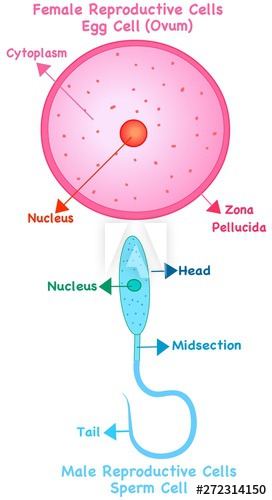
To begin my dictionary defines sex as: The property or quality by which organisms are classified according to their reproductive functions. So in our quest to study the diversity of sex we are going to have to look at some of the many ways living creatures reproduce.
In sexual reproduction the egg cell, defined as female, is large and contains a lot of nutrients while the sperm cell, defined as male, is small but very mobile. The sperm cell must find the egg cell in order to fertilize it. (Credit: Stock.Adobe.com)
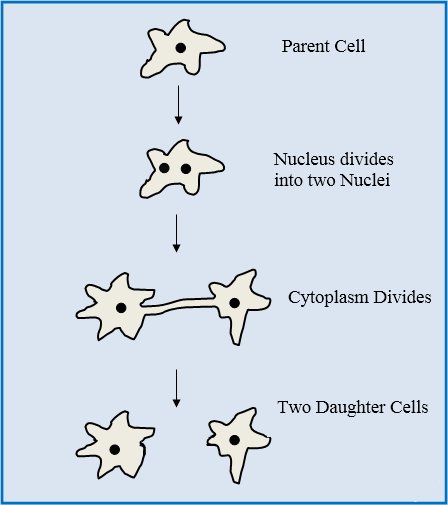
Let’s begin with the simplest of all living things, the single celled organisms that we learned about back in high school. The structure of such creatures is so simple that they are not capable of possessing differences between individuals that could be identified as making them either male or female. Instead these creatures reproduce asexually, that is without any sexual contact from another member of their species. Whenever a single celled creature has absorbed enough nutrients to reproduce it will begin the process of cell division that produces, not an adult and child but two identical daughter cells. In asexual reproduction the daughter cells both receive only the genetic information of their single parent.
A single celled organism reproduces without sex through the process of Mitosis. (Credit: DifferenceBetween.com)
It is that mixing of the genetic information from two parents that is the advantage of engaging in sex after all. Sex allows new, beneficial mutations to quickly spread throughout a population. Sex increases the variation of characteristics within a species; variations that natural selection can work with in order to better adapt a species to its environment.
As we know, it is in the multi-celled organisms, creatures with groups of cells dedicated to perform certain tasks, in other words organs, that we find differences between individuals that are related to that individual’s function in reproduction. And due to their greater complexity it is among the multi-celled organisms that we find the greater range of sexual behaviors.
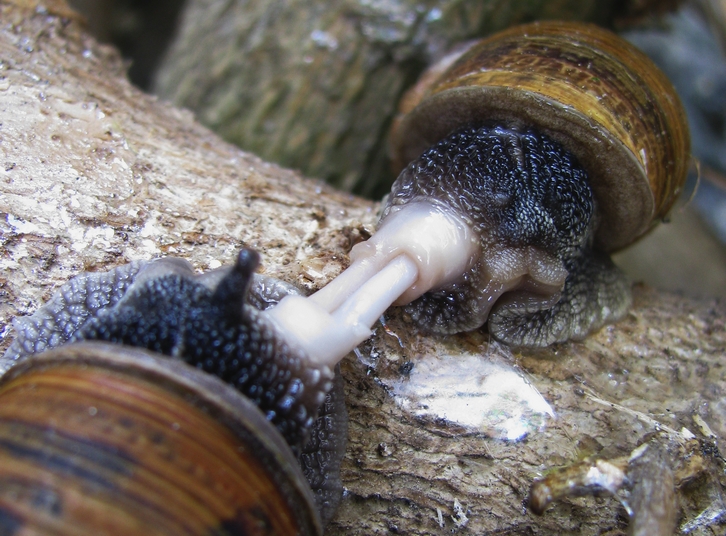
We’ve already mentioned hermaphrodites, creatures with both male and female sex organs and who are capable of both being fertilized by and fertilizing another member of their species. Many species of worms, molluscs and flowering plants are hermaphrodites.
Two hermaphroditic snails mating. Each is using its penis to fertilize the other! (Credit: Wikipedia)
Even among species with individuals that can be clearly differentiated into female and male sexual behavior can vary greatly. In the insect order hymenoptera, ants, bees and wasps, an unfertilized female can lay an egg that will develop into a fully functioning male, an actual example of a virgin birth. That male can then have sex with his own mother, fertilizing her so that all of her offspring from then on are female!
In honeybees the male drones are produced from unfertilized eggs! They then fertilize the queen to produce female, but sterile workers! (Credit: Encyclopedia Britannica)
Now
if you’re thinking that such unusual sexual behaviors are confined to the
lower, i.e. invertebrate animals well think again. There are many species of
vertebrates, especially fish who exhibit a different type of hermaphroditism
known as sequential hermaphroditism. As you might guess from the name a
sequential hermaphrodite is an individual who is born as one sex but who may
during the course of their life change their sex.
Examples of sex changes in both directions are well recognized. One is the popular clown fish (genus Amphiprion) that exists in groups with a single large breeding female and a smaller breeding male along with some non-breeding members. If the breeding female should die the breeding male will become female and one of the non-breeding members will become the new breeding male.
The familiar and popular clown fish is a sequential hermaphrodite. It can change its sex from male to female! (Credit: Live Science)
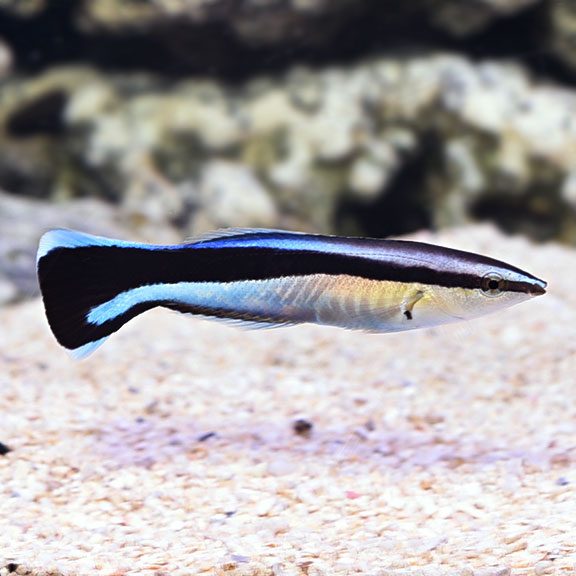
Another familiar reef fish, the cleaner wrasse (family Labridae) behaves in almost the exact opposite fashion. The single male in a group will dominate all of the females while the largest female dominates all the others and so on down the list until the smallest wrasse gets picked on by everybody. Again if the dominant male should die the top female will change sex and become a male.
The Cleaner Wrasse on the other hand can change from being a girl to a boy! (Credit: LiveAquaria)
Have
you noticed how the sex of an individual in these species is determined by
their social status? To confirm this interpretation there are reef fish of the
species Lythrypnus dalli where the sex of an individual can go back and forth
depending on whether it is dominant, male or submissive, female.
Even mammals have a variety of sexual behaviors; the difference between marsupials who carry their young in a pouch and mammals with a womb is well known. There are also many species where a dominant male gathers a harem to himself while smaller males are out of luck. Then there are some mammals who only mate at certain times of the year while others engage in sex year round.
Even among the mammals there is a verity of reproductive techniques. (Credit: Allposter.com)
By
now I hope you’ve realized that the stereotypical male-female, boy meets girl
style of reproduction is not carved in stone, it is not a universal archetype
of how things must be. Sex is all about mixing genes so that new, better
adapted traits can be spread through a population more quickly giving natural
selection a better chance to improve a species. Evolution doesn’t really care
how that mixing takes place so there is a great diversity of sexual behaviors
across the natural world.
If you’re interested in astronomy you may have sometime heard the planet Venus being described as Earth’s twin, although nowadays it’s more often called Earth’s evil twin. Twin, because Venus is nearly the same size as the Earth and is the same sort of rocky planet with an atmosphere as our home world is. Not only that but because Venus is the closest planet to Earth in its orbit around the Sun conditions on its surface should be close to those here on our planet.
Venus as seen through a telescope shows only a think layer of clouds. (Credit: Sky and Telescope)
Indeed, not so long ago Venus was imagined to be a somewhat more tropical version of the Earth. Covered by a thick layer of clouds it was thought that the planet’s entire surface was probably one huge rain forest inhabited by creatures appropriate to a jungle environment.
In the science fiction of the 1950s Venus was a world inhabited by alien, and dangerous creatures. (Credit: Wikipedia)
The data sent back by the first space probes to Venus shattered that dream. The average surface temperature on the planet was found to be over 400ºC, the atmosphere is some 90 times that of Earth’s and is composed of 96.5 carbon dioxide with absolutely no trace of water vapour. It’s the carbon dioxide that’s led to the extreme temperatures of course; we’ll all familiar with how CO2 is a greenhouse gas after all. And so Earth’s twin quickly became known as our evil twin.
This is what the surface of Venus looked like to the Soviet Venera lander. (Credit: Roscosmos)
This
reality begs the question then, if Venus is so similar to Earth in some ways,
how can it be so different in others?
A new study by Michael Way and Anthony Del Genio of NASA’s Goddard Institute for Space Studies attempts to answer that question. In a paper they have delivered at the European Planetary Science Conference, Division of Planetary Science or the EPSC-DPS joint meeting for 2019 the two scientists have outlined the results of their simulations of surface conditions on Venus using long-term climatological models.
Based upon those simulations Way and Del Genio assert that for billions of year Venus may in fact have resembled that watery, tropical world imagined in Sci-Fi novels. By their calculations it may have been as little as 700 million years ago that a runaway greenhouse disaster began that turned Venus into the uninhabitable boiler we see today.
Based on their research Doctors Way and Del Genio believe that Venus could have been inhabited as little as 700 million years ago. (Credit: Wordless Tech)
So what was it that triggered the runaway greenhouse effect? Where did all of that CO2 come from? Well here on Earth we have an enormous amount of carbon that’s trapped inside the planet’s crust, not only as coal and other fossil fuels but also in the form of various minerals such as calcium carbonate, also known as calcite. Way and Del Genio speculate that a massive volcanic event could have released huge amounts of carbon into the air initiating the runaway greenhouse.
Here on Earth volcanic eruptions release hugh amounts of carbon dioxide. Could this be what happened to Venus (Credit: CNN.com)
Just such a volcanic event is known to have occurred here on Earth some 250 million years ago and is known as the Siberian Traps event which is thought to have caused the mass extinction at the end of the Permian period. The carbon released by the Siberian Traps was later re-absorbed back into the ground but on Venus something must be preventing that re-absorption.
250 MYA the massive volcanic eruptions that formed the Siberian Traps may have also caused the extinction of 95% of all living species here on Earth. (Credit: Gracebluered.com)
At
the moment we can only speculate about what factor or process is preventing
that re-absorption. Way and Del Genio are calling for newer, more advanced
space probes to re-examine Venus in order to better understand what is going on
there. We need more data if we’re ever going to understand what transformed
Venus from a world that could have possessed life into the hellscape it is now.
And perhaps more importantly, how can we make certain it never happens to our
Earth!
In his first interview with the press promoting his new movie ‘Ad Astra’ director James Grey described it as a combination of ‘Apocalypse Now’ and ‘2001: A Space Odyssey’. I’m quite certain that’s exactly how he sold his concept to the studio heads that funded ‘Ad Astra’. Not a bad idea when you consider that both movies are considered to be classics. The problem is that in that in ‘Ad Astra’ the combining is clumsily executed and quite frankly, unimaginative.
Poster for the Film ‘Ad Astra’ (Credit: Connect Savanna)
Let’s begin with ‘Apocalypse Now’ which was itself a adaptation of the Joseph Conrad novella ‘Heart of Darkness’ to fit the War in Vietnam. In ‘Apocalypse Now’ a U.S. Army Captain named Willard is sent into the deep jungle along the Vietnam / Cambodian border to make contact with a Colonel Kurtz. According to the Army Kurtz has gone rogue, fighting the Vietnamese Communists with native troops his own way, in other words just slaughtering them without regard for the rules of war.
In Apocalypse Now Marlon Brando played an eerie Colonel Kurtz, a man driven mad by the horrors of war. (Credit: Electric Palace)
Once Captain Willard finds Kurtz his orders are to terminate Kurtz’s command, ‘Terminate with extreme prejudice’, in other words the Captain has been ordered to assassinate the Colonel. The majority of the movie however concerns Willard’s journey to Kurtz’s location and is composed of a series of scenes depicting the insanity of war but which have no real connection to the actual plot.
The plot of ‘Ad Astra’ is quite similar. At the beginning we learn about an astronaut named Clifford McBride (Played by actor Tommy Lee Jones). McBride is the commander of the Leto Mission to the outer Solar System in a search for extraterrestrial intelligence. The Leto mission we are told was assumed lost some 12 years ago.
In Ad Astra Tommy Lee Jones plays Clifford McBride who has been driven mad by Space. (Credit: USA Today)
We
also learn that McBride murdered the other members of the Leto’s crew and is
actually still alive around the planet Neptune where he is now using his
spaceship’s anti-matter to cause power surges that are threatening all life in
the solar system. I suppose by now you’ve guessed that McBride is the Kurtz
character.
The Captain Willard character in ‘Ad Astra’ is named Roy McBride (Played by Brad Pitt). Now if you happened to notice that the two main characters have the same last name you’re right, they’re father and son which adds a lot of psycho-drama to the movie without making it any more interesting. As in ‘Apocalypse Now’ Roy McBride’s journey to his father is punctuated with such meaningless scenes as an attack by Moon pirates and a Mayday from another spaceship. So much for the resemblance to ‘Apocalypse Now’.
Brad Pitt plays Roy McBride who is journeying through the solar system to stop his father from destroying all life. (Credit: Polygon)
As far as I’m concerned the resemblance to ‘2001: A Space Odyssey’ consists mainly in the production values, that is the sets and special effects which look pretty good. Not as good as 2001’s or The Martian’s, but pretty good. It’s apparent that someone has paid a lot of attention to such things as the spacesuits, the look of the spaceship’s and the scenery such as the Moon, Mars and finally Neptune.
While the production values of Ad Astra are good they can’t make up for an awkward script. (Credit: Fox News)
The
problem is that the attention to detail only extends as far as the look of the
movie. You remember I mentioned that the senior McBride is doing something with
anti-matter around Neptune that is causing ‘power surges’ back here on Earth.
Well that’s about all you ever learn about those surges, you never even get to
find out if the older McBride is causing them deliberatly or not.
There are in fact a large number of physically unrealistic events in ‘Ad Astra’ the most egregious of which is when the younger McBride uses a special laser on Mars to send a message to his father around Neptune. Now Neptune at its closest is more than four light hours from Mars so a round trip message has to take nearly nine hours minimum. Well that Martian laser must be real special because the reply comes back in about two minutes. Such a cavalier attitude toward the laws of physics and science in general is not a good thing for a movie that is trying to promote itself as hard Sci-fi.
2001: A Space Odyssey still holds place of honour as the best hard sci-fi movie! (Credit: MGM)
In the end the two McBride’s finally meet and we discover that the search for alien intelligence has driven the old man mad. He’s lost all of his humanity in the emptiness of space.
The real plot of Ad Astra is simply mankind becoming lost in the vastness of space. (Credit: IMDb)
I
think that’s the moral the creators of ‘Ad Astra’ were trying to portray. If
you want to find intelligence you should look right here on good old Earth.
There have been several interesting developments is the exploration of space this past month. Most deal with the discoveries made by unmanned probes but one deals with NASA’s Artemis program, the space agency’s plan for returning astronauts to the Moon. I think I’ll start with Artemis.
NASA’s logo for its planned Artemis Program back to the Moon. (Credit: NASA)
You’ll recall that in several posts I have mentioned that NASA intends to build a space station called the Lunar Gateway in orbit around the Moon to use as a depot and waystation for lunar exploration. See posts of 30Sept2017, 24Mar2018, 14Oct2018, 31Dec2018, 6Mar2019 and 29May2019. Additionally NASA hopes to use the Gateway as a platform for studying long-term human occupation of deep space, i.e. space outside of Low Earth Orbit (LOE).
Planned configuration of the Lunar Gateway. (Credit: Spacenews.com)
Currently NASA intends to use a mixture of rocket types to construct the Gateway and the proposed Lunar Lander. This plan would include the massive Space Launch System (SLS) still under development as well as Space X’s Falcon Heavy reusable rocket. The use of reusable rockets as much as possible is thought to be essential for a program that is already grossly underfunded.
Unlike the SLS, Space X’s Falcon Heavy is a reusable rocket and therefore MUCH CHEAPER!!!! (Credit: The Verge)
Well
it is starting to appear that some members of congress may not be such big
supporters of the Gateway and for once there’s bipartisan agreement. At a
recent meeting of the House subcommittee on space both committee chair Oklahoma
democrat Kendra Hall and Alabama republican Mo Brooks strongly questioned
NASA’s planned use of private rockets at all.
Instead Hall and Brooks want NASA to accelerate the development of the SLS’s ‘Exploration Upper Stage’ (EUS), which is planned to increase the payload that the SLS can deliver to Lunar orbit from 26 to 37 tons. This EUS is a part of NASA’s long term goals for the SLS but it is scarcely beyond the design stage and its development would cost billions and add years to a program that is already well over budget and behind schedule. However the use of the EUS would allow NASA to send a crew directly to the Moon’s surface without the need of a Lunar Gateway. Exactly the way the Apollo program did it back in 1969.
NASA is Currently developing the SLS as configured in the two versions on the left. The EUS would allow the four versions on the right which are capable of delivering much more payload into lunar orbit. (Credit: Vox)
None
of this has anything to do with science or engineering or even budget, it’s all
about corporate rivalry. You see Boeing is the prime contractor of the current
version of the SLS, and would be prime on the development of the EUS. Add to
that the fact that Boeing is getting tied of Space X grabbing its market share
just because reusable rockets are so much cheaper and you have Boeing trying to
use a little political muscle to push Space X out of the Artemis program.
With every bit of news I hear about the Artemis program the more convinced I become that it will achieve nothing except a huge waste of resources. I’m very much afraid that the manned space program will achieve nothing until either the Chinese or perhaps private space companies like Space X are about to land on the Moon. We Americans don’t actually care about exploring space; we just have to be first.
NASA continues to have more success with its unmanned space probes. I suppose that’s because, since they are lower profile than manned missions the agency is allowed to make its decisions based on science and engineering not politics.
One of these successes is the Juno space probe currently studying the planet Jupiter. Recently the spacecraft made its 22nd close approach to the giant planet and was in the right position to take a photo of a very impressive event, an eclipse of the Sun on Jupiter caused by its innermost moon Io. See image below.
Image taken by the Juno Space probe of an eclipse of the Sun on Jupiter caused by it’s innermost moon Io. (Credit: NASA)
Now
it turns out that eclipses occur on Jupiter considerably more often than they
do here on Earth, after all Jupiter has four large moons all of which are
capable of producing eclipses. The eclipses on Jupiter are not as impressive as
ours are however because by sheer coincidence the angular size of our Moon and
the Sun as seen here on Earth are nearly identical. This means that the Moon just
covers the Sun’s disk leaving the entire solar corona visible. See my post of
24August 2017 for the story of my first total eclipse.
On
Jupiter however the Sun is about five times further away so it’s angular
diameter in Jupiter’s sky is much smaller, only about 0.1º instead of the 0.5º
in our sky. That makes the Sun look smaller than any of Jupiter’s four big
Moons.
Because
it’s the closest, Io looks largest on Jupiter, about as large as our Moon does
here on Earth. That means that Io can completely cover not only the Sun’s disk
but the entire corona as well. Ganymede and Europa would probably do the same
since each of them looks more than two and a half times the diameter of the Sun
on Jupiter.
Only
Callisto, the farthest of the four from Jupiter, would produce a show similar
to that of an Earthly eclipse. Its angular diameter, as seen on Jupiter is only
about 40% larger than the Sun’s so under the right conditions a good deal of
the corona could probably be seen.
One more interesting fact, since Jupiter has four moons capable of producing eclipses it is quite possible for Jupiter to experience several eclipses, caused by different moons at the same time. I happened to come across an image of Jupiter, taken from Earth in 2009 of three eclipses happening at once! The moons involved are Io, Ganymede and Callisto.
Three eclipses on Jupiter happening at the same time! (Credit: NASA)
The
moon Io is in the news for another reason as well. You may recall that the
voyager space probes discovered that Io is the most volcanically active place
in the solar system. This is because Io is being constantly pulled not only by
huge Jupiter itself but by its three brother moons as well. This tugging and
squeezing heats up the moon’s interior, heat that is released through
volcanoes.
The largest volcano on Io, and the largest known active volcano in the solar system is called Loki after the Norse god of fire. Planetary scientists have been studying this powerful beast as best they could ever since it was first discovered. According to a paper published back in 2002 with lead author Julie Rathbun, Loki erupts on a regular basis about every 500 days.
Jupiter’s moon Io with the monster volcano Loki dead center. (Credit: NASA)
Now Rathbun, who is currently with the Planetary Science Institute, has presented at poster at the current 51st meeting of the Division for Planetary Sciences of the American Astronomical Society. Posters at conferences are a common technique for scientists to announce results of research before a formal paper is written. Doctor Rathbun’s announcement was in fact a prediction that Loki will erupt sometime in the next few days.
Doctor Julie Rathbun has predicted an eruption of Loki within the next few days. (Credit: Twitter)
Now predicting a volcanic eruption is a very risky business. Volcanologists here on Earth have been trying to find some technique for predicting eruptions for centuries now. Doctor Rathbun is confident however and thanks to her warning both telescopes here on Earth and the Juno space probe should be ready to study the event when, and if it occurs.
Photographing
eclipses and predicting eruptions halfway across the solar system, we have come
a long way!
I think I ought to start this post with a little honest disclosure about my own smoking history. I smoked old-fashioned cigarettes for almost 30 years and managed to finally quit about 15 years ago. My doctor tells me that I appear to have no ill effects because of all my years of smoking so I count myself as being very lucky. And like many ex-smokers I now support any and all efforts to get people off tobacco and in particular to keep young people from ever getting hooked in the first place.
Credit: Get Healthy Clark County
In contrast, about ten years ago the tobacco industry invented a new way for people to smoke, e-cigarettes or vaping as its also known. In essence what an e-cigarette does is boil a small amount of solution from an inserted container known as a ‘pod’. In addition to water these pods contain the chemical nicotine along with a variety of flavourings that the consumer can choose. The smoker then inhales the aerosol generated and the nicotine passes through the lungs into the blood stream just as it does when a person smokes an ordinary cigarette. You’ll recall that nicotine is the reason people smoke in the first place both because the chemical is a stimulant but more so because it’s highly addictive.
At first e-cigarettes looked just like ordinary cigarettes but now they come in a variety of shapes and sizes! (Credit: The Continuum of Risk)
The rational that the inventers and manufacturers of e-cigarettes gave for marketing their product is that since there’s no actual smoke involved there’s none of the carcinogens that cause lung cancer. This is assumed to make e-cigarettes safer than ordinary cigarettes. Safer perhaps but certainly not safe since it’s the nicotine that leads to heart disease among smokers and more smokers actually die of heart disease than lung cancer.
There is a 20 year lag between starting smoking and the incidence of lung cancer but otherwise the two quantities are nearly identical (Credit: Wikipedia Commons)
Still,
that logic allowed e-cigarettes to be advertised as safer than cigarettes. At
the same time the completely unfounded claim was also promoted that heavy
smokers could use e-cigarettes as a pathway to quitting. Together these
untested assertions were employed by the manufacturers of e-cigarettes to make
their product seem almost like a treatment for smoking rather than just another
way of injecting poisons into yourself.
None of those claims were backed up by any data whatsoever. No long-term studies of the health risks of using e-cigarettes have been completed so the only thing that can be said about smoking e-cigarettes is that the nicotine still makes them dangerous. In fact chemical analysis has shown that many other dangerous substances are present in the aerosol generated by e-cigarettes calling into question the claim that they are at all safer than ordinary cigarettes.
We still don’t know all of the toxic chemicals that are contained in the aerosol from an e-cigarette (Credit: Wikipedia Commons)
For a time the number of people using e-cigarettes was small and consisted almost exclusively of established smokers looking for a safer alternative. But in their efforts to increase sales the e-cigarette manufacturers started extensive advertising campaigns touting how ‘safe’ e-cigarettes were. Then the manufacturers began selling fruit flavoured and even candy flavoured vaping pods that are effectively more attractive to teenagers and even children than to the adults who are legally allowed to purchase the product.
The easiest way to measure the growth of e-cigarette use is by measuring the money being spent on them! (Credit: Heineventures)
Of course the vaping industry categorically denies that they are deliberately advertising to children. However it is an established fact that several overzealous e-cigarette salesmen have actually gone into high schools and promoted their product to students as being safe!! Not safer than real cigarettes mind you, just plain safe…a complete misrepresentation of available facts.
Not only are the advertisements for e-cigarettes geared toward teenagers but they make use of the social media platforms most frequented by teenagers. (Credit: Smithsonian Magazine)
The
end result of all that sophisticated media hype was that, after years of
declining numbers in people who smoked we now have millions of people who have
become hooked on e-cigarettes, especially teenagers. Nearly 11 million adult
Americans and two million teenagers are current e-cigarette users. That’s a big
market and it means that there’s a lot of money to be made from e-cigarettes,
$11.8 Billion in 2018 and the estimated market for 2024 is $16.5 Billion.
And it’s the same old companies making that money; the most popular brand of e-cigarettes, JUUL is 35% owned by Phillip Morris while second place Vuse is a subsidiary of R. J. Reynolds. Both are tobacco companies that for decades continued to deny the overwhelming medical evidence linking their products to millions of deaths. Now these same companies are making the same old arguments to defend their new products.
Remember the Marlborough Man, well he died of lung cancer. Now the company that sold that poison is selling the e-cigarettes JUUL (Credit: Amazon)
Recently the problem of e-cigarettes has taken an even more dangerous turn. Just this year more than 500 people who smoke e-cigarettes have been diagnosed with severe lung problems while seven people have died. At the moment doctors have no idea why e-cigarettes have suddenly turned so deadly. Remember e-cigarettes have been around for 10 years so why have all these people just gotten sick this year! The working hypothesis is that some people have been injecting THC, the chemical from marijuana into their pods and that it is the THC that is causing all the injuries. However there is some evidence to indicate that THC cannot be the sole cause of all the recent cases.
We are only just learning the dangers of vaping! (Credit: TruLaw)
The plain fact is that e-cigarettes are unhealthy, maybe they are a little less unhealthy than real cigarettes but nevertheless they are unhealthy. Such a dangerous product should never have been allowed to be openly sold before extensive studies had been conducted to better quantify just how unhealthy they were.
E-cigarettes and other tobacco products are often sold right next to candy as a means of hooking children as new customers. (Credit: Counter Tobacco)
The tobacco companies behind e-cigarettes knew how to circumvent any sort of government oversight however and so now a whole new generation is getting hooked on the same old poison I got hooked on back in high school. I was lucky and quit before cigarettes killed me. I wonder how many of the users of e-cigarettes won’t be so lucky!
Post Script: Only a week has gone by and the epidemic of lung injuries associated with vaping has more than doubled in size. More than 800 people have been diagnosed and 14 have died! Although a link to THC in vaping pods seems likely Doctors are still at a loss as to exactly what is going on. All that they can do at the moment is to advise everyone “DON”T VAPE”!!!!
There
have been a couple of major discoveries in astronomy this past month, each in
their own way teaching us something about the universe outside our solar
system, and how similar that is to what goes on inside our solar system.
The first story concerns one of the now over 4,000 planets that have been discovered orbiting around other stars. Exoplanets the astronomers are calling them and most were discovered by the no longer functioning Kepler space telescope. (See posts of 16Dec2017, 28Apl2018 and 3Nov2019)
A chart detailing some of the discoveries made by the Kepler Space Telescope. (Credit: Sky and Telescope)
Most of the exoplanets that have been discovered to date are considerably larger than our Earth is, let’s be honest the bigger anything is the easier it is to see, and most have been found to be orbiting rather close to their parent star. Neither of these conditions is expected to make these exoplanets hospitable for life but the astronomers know that if they find enough exoplanets eventually they’ll start finding some that look more like Earth and which could be inhabited.
Our techniques for discovering exoplanets are far more likely to find big ones. This is a classification as of 2013. (Credit: Universe Today)
In fact their latest candidate possesses an Earth like feature never before seen in an alien world, water vapour in its atmosphere. The planet is officially known as K2-18b and it orbits around the small red dwarf star K2-18 that resides about 110 light years away in the constellation of Leo. Although K2-18b orbits closer to its star than the Earth does to the Sun because K2-18 is dimmer than our Sun the estimated temperature on K2-18b is between 0 and 40 degrees Celsius. That temperature is just right for water to exist on the planet’s surface and nearly perfect for life. Astronomers succeeded in detecting the water vapour in the planet’s atmosphere by studying the light coming from K2-18 as K2-18b was passing in front of the star. That light showed the characteristic absorption lines of water vapour.
An Artist’s impression of what the exoplanet K2-18b might look like. (Credit: ESA / Hubble)When an element of Chemical Compound is heated they emit an emission spectra, top image is hydrogen’s. When light passes through the same material when cool it absorbs those same frequencies of light becoming an absorption spectra. (Credit: Physics Stack Exchange)
Before you start planning a visit to K2-18b however I should point out that the planet has a mass estimated at about eight times that of Earth and possesses a very thick atmosphere. Together these facts make the planet more like a warm version of Uranus or Neptune than our Earth. Additionally the planet’s star K2-18 is, like many small stars quite active with a large number of solar flares that might bath the planet’s surface in radiation. Still that thick atmosphere would give the planet’s surface some protection and if it does have oceans it is possible that life could exist there.
Astronomers will keep searching the stars of our galaxy looking for worlds that may possess life. Indeed the new James Webb Space Telescope that is expected to be launched in March of 2021 has been designed in part to carry out much more detailed studies of planets like K2-18b. So perhaps in just the next decade or so astronomers may finally discover a planet that truly is Earth like.
The James Webb Space Telescope is nearing completion and launch is expected in 2021. (Credit: Popular Science)
My second story concerns the recent observation of a comet like object that has entered our solar system from outside and is going to pass around the our Sun before heading back out into interstellar space. You may recall hearing about the first observed such an interstellar immigrant that was given the name Oumuamua a little more than a year ago. (See my post of 23May18).
The interstellar object named Oumuamua passed through our solar system in 2017. (Credit: Twitter)
Our new visitor was discovered on August 30th by Gennady Borisov of the Crimean Astrophysical Observatory and has been given the temporary designation of C/2019 Q4 (Borisov). The object has since been observed by more than a half dozen other observers and its orbital parameters have been tentatively determined with a result that the eccentricity of C/2019 Q4 is around 3.2. Now an object in a stable orbit has an eccentricity of between 0 and 1 so an eccentricity of 3.2 means that C/2019 Q4 will make one quick pass by our Sun and then head back out into interstellar space just as Oumuamua did back in 2017.
Unlike Oumaumau the interstellar object C/2019 Q4 (Borisov) has already show evidence that it is a comet. (Credit: Sci-News.com)
There are a couple of big differences between C/2019 Q4 and Oumuamua however. For one whereas all observations of Oumuamua indicated that it was a hard solid object, like an asteroid, C/2019 Q4 has already shown clear evidence of a comet’s tail. In other words Oumuamua was a rock while C/2019 Q4 is a dirty snowball.
The more important difference however may be that C/2019 Q4 has been discovered well before it passes the Sun and astronomers hope to have more than a year to study it. Oumuamua on the other hand, was only discovered after it had passed the Sun and was on its way out of the solar system, leaving astronomers a little more than a month to observe it. Click on the link below to be taken to a YouTube video of the estimated track of C/2019 Q4 through our solar system. https://www.youtube.com/watch?v=vqMJo3DHOfg
I’m certain there will be a lot more to learn about C/2019 Q4 during the next year, and I hope they come up with a real name before long. You can be certain that I’ll keep you well informed about it.
Invasive species are defined as populations of living creatures that have been transported from their natural habitat and become established in another ecosystem perhaps thousands of kilometers away. Sometimes this movement is a natural occurrence, such as when a few finches were somehow blown onto the Galapagos Islands, became established and evolved into some fifteen recognized species. Indeed such rare but natural transplanting of species is considered to be a driving force in evolution as the relocated population adapts to its new environment.
The 15 Species of Finches inhabiting the Galapagos Islands are all descended from a few finches that somehow survived being blown to those distant islands. (Credit: Pinterest)
More often however it is human beings who have transported the creatures either intentionally or accidentally. One example of the latter category would be the common salt water aquarium fish the lionfish, any member of the 12 species of the genus Pterois but particularly P volitans and P miles. See images below.
Pterois volitans, the Red Lionfish is a popular aquarium fish that should only be kept by a very experienced hobbyist. (Credit: Wildlife Society)Pterois miles is another popular species of Lionfish. (Credit: Enalia Physis)
Lionfish are native to the Indian and western Pacific oceans where they are a predatory species feeding on small fish and invertebrates. Adult lionfish are generally 20-40cm in length and can weigh more than a kilogram. Their numerous spiny fins and colourful stripes have made them a popular aquarium fish, even though the animal’s spines are venomous and can produce a painful sting along with vomiting, nausea, convulsions and numerous other ill effects. Because of the danger of their spines Lionfish should only be kept by the most experienced of aquarium Hobbists.
The natural home for lionfish are the blue (P miles) and Green (P volitans ) shaded regions. They are a destructive, invasive species in the red areas. (Credit: USGS)
Even though lionfish are popular pets it
appears as if some aquarium keepers along Florida’s Atlantic coast must have
decided that they were more trouble than they were worth and decided to release
their pets into the ocean. Once free the lionfish began doing what fish do and
without their natural predators the lionfish population has exploded. Lionfish
are now regularly found along the US coastline from Cape Hatteras in North
Carolina to Texas and throughout the Caribbean islands.
The
destruction caused by lionfish consists mainly in their preying on native
species, particularly on the young fish of valuable game species. It is
estimated that the increasing lionfish population could lead to a reduction of
80% in the biodiversity of Gulf and Caribbean coral reefs.
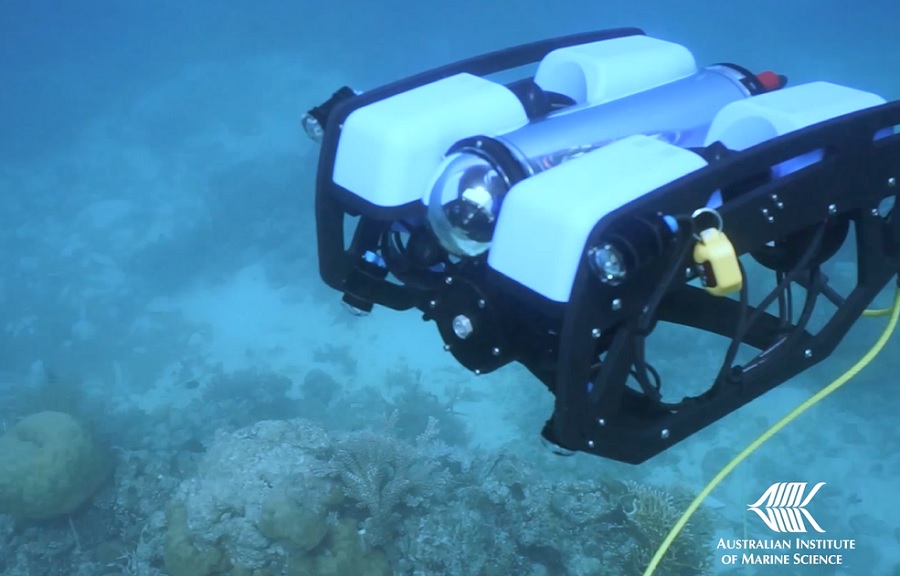
To combat their spread government and private conservation groups are developing programs to eradicate the lionfish from the waters they are now infesting. Currently biologists and fishermen are working to develop special traps and even robotic hunters that will catch lionfish without harming native species. At present however the most efficient technique for dealing with lionfish is spearfishing by scuba divers.
Spearfishing is presently the best method for controlling the population of these predators. (Credit: Deeperblue.com)
One helpful fact is that lionfish are quite tasty if you fillet them properly; remember they are venomous. So if oceanic scientists do actually develop a technique for large scale culling of lionfish don’t be surprised if someday you see lionfish offered at your local fishmarket.
Broiled Lionfish with Paprika and Herbs
Until then contests and fishing tournaments are being organized to increase interest in harvesting lionfish all along the eastern and gulf coasts. The Florida Keys National Marine Sanctuary has even gone so far as to license divers to hunt lionfish within its boundaries, a thing almost unheard of for a wildlife sanctuary.
Poster for a lionfish catching tournament. (Credit: The Woody Foundation)
Eventually
lionfish will simply become a normal part of the marine environment along the
southern US coast. In time other animals will learn to prey on them and that
will impose a control on their population. In fact it appears that sharks may
be immune to the lionfish’s venom, some scientists are even trying to teach
sharks to prey on lionfish.
How
much damage the lionfish will do to the biodiversity of the Gulf and Caribbean
before then however can only be guessed at right now. A lot of trouble because of a few people who didn’t want to take
care of the animals they bought thinking that they looked really cool!