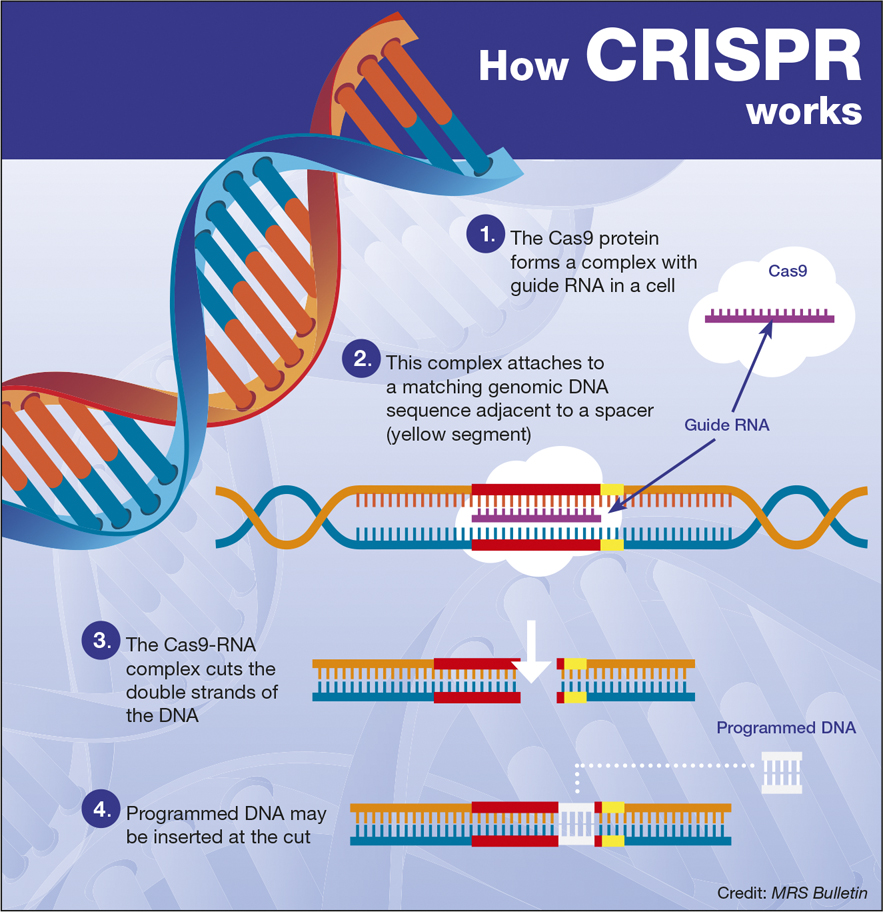
In all of modern science there is perhaps no more rapidly advancing field than that of genetic research. Much of that progress has come about because of the development of the molecular gene editing tool CRISPR (which stands for Clustered Regularly Interspaced Short Palindromic Repeats) that allows biochemists to literally cut and/or paste sections of DNA into the chromosomes of living cells. I have talked about CRISPR several times in previous articles, see posts of 2 March 2019, 12 January 2019, 1 December 2018, 1 September 2018 and 5 August 2017, and the full potential of CRISPR is still only being guessed at.
How CRISPR Works (Credit: Cambridge University Press)
Now the latest experiment is making a bold and daring attempt to treat fully grown persons who are sufferers of the inherited genetic disorder Sickle Cell Anemia, a condition that affects about 100,000 people living here in the United States and millions of others worldwide. This is the first ever attempt to use CRISPR to modify the cells of adult patients in the hopes that the altered cells will allow those patients to live a more normal life.
The Genetic disease Sickle Cell Anemia is a chronic ailment for millions of people (Credit: Familydoctor.org
Before I continue let me talk a little bit about the genetic disease Sickle Cell Anemia. This is a disorder that affects the bone marrow and leads to the production of red blood cells with a defective protein that causes the cells to be deformed, sickle shaped. These deformed blood cells are thereby unable to carry a normal amount of oxygen leading to a permanent and in some cases crippling weakness in the affected person. Most sufferers of Sickle Cell Anemia are ethnic African or African-American and since the disease is inherited it can devastate a family for generations.
Sickle Cell Anemia is an inherited genetic disorder (Credit: Synthego)
The procedure being tested is to take cells from the patient’s bone marrow and modify the cells DNA using CISPR in order to make them produce a protein that is normally only formed by the human body while in the womb and during early childhood. It is hoped that the production of this protein will correct the deformations of blood cells caused by the defective protein, thereby alleviating the anemia caused by sickle cell.
Possible Techniques for using CRISPR to cure Sickle Cell (Credit: American Chemical Society)
The experimental treatment for Sickle Cell Anemia is being conducted at eight hospitals and clinics in North America and Europe and is being overseen by CRISPR Therapeutics of Cambridge Massachusetts in association with Vertex Pharmaceuticals of Boston. The current plan is to have up to 45 patients take part in the initial trials of the experiment.
Patient undergoing CRISPR treatment for Sickle Cell Anemia (Credit: NPR)
It
will be months before the researchers know for certain whether or not the
modified cells are even producing the desired protein let alone if the protein
is actually helping to improve the health of the study’s patients. Then, even if
there is strong evidence that the procedure has worked, there is the question
of how long will the benefits last? Will this technique produce a permanent
cure or will the effect be only temporary?
These
are questions that only time can answer, but we are at the threshold of a new
medical technology. This may be the first attempt to treat patients with a
genetic disease by using CRISPR but it certainly will not be the last.
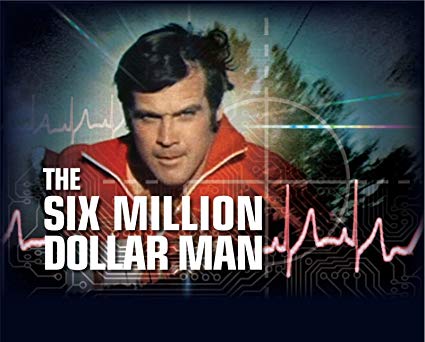
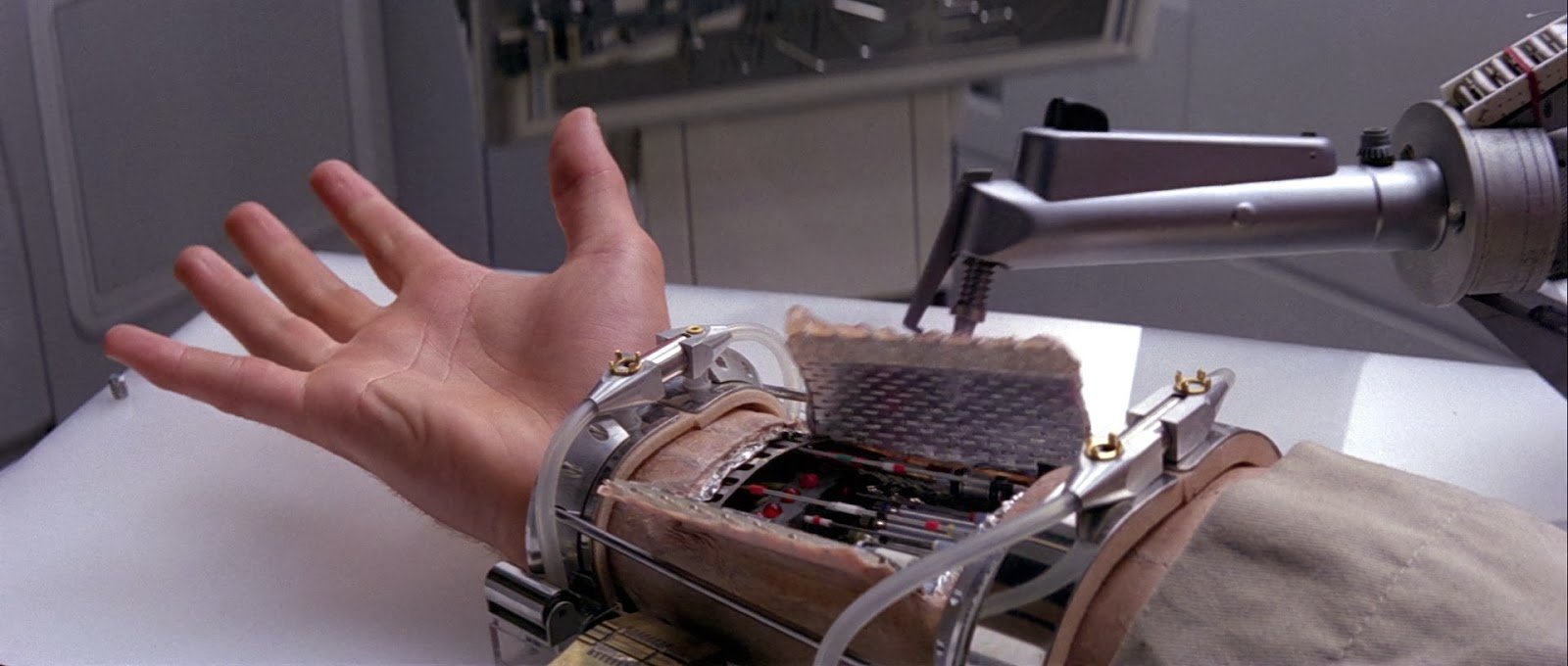
The development of prosthetic limbs has advanced so quickly in the last few years that it really seems as if our technology is catching up to the science fiction ‘bionic’ limbs in movies and TV from 40 or 50 years ago. In fact a new prosthetic arm being developed at the University of Utah is so sophisticated that the researchers have named it the ‘Luke Arm’ for the ‘Star Wars’ character Luke Skywalker who famously lost his arm to Darth Vader and had it replaced with an artificial one.
Steve Austin, ‘The Six Million Dollar Man’ was a cyborg with an artificial arm and two artificial legs (Credit: Amazon)In ‘The Empire Strikes Back’ Luke Skywalker looses his arm in a fight with Darth Vader and gets a replacement! (Credit: 20th century Fox)
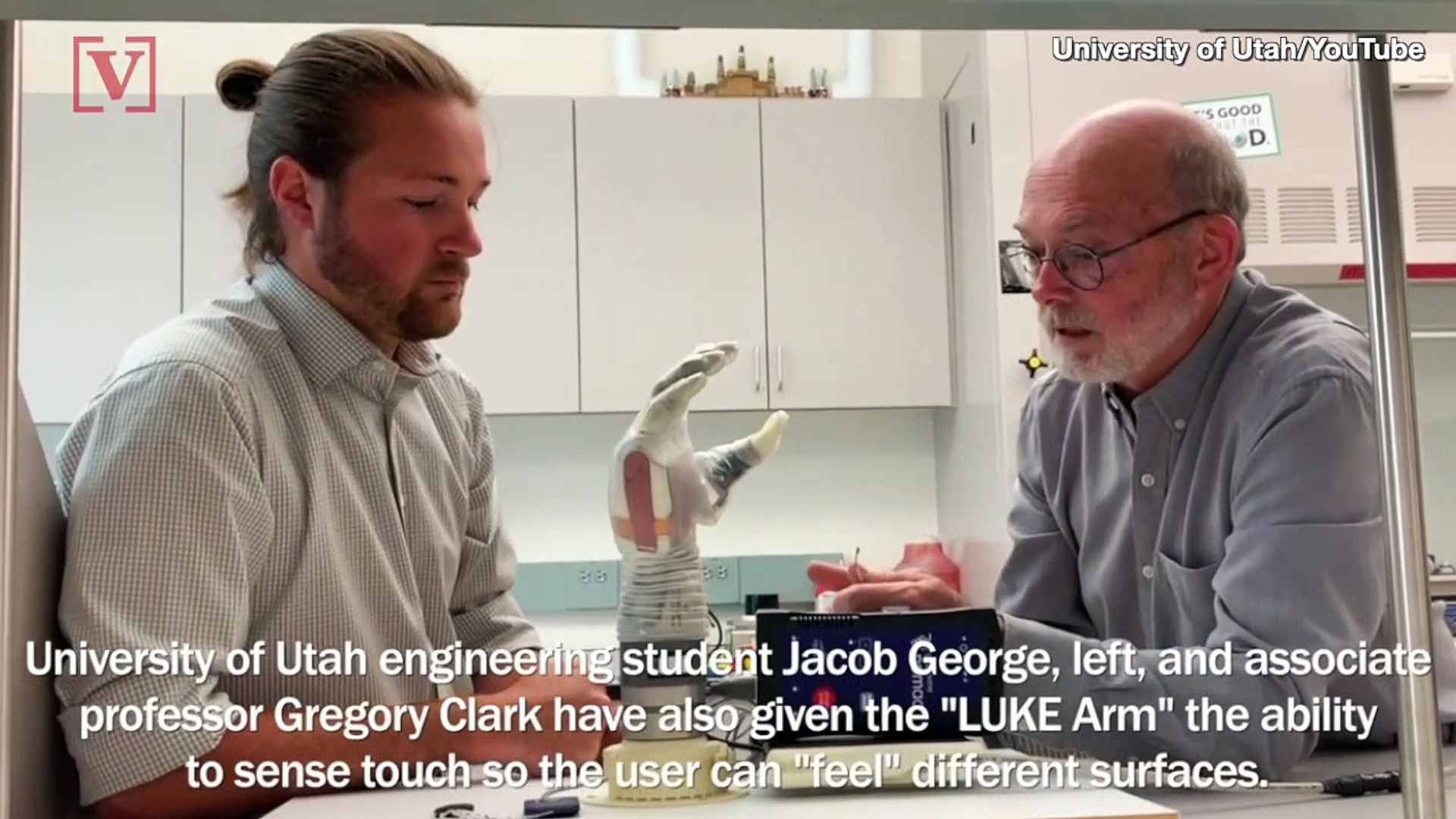
While the prosthetic undergoing testing is designed for people who have had their left arm amputated below the elbow but the developers are confident that the design can be easily adapted to both the right hand and amputations above the elbow. Mechanically the arm is constructed of metal motors overlayed by a clear silicon skin which has had one hundred electronic sensors imbedded in it.
The Luke arm being benchtested at the University of Utah (Credit: Unews, University of Utah)
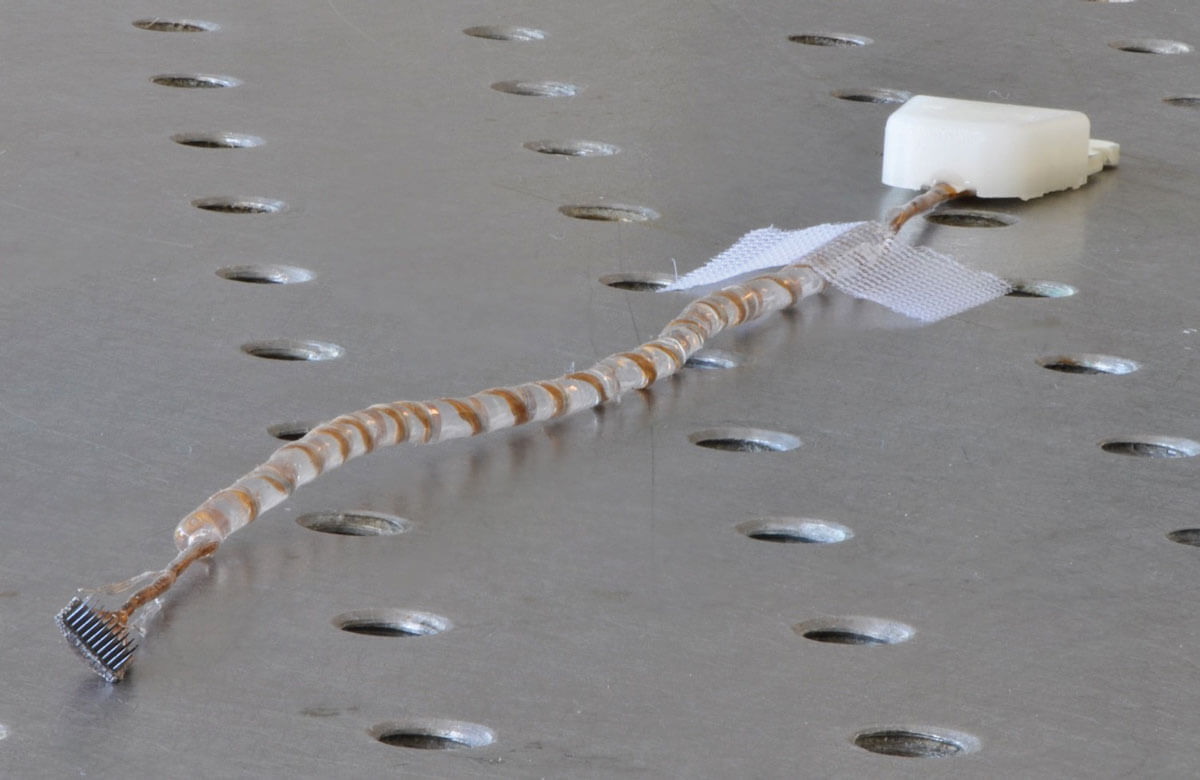
So sophisticated is the prosthetic that not only can it move and grab in response to signals from the wearer’s brain but it can send sensory signals back to the brain that are interpreted as the feelings of touch, heat and even pain. This is accomplished by a system of microelectrodes and wires that are implanted in the wearer’s forearm and connected between the nerve endings of the lost limb and the arm’s one hundred sensors.
The Luke Arm’s Sensoty electrode carries 100 sensory inputs between the arm and the Brain (Credit: Unews, University of Utah)
The
system of microelectrodes has been named the Utah Slanted Electrode Array and
was invented by Professor Emeritus Richard A. Normann. The array is connected
to an external computer that serves as a translator between the biological and
electronic signals.
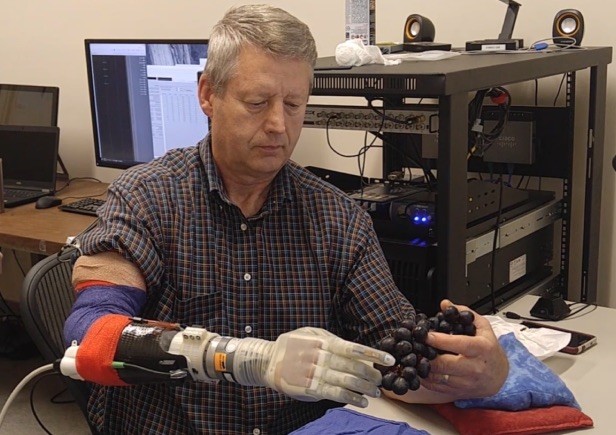
Patients using the ‘Luke Arm’ have succeeded in performing even delicate activities such as removing a single grape from a bunch or picking up an egg. This is because the sensors in the arm allow the user to actually feel the softness or hardness of the objects they touch. One test subject, Keven Walgomott of West Valley City Utah, even asserted that he could feel the softness of his wife’s hand as he held it with the ‘Luke Arm’.
Volunteer amputee Keven Walgomott using the Luke Arm (Credit: Interesting Engineering)
According
to Jacob George, the study main author and a doctoral candidate at the
University of Utah. “We changed the way we are sending that information to
the brain so that it matches the human body…We’re making more biologically
realistic signals.”
The
researchers are currently working on a portable version of the Luke arm that
will allow in home trials to begin. Testing of the Luke arm could take another
few years before FDA approval is granted and the prosthetic becomes
commercially available. Nevertheless, the day is coming when artificial limbs
will be providing amputees with a quality of life that is nearly equal to the
natural ones they have lost.
In
the story above I mentioned that Luke arm has one hundred sensors implanted
with it. Now that may sound like a lot but of course a real arm has thousands
of nerve endings giving our brain a much more complete impression of everything
that’s happening to that limb. Could an electronic skin, like that on Luke arm,
ever be developed that possesses as many sensors as natural skin?
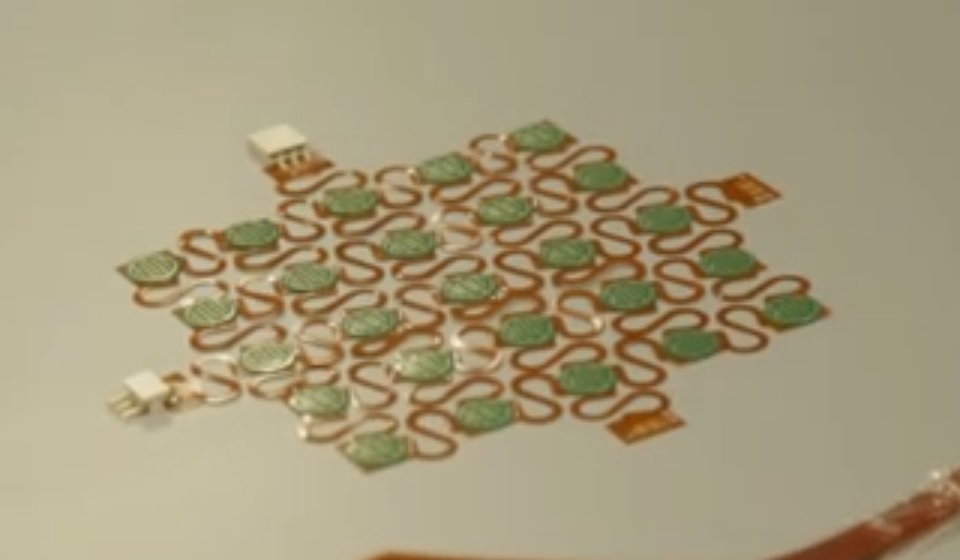
They’re already working on it! Scientists at the Department of Materials Science and Engineering at the National University of Singapore have developed a sampling architecture of sensor arrays that they have named the ‘Asynchronously Coded Electronic Skin’ (ACES). The engineers assert that ACES could work with arrays of up to 10,000 sensors and have even fabricated and tested a 250 sensor array to demonstrate their technique.
Some of the sensors used to test ACES (Credit: Edgy.app)
Now
there are several problems that you’re to need to overcome if you intend to greatly
increase the number of sensors in your system. The first is simply data
overload, that is more data than a computer, or even our brain can handle. The
second is sampling speed. With thousands of sensors waiting to have their data
taken, even at a high sampling rate a large faction of a second or more can
pass between each time a particular sensor is sampled. That means that an
emergency signal, burning heat or a stabbing wound could go unnoticed until
real damage is done.
The technique used by the engineers in Singapore is actually modeled on the way the nerves in our body communicate with the brain, an ‘event based’ sampling protocol. Think about it, when you first sit down in a chair you feel a large area of pressure as your skin makes contact, but after a second or so you hardly feel the chair at all. This is because our brain only reacts to changes to the messages from our nerves. The brain only pays attention when our nerves tell it that something, an event, is happening.
The electronic architecture of ACES (Credit: Cosmos Magazine)
The
ACES system does much the same thing, only passing on the data of sensors that
are measuring changes to their environment. In this way it prevents data
overload while at the same time enabling important information to quickly
become available to the controlling intelligence.
The researchers in Singapore hope that their
ACES system will prove to be applicable not only for sensors in prosthetic
limbs but also for increasing the ability of Artificial Intelligence systems to
sense and manipulate their environment. In that way ACES may be another step
forward in shaping the human-machine interface of the future.
The ancient writers of the bible liked to portray all of their neighbors in a very negative way but undoubtedly the people they called the Philistines received more than their share of bed press. According to the bible the Philistines lived along the Mediterranean coast just to the east of the central highlands where the Hebrew people resided. Here they built five city-states, Gaza, Ashkelon, Ashdod, Ekron and Gath.
Map of Ancient Canaan showing the region ruled by the Philistines (Credit: Crystalinks)
So who were the Philistines, the original Hebrew word Philištim simply means ‘people of Plešt’ whoever or whatever Plešt may have been. In the Bible however the Philistines are always treated as somehow different from the Canaanites or Moabites or Egyptians who were the Semitic neighbors of the Hebrews. Philistine names, like Goliath or Delilah, and the customs recorded in the bible also point to a non-Semitic origin.
In the bible the Philistines are depicted as being continually at war with the Hebrews (Credit: Facts and Details)
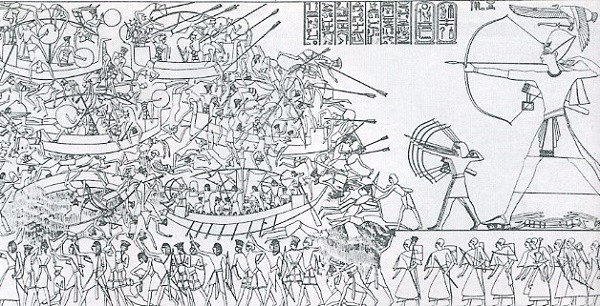
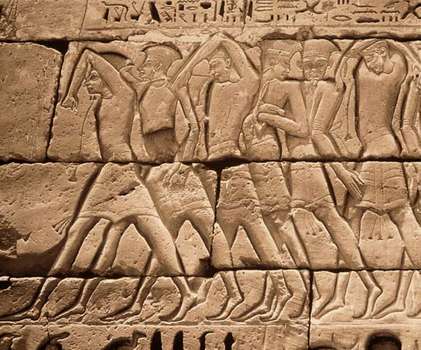
The first clues to the origin of the Philistines were discovered during the early archaeological expeditions to Egypt in the 1840s. It was the Egyptologists Edward Hincks and William Osborn jr. who published the history of the Pharaoh Ramesses III and his battles with a ‘sea peoples’ that were also known by the name of Peleset (Philistines???). According to Egyptian inscriptions Ramesses III defeated these Peleset in a naval battle in the River Nile as well as a land battle along the eastern Mediterranean not far from the city of Gaza!! The inscriptions go on to state that Ramesses III later settled his captives in a series of ‘strongholds’.
Inscription of Ramesses III defeating the ‘Sea People” (Credit: TheTorah.Com)Captive Philistines as illustrated by the Egyptians (Credit: Encyclopedia Britannica)
There are those who doubt that theory however stating that the similarity of names is hardly conclusive evidence. At the same time there is little archaeological support for a large-scale settlement of people in the region around Gaza in the 11th century BCE. Some scholars point to the use of the term ‘allophyloi’ (of another tribe) in the Greek translation of the bible, the septuagint to indicate that the Philistines were simply ‘non-Hebrews’, any enemies of the Hebrews. However the bible’s own descriptions clearly seem to refer to a definite ethnic group living in a definite place.
None
of which gets us any loser to answering the question, who were the Philistines?
If they weren’t Semites like the Hebrews or Egyptians or Canaanites, who were
they linguistically and culturally? Where did they come from?
Based upon the clues in the bible and the Egyptian inscriptions the leading hypothesis is that the ‘sea peoples’ came mostly from the area around the Aegean Sea including Crete, Cyprus, the western coast of modern Turkey as well as Greece itself! The idea that a large force of bronze age Greeks might have invaded the southeastern Mediterranean coast fits also in with the well attested destruction of the Mycenaean cites at that time.
How can we ever know? That was three thousand ago and the records from that time are incomplete and not conclusive. Yes there is some archeological evidence such as the discovery at Ashkelon of Late Helladic IIIc Mycenaean pottery but the pottery could have come via trade. The evidence may lean toward an Aegean origin but how can we be sure?
Examples of Philistine Pottery that resembles that of Pottery from the Aegean (Credit: Bible Odyssey)
Perhaps
the modern science of DNA testing can give us the answer. After all, we’ve all
seen the ads telling us how DNA can reveal our ancestry. And remember how DNA
was used to prove that the body found in a parking lot was actually England’s
King Richard III. Couldn’t the same techniques be employed on skeletons from
the right area and time period by archeologists?
In fact scientists have now done just that. In 2016 archeologists working at Ashkelon announced that they had discovered the first known Philistine cemetery, the culmination of 30 years of digging. The team, led by co-director Daniel Master of Wheaton College unearthed the remains of at least 108 individuals from which DNA was successfully removed from ten. The results of the DNA analysis clearly showed that the people buried in the cemetery were not related to any of the local ethnic groups but instead showed a strong European, probably a southern European relationship.
Archaeologists at work at the Philistine cemetery at Ashkelon (credit: National Geographic)
So
it appears as if the hypotheses about an Aegean origin for the people know in
the bible as Philistines was true. Goliath and Delilah may have been the
descendants of Odysseus or Agamemnon or some of the other well-known characters
of the Greek heroic age.
Think about that for a moment, could the ‘sea peoples’ have brought with them the stories that would become the later Greek myths. We could speculate that the Philistines told their stories about Hercules and the Hebrews responded by imagining stories of their strongman Samson. After all the first of Hercules twelve labours is strangling the Nemean lion whose hide was so tough no weapon could pierce it, while in the bible Samson’s first feat of strength is strangling a lion with his bare hands!!
Hercules slaying the Nemean Lion (Credit: Theoi Greek Mythology)Samson slaying his lion (Credit: Geni)
Could the story of Yahweh testing Abraham by demanding the sacrifice of Isaac, and then stopping the ritual once he was sure of Abraham’s faith, be the Hebrew answer to the Greek tale of the Goddess Artemis’s demand that Agamemnon sacrifice his daughter Iphigenia to her!
Iphigenia and Isaac being prepared for Sacrifice (Credit: PD)
We
may never know the answer to these questions, cultural cross connections leave
few traces in the archeological record. One thing we can be certain of however
is that since this is the Middle East the DNA results would quickly become
politicized!
In fact Israeli Prime Minister Benjamin Netanyahu has already used the results to declare that since the Philistines came from Europe then the modern Palestinians have no claim to any of the lands of the Middle East. He is of course assuming that the Latin word Palaestina is the same as the Greek word Philistinoi which maybe true but is a subject of considerable contention among scholars.
I suppose the only thing we can really be sure of is that David didn’t defeat Goliath; they’re still fighting it out!!!
No matter what you’ve heard this war ain’t over yet!!!! (Credit: Leadership Platform)
Before I start to discuss colourblindness perhaps I should start by taking a moment to talk briefly about how it is that we are able to see colour in the first place. Now most people are familiar with the fact that at the back of our eyes, the retina, there are two groups of light sensitive cells that are called rods and cones based upon their shape. The rods are sensitive to the intensity of the light whatever the colour, if we had only rods we’d see everything in black and white, complete colourblindness.
The Anatomy of the Human Eye (Credit: Wikipedia)
The
cones on the other hand come in three types; some are sensitive to the longer
wavelengths of visible light, the colour red. Others are sensitive to the
shorter visible wavelengths, the colour blue. The final group is sensitive to
the middle wavelengths, the colour green. Together these three types of cones
give us the ability to distinguish thousands of shades of colour.
Colourblindness
is defined as a decreased ability to discern the full range of the colour
spectrum of visible light. In other words some of the cone cells are not
functioning properly.
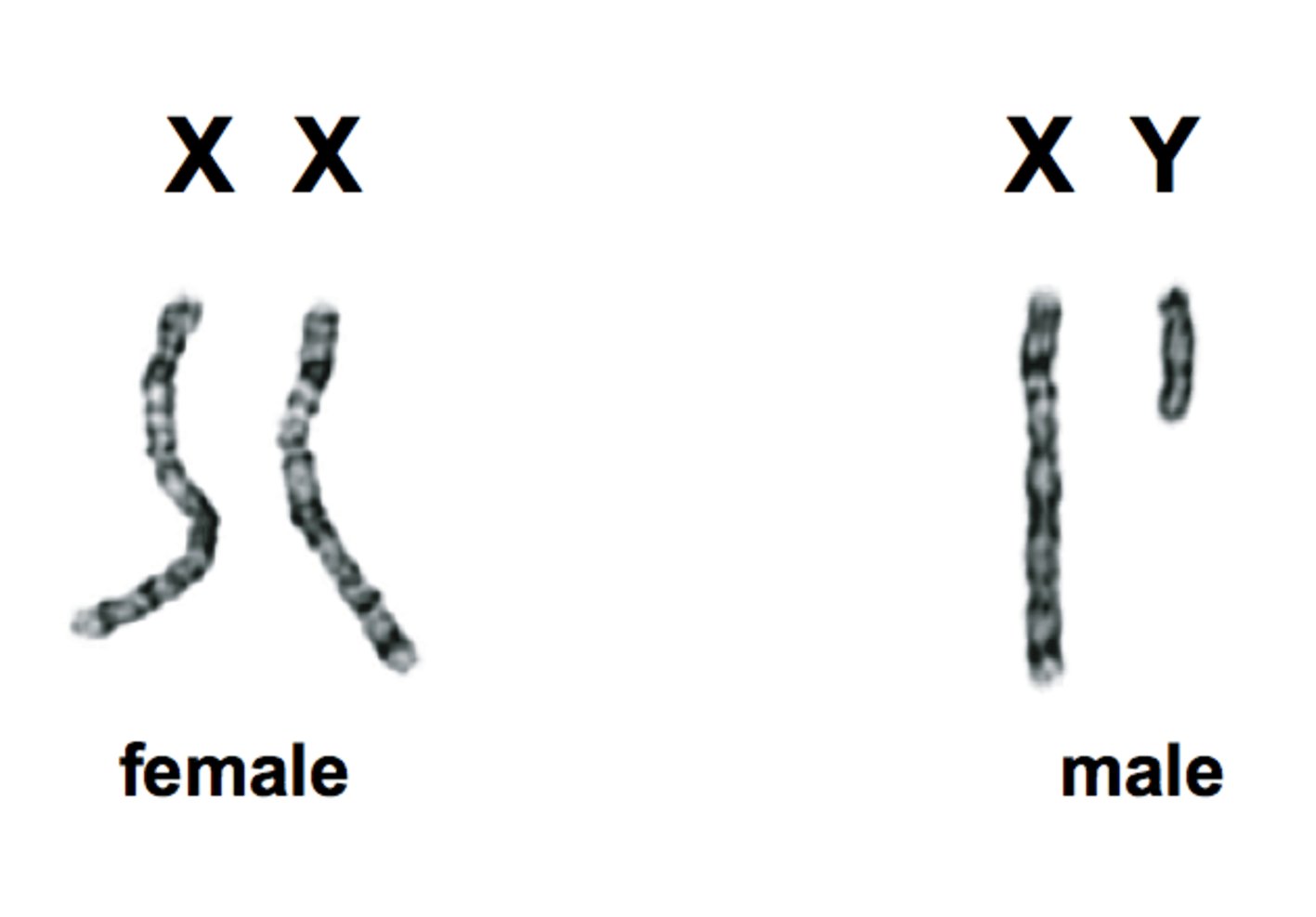
The most common form of colourblindness consists of some degree of difficulty in distinguishing between the colours red and green and is known clinically as dichromatic. Dichromatic colourblindness is both genetic in nature and sex related since the gene for the red / green cone cells occurs on the X chromosome of the X-y sex pair.
How people with Dichromatic colourblindness see the world (Credit: School Work Helper)
The defective gene for colourblindness is recessive in nature so since women have two X sex chromosomes both of the chromosomes must have the defective gene in order for her to be colourblind. A woman with only a single defective X chromosome can be a ‘carrier’ of colourblindness however.
The X-Y Chromosomes determine whether you’s a girl or a boy but can also carry sex related mutations like colourblindness and hair loss (Credit: Socratic)
A
male on the other hand has only one X sex chromosome, which he gets from his
mother. Therefore if a woman is colourblind all of her male offspring will be
colourblind. If a woman is only a carrier of colourblindness then half of her
sons will inherit the defective gene and develop colourblindness. Because of
this many more men are colourblind, about 8%, as opposed to women, 0.5%.
Colourblindness varies in degree with most colourblind people having only a small loss of colour vision. The chart below shows the different recognized ‘types’ of colourblindness along with the percentage of the population effected.
Types of Colourblindnesss and percent of population effected (Credit: Wikipedia)
Determining whether of not a person has colourblindness is usually accomplished by testing them with one or more Ishihara colour test plates, an example of which is given below. In this example a person with normal colour vision can clearly see the number 27 in the center of the design while a person with a slight colour deficiency will see the number 21. A person with total red / green colourblindness will not see any number at all!
An Ishihara test for Red-Green Colourblindness (Credit: Wikipedia)
There is no cure for colourblindness. Recently however there have been attempts to ‘correct’ colourblindness with specially designed glasses in a manner similar to the way that near or farsightedness can be corrected. The glasses are commercially available under the trademarked name EnChroma® and were developed by developed by a pair of scientists, Andrew Schmeder, a mathematician who studies the psychology of perception, and Don McPherson a glass researcher who has invented specialized laser safety glasses for surgeons.
How the Enchroma glasses are supposed to work (Credit: All About Vision)
According
to the inventors the EnChroma® glasses work by eliminating just those
wavelengths of red and green light that confuse the eye’s cone cell receptor
which allows the brain to perceive a greater colour contrast. EnChroma® Inc.
estimates that 80% of colourblind people can see improved colour vision with
the help of the glasses and judging by the reaction in Youtube videos of
colourblind people who try them for the first time they succeed miraculously.
Not
everybody is so convinced however. Researchers at the University of Grenada’s
department of Optics in Spain have conducted a test of the EnChroma® glasses
with 48 colourblind individuals, over 200 people volunteered for the test. The
results of this study, which were published in the journal Optics Express, seem
to show that the EnChroma® glasses only marginally perform better than ordinary
hunting glasses at increasing colour perception. The conclusion reached was
that the wearers of EnChroma® do not perceive new colours so much as see the
same colours in a new way.
Sounds
a bit like we’re arguing semantics to me. While it’s true that the claims made
by EnChroma® Inc are exaggerated, they’re trying to sell the glasses after all,
the company has never claimed to be able to ‘cure’ colourblindness. Reality is
probably somewhere in the middle with the EnChroma® glasses allowing people
with a mild form of red / green colourblindness to separate the two colours
more readily.
And
at least that’s a start. The development of EnChroma® glasses is the first even
slightly successful treatment for colourblindness. Hopefully in the years to
come improved versions of the glasses will be developed that perform better,
and for more types of colourblindness.
In
the long run there has been some research conducted by Maureen Neitz at the
University of Washington that has employed gene therapy to cure colourblindness
in monkeys. It may in fact be only a few years before there are some treatments
available that can significantly improve the ability of people born with
colourblindness to see the world with all of the rich tapestry of colours the
rest of us take for granted everyday.
There
have been a lot of things happening in the exploration of space lately, some of
it’s been hopeful, some not so much. Both manned and robotic space missions are
concerned and with so many stories to cover let’s get to it.
Perhaps the best news concerns the successful test of the Orion manned capsule’s launch abort escape system that NASA conducted on the 2nd of July. The entire test went perfectly with a small booster rocket taking the unmanned Orion capsule to approximately 10,000 m, see image below of takeoff. This altitude was chosen for the test because on an actual flight using NASA’s Space Launch System (SLS) as the launch vehicle 10,000 m will represent the time of ‘max-Q’ or maximum pressure due to air resistance.
The Orion Space Capsule sits atop it’s test booster ready for its abort Test (Credit: Spaceflight Now)
At 10,000 m Orion’s abort system fired its own rockets to pull the capsule away from the booster, demonstrating its ability to swiftly remove the astronauts to a safe distance from any potential danger. This latest test clearly shows that the Orion capsule and its support systems are ready for their first mission. Now all we need is for the SLS to be completed in order to get the Orion into space and beyond Earth orbit.
The moment of ignition of the Orion capsule’s Abort rockets (Credit: CBS News)
As usual Space X is also making news. Thanks to their reusable Falcon 9 rocket the Hawthorne California based commercial launch corporation is swiftly coming to dominate the business of putting satellites and cargo into Low Earth Orbit (LOE). This month however it’s their Falcon Heavy rocket that’s pushing the envelope. On the 25th of June Space X successfully launched its Falcon Heavy rocket for the third time placing an incredible 24 separate satellites into Low Earth Orbit (LOE).
Liftoff of the third launch of Space X’s Falcon Heavy rocket (Credit: Business Insider)
This
latest mission again demonstrated the ability of Space X to recover and reuse
its first stage boosters with the two side boosters of the Falcon heavy
returning safely to Cape Canaveral. In addition, for the first time ever the
nosecone fairing, used to protect the cargo during the launch, was successfully
caught in a net aboard a recovery ship, ready to be reused as well.
Unfortunately
the Falcon Heavy’s central booster missed its recovery ship, exploding in the
water nearby. However this launch required the central booster to attempt the
longest, 1,200 km downrange, landing yet by Space X so a safe landing was considered
to be a 50 / 50 shot at best.
There is also some bad news for Space X however. The tentative date for the first manned launch of their Dragon capsule has been pushed back into November and is likely to be even further delayed. After a successful unmanned test of their Crewed Dragon Capsule back in April there had been hopes that a manned mission could occur as early as this month or August. Unfortunately a later static test of the capsule’s abort system produced an ‘anomaly’, in other words an explosion, which led to this latest delay. This is yet another setback for NASA’s commercial crew program and leaves the space agency dependent for a little while longer on the Russian Soyuz space vehicle for getting American astronauts to and from the International Space Station.
The ‘Anomaly’ that occured during testing of the Space X Dragon Capsule (Credit: Express.co.uk)
As I mentioned above Space X is grabbing an ever larger share of the space launch industry, which if you think about it means that somebody has to be losing their share of the market. One of the organizations that are falling behind is the European Space Agency (ESA) whose Arian 5 rocket was just five years ago arguably the most popular vehicle for putting a commercial satellite into orbit. The reduction in cost that the reusability of the Falcon 9 rocket provides however, has made the Arian 5 effectively obsolete so now the ESA is rapidly trying to play catch up to the American firm.
Therefore the ESA is looking into developing a reusable rocket of its own in order to compete with Space X and regain some of their lost market. The space agency has recently announced that five million euros have been provided to the German space agency, DLR to perform an initial design study of such a rocket which has been given the tentative name of Callisto.
Going by the stated goals of the project the result of the study is certain to be a virtual copy of the Falcon 9. In fact the Europeans are quite open about it. “We are convinced that it is absolutely necessary to investigate Retro Propulsion Assisted Landing Technologies,” that’s the formal name of the landing technique used by the Falcon 9, “to make re-usability state-of-the-art in Europe.”
Planned European rocket ‘Callisto’ looks little different from the Falcon 9 (Credit: Space News)
For
my last story this month I’ll discuss something a bit more long range, and a
lot further from planet Earth. On the 22nd of June NASA announced a new mission
that will be a part of their New Frontiers program. The chosen mission is to
send a robotic aerial drone that will fly in the dense atmosphere of Saturn’s
moon Titan.
To say that this mission, which has been named ‘Dragonfly’, will be ambitious is putting it mildly; there are a large number of engineering difficulties to be overcome. The surface gravity of Titan is only one quarter that of Earth however, and the moon’s atmosphere is fully 50% denser than Earth’s so the idea of a flying probe seems quite feasible.
Mission profile of NASA’s planned Dragonfly mission the Titan (Credit: Wikipedia)
As
I see it there are two big problems to overcome, power and communications.
Power is a problem because Titan is so far from the Sun that any kind of solar
power is useless. All of our probes beyond Jupiter so far have been powered by
Radioisotope Thermoelectric Generators (RTGs) and NASA plans on during the same
for Dragonfly. Nevertheless flying takes a lot of energy so there will
undoubtedly be a considerable amount of time spent on the ground recharging
Dragonfly’s batteries between flights.
Communications
will be a tougher problem to deal with because of a very simple fact: at its
closest Titan is more than a light-hour’s distance from Earth. This means that
if the drone encounters violent, buffeting winds or some other unexpected
problem while its flying the controllers back on Earth won’t even know that
it’s happening for at least an hour. And then any instructions sent to the
probe will take an equal amount of time to get back to it. By that time the
emergency would probably be over, or the probe may have crashed and been
destroyed!
Probably
the only way around this problem will be for the probe to have the most
sophisticated computer Artificial Intelligence (AI) ever installed on a space
probe. Such a computer will be essential in order to enable the space probe to
handle whatever Titan throws at it, without human instruction or control.
Expected
to launch in 2026 and reach Titan in 2034 Dragonfly is the sort of deep space
mission that would have been considered impossible just a few years ago. The
space agency’s recent successes with its Mars rovers and space probes to
Jupiter along with asteroids and comets have given NASA the skills, and the
confidence to even tackle flying on Titan!
A couple of new discoveries have recently been published about the ancient and extinct sea creatures known as trilobites so I thought that this would be a good opportunity to discuss these fascinating creatures in some detail. I’ll begin with a few general facts about trilobites.
The Trilobite Phacops rana, the state fossil of Pennsylvania (Credit: Flickr)
First of all trilobites are members of the phylum arthropoda, the jointed limbed animals that include crustaceans, insects and spiders. In fact trilobites are generally recognized as the earliest members of that group of animals with fossils going back as far as 540 Million years ago. Trilobites not only evolved a long time ago they also went extinct a long time ago. The last trilobites died in the Permian extinction event about 250 million years ago, see my posts of 16 February 2019 and 2 June 2018. That’s several million years before the first dinosaur ever evolved!
Because
trilobites lasted so long, and their exoskeleton fossilized so easily
paleontologists have been able to identify more than 50,000 different species.
During their almost 300 million year existence trilobites evolved to occupy
nearly all of the ecological niches occupied by modern marine arthropods
including that of scavenger, predator, filter feeder and even a swimming species
that fed off of the plankton near the surface.
Looking at the figure below, you can see that Anatomically trilobites are defined by their broadly oval shape and the three main sections of their body going side to side, right pleural lobe, axial lobe, which is often raised, and left pleural lobe. Many people incorrectly think that the three lobes of the name trilobite refer to the three sections going front to back with the cephalon (head), thorax and pygidium (tail). (I did when I was young!)
The main anatomic parts of a Trilobite (Credit: Wikipedia)
Early trilobites, such as Olenellus from the Cambrian period seen below, had a cephalon that was much larger than their pygidium. As trilobites evolved however their tails grew to almost the same size and shape as their head as seen below in Phacops from the Devonian period. This adaptation allowed later trilobites to roll up into a protective ball in much the same way as a modern armadillo does. Fossils of such rolled trilobites are often found in Devonian, Mississippian and Pennsylvanian rocks.
The Cambrian Trilobite Olenellus fremonti (Credit: American Museum of Natural History)An enrolled specimen of Phacops rana (Credit: Fine Art America)
With a history of 300 million years and at least 50,000 species trilobites varied considerably in their particulars, especially size and ornamentation, see images below. The largest known trilobites are from the genus Isotelus of the Ordovician period some 450 million years ago specimens of which are as long as a meter. There are a number of candidates for the smallest member of the group but many small trilobites were no larger than a pea.
A beautiful specimen of Isotelus maximum (Credit: Geoclassics)A species of Trilobite ornamented with spines, presumably for protection (Credit: Tack Raccoons) Another spiny trilobite (Credit: Catawiki)
For the most part however trilobites remained rather conservative in their basic body plan. This may have contributed to their eventual extinction as competitors such as crustaceans and fish evolved structures like jaws and manipulating pincers that allowed them to outperform the trilobites.
As fossils a complete trilobite is fairly rare, one or two can represent a good day’s hunting. On the other hand recognizable pieces of trilobites are very common. The reason for this is that like all arthropods trilobites had to molt in order to grow. So a single live trilobite could in the course of its life produce many empty shells that would quickly break up to produce a lot of trilobite pieces.
Fragments of many fossils including a Trilobite tail right in the middle (Credit: The fissil forum)
A couple of recent studies have further increased our knowledge of these ancient creatures. The first concerns the discovery of a new species of trilobite from Australia that has been named Redlichia rex. The name is a reference to the well known dinosaur Tyrannosaurus rex because of R rex’s large size, 30cm, and leg spines that could be used to crush the trilobites food. The fossils of R rex come from the Emu bay shale of Australia’s Kangaroo island and are exceptionally well preserved revealing details of even the animal’s delicate antenna, see image below.
Artists impression of Redlichia rex along with a fossil specimen (Credit: Species new to Science)
Because
of R rex’s large size and crushing legs it is believed that the trilobite was a
predator, and perhaps even a cannibal. Specimens of R rex have been found with
healed injuries so the question is, what could have preyed on these large, for
the Cambrian period, animals. While there are several possibilities it has also
been suggested that R rex may have preyed on its own kind!
The
second discovery also comes from a fossil site that is well known for
exceptionally well-preserved specimens, the Guanshan location in eastern Yunnan
province China. In this study it’s not a new species of trilobite that’s been
announced, it’s the discovery of the earliest known evidence for a stomach and
digestive system!
Using some of the best specimens of the trilobite Palaeolenus lanteroisi, see image below, researchers from the American Museum of Natural History in New York and the Early Life Institute at Northwest University in Xi’an China actually succeeded in ‘dissecting’ the fossils. That is, they have managed to carefully remove a portion of the upper layers of the fossil in order to examine the petrified remains of the animal’s internal organs.
Examples of dissections performed on fossils of long dead Trilobites (Credit: Hopkins, Chen, Hu and Zhang)
What
they found was a well-developed digestive system with a large stomach or ‘crop’
in its cephalon. That’s right trilobites appear to have had their stomach’s in
their heads not far from their mouths!
A long alimentary canal then went through the length of the rest of the
trilobite’s body to an anus at the animal’s posterior.
Trilobites have a special place in the history
of life, as one of the first complex, multi-cellular forms of animal they
dominated the ancient Cambrian and Ordovician seas. Thereafter they gradually
declined, finally becoming extinct during the Permian catastrophe. Nowadays for
any fossil hunter a good trilobite specimen will always be a small prize to be
treasured.
This is the eight and final post in a series celebrating the fiftieth anniversary man’s first landing on the Moon. In this post I will discuss the mission of Apollo 11 and the contribution of all of those who contributed to the achievement of mankind’s oldest, greatest dream.
We will never know who was the first human to dream about going to the Moon but surely that is one of humanity’s oldest desires! (Credit: NASA)
Whoever was the first human being to imagine going to the Moon is lost in the mists of prehistory but we know that the Roman poet Lucretius wrote a story about traveling to the Moon in a dream during the first century BCE. Other similar dream like stories where occasionally written during the next sixteen hundred years before the French author Cyrano de Bergerac penned the first non-supernatural trip to the Moon around 1662. In Cyrano’s ‘Comical History of the States and Empires of the Moon’ the trip from Earth was made using balloons and, get this, rockets!
Cover of a modern edition of Cyrano de Bergerac’s ‘A Voyage to the Moon” (Credit: Barnes and Noble)
Starting
in the late 19th century the pace of Moon travel stories picked up with Jules
Verne and H. G. Wells penning the best-known novels. 20th century stories about
going to the Moon are too numerous to mention but you take my point, people
have been wondering about the Moon, dreaming about what it would be like to
travel there ever since we’ve been human. Indeed, in my own opinion, the sense
of wonder and mystery that we feel when we look up at the night sky is the key
difference between our animal ancestors and ourselves.
Starting in the early 20th century there were other sorts of dreamers thinking about the Moon, dreamers with training in mathematics or engineering. Men like Constantine Tsiolkovsky, Robert Goddard and Herman Oberth who began to consider how a trip into outer space could actually be accomplished. Men who began working on the designs and technology of the rockets that would be needed to take a man to the Moon.
Left to Right Tsiolkovsky, Goddard and Oberth (Credit Public Domain)
In
my previous posts about the Space Race I’ve mentioned the names of Werner von
Braun and Sergei Korolev as the two men who built the rockets that took us into
space and it’s worth noting that van Braun knew Oberth very well and Korolev
read all of Tsiolkovsky’s writings as a student in the Soviet Union.
So
it was that during the middle of the 20th century the technology needed to
reach the Moon was within reach. Getting to the Moon was going to take more
than just good engineers however; it was going to take money, lots of it, and
the political will to provide that money.
Enter
the space race, a contest of will between the two opposing superpowers of the
United States and the Soviet Union. A test of two ideologies each determined to
prove to the rest of the world that their way of life was superior. As I have
written in my earlier posts, the race began when the Russians succeeded in
surprising the world by launching Sputnik before the Americans even attempted
to put a satellite into space.
When President Kennedy announced NASA’s goal of reaching the Moon he didn’t explicitly give the space race a finish line, the Russians never admitted to being in the race after all. Nevertheless the race was on and by the beginning of 1969 the Americans were on the verge of meeting Kennedy’s challenge while the Soviet Union’s space program was beset with a string of failures.
John F. Kennedy gives the United States the goal of sending a man to the Moon! (Credit: NASA)
Which brings me to Apollo 11 and its crew of Neil Armstrong, Edwin ‘Buzz’ Aldrin and Michael Collins. Armstrong and Aldrin would be the two astronauts who would make the final descent and landing in the Lunar Module (LM) while Collins remained aboard the Apollo Command and Service Modules (CSM) in Lunar orbit.
The Crew of Apollo 11. Left to right Armstrong, Collins ans Aldrin (Credit: NASA)
The mission of Apollo 11 began on the 16th of July at 13:32 UTC as the Saturn V rocket rose from launch pad 39A at Cape Kennedy. After spending an orbit checking out their spacecraft Apollo 11 reignited the engine on their S-IVB stage at 16:22:13 UTC in order to break free of Earth’s gravity and send the three crewmen on their way to the Moon.
The launch of Apollo 11 (Credit: NASA)
Apollo 11 entered lunar orbit three days later on the 19th at 17:21:50 UTC and Armstrong and Aldren began preparing the LM for the last, historic leg of their journey. The LM began its descent at 17:44 UTC on the 20th.
The Apollo 11 Lunar Module prepares to descend to the Moon’s Surface (Credit: NASA)
Much
has been said about the last few seconds of that descent. It wasn’t until
several days later that the general public learned that the LM’s autopilot was
sending the craft straight into a large crater filled with dangerous boulders.
With the total lack of nerves for which he was known even among his fellow
astronauts, Armstrong took manual control and flew the LM several kilometers
farther, finally finding a suitable landing area with only about 25 seconds of
fuel remaining in the craft.
Human beings landed on the Moon for the first time on 20 July 1969 at 20:17:40 UTC. At 02:51 on the 21st, Armstrong squeezed out of the LM’s landing hatch and began climbing down the nine rung ladder. Stopping long enough to pull a D-ring that opened an equipment storage panel Armstrong activated a black and white TV camera that sent the momentous images back to Earth for all humanity to watch.
Neil Armstrong takes the first step on the Moon (Credit: NASA)
As
he stepped off the LM’s landing pad and made the very first footprint on the
Moon Armstrong said the words that have now become history. “That’s one
small step for a man, one giant leap for Mankind.” Much has been said over
the last 50 years about the missing “a” in the first phrase. Did Armstrong
forget himself for an instant and not say it, did a radio glitch cause it to
get lost. It doesn’t matter the sentiment is exactly right.
Armstrong was soon joined by Aldrin on the Lunar surface and for a little over two hours the astronauts gathered about 45 kg of Lunar rocks and soil for analysis back on Earth. They also deployed a number of science experiments that included a seismograph and a Laser reflector. The astronauts returned to the cabin of the LM and closed the hatch at 05:01 UTC.
After
a sleep period of seven hours, mission control in Houston woke the astronauts
and they prepared for their liftoff for the Moon’s surface. Liftoff took place
at 17:54 UTC. In all the astronauts spent 21.5 hours on the Lunar surface.
Returning to orbit around the Moon the LM rendezvoused with the CMS at 21:24 UTC. The Moon walkers spent the next two hours transferring all of their samples along with the film that they had taken before jettisoning the LM module. The LM would later be remotely directed to crash back onto the Moon’s surface so that the seismograph the astronauts had left behind could detect the vibrations. Analyzing those vibrations would tell geologists a great deal about the structure of the Moon’s interior.
Buzz Aldrin stands next to the Seismograph left on the Moon by the Apollo 11 astronauts. (Credit: NASA)
With the entire Apollo 11 crew now reunited in the CSM the preparations began for the engine burn that would return the astronauts to Earth. After leaving Lunar orbit the three-day journey back to Earth passed uneventfully. The Apollo 11 Command module, with the three astronauts and their cargo of the first ever samples of a extraterrestrial body splashed down in the Pacific Ocean 2,660 kilometers to the east of Wake Island at 16:51 UTC on the 24th of July. The total mission duration was 8 days, 3 hours and 19 minutes but in another sense the journey of Apollo 11 had really begun when the first human gazed at the Moon and wondered.
So
mankind’s greatest journey came to an end, ten more American astronauts would
later walk on the Lunar surface in the next two and a half years but of course
it is Apollo 11 that is the best remembered. Eugene Cernan would be the last
man to walk on the Moon in December 1972. At the time no one would have
imagined that after the triumph of Apollo that 47 years would pass without
another human being going any further than Low Earth Orbit (LOE).
So
what happened to the spirit of Apollo? What happened to man’s insatiable
curiosity? Why haven’t we gone on, beyond Apollo, beyond the Moon?
In some sense we have. Since Apollo we’ve sent robotic probes to every planet along with moons, comets and asteroids. Robotic probes are both far cheaper and less risky since there’s no need to keep fragile human beings alive so to a large extent robots have taken over the role of explorer from human beings.
The Unmanned Cassini spacecraft spent years studying the planet Saturn and its Moons (Credit: NASA)The Voyager space probes have even left the Solar System (Credit: NASA)
There’s also been a lot of political turmoil, the Soviet Union of course actually collapsed in the 1990’s. Meanwhile here in the United States it has seemed as if every new President that gets elected has a new goal for NASA to pursue, with the result that NASA gets nowhere.
Whatever the cause of this 40 year pause in manned space exploration it does seem to be coming to a close. NASA is nearing completion of the Orion manned Capsule and the Space Launch System for exploring beyond LOE. Meanwhile China is slowly but slowly but surely progressing with their space program and, perhaps most importantly commercial companies like Space X and Boeing are about to send people into space.
The Space race is once again picking up its pace, and this time a return to the Moon or a voyage to Mars will not be a one shot deal just to demonstrate we can do it. Next time it will be the beginning of a permanent human presence, the beginning of the human colonization of outer space.
The Apollo 11 Landing site as photographed by the Lunar Reconnaissance Orbiter in 2011 (Credit: NASA)
And
I promise that I’ll keep you informed of all of the developments here on
‘Science and Science fiction’.
Yes it’s true, after about a month and a half of being offline due to some hacker taken control of my site Science and Science Fiction is back and ready to resume posting new articles to keep you informed about what’s happening in the world of science and science fiction.
It was tough, I lost almost all control over the site to some damned computer hacker trying sell drugs from Canada! These people who think that they can just take away everything you’ve built in order to try to make a couple of dishonest bucks for themselves.
Anyway we are back and starting tomorrow we will resume our postings so be certain to stop by and check out the renewed ‘Science and Science Fiction’!!!
(NOTE: Science and Science Fiction is having a few problems right now with its platform program WORDPRESS. One of these problems is that I can’t insert any images into the body of my posts!!!! Right now the IT support at my host IPAGE is working the problem and hopefully they’ll fix the problem soon.
In the meantime however I want to check and see if I can still publish my posts I’m going to try to publish this one without images. Once everything is back to normal I’ll edit the post to add images but until then at least you can still read about the latest in Science and Science Fiction!!!)
Modern physics right now has a couple of big problems that are called Dark Energy and Dark Matter. I say they are big problems because we estimate that they make up more than 95% of the energy in the Universe while we know nothing about them aside from a few educated guesses.
In this post I’ll be discussing Dark Matter and in particular the latest experiment to attempt to detect and learn something about the nature of Dark Matter, the LZ experiment. Before talking about LZ however let’s take a step back and consider some of the evidence that has led physicists and astronomers to even consider the possibility of Dark Matter.
About fifty years ago astronomers began to make careful estimates of the masses of the various galaxies that they were observing in their telescopes. They made these estimates using two different techniques. (In science if you can measure something in two completely different ways and get the same answer from both that’s usually considered strong conformation that you’re getting the right answer!)
The first technique was very straightforward, count, well estimate, the number of stars in the Andromeda galaxy let’s say, and since we know the mass of one star, our Sun, a simple multiplication gives you an estimate of the mass of Andromeda. The second technique employed Newton’s laws of gravitation and required measurements of the velocities at which stars of various distances from the center of their galaxy orbited around that center. Both techniques required an enormous amount of very careful, painstaking measurements and so at first no one was surprised that the initial results were not very close.
As time went on however and the measurements became more accurate the discrepancies didn’t go away. Worse, the results always differed in the same way, that is the Newton’s laws astronomers always had the galaxies weighting more than the astronomers who counted stars, and the ratio between the two groups was always a factor of about six times as much mass as could be seen. It was looking as if there was a lot of matter in galaxies that couldn’t be seen, a lot of Dark Matter!
As astronomers began to consider what this Dark Matter could be made of they first considered fairly normal objects like red dwarf and brown dwarf stars. Red dwarfs are stars that are so small and dim that they are all but invisible at stellar distances while brown dwarfs are even smaller, so small they can’t even start hydrogen fusion in their cores and so are not really stars. They’re bigger than a planet, but not big enough to be true stars. Collectively these objects were called MAssive Compact Halo Objects or MACHOS and large numbers of them, larger than the number of ordinary stars, could account for a sizeable amount of the required Dark Matter in the galaxies.
So astronomers began looking for these MACHOS in our local stellar neighborhood in order to get a measurement of how common they were. In particular the Hubble space telescope was employed in the search but the final results were disappointing. A few brown dwarfs and very small red dwarfs were found, but not nearly in the numbers needed to even double or triple the masses of the galaxies.
It was at this point that the physicists got interested, because some of their theories about sub-atomic particles were indicating that for every particle we knew about, there should be a massive ‘Supersymmetric’ partner that only interacts weakly with other particles. These particles were given the name ‘Weakly Interacting Massive Particles’ or WIMPS and particle physicists were actively searching for these WIMPS in their powerful particle accelerators and other experiments. The possibility that these WIMPS could be the Dark matter astronomers were looking for only increased the effort to detect them. So it is that we come back to the LZ experiment!
The LUX-ZEPLIN or LZ experiment represents a collaborative effort between two previous searches for Dark Matter, the America LUX (Large Underground Xenon) and British ZEPLIN (ZonED Proportional scintillation of LIquid Nobel gasses) experiments. The LZ experiment will be conducted at the Sanford Underground Laboratory 1.5 kilometers beneath the Earth’s surface in the Homestake mine in Lead South Dakota. The LZ experiment like its predecessors LUX and ZEPLIN has to be conducted deep underground in order to minimize the number of false detections caused by cosmic ray particles.
The LZ experiment’s main detector will consist of a vessel containing 7000 kg of liquid Xenon with a small layer of xenon gas at the top while both the top and bottom of the vessel are covered with photomultiplier tubes. Any interaction between a WIMP and a nucleus of a xenon atom will immediately release a few photons of light that will be detected by the photomultiplier tubes. At the same time an electron will be knocked away from the atom. This atom will travel upward due to a uniform electrical field surrounding the xenon container. After a few milliseconds the electron will reach the xenon gas where it will ionize some of the gas atoms releasing more photons that will also be detected by the photomultipliers.
It is this unique signature of a few photons followed a fraction of a second later by more photons that will indicate the detection of a WIMP. There is a problem however; an ordinary neutron passing through the xenon vessel could produce a very similar signal. In order to filter out the false signals from neutrons the entire xenon vessel will be placed inside an outer detector containing 17,000 kg of gadolinium-loaded liquid scintillator (GdLS), which is a neutron absorber, releasing more photons.
So if the outer GdLS detector signals a neutron absorption immediately after the inner xenon detector detects a possible WIMP, that WIMP candidate will have to be rejected as a false event. This shows you the enormous lengths that physicists must go to in order to make absolutely certain that they are detecting just the particle that they are searching for.
The LZ experiment is now under construction and is expected to begin operation in 2020. In a few years then we may hear about the first confirmed detector of a WIMP, we may for the first time observe and learn something about an actual piece of Dark Matter.
This is the seventh in a series of posts in celebration of the fiftieth anniversary of Apollo 11 and man’s first landing on the Moon. In this post I will discuss the Soviet Union’s Lunar program taking a detailed look at the factors and decisions that not only enabled the American Apollo program to achieve the first landing on the Moon, but which doomed the Russians to never even achieving a Lunar landing.
Actually back during the 1960s the Soviet Union never even admitted to having a Lunar program, they denied they were even in a race. The Americans may have committed themselves to getting to the Moon by 1970, the Russians said, but we will continue to explore space in our own direction at our own pace.
Even after the Apollo landings the Russians did not admit to having lost anything. Oh, they congratulated the Americans for their achievement. At the same time however they maintained that they were concentrating their efforts toward long-term habitation of Low Earth Orbit (LOE), which they did in the 1970s and 80s with their Salyut and Mir space stations. As far as anyone in the west knew for certain, there never was a space race!
The Soviet Union never admitted to having a Lunar Program claiming instead that they were working on their Salyut Space Station. See here with a Soyuz spacecraft docked (Credit: Pinterest)
In fact the Russians were absolutely determined to get to the Moon first, to beat the Americans. In the 1960-62 time frame the Russians were in the lead in space and they fully intended to stay there. The recognition and respect that the Soviet Union had gathered from their achievements in space only made them hungry for more. More than that they had come to regard the new frontier of space as where their Soviet / Communist system would prove its superiority to decadent capitalism. It was only years later, after of collapse of the Soviet Union that the full extent of the Russian Lunar program finally became public.
Soviet Premier Nikita Khrushchev saw the Russian dominance in space as proof of the superiority of Communism (Credit: Time Magazine)
One of the problems of the Soviet space program was that their chief designer Sergei Korolev, didn’t get along with Khrushchev (Credit: Roscosmos)
It turned out the Soviet’s had two Lunar programs, and that was probably their first mistake! The larger Russian program was led by their ‘Chief Designer’ Sergei Korolev, the man who had put both Sputnik and Yuri Gagarin into orbit. Korolev knew that he would never have as much money and resources as the United States could spend on Apollo so his plan was a scaled down version of NASA’s program. Korolev’s version of the Saturn V launch vehicle was called the N-1 and would have been capable of sending just about half as much payload out of Earth orbit and on a trajectory to the Moon. See image below.
Russia’s massive N-1 Rocket, second in power only to the Saturn-V. The rocket would fail in all four of it’s attempted launches (Credit: Roscosmos)
Because of the reduced capability of his launch vehicle Korolev had to scale down all of the other components of a Lunar mission. A modified 2-man version of the Soyuz spacecraft would carry two cosmonauts to Lunar orbit from where a single-man Lunar lander would take a lone cosmonaut to the Moon’s surface, see images below.
A two man version of their Soyuz spacecraft would take Russian cosmonauts to the Moon (Credit: mek.kosmo.cz)
A single cosmonaut would make the trip to the Lunar surface aboard this lander (Credit: ninfinger.org)
Imagine for a moment if you will what it would have been like to be that lone human being rocketing down to the Moon’s surface. At least Neil Armstrong and Buzz Aldren had each other for support as they went ‘where no man had gone before’. The Russian cosmonaut would have been alone as no other human had ever been.
The second Soviet Lunar program was led by Vladimir Chelomei and would not actually have placed a cosmonaut on the surface of the Moon. Instead Chelomei intended to use his large Proton rocket, originally called the UR-500, to send a two-man Soyuz on a single loop journey around the Moon. If you’re wondering why the Soviet government would even fund a program that wasn’t even intended to go all the way well there were two reasons. First unlike the rockets Korolev built that took days to fuel and were unusable as weapons of war, Chelomei promised a large rocket that used storable fuel and that could be converted into an Intercontinental Ballistic Missile (ICBM). Second, let’s just say that Chelomei was better at playing politics, flattering his bosses on the Politburo, one of his chief assistants was actually the son of Soviet Premier Nikita Kruschev.
In the long run Chelomei’s Proton rocket did become Russia’s most successful heavy lift launch vehicle, placing into orbit the Salyuts, Mir and even modules of the International Space Station (ISS). During the space race however Chelomei just sucked much needed funds away from Korolev’s program.
Eventually Vladimir Chelomei’s Proton rocket proved to be a successful space launch vehicle but during the space race it was just a distraction. (Credit: Wikidata)
Then in January of 1966 the Soviet program suffered the loss of it’s chief designer as Sergei Korolev died on the operating table after entering the hospital for routine surgery for a bleeding polyp in his large intestine. Now Korolev had been sick for years, ever since being sentenced to a gulag by Stalin, and he’d literally worked himself to exhaustion to keep the Soviet space program on top. The precise effect of the loss of one man cannot ever be known but the fact that the Russian space program would experience several major setbacks in the next few years leaves you to wonder what Korolev would have done if he’d not died.
The first disaster occurred just a year later as the Russians launched their new Soyuz spacecraft on its first mission. A catastrophic entangling of the descent parachutes during the landing resulted in the death of cosmonaut Vladimir Komarov. Since the Soyuz spacecraft was a central component of both Soviet Lunar programs the tragedy of Soyuz one was a major blow.
The crash of the Soviet Soyuz 1 spacecraft (Credit: Roscosmos)
Worse was to come for in 1967 the first two test launches of Chelomei’s Proton launch vehicle both ended in failure while in February of 1969 the first test launch of Korolev’s monster N-1 rocket exploded only seconds after launch.
Test launch of the Russian N-1 Rocket, just seconds before its failure (Credit: Roscosmos)
With the failures of the first tests of the Soviet heavy launch vehicles the race over, Apollo 11 would land successfully on the Moon just five months later. Still, the Russians could have kept trying; coming in second is better than failing to finish isn’t it.
In fact they did keep trying, testing their huge N-1 rocket three more times, with each test resulting in the total destruction of the rocket less than a minute after launch. After the final failure on 23 November of 1972 the entire Soviet Manned Lunar was not only canceled but orders went out to deny that it had ever existed.
So why did the Soviet Union never get to the Moon? Was it the political infighting between two Lunar programs? Was it the death of Korolev? Or did the Americans simply outspend their cold war adversaries? A bit of all three if you want my opinion. As the space race came to its end there was only one competitor left, the first man on the Moon would be an American.