People often confuse Archaeology and Paleontology. Here are a couple of News Stories that can Illustrate the Difference.

Watching or reading the news you will occasionally come across stories where even a well educated journalist seems to be baffled about whether the topic of the story is Paleontology or Archaeology. After all, both sciences deal with the past, both dig up their evidence from the ground and it seems like much of that evidence consists of bones. Not only that, but there is without doubt a small but very important region of overlap between the two disciplines. So it’s easy to understand how non-experts can get confused.

The big difference between the two sciences is us, human beings. Archaeology deals with the human past, not only human remains but the remains of our activity. Material objects, anything from small tools to entire buildings are just as important to Archaeology as are human bones.

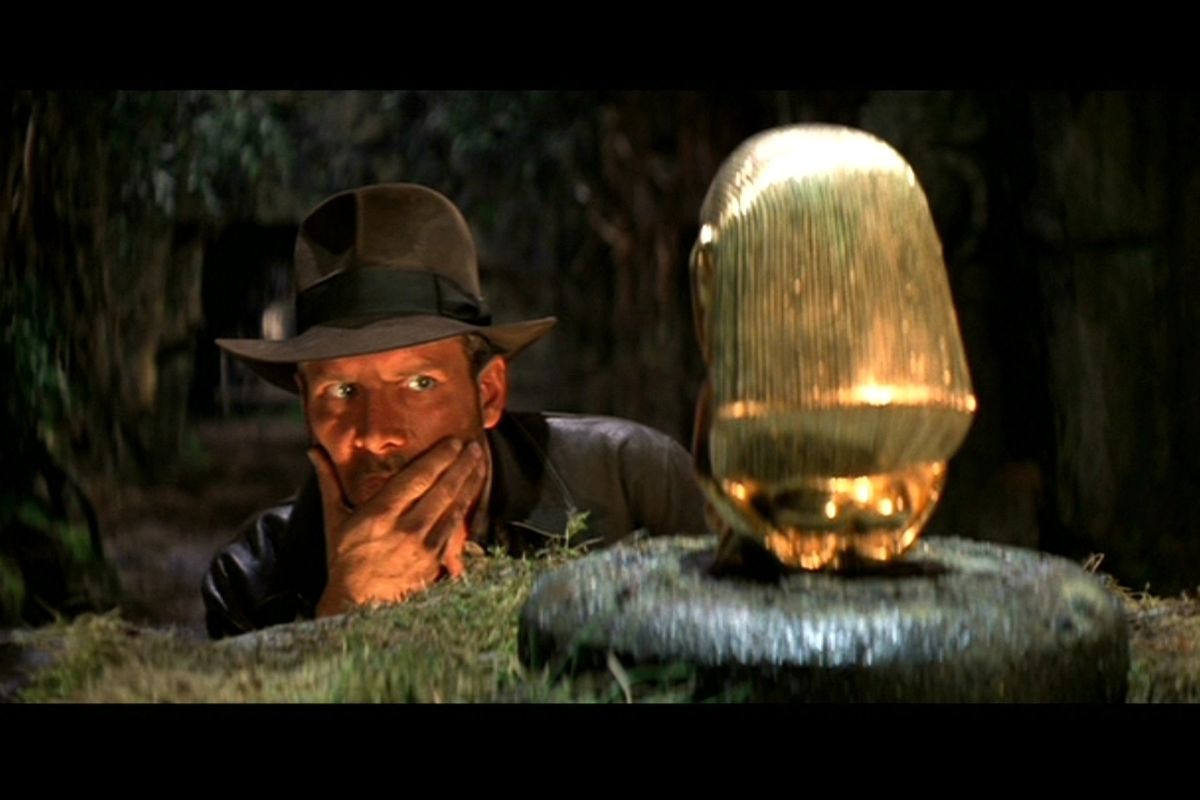
Unfortunately this is most people’s idea of an Archaeologist (Credit: Paramount Pictures)

The subjects of Paleontology on the other hand are all of the creatures that ever lived on this Earth, right back to the very earliest living cell. In some sense therefore Archaeology is a subset of Paleontology. We are still living creatures after all. However the enormous range of material objects left by humans is so large and so unlike the remains of other living things that the two sciences operate in two completely different ways.

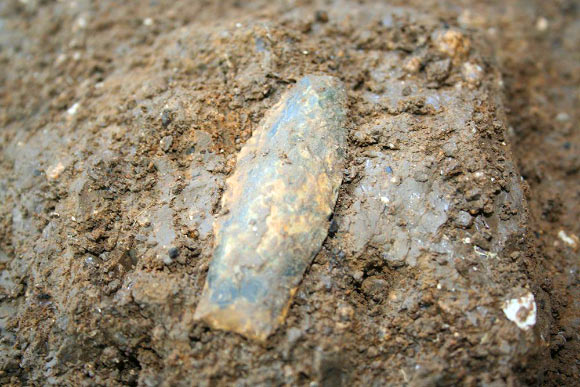
The first story I’d like to discuss illustrates this difference by showing how much archaeologists can learn from an ‘artifact’, a tool made thousands of years ago. In this case the tool is a stone spear point made by the earliest inhabitants of the Western Hemisphere in the region now known as Texas.

Pre-Clovis Spear Point found at the Friedkin Site (Credit: Sci News)

The Debra L. Friedkin archaeological site outside of Salado Texas has been excavated by researchers from Texas A&M University for more than a dozen years now. The remains here are some of the earliest evidence of human habitation in the Americas dating back some 15,500 years. These remains predate the classic Clovis remains first found in nearby New Mexico.

Some of the Stone Tools found at the Friedkin Site (Credit: Texas A&M University)

That makes the Friedkin site very important because for decades the Clovis culture, first described in the 1920s from digs outside of the town of Clovis New Mexico, were thought to be the remains of original people who came to the Americas about 13,000 years ago. In the years that followed numerous sites in both North and South America were found that produced artifacts consistent with Clovis culture.

Over the last twenty years however a few sites have been discovered that date several thousand years older than the Clovis sites. So far however these sites have only produced a small number of artifacts, making it difficult to determine whether or not these people were earlier examples of the Clovis culture, or do they represent an entirely new, unknown people.

Texas A&M Professor Michael Waters thinks that the Friedkin site can provide that answer, and in his opinion they are an entirely new people. The artifacts discovered by Professor Waters and his team even include the earliest known stone spearheads, see image above.

“The dream has always been to find diagnostic artifacts such as projectile points that can be recognized as older than Clovis and this is what we have at the Friedkin site.” Waters says. Whether or not other Archaeologists will accept Professor Waters’s conclusions remains to be seen but with each piece of evidence the answer becomes clearer.

Now in that story we were only talking about artifacts, that is objects manufactured by human beings. In this next story the evidence will consist solely of the actual remains of living creatures. So that means this story comes from the science of Paleontology. Also, where the story from Texas dealt with evidence that was fifteen thousand years old, the evidence in this story is over 400 million years old!

Unfortunately this is most people’s idea of a Paleontologist (Credit: Universal Pictures)

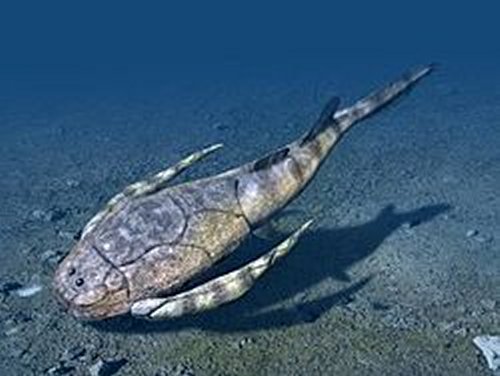
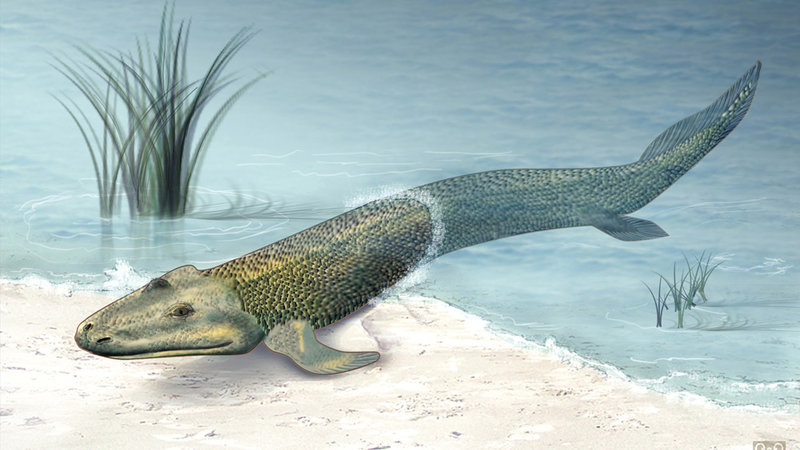
The first animals to possess a backbone and an internal skeleton, the first vertebrates that is were fish, although very strange looking fish they were. The earliest fossils date from about 480 million years ago but such fossils are few in number and show little diversity. Vertebrates were a small, not very successful group of animals. About 60 million years later however the fossil record explodes with numerous new species of fish suddenly appearing.

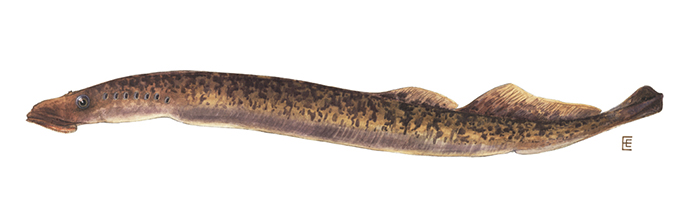
Cephalaspis lyelli, an early jawless fish (Credit: Art.com)

In their search for the explanation of how this explosion of vertebrates happened Paleontologists have looked to find out where this explosion happened. That is, did the diversification of fishes occur in the open ocean or perhaps it occurred around the ancient coral reefs of that period.

Now a new study proposes a different solution. Paleontologists Lauren Sallan of the University of Pennsylvania and Ivan J. Sansom of the University of Birmingham have generated a database of 2,728 specimens of fossil fish from around 420 million years ago. In particular the database records the environmental conditions of where the fossil animal lived.

“The Nice thing about the fossil record,” according to Sallan. “Is that we often find fishes in the context of where they lived. The rock that holds them tells us what their environment looked like, whether it was reef, shallow water, deep water, a riverbed or a lake.”

What Professors Sallan and Sansom have found is that the explosion of fish species occurred in the shallow waters right up near the shore, between the reefs and the beach. In this environment these early fish acquired adaptations, such as bottom dwelling, that later enabled them to fit into niches in both the coral reefs and deeper more open waters.

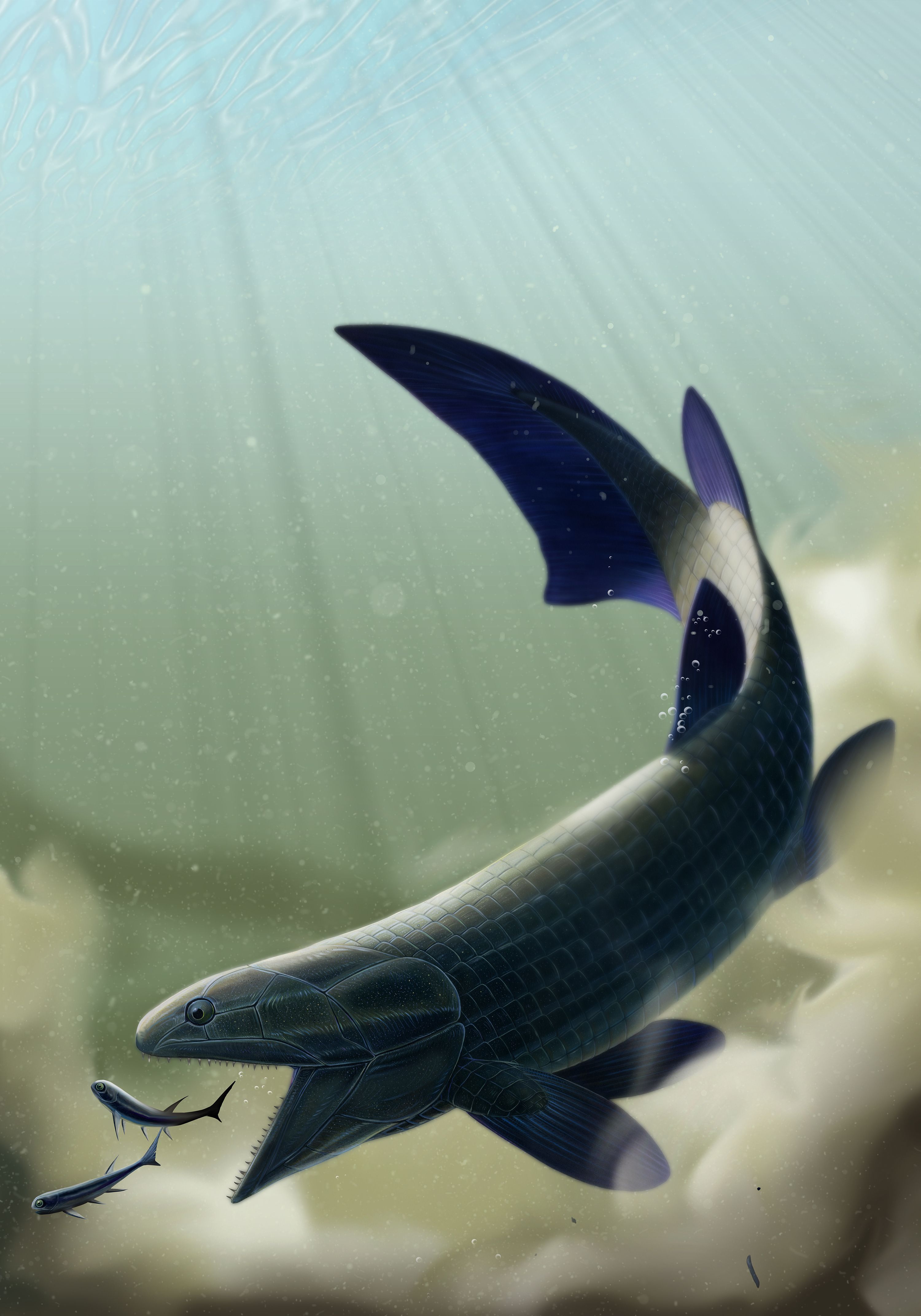
Living near the shoreline also allowed fishes to adapt to freshwater more quickly and more successfully than other major groups of animals such as the arthropods and mollusks. And there was one more adaptation that that occurred at this time which gave these early vertebrates a distinct advantage. This was when fish first acquired jaws!

Jaws gave fish a big advantage. Osteolepis, and early jawed fish. (Credit: Pininterest)

So there you have it. Two examples of new research, one from the science of Archaeology, the study of humanity’s past, the other Paleontology, the study of life’s past.

Get Ready to Blow Your Mind: Optical Illusions and How They Work.

I think my post today may be a little short on content, but don’t worry, I’ll make up for it with some eye-popping pictures. Before I talk about optical illusions however let’s take a moment to recall just how it is we can see anything.

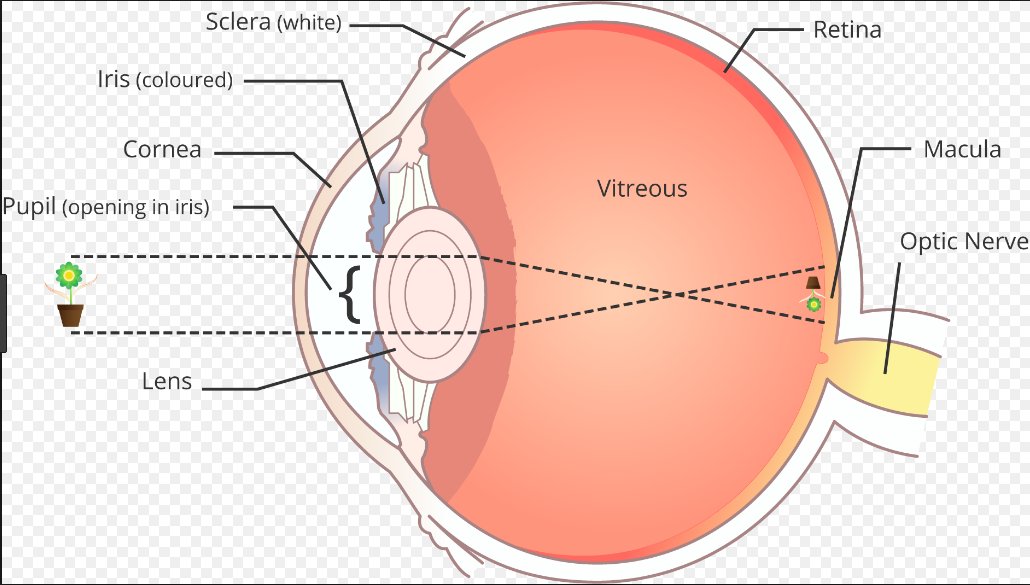
Without going to any detail, light enters our eyes through the iris, which acts as a lens, and forms an upside down image at the back of the eye. Here light sensitive cells, rods and cones, pick up the light and sent signals to our brain which has to not only turn the image right side up but has to interpret what all of those signals mean. (See Image Below) Optical illusions work by playing with that interpretation by the brain in some way that makes us see things that aren’t really there, or miss something that is.

How the Eye Works (Credit: The Foundation for Fighting Blindness)

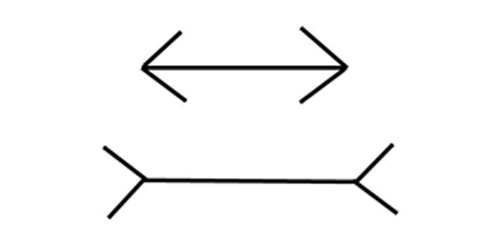
Let’s start with a simple example like the two small stick figures shown below.

Simple Optical Illusion. Which HORIZONTAL line is longer? (Credit: Public Domain)

Obviously the entire lower figure is wider than the entire upper figure but is the lower horizontal line, and only the horizontal line longer. It certainly looks like it is doesn’t it! If you measure the two horizontal lines however you will find they are actually the same length. Because the entire lower figure is longer it makes our brain think that the lower horizontal line is longer. It’s the orientation of the < and > lines at the ends of the horizontal lines that trick our brain into thinking that the lower line is longer.
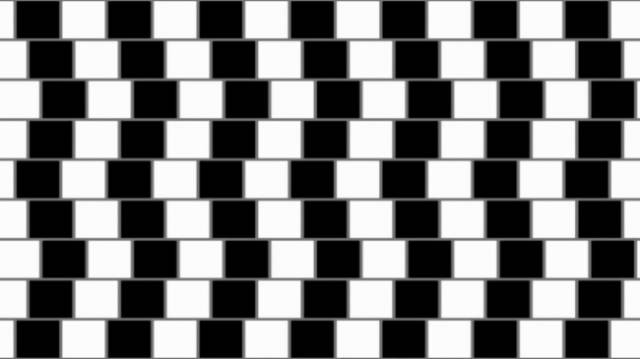
Let’s try the more complex yet similar example below.

Optical Illusion 2. Are the horizontal lines parallel or not? (Credit: Public Domain)

Here we have rows of alternating black and white boxes that are slightly offset from each other vertically. This offset causes our brain to see the horizontal lines as cock-eyed; certainly they don’t look like they’re parallel. But they are parallel, if you don’t think so take out a straight edge and see for yourself.

One more example of this type of illusion is shown below.

How many long square ended blocks are there? Count at both ends! (Credit: Public Domain)
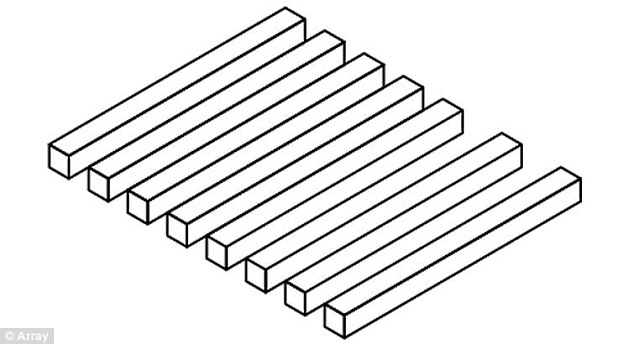
Here we have what appears to be a number of long square blocks but if you go to the left hand side first and count the number of blocks, then go to the right hand side and count again you’ll find that the left hand side has one more block! How is that possible?

What’s going on here? Well our brain can only concentrate on one side of the image at a time and the middle is just a bunch of lines so we don’t see anything wrong, we don’t see the trick unless we stop and carefully examine the situation.

Optical illusions such as these are designed to probe the limits of how our brains process the signals sent to it by our senses and psychologists use them to learn something about how our brains work. We can illustrate another way to trick the brain with an optical illusion like the familiar one below.

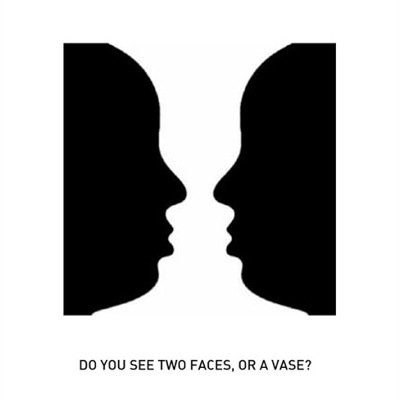
Which do you see, the Vase or the faces? (Credit: public Domain)

Which do you see, the two faces or the vase? Of course the image combines both but the trick here is that once our brain has found one interpretation it stops looking for any other! I think that’s a pretty important fact about the brain we just learned don’t you. Let’s try another, similar one.

The image shows different objects depending on which side is up! (Credit: Public Domain)

Here the trick is that, upside down the rabbit has become a mustachioed man. If you only look at one image or the other it’s not so easy to see. Again our brain accepts one interpretation and that’s good enough. It isn’t designed to look for a second.

The last type of optical illusion I’d like to illustrate is the sort where our brain is tricked into seeing motion where there is none. Check out this one.

The Circles seem to rotate even though this is a still image! (Credit: Public Domain)

No this is not a video, nothing is moving trust me but it sure looks like those circles are rotating doesn’t it? The trick here is obvious, by composing an image out of multiple connected curves our brain tries to follow those curves as if they were moving.

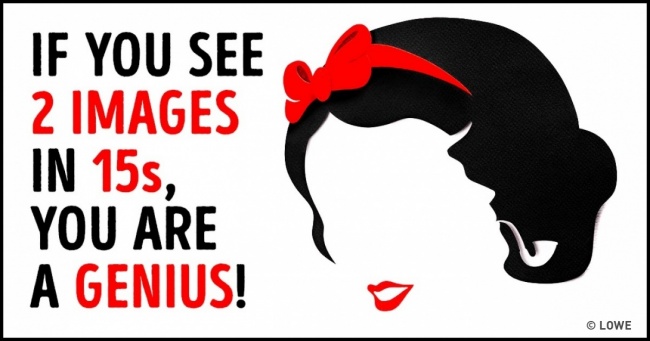
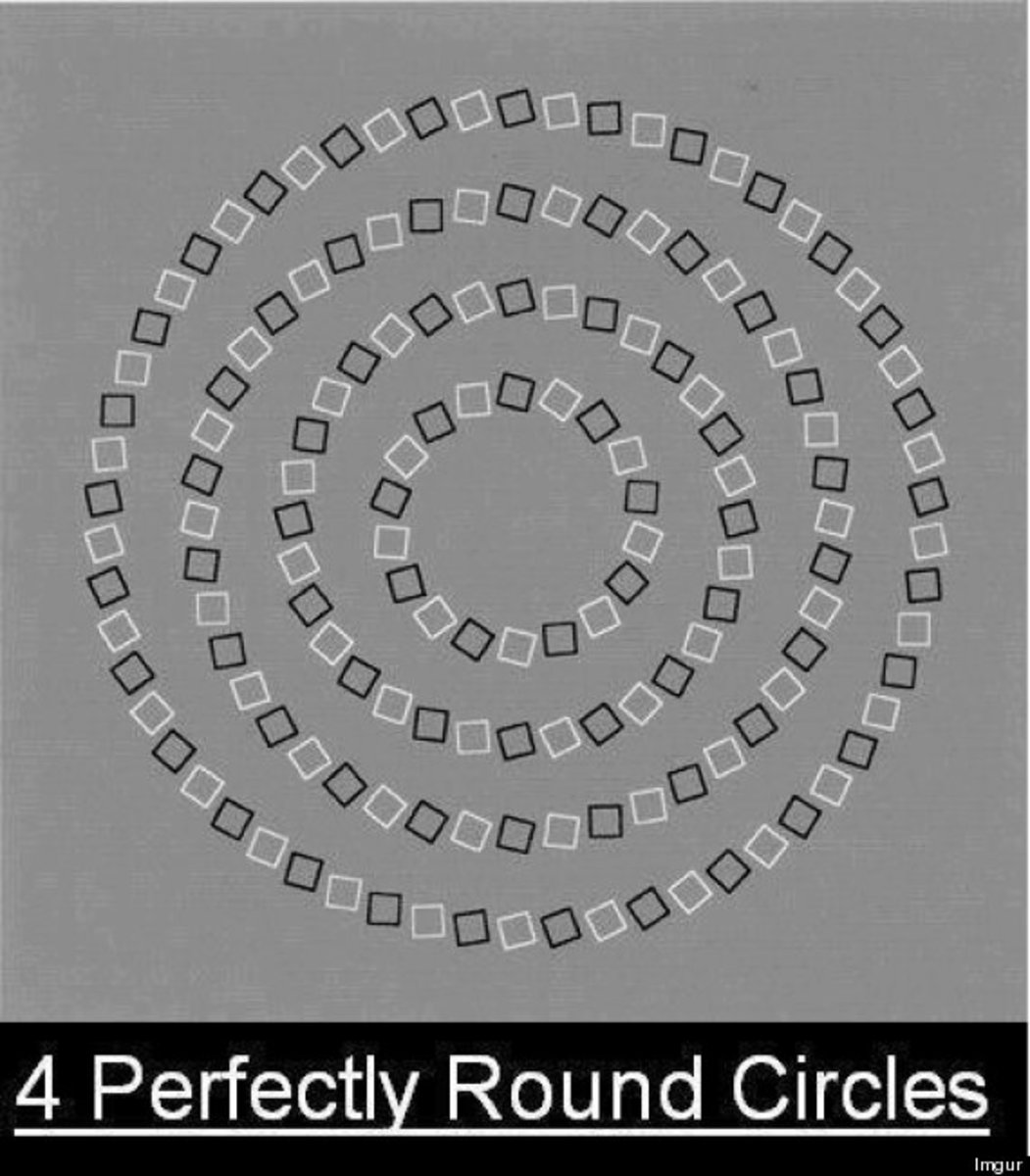
Optical illusions such as these are an important tool in studying the brain, how it perceives and reacts to the reality around us, but let’s be honest, they’re also really cool. I’ll leave you with a few more examples. See if you can figure out which type each is.

This one will definitely blow your mind! (Credit: Public Domain)
Find the Hidden image! (Credit: Public Domain)
Yes the circles are really nice and round! (Credit: Public Domain)


Movie Review: First Man

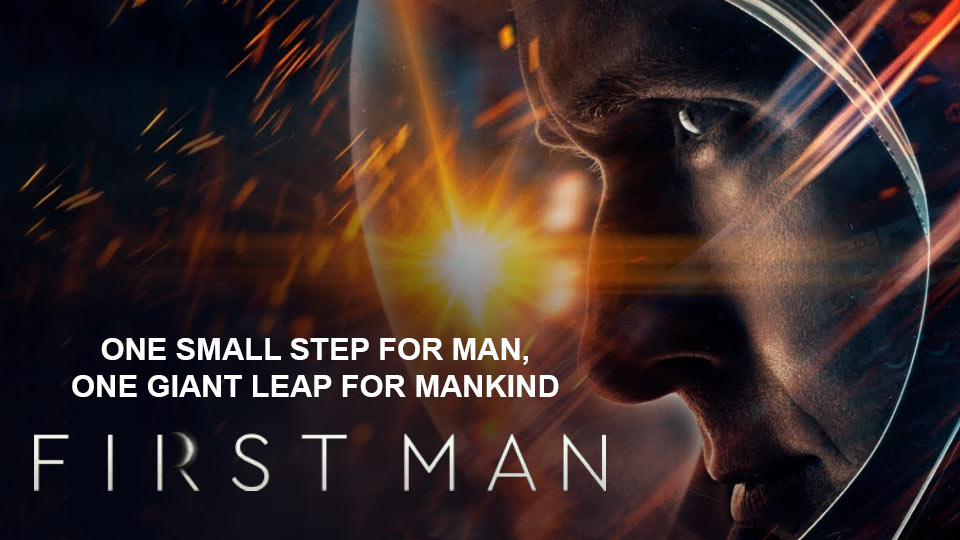
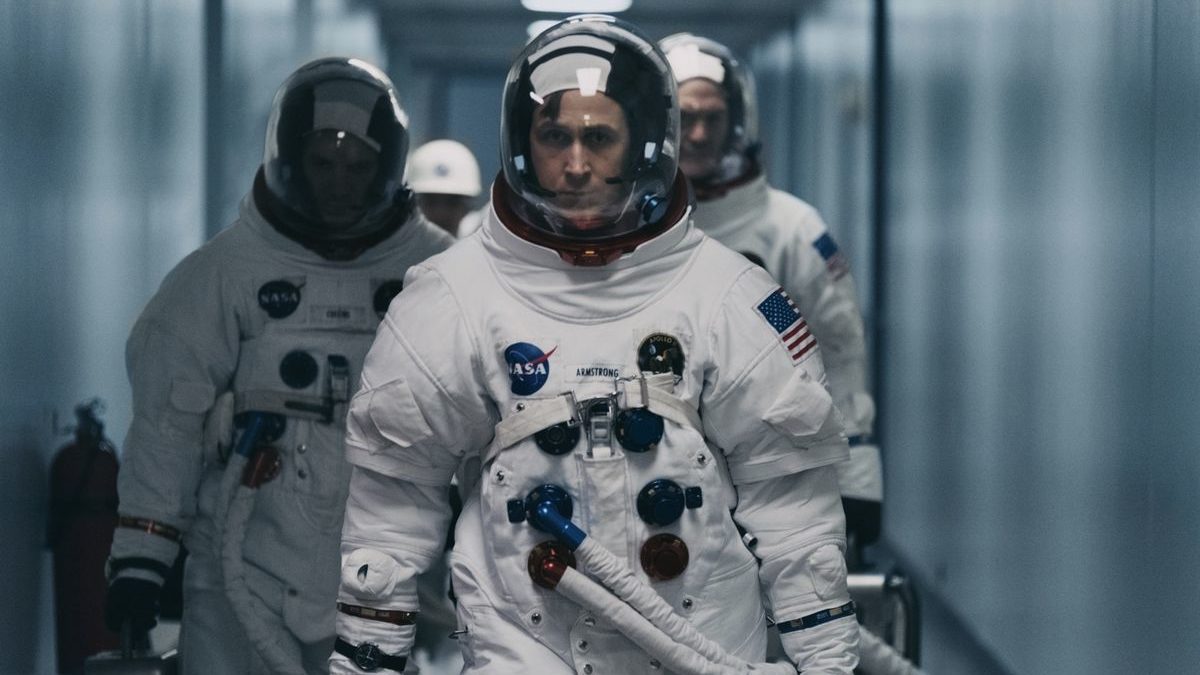
First Man from Universal Pictures (Credit: Universal Pictures)

I don’t think I’m giving away any spoilers by letting you know that ‘First Man’ is a film biography, a filmography of the life of Neil Armstrong, the ‘First Man’ to set foot on the Moon. The creative team of director Damien Chazelle and actor Ryan Gosling, who worked together on the film ‘La La Land’, now bring us a portrait of Armstrong as man who is more comfortable in his relationships with machines than he is with other people. The image below shows Ryan Gosling as Neil Armstrong.

Ryan Gosling as Neil Armstrong (Credit: Universal Pictures)

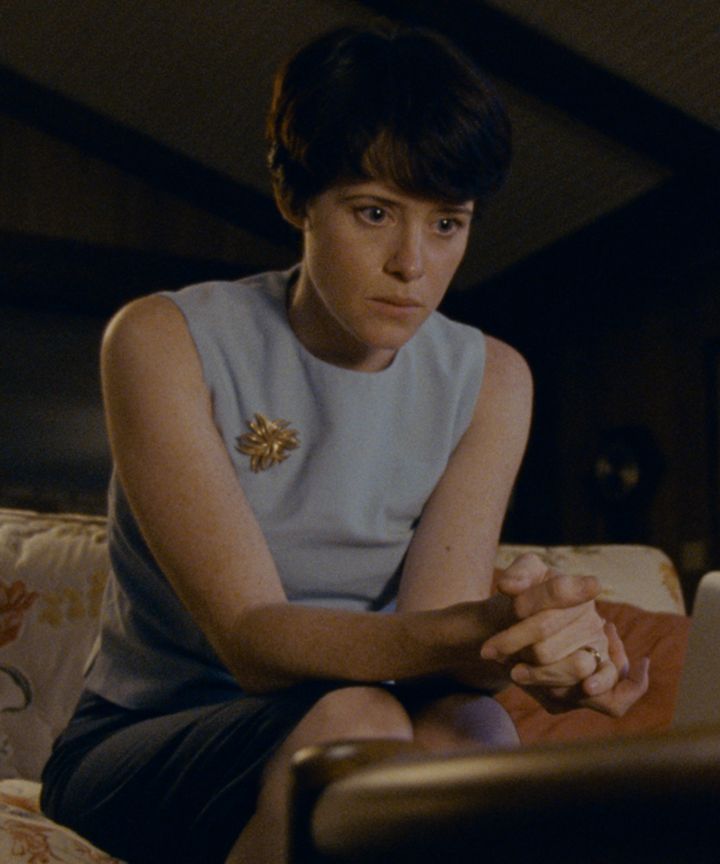
By all accounts this portrayal is uncomfortably accurate. Astronauts as a group are not overly emotional, preferring to “maintain an even strain” as Tom Wolfe put it in his book ‘The Right Stuff’. Armstrong however was in a class by himself, escaping from almost certain death with a ‘well that’s my job’ attitude while preferring solitude at times of emotional crisis when most of us would seek the company of our family and friends. At times this solitary nature even led to an emotional gulf with his wife Janet, played by actress Clair Foy.

Clair Foy as Janet Armstrong (Credit: Universal Pictures)

The movie begins with Armstrong in the experimental X-15 spacecraft, attached to the underneath of a B-52 bomber and ready to begin a flight. This is the first in a series of incidents when Armstrong could easily have been killed but where his calm ability to choose the best option when there is absolutely no good option prevented disaster.

The centerpiece of Armstrong’s talent for saving the mission against the odds is the flight of Gemini 8 where Armstrong, as commander and David Scott as co-pilot succeeded in making the first docking in orbit of two spacecraft. A few hours after the docking however the combined spacecraft began an anomalous roll. Thinking, hoping that the problem was in their Agena target vehicle Armstrong undocked only to have the roll get much worse. The roll got so bad that Scott blacked out and everyone agrees that Armstrong should have as well, a situation that would have meant death for them both. Armstrong got the wayward Gemini under control however, long enough to make an emergency re-entry, saving both the mission and their lives.

It was Armstrong’s cool headedness in Gemini 8 that led to his being selected as commander for Apollo 11. In the movie the scene where Deke Slaton tells Neil that he is scheduled to be the first man on the Moon the response is typical Armstrong, ‘O’k’ is all he says.

The movie’s the special effects are simple perfect; the attention to detail is exquisite and not just for the spacecraft. Everything has a real 1960s feel to it right down to the haircuts and clothing. There are more actual sets than CGI, which I prefer but the scenes that do employ CGI are some of the best I’ve seen. I’d like to mention one other thing, flying in an experimental aircraft or a spacecraft is a lot bumpier than a normal domestic airline flight and ‘First Man’ gives you enough shaking and rolling to make you feel as if you’re really in the cabin with Neil.

Ryan Gosling time travels back to the 60s in First Man (credit: Universal Pictures)

The climax of the film is of course the landing on the Moon and again Armstrong’s calm determination saves the day when the Lunar Module’s autopilot is about to land them in a crater full of boulders. Seeing the disaster approaching Neil takes control and pilot’s the lander to a save area with only two seconds of fuel remaining. Once they are safely on the Moon, the first men to ever reach our nearest cosmic neighbor, Neil and Buzz Aldrin merely shake hands and get back to work.

There’s been a bit of controversy over the fact that the movie does not show Armstrong and Aldrin planting the American Flag on the Moon. The flag is shown several times but since it did required both men to secure it in the ground, and this movie is about Neil the actual erection isn’t shown. Instead we get a poignant scene where Armstrong takes a necklace that had belonged to his little daughter, dead now seven years, and drops it into a Lunar crater. It wasn’t that he didn’t have emotions; he just preferred to keep them private.

That’s a real change from our current herd of heroes; high-fiveing each other while bellowing like a bull. Or spiking the ball and doing a dance in the end zone. I think we could use a few more Neil Armstrongs, you know the type. The kind who, when you ask them how it felt to be the first man on the Moon reply, “It was my Job”.

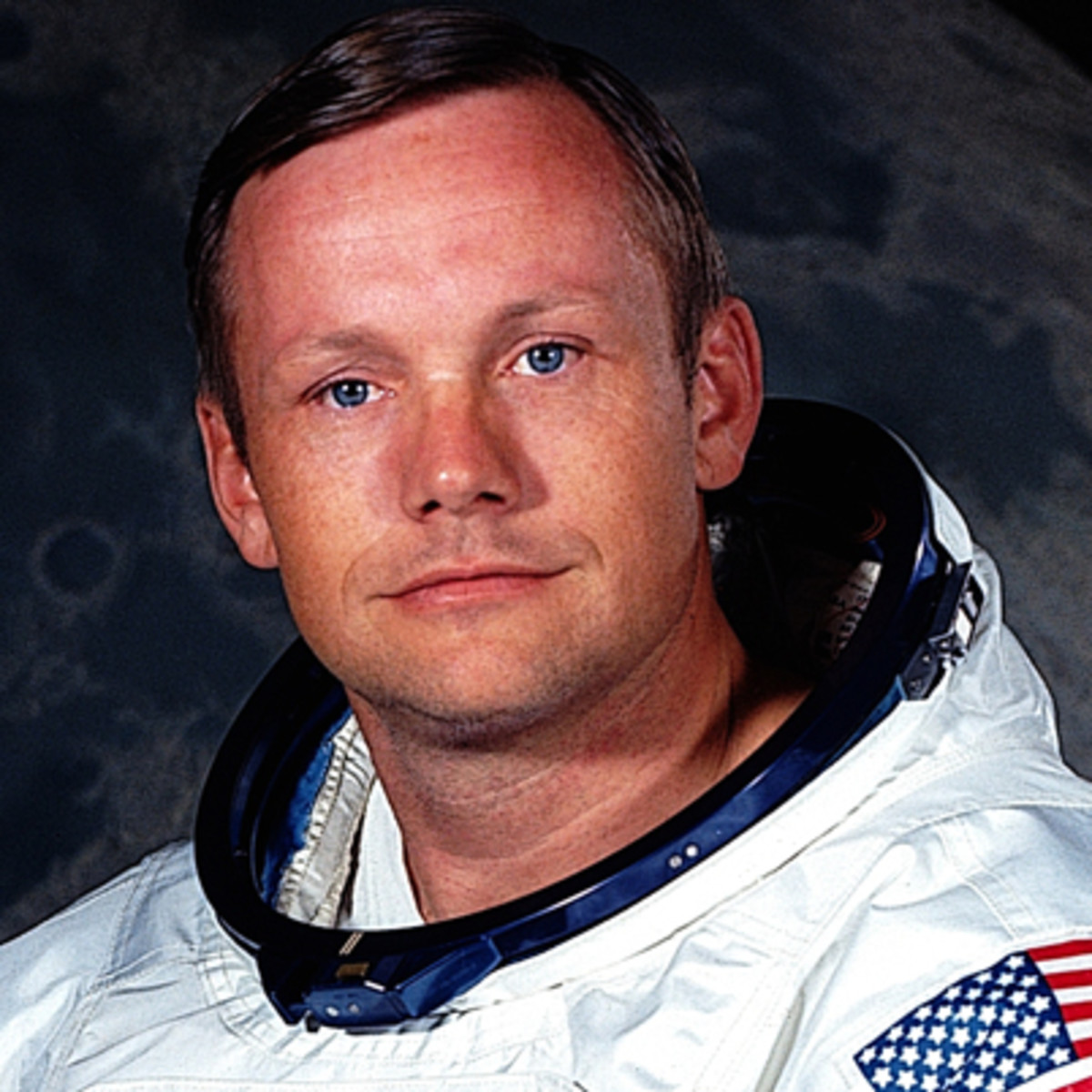
The Real Neil Armstrong (Credit: NASA)

The Ice Cube Experiment. High Energy Physics at the Bottom of the World.

Physicists who study the way the Universe works at its simplest, most fundamental level do so by examining the collisions between elementary particles like the electron, quarks and neutrinos. The higher the amount of energy in those collisions the more we can learn about their behavior, the more we learn about the rules by which the universe is built. This is why physicists need to build such powerful particle accelerators such as the Large Hadron Collider at CERN.

However every day the Earth is struck by particles coming in from outer space with billions of times as much energy as the most powerful ever produced by human science. These particles are called the Ultra High Energy Cosmic Rays (UHECR) and physicists would love to be able to use their enormous energy in their experiments. The problem is that we never know exactly where on earth the most powerful of these particles are going to strike so how do we study them? How do we get them inside our instruments so that we can study them? Obviously in order to catch these UHECR you need a really big detector, and a lot of patience.

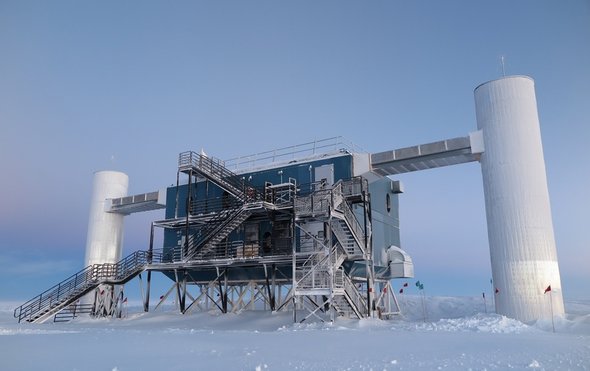
Enter the Ice Cube Experiment down in Antarctica. This experiment uses a cubic kilometer of the ice on that frozen continent as a detector for UHECR collisions. (That’s a block of ice one-kilometer long by one-kilometer wide by one-kilometer deep) The image below shows the experiments control facility sitting on the Antarctic ice.

The Ice Cube Experiment’s above ground (ice) Control Center (Credit: Scientific American)

The Ice Cube Experiment was constructed by drilling eighty-six, one-and a half kilometer deep holes into the ice and inserting long strings of ultra sensitive light detectors (Called Digital Optical Modules or DOMs) into the holes. (There are 5,160 of these DOMs total) Deep within the ice the only light that will be possible for the DOMS to detect will be that which is given off by the UHECR as they collide with atoms in the ice. The image below shows the overall layout of the Ice Cube Detector.

The Layout of the Ice Cube Experiment (Credit: Ice Cube Collaboration)

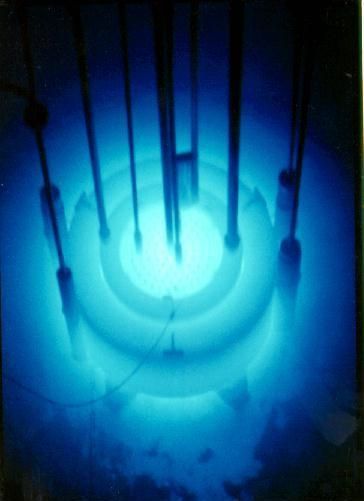
The light given off by these fast moving particles is called Cherenkov radiation, which is best known as that eerie greenish-blue glow around a nuclear reactor. Just what Cherenkov radiation is requires a little bit of explanation.

Cherenkov radiation coming from a Nuclear Pile (Credit: Reed Z)

We all know that nothing can travel faster than the speed in a vacuum. However the speed of light in transparent materials, like air or water or glass or ice is lower than the speed of light in a vacuum. So what happens when a sub-atomic particle like a proton is traveling through ice faster than the speed of light in ice? Well, what happens is the particle emits energy in the form of Cherenkov radiation until its velocity is below the speed of light in ice and it is this Cherenkov radiation that the DOMs of Ice Cube detect. The image below shows one of the DOMs.

One of Ice Cube’s Digital Optical Modules (DOMs) (Credit: The Ice Cube Collaboration)

The primary type of elementary particle that Ice Cube is designed to study are neutrinos and yes I know I talk about neutrinos all of the time (See posts of 30 July 2017, 2 December 2017 and 6 June 2018). Over the last twenty years however we have learned so much about our Universe by studying neutrinos and we have the possibility of learning more about Supernova, Gamma Ray Bursts, Blazars and even the Big Bang itself by studying the high-energy neutrinos given off by those events.

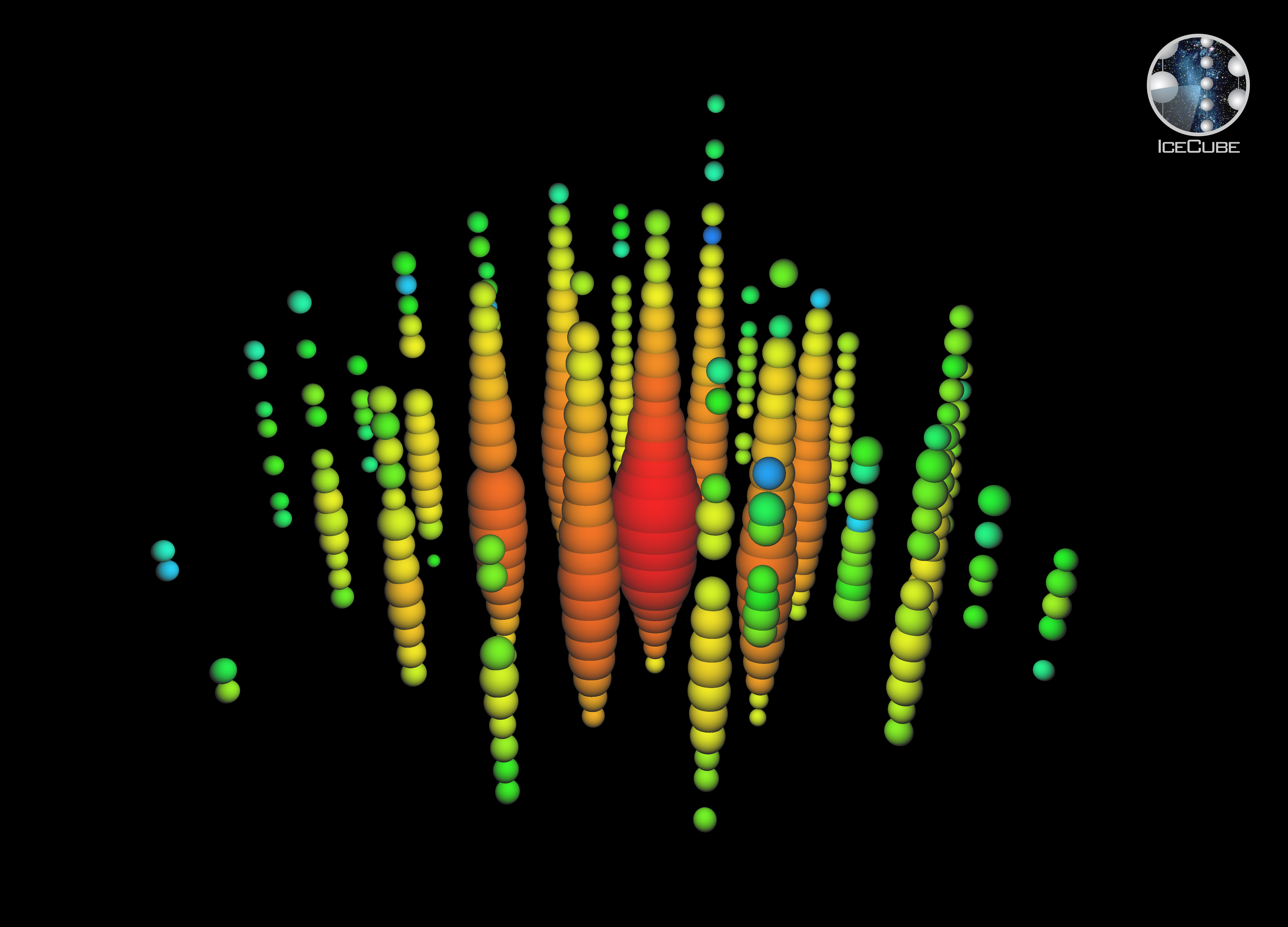
In fact according to two recent papers from the teams of scientists running Ice Cube a neutrino event that was detected by Ice Cube on 22 September of 2017 has been traced back to it original source, a Blazar designated as TXS 0506+056. Objects like Blazars have been observed in the past with optical and radio telescope along with X-ray and gamma ray telescopes and now the Ice Cube Detector as well. The image below shows graphically what a detection by Ice Cube looks like.

The Highest Energy Event yet measured by the Ice Cube Experiment (Credit: The Ice Cube Collaboration)

As you might guess there are already plans to expand Ice Cube. Called Ice Cube Gen-2 the design calls for a detector that could be as large as four kilometers in diameter. Such a large detector could record hundreds of events every day that are millions of times as powerful as those produced at CERN. Ice Cube Gen-2 will benefit from the knowledge gained in the construction of the current Ice Cube in an effort to reduce cost.

It’s as simple as this, the more different ways we look at the Universe the more we learn about the Universe. The Ice Cube experiment in Antarctica is a new way of looking and I think that we’re going to learn a lot. If you’d like to learn more about the Ice Cube Experiment click on the link below to be taken to the experiment’s website.

http://icecube.wisc.edu/

Space News for October 2018

The big news story this month has to be the launch failure of a manned Soyuz spacecraft on its way to the International Space Station (ISS). The launch took place from the Baikonur Cosmodrome on the 11th of October at about 0847 GMT but it was only a few minutes into the mission that the failure occurred. The image below shows the Russian Soyuz vehicle taking off before the trouble began.

Launch of the failed Soyuz Mission to the ISS (Credit: The Verge)

Thankfully the two-man crew, one Russian and one American, were able to escape from the failed rocket booster rocket and have been safely rescued. The bad news is until a thorough investigation of what went wrong is conducted the entire human race is without a means of putting anyone into outer space. The men on the ISS can return, they have their return Soyuz capsules already up there, but no replacements can go up to take their place.

At the moment there are few details as to the precise nature of the failure. So far it appears that the launch rocket’s second stage failed to separate from the first stage but it could be months before we learn exactly what happened. Ironically an astronaut already on the ISS was filming the launch from orbit and may have in fact have photographed the failure as it occurred. The image below is from that filming.

Soyuz Failure as seen from the ISS (Credit: BGR.com)

Both NASA and Roscosmos, the Russian space agency have already begun investigations but there is no way of telling how long they may take. Until both space agencies are convinced that they have found and fixed the problem the Soyuz is grounded, there will be no more manned space launches.

This disaster has been a possibility ever since NASA ended the Space Shuttle program seven years ago. In all of that time the US has been completely dependent on the Russians to take our astronauts back and forth to the ISS, at about $60 million dollars a ticket! Having only a single space system capable of manning the ISS, a single point of failure, is always a risky way to operate.

The immediate effect of the Soyuz failure on mission of the ISS is that two crewmembers will not be able to undertake their scheduled mission of staffing and maintaining the ISS, although NASA director James Brindenstine has announced that he still expects a December Soyuz launch to go forward. As to the long-term effect, I guess we’ll just have to wait and see.


Is there any other solution? Is there nothing we can do except wait for the Soyuz to be recertified for manned missions. Well an announcement by NASA just a few days before the Soyuz failure may point to the way forward.

For the past several years NASA has been funding Space X and Boeing in their development of manned capsules under the Commercial Crew Program (See my post of August 4th 2018 for the announcement of the planned first crews). Well NASA has just announced a tentative timetable for the first manned launches to take place from American soil since 2011.

Space X will conduct an unmanned test mission of their Dragon capsule in January of 2019 and if all goes well that will be followed by a manned mission to the ISS in June 2019. Boeing meanwhile will conduct its unmanned test launch of its Starliner capsule in March with a manned mission to the ISS in August.

Now before you say, that’s great, at most we won’t be able to send astronauts to the ISS for eight or nine months and after that we won’t even have to pay the Russians for a ride; that schedule is assuming everything goes according to plan. Also, the first missions to the ISS were intended to be for a one week stay only. Will NASA be prepared to risk a longer mission to the ISS with unproven spacecraft? That’s a very good question and I’ll wager that the engineers working on the commercial crew program, NASA, Space X and Boeing are very busy right now considering that option. The images below show Space X’s Dragon and Boeing’s Starliner capsules.

Boeings Starliner and Space X’s crewed Dragon Capsules (Credit: Space News)

Anyway you look at it the next the next year in manned spaceflight is going to be very eventful.

In the long term however there has also be some interesting news that may show us a glimpse of the future of manned space exploration. This week Lockheed Martin released its preliminary design for a reusable Moon lander that would take four astronauts from Lunar orbit to the surface and back to Lunar orbit after a week’s stay. The lander, see image below, would then be refueled in orbit for subsequent missions.

Lockheed Martin’s Preliminary Design for a reusable Moon Lander (Credit: Space News)


This idea of a reusable lander would be an extension of NASA plan for a space station in Lunar orbit known as the Lunar Gateway (See post of March 24th 2018 for more details).  In other words we’re taking about systems that won’t be ready for ten years at the very least so all of this is very preliminary!

It does seem as if, after several decades of going nowhere, the various space programs around the world are starting to find their way forward in the manned exploration of space.

Nobel Prizes for 2018, Medicine, Physics, Chemistry.

The first week of October is always an exciting time in the scientific community; it’s when the Nobel Prizes are announced. The order of announcement changes ever year and this year it went Medicine, then Physics and finally Chemistry so I’ll follow that order as well.

The two winners of the 2018 Nobel Prize in Medicine and Physiology are Doctors James P. Allison of the University of Texas M. D. Anderson Cancer Center and Tasuku Honjo of Kyoto University. The research conducted by the two scientists consisted in both understanding why our immune systems refuse to attack the cancer cells that are destroying our bodies along with discovering the first drugs that enable our immune systems to fight cancer.

2018 Nobel Prize Winners in Medicine. Tasuku Honjo (l) and James Allison (r) (credit: The Daily Star)

This has always been the biggest difficulty in fighting cancer, because cancer cells are actually our own cells gone berserk the white blood cells in our immune system won’t fight them. For decades scientists have searched for some way to alert those white blood to attack the cancer cells.

Drs. Allison and Honjo worked by studying the chemical ‘checkpoints’ that white blood cells use to recognize ‘friendly’ cells. Dr. Allison succeeded in identifying one such checkpoint that he called CTLA-4 while the checkpoint Dr. Honjo discovered he named PD-1. Once these two checkpoints were understood it became possible to develop drugs that inhibited their function. Without the correct recognition signal the white blood cells now attacked the cancer cells.

This new technique is not without its problems. For one thing it is expensive, the chemical checkpoints differ for every person. For another the drug sometime simply fail to work and rarely they can even cause the patients immune system to begin attacking healthy cells. Nevertheless, checkpoint inhibitors as the drugs are known, have brought miraculous recoveries in patients whose cancer had been deemed untreatable by other techniques. The work of Drs. Allison and Honjo has brought us a powerful new weapon into our fight against cancer.


The three winners for the 2018 Nobel Prize in Physics are all pioneers in the use of Lasers in both biology and medicine. Doctor Arthur Askin of Bell Laboratories received his share of the prize for his development of lasers as ‘Optical Tweezers’. You see the particles of light do have momentum and a beam of light can direct ‘radiation pressure’ on an object it strikes. This allowed Dr. Askin to employ the intense light of lasers to actually to hold and even manipulate tiny objects such as individual cells and even down to single atoms.

2018 Nobel Prize winners in Physics, Donna Strickland (l), Gerard Mourou (c), and Arthur Askin (r) (Credit: The India Express)

The two other scientists sharing the physics prize are Doctor Donna Strickland of the University of Waterloo and Gerard Mourou for their work in high intensity, short pulse duration lasers. The work of Drs. Strickland and Mourou has had extensive applications in industry and medicine and is perhaps best known for it use in Lasik eye surgery.

This years physics Nobel also garnered some attention because Dr. Strickland became the first woman in fifty-five years to receive the award, and only the third woman ever. The only comment I’ll make on that aspect of the award is that I hope the day soon comes when the sex or ethnicity of a Nobel Prize winner is a matter of no importance whatsoever.


Finally we have the 2018 recipients of the Nobel Prize for Chemistry who are Francis H. Arnold of the California Institute of Technology along with George P. Smith of the University of Missouri and Sir Gregory P. Winter of the MRC Laboratory of Molecular Biology at Cambridge, UK. All of these scientists have worked in the field of organic chemistry with some of the most complex chemicals known to science.

Chemistry Nobel Laureates for 2018. Gregory P. Winter (l), Francis H. Arnold (c), and George P. Smith (Credit: NPR)

Doctor Arnold’s research has concentrated on “the directed evolution of enzymes” those organic catalysts that perform so many important functions in living creatures. Meanwhile Dr. Smith developed a technology known as ‘phage display’, using a virus that infects bacteria to develop new forms of proteins while Dr. Winter used phage display to direct the evolution of antibodies, thereby producing new pharmaceutical drugs. Many drugs are now being developed by this technique including some that neutralize toxins, combat rheumatoid arthritis, psoriasis and other autoimmune diseases.

The yearly choice of those scientists who receive the Nobel Prize is often the only time that the important work being carried out by scientists receives any publicity in the news media. Perhaps, given the acrimonious, contentious and partisan nature of so much of our news these days it might do us good if our nightly news programs spent a little more time on stories about the advances of science being made everyday. Stories like those about this year’s Nobel Prize recipients.


Have you ever seen the Spacestation with your own eyes as it orbits around the Earth; it’s actually really easy.

I know that I’ve probably mentioned the International Space Station (ISS) a hundred times in the posts of this blog. I also know that I’ve shown at least a score of pictures of the ISS, and of course you can easily find a thousand images of the ISS on the web. The image below is of the ISS.

The International Space Station as seen from Space (Credit: NASA)

But have you ever seen the Space Station itself, with your own eyes as it streaks across your sky shortly after sunset or shortly before dawn. Well with a little help from NASA it’s really pretty easy. I know because I’ve seen it myself close to fifty times by now.

Now the orbit of the ISS is inclined to the Earth’s equator at an angle of 51.56º so sooner or later it will pass over every point on Earth between latitudes 51.56ºN   and 51.56ºS. That means that the ISS regularly flies right over the head nearly 80% of the human race.

But you can’t see it during the daytime, the brightness of the Sun will simply drown it out. And you can’t see it in the middle of the night either because it will be in the Earth’s shadow and therefore not illuminated. You have to catch it during the short periods of time when you on the Earth’s surface are in darkness but 400 kilometers above you the station is still in the sunshine.

But don’t worry, NASA’s already done all of the work for you, and the right conditions happen fairly frequently. Before you go to NASA’s site however let me give you a few hints about seeing the station. First of all you’re going to need a clear sky, I hope that doesn’t surprise anyone. You’re also going to need to know the directions of the compass at your viewing place, that is you’ll need to know what direction is North, South, East and West. Another important thing to keep in mind is to try to get away from trees and buildings. You want to be able to see as much of the sky as you can!

Click on the link provided below to be taken to the space agency’s “Spot the Station” website.

https://spotthestation.nasa.gov/

Now when you get to the “Spot the Station” site at the top of the page in the middle you’ll see Spotting Opportunities”, click on that to be taken to another page with a map of the world. Successively clicking on your location will eventually get you to the calculated position closest to your home. For me that is Independence Hall in Philadelphia, see image below.

Information on Spotting the Space Station (Credit: NASA)

Looking at the table in the lower right of the image you can see that there are five columns. The first column is labeled Date, giving the date and time that the ISS will become visible where you are. You can see that for Philadelphia there are quite a few opportunities.

The second column is Visible, which tells you for how long the ISS will be visible.

The third column is Max Height: this tells you the maximum elevation, in degrees that the ISS will attain during that sighting. Now the horizon itself is 0º and 90º is straight up. Obviously the larger the Max Height the easier the ISS will be to spot but I have seen on occasion when it when it got no higher than 15º.

The fourth column is labeled Appears. This tells you both the compass heading and the height in degrees above the horizon of the point where the station will appear. As a good rule of thumb, your fist held at arms length is about 10º so if the station is going to appear 20º above the west lets say, that’s two fists above the horizon in the western sky.

The fifth and final column is Disappears, this is identical to Appears except that this is where the ISS will vanish

So what does the ISS look like as it passes overhead? Well to me it looks like a very bright, silvery star that moves quite fast across the sky. The glow of the ISS is steady, there’s no blinking lights as with an airplane.

If you have binoculars, and a steady hand, the ISS will become a definable object, small but no longer just a point. There are even amateur astronomers who have succeeded in photographing the ISS from the ground. I’ll leave you today with one such image of the station silhouetted against the Sun, and if you look close you can see that the space shuttle is docked there. Good luck in trying to catch the International Space Station.

ISS and Space Shuttle seen against the Sun (Credit: Wired)

Mathematician Sir Michael Atiyah claims that he has proven the Riemann hypothesis concerning the distribution of Prime Numbers.

Sir Michael Atiyah is considered to be one of the World’s leading mathematicians; he has already received two of the highest awards in the field, the Fields Medal and the Abel Prize. And the Riemann hypothesis, that an equation known as the Riemann zeta function can produce all of the Prime Numbers, has been called math’s most important unsolved problem. So when a top mathematician announces that he has solved the biggest problem its major news. The image below is Sir Michael.

Sir Michael Atiyah (Credit: Scientific American)

But that’s just what happened on the 24th of September on a stage at the Heidelberg Laureate Forum. At that forum Sir Michael presented what he himself described as a “radically new approach.” Dr. Atiyah’s proof will still have to be reviewed by other mathematicians before it will be accepted but the very possibility of that this problem could be solved has riveted the math world.

Now I don’t pretend to completely understand Sir Michael’s proof, yet. I just downloaded a copy and am working my way through it, remember I’m a physicist not a mathematician specializing in number theory. However I hope that I can explain something about prime numbers and why the Riemann hypothesis is so important.

We’ve all heard of prime numbers, those numbers that are divisible only by the number one 1 themselves. For example, while the number 6 can be written as 2×3, the number 7 can only be written as 1×7, 7 is a prime number. The prime numbers below 100 are given below. (one is traditionally not considered prime).

2, 3, 5, 7, 11, 13, 17, 19, 23, 29, 31, 37, 41, 43, 47, 53, 59, 61, 67, 71, 73, 79, 83, 89 and 97.

Now take notice first of all that the number 2 is the only even prime number. That’s because all of the other even numbers can be divided by 2. You can also see how the distance between successive prime numbers is getting bigger, primes spread out as the numbers get bigger.

We’re not certain whether it was the Egyptians or Mesopotamians who first noticed that primes were different from other numbers but we do know that it was the Greeks, either Pythagoras or one of his students, who proved that there were an infinite number of primes. The proof is simple, and only takes three lines so what do you say. Shall we give it a try?

We will start by assuming that there is only a finite number of primes, let’s say p1, p2, p3, through  pn, that is we have n prime numbers total. Now we will demonstrate that that assumption is false. First we multiply all n of the prime numbers and add 1 to get, I’ll call it X.

X= (p1 x p2 x p3 x  …x pn) +1

Now, if we divide X by any of the primes, let’s say pi there will always be a remainder of the 1/pi. This means that either X must itself be prime, or evenly divided by some other prime not in our set of primes. In either case our assumption that we had all of the primes must be wrong, there are an infinite number of prime numbers.

O’k so how do we find those numbers that are prime? Is there some equation that will generate all of the primes for us?

Well, mathematicians searched for just such an equation for a very long time. Several partial equations, that is formulas that worked for a while, generating some primes were developed. One of the greatest mathematicians of all time, Bernhard Riemann worked for many years on prime number theory, his equation is known as the Riemann Zeta function. By the way Bernhard Riemann also developed the equations of geometry that Einstein used for his theory of gravity. The image below is Bernhard Riemann and beneath him is his Zeta function.

Bernhard Riemann (Credit: Famous Mathematicians)
The Riemann Zeta Function (credit: Public Domain)

Riemann published his zeta function back in 1859 and in the years since then it has been checked, and confirmed, for the first 10,000,000,000,000 (that’s ten trillion!) primes but that doesn’t mean that it will work for all primes. Remember there are an infinite number of primes so ten trillion is actually not very many!

Sir Michael Atiyah claims to have proven that the zeta function works for all primes and if he’s right that will be a tremendous achievement. Other mathematicians now get to try to pull the proof apart. We’ll see what happens.


Some Stories from the Animal Kingdom.

Over the last week or so there have been a number of small but nevertheless interesting stories concerning a wide assortment of different animals. Since none of them were extensive enough to warrant a post of their own I’ve decided to collect several of them into the same post.

Let’s start close to home, for me at least. For many years a species of Green Crab (Carcinus maemas) native to Europe has been causing a lot of destruction along the coasts off New England. The green crabs consume both juvenile clams and eelgrass, both of which are important for many of the seafoods that are collected in those waters. This is another example of an invasive species that hopped a ride on one of our ships and has now become a pest in the environment in which we accidentally placed it. The image below is a green crab.

European Green Crab Carcinus maenas (Credit: NRDC)

The story is now getting worse however, because a newer, larger and more aggressive variety of the green crab is moving south from the waters around Nova Scotia. Whereas the green crabs New Englanders had become familiar with are shy and try to hide from large creatures such as humans the Canadian crabs are so belligerent that researchers who try to collect specimens find themselves being attacked by the crabs. “Any time I went to grab one they went to get me instead,” said Louis Logan, a University of New England graduate student taking part in the research. In the labouratory a comparison of the destructive abilities of the two varieties clearly showed that the more aggressive species caused far more damage.

Since the green crabs originally came from Europe I guess it’s only fair that our next story should come from Europe. The small town of Aitoliko is sometimes known as the ‘Venice of Greece’ because of it’s many picturesque canals but over the past week Aitoliko has become famous for something much ickier. A vast carpet of spider webs is now covering Aitoliko, every tree and many of the buildings are completely enclosed within a layer of spider silk, see images below.

Spider Web in Aitoliko Greece (Credit: The Japan Times)
More Spider Webs (Credit: USA Today)

Now to produce such a monstrously huge blanket of webbing you’d think you would have to have a monstrously large spider but you’d be wrong, spiders of the Tetragnatha genus have a leg span usually less than two centimeters but can produce sheet-like coverings than serve as homes to thousands of individual spiders.

Spiders of this genus are known to often produce web systems similar to those now seen in Aitoliko although rarely are they this extensive. There’s no mystery, no mad doctor behind the enormous population surge in spiders however. The temperature this summer in Aitoliko has been just perfect for the breeding of the spider’s chief source of food, gnats. So with a lot of gnats breeding a lot more gnats you get a lot more spiders and a small Greek town covered in spider webs.

“It’s a simple prey-predator phenomenon,” according to Fotis Pergantis a Greek biologist. “…Once the temperatures begin to drop the gnat populations will die out, the spider population will decrease as well.”


Another story this week concerns another type of arthropod predator. The Praying Mantis is arguably the fiercest, most voracious killer for its size of any animal on Earth. The stick-like insect will literally devour anything it can grab, in fact female praying mantis are legendary for eating their mates during the act of mating. See image below.

A Female Praying Mantis eating her Mate (Credit: Australian Geographic)

Now, for the first time the praying mantis has been observed in the act of fishing. That’s right, if a small enough fish comes close enough to a praying mantis it’s dinner.

The observation was made in India, home to the giant Asian mantis, Hierodula tenuidentata, at a small artificial rooftop pool. The pool is stocked with the common freshwater fish the guppy and for five nights in March of 2017 the pool was visited by a male giant Asian mantis.

The mantis was observed to perch on one of the water lilies that grew in the pool and wait, a typical hunting strategy of mantises. Over the course of the five nights the mantis was seen to catch and eat nine of the guppies. See image below.

Fishing Praying Mantis (Credit: National Geographic)

As I said earlier, the praying mantis has a reputation of simply being one of the best hunters you will ever find. Now for the first time we know that they’re not too bad at fishing either.


Which brings me to my last story, which actually is about a robotic sea creature. You may recall my post of the 8th of September where I discussed several aquatic hunting robots that were being developed to help eradicate invasive species in the waters of Florida and The Great Barrier Reef, well this story is about another robotic sea creature, although a gentler one.

Engineers at Florida Atlantic University and the US Office for Naval Research have been working on the design and development of a robot jellyfish which is intended to serve as an instrument to monitor and study ocean environments such as coral reefs. The robot, see image below, is based upon the anatomy of the larval stage of the moon jellyfish (Aurelia aurita) and the first prototypes were made by 3-D printing.

Robot Jellyfish Swimming (credit: Jennifer Frame et al)

The development team hopes to soon incorporate a variety of sensors onto their robot jellyfish soon along with the ability to navigate through complex ocean terrain.

O’k so maybe a robot jellyfish isn’t an actual animal but it certainly is an example of how the lessons learned from the animal world are being incorporated into our robots even as we learn more and more about the many different ways animals have evolved in order to live in this world.

Psychologist Walter Mischel, originator of the famous, or infamous Marshmallow test, dies at the age of 88.

Doctor Walter Mischel, a leading researcher in the fields of personality theory and social psychology died on the 12th of September 2018 in New York City, aged 88. At the time of his death Dr. Mischel was Professor Emeritus of Psychology at Columbia University but it was at Stanford University back in the 1960s and 70s that Dr. Mischel conducted his most well known experiments, the Marshmallow test. The image below is of Walter Mischel.

Walter Mischel (Credit: AZ Quotes)

The Marshmallow test is simple enough on the surface. The test subjects were children who all attended Stanford’s Bing Nursery School, ages 4 to 6. The children were placed in a room with only a table and chair (child sized) where an adult tester gave each child a treat, a marshmallow or a cookie. The tester told the children that if they didn’t eat the treat until the tester returned they would be given a second treat. The tester then leaves the room, usually for fifteen minutes and the child was filmed during the entire test.

The test is a study of the psychology of delayed gratification, whether or not the test subject has the patience to wait for a greater reward. Dr. Mischel’s original intent was to discover at what age between 4 and 6 this patience developed but over the course of time the test unveiled a great many other secrets as well.

The Marshmallow Test (Credit: Performance Coach University)

As you might guess, the majority of the children simply eat their treat the moment the adult leaves the room. The most interesting initial discovery however was that those children who succeeded in waiting generally did so by distracting themselves, even if it was no more than just turning their chair around so that they couldn’t see the treat. Of the 600 children who took part in the original set of tests, just over a third waited and received their promised second treat.

In 1988 and 1990 Dr. Mischel conducted a follow up study of the children who had taken part in the test and were now teenagers preparing for college. What Dr. Mischel found was that those who had as children waited and gotten the second treat had statistically preformed much better in school, even had significantly higher scores on the Scholastic Aptitude Test (SAP) needed for admission to college. It was found that even the children’s parents considered them to be more mature, more reliable. The same psychological traits that had enabled them to succeed at the marshmallow test were now allowing them to succeed in later life.

Marshmallow Follow Up (Credit: Slideshow)

This is not to say that the results of the marshmallow test can be used to predict future success. Even Dr. Mischel strongly cautioned against any such assumptions, “The idea that your child is doomed if she chooses not to wait for her marshmallows is really a serious misinterpretation,” he said in an interview. In fact later studies would show that social and economic status were critical factors in determining whether or not a child would wait for the second treat.

Before I go it’s important to note in our current political climate that Doctor Walter Mischel was an Austrian Jew whose family fled the Nazi occupation of Austria in 1938 and who entered the United States as a political refugee. Arriving in the United States at the age of eight with basically nothing Walter Mischel managed to get his Ph.D. from Ohio State University and taught at the University of Colorado and Harvard along with Stanford and Columbia. Another example of how the United States profited from someone that another country didn’t want because of blind racist hatred.

However Science can only take us so Far! (Army HEALTH)