Archaeological news for November 2022: We owe so much to the Bronze Age Minoan and Mycenaean civilizations of ancient Greece but much of who they were and where they came from are still a mystery.

Here in America our founding fathers were both admirers and students of the Iron Age Greek civilization that was considered by some in the 18th century to be the founding fathers of the European civilization of their day. Many of the ideals of classical Greece, like personal liberty, democracy and a liberal as opposed to religious education became part of American culture because our founding fathers respected the ancient Greeks so much.

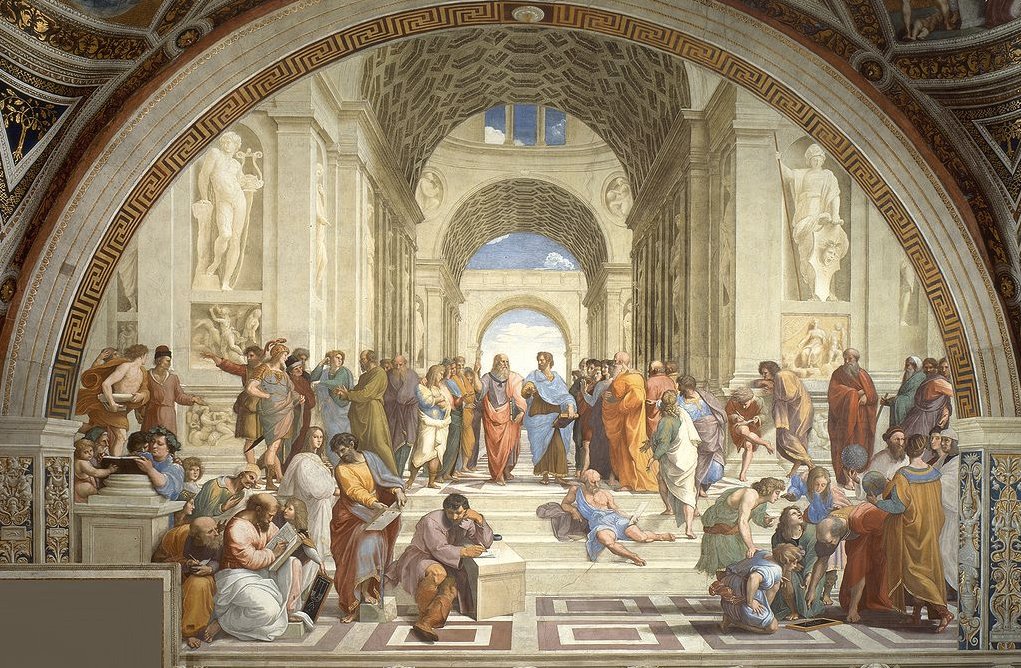
The western ideal of ancient Greece. A bunch of guys talking to each other. By the way all those arches were actually invented by the Romans, Greek architecture didn’t use arches! (Credit: Khan Academy)

So then who did the Iron Age Greeks regard as their founding fathers? Who did Socrates, Pericles, Herodotus and Euripides admire and look back to for inspiration? Well, that would be the still more ancient Bronze Age cultures that archaeologists have named Mycenaean on the Greek mainland and the earlier Minoan on the Island of Crete. These two peoples built the first civilizations in Europe and therefore are therefore the founding fathers of so much of human history.
The lands of Bronze Age Greece. The Minoans were centered on Crete and the islands of the Aegean while the Mycenaeans lived on the Greek mainland. (Credit: AllatRa Canada)

For thousands of years most of what we knew about these Bronze Age peoples came from the myths and stories told by the Iron Age Greeks like Homer and later authors. Starting from the late 19th century however archaeologists have learned a great deal about the Minoans and Mycenaeans, sometimes confirming, sometimes contradicting the ancient tales.

Theseus slaying the Minotaur as shown on a jar from the classical Greece period. This is the best known story concerning the Minoan civilization. (Credit: Quatr.us)

Let’s get one thing straight from the start. The Mycenaeans and Minoans did not call themselves by those names. Those terms are strictly archaeological labels for a large number of excavated sites that have been dated to the time of Bronze Age in Greece and Crete. Even Homer didn’t call the heroes of his epics Mycenaeans or Minoans, he called them Achaeans to differentiate them from his own people the Dorians. Recent analysis of the diplomatic archives of the Hittites and Egyptians have indicated that the Mycenaean people may have called themselves something like the Ahhiywans, similar to Homer’s Achaeans, but we have no idea what the ancient Minoans may have called themselves.

According to Homer the warriors who attacked Troy called themselves ‘Achaeans’ and Homer did not considered them to be the same race as his people. (Credit: Reddit)

Whatever they called themselves Homer considered the Mycenaeans to be a completely different people and culture from his own Doric people. And judging by the myths the Mycenaeans considered themselves to be different from the Minoans.

The palace of Knossos as it would have been during the height of the Minoan civilization. (Credit: Hercynian Forrest)

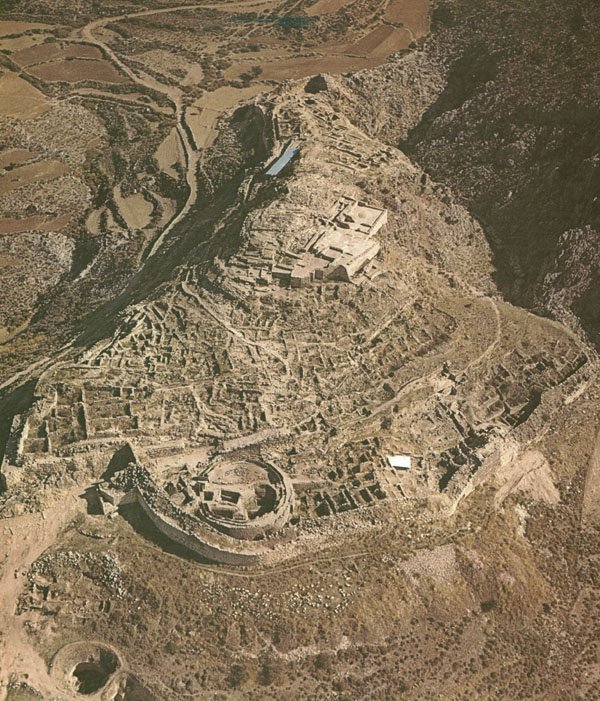
The name Mycenaean comes from the ruins of Mycenae, the largest and wealthiest of the Bronze Age palatial centers that have been excavated in mainland Greece. According to myth Mycenae was the palace of Agamemnon, the leader of the Greeks during the Trojan War. The Minoans, on the other hand were named for King Minos the most powerful king of Crete in the ancient myths.

The citadel of Mycenae as seen from the air as it exists today. Obviously the Bronze Age people were very concerned with defense. (Credit: Mycenae Archeology Department)

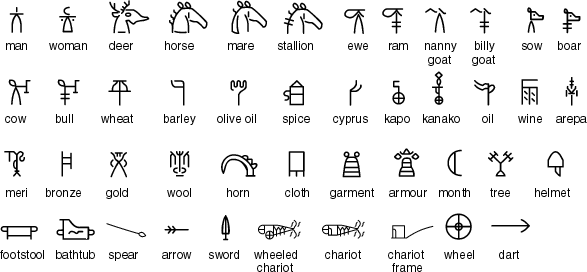
Both the Minoans and Mycenaeans possessed a form of written language that have been given the names Linear A, for the Minoans, and Linear B for the Mycenaeans. A major advance in understanding these Bronze Age cultures came in the 1950s when Micheal Vintris succeeded in deciphering the Linear B of the Mycenaeans and it was discovered that their language was Greek, not too different from the Greek of Homer. Linear A however has resisted all attempts at translation and we have only guesses as to what kind of language the ancient people of Crete spoke.

Linear B is known to have used symbols to both represent syllables the way our modern letters do…
…and also ideas the way Egyptian hieroglyphs do. (Credit: Mathweb.ucsd.edu)

Now archaeologists and historians have a new tool with which to try to understand who the Minoans and Mycenaeans were, where they came from and what relations they have to the people of modern Greece, DNA analysis. A study has just been published in the Journal Nature that details the genetic makeup of nineteen individuals whose remains were unearthed from Bronze Age sites across mainland Greece and Crete. The study also compared that ancient DNA to that of 334 living people from around the world including 30 individuals from modern Greece.

As ancient people migrated around the world their DNA went with them. By studying the DNA of people around the world today scientists can learn something about those prehistoric migrations. (Credit: Wikipedia)

What the researchers found was continuity; some 60-80 percent of the Bronze Age DNA was shared with the modern Greeks. What’s more, when the ancient DNA was compared to DNA samples from sites dated to the Neolithic period, some 7000 BCE, they again found a great deal of overlap. So it seems that Homer was incorrect when he asserted that the Achaeans were a completely different people than his own Dorians.

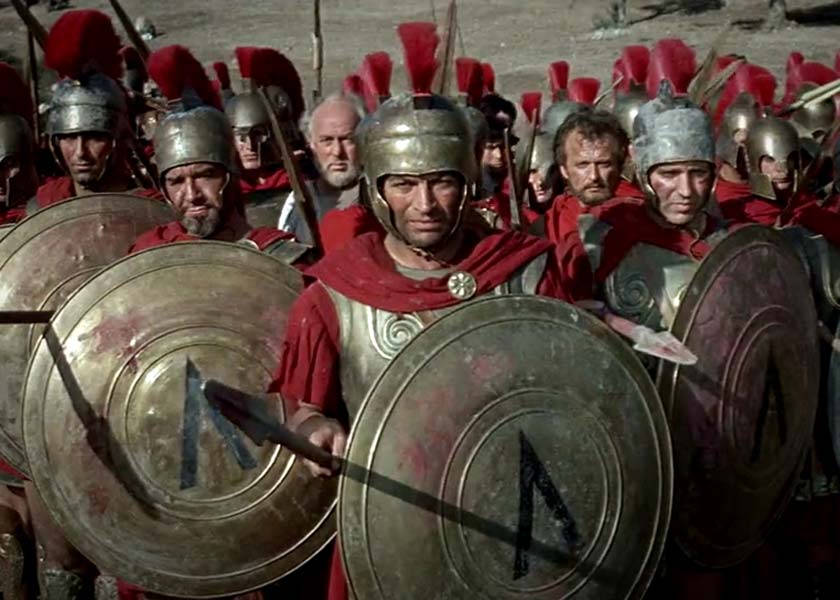
The Spartan King Leonidas, leader of the 300 Spartans and played by Richard Egan in the center, claimed to be descended from Heracles. He may have been right. Modern studies show that a lot of Mycenaean DNA lived on to the Dorian people of classical Greece and still lives on today. (Credit: Obscure Hollywood)

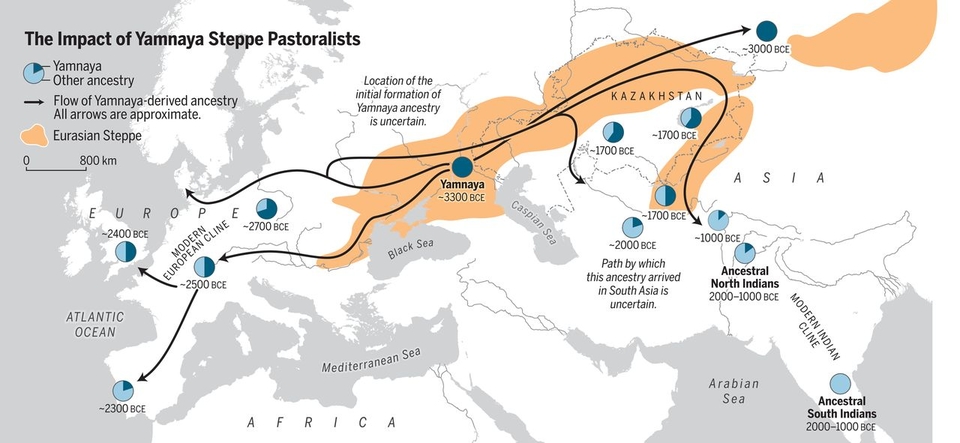
So genetically the people of Greece today pretty much come from people who lived in that part of the world nearly 10,000 years ago! Oh, the study did show some foreign influence; about 10% of the Minoan and Mycenaean DNA appears to have come from the region around modern Iran. Also the Myceaeans, but not the Minoans had genetic similarities to people from the steppes of Eastern Europe and central Asia, the land of the people who the classical Greeks would call the Scythians.

During the Classical Greek period the steppes of southern Russia and Ukraine belonged to the nomadic Scythians who the Greeks considered the prototype of a barbarian. (Credit: Wikipedia)

Still, for the most part, the Greeks have been Greek for longer than recorded history, a testament to the Greek spirit and the impact it has had on the Human spirit around the globe.

Climate Change: COP 27 ends with an historic agreement for richer nations to provide money to help poorer nations that are already suffering from climate disasters. On the other hand little progress was made in actually stopping the greenhouse gasses that are causing the climate problems.

Every year representatives from nearly 200 countries come together at a chosen location to discuss efforts toward fighting global warming and the harmful changes in our planet’s climate caused by it. The first such conference was held in 1995 and given the title COP 1.

The slogan for COP27, the international conference on Climate Change was a ‘New Era of Implementation’, but not much got implemented. (Credit: IFLR)

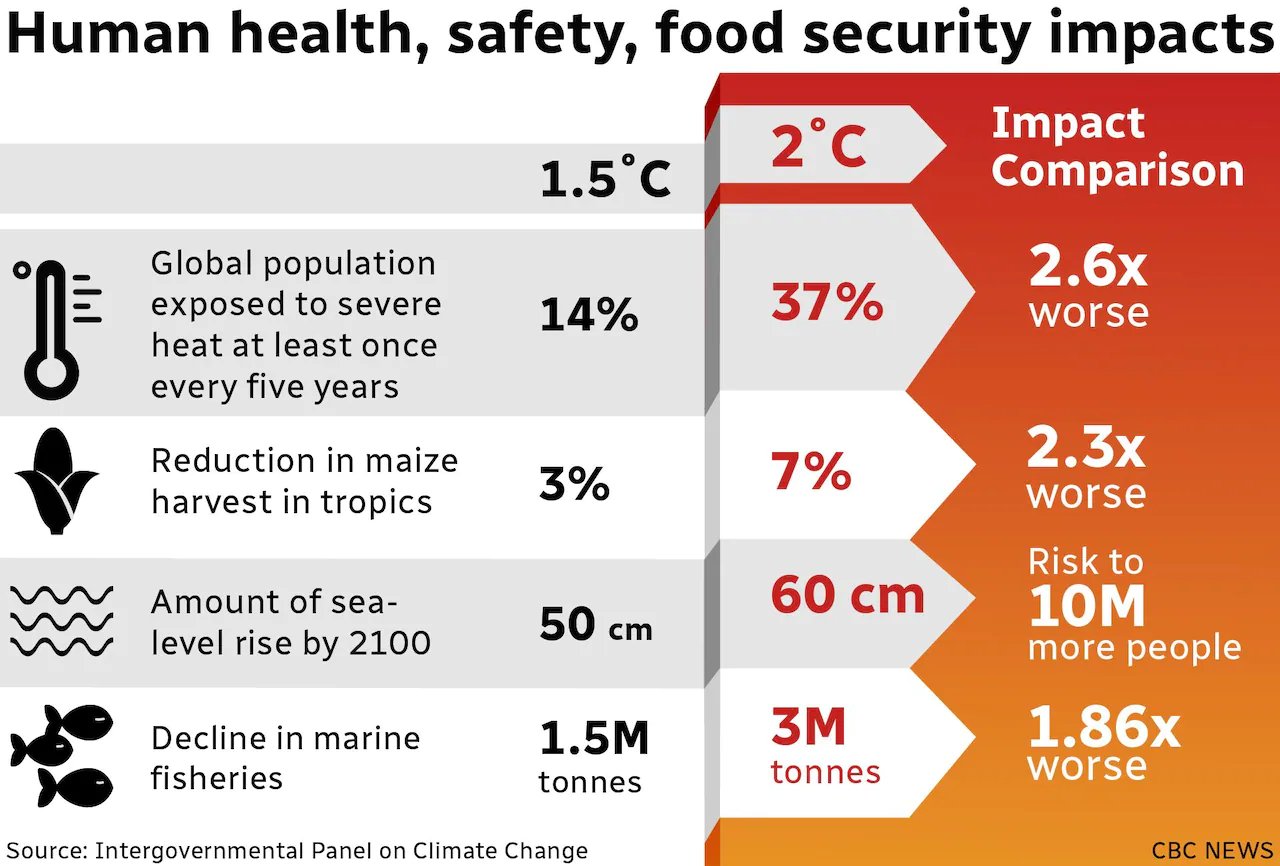
Each succeeding forum has added one to the number with COP 20 back in 2015 generating the famous ‘Paris Accord’ where a target figure of a rise in global temperature of no more than 1.5º C above pre-industrial levels was pledged by every nation in attendance. However no concrete plan to eliminate greenhouse gasses such as CO2 and Methane was agreed upon in Paris and every conference since then has basically failed to stop the ever increasing rise in fossil fuel emissions.

The difference in the damage done to our environment but 1.5 degree and 2 degree rise in temperature. We’re basically already at 1.5 degrees and doing little if anything to stop getting to 2 degrees. (Credit: CBC)

 Last year’s COP 26 in Scotland could not even reach an agreement on how or when to eliminate the use of coal, the worst emitter of CO2. Plans to issue a strong final statement on ‘Phasing Out’ coal were scuttled by India, the world’s forth largest emitter of CO2 but a nation still considered to be ‘developing’ and which in fact has plans to greatly increase its fossil fuel emissions. The wording that was finally agreed to was to ‘Phase Down’ coal use instead of ‘Phase Out’.

The use of coal to generate energy is the worst polluter but at COP26 in Scotland the nation of India refused to accept the wording of ‘Phase out’ the use of coal instead forcing the term “Phase Down’ on the conference. (Credit: The Wire Science)

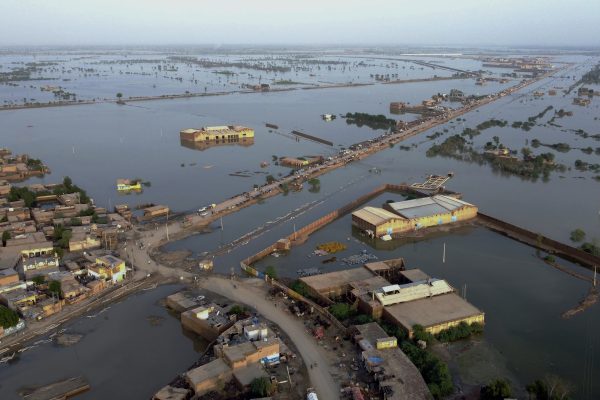
With so much contention making it impossible to develop any realistic plan to fight global warming it not surprising that the negotiators at COP 27, held in the Egyptian resort city of Sharm el-Sheikh on the Red Sea, spent more of their time tackling a different part of the climate problem. The negotiators concentrated their efforts on the question of how to help those of the poorer countries of the world who are already suffering from climate change. Over the last year the flooding in Pakistan and Niger coupled with severe droughts in east and south Africa have brought attention to the fact that many of the countries that produce the smallest amounts of greenhouse gasses are enduring some of the worst consequences of global warming.

It’s estimated that one third of the nation of Pakistan saw flooding this year, millions suffered and the chances of more of this happening just keeps growing. (Credit: The Diplomat)

For the past thirty years these poorer countries have been pushing the richer countries, who just happen to be the biggest polluters, to establish a reparations fund that will help pay the costs of disaster relief. And for the past thirty years the richer countries have resisted signing a blank cheque that could keep them paying into this fund for decades. Another complication was the status of China, which back in 1995 was still a small economy producing only a small amount of greenhouse gasses but which since then has become the world’s second biggest economy and the biggest emitter of both CO2 and methane. So should China contribute to this fund or should it, and this would be a real farce, actually benefit from such a fund?
China has swiftly become the world’s worst polluter (top), but it’s still considered to be a ‘Developing Country’. The harm the Chinese are doing to their own country is easily seen (bottom). (Credit: Financial Times / New York Times)

Right at the start of COP27 the European Union signaled that they were now ready to support the reparations proposal but the United States was still reluctant. When the US’s chief negotiator, former US Senator John Kerry tested positive for Covid-19 it appeared that the entire conference might end without any real progress.

Former Senator John Kerry is America’s special representative for climate change. He’s pushing hard but there’s only so much one man can do. (Credit: The American University in Cairo)

Only a willingness to extend the negotiations through the weekend allowed the conference to come to an agreement. The world now has an established fund, endowed by most of the world’s richer nations, to help poorer countries pay for the damage done to them by climate change. Before you start thinking that a tremendous achievement was made however bear in mind that the richer nations have yet to announce how they will contribute and for how long and the status of China has yet to be decided.

The poorer nations of the world, who have contributed little to the huge amounts of greenhouse gasses in our atmosphere are nevertheless suffering the most. They want those nations that profited from fossil fuels to pay for the damage. (Credit: WNYC)

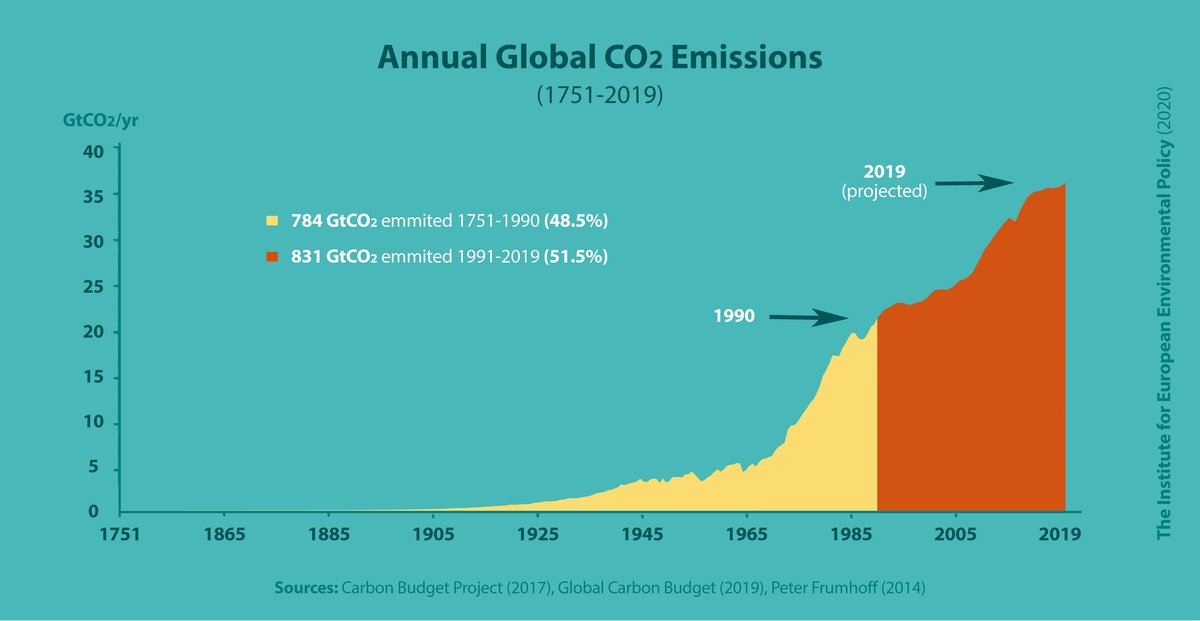
The worst part however is that by appearing to make progress on who will pay for the damage caused by climate change absolutely nothing was achieved toward reducing, let alone eliminating the use of fossil fuels for energy production. So the release of greenhouse gasses is going to continue, in fact increase, increasing both the severity and length of the whole problem.

They just keep rising. Greenhouse gasses are being released in ever growing quantities and we’re simply not doing enough to stop the trend. (Credit: Institute for European Environmental Policy)

The final report from COP27 did restate the goal of preventing global temperature rise from exceeding 1.5ºC over pre-industrial levels but it also restates that coal use is to be ‘phased down’ not ‘phased out’. The world still has no agreement on or plan for how to stop making the problem of climate change worse.

The whole world is in this position! (Credit: Shutterstock)

And while the politicians dither more greenhouse gasses are being dumped into the atmosphere every day causing the world’s temperature to continue to rise bringing with it ever more severe climate crisis.

Is Cosmology, the study of the entire Universe, reaching a crisis as ever more precise measurements continue to show small but significant deviations from our models?

Back when I was in college the standard model of Cosmology consisted of a Big Bang that happened between 10-15 billion years ago. That detonation led to an expansion of the matter in the Universe that could be seen in the red shift of light coming from distant galaxies, the rate of that expansion was given the name ‘Hubble’s Constant’.

No, not that ‘Big Bang’. (Credit: Rotten Tomatoes)
This ‘Big Bang’. The evidence for this basic model of how our Universe evolved is now overwhelming. However there are still some discrepancies in the details that could be clues to new Physics. (Credit: Wikipedia)

Even as the Universe as a whole expanded locally matter clumped together due to gravity to form the galaxies and stars we see today. The model also predicted that the force of gravity between the galaxies would slow down the rate of expansion so that today Hubble’s ‘Constant’ would be smaller than it was billions of years ago.

Carl Hubble’s graph from his original 1929 paper where he announced the expansion of the Universe. The general trend of greater velocity with greater distance is easy to see but determining the exact slope of the line is very difficult. We still are having problems with that. (Credit: Universe Today)

The big Question, back when I was in college, was whether or not the force of gravity was strong enough, was there enough matter in the universe to eventually bring the expansion of the Universe to a stop billions or even trillions of years from now. If that happened the Universe would begin to contract until there was a ‘Big Crunch’. Or if there wasn’t enough matter in the Universe then it would just expand forever with all of the stars dying out as they ran out of fuel. A cold, empty Universe that was paradoxically called ‘Heat Death’ because the entire Universe would be at thermal equilibrium so that no work could be done.

Will the expansion of the Universe someday come to a stop and reverse itself into a ‘Big Crunch’ or will the expansion go on forever, maybe even accelerate. That’s the big question right now. (Credit: Astronomy Magazine)

Oh, and then there was something wrong with the way the galaxies behaved, their dynamics. They acted as if they contained more matter than we could see, so astronomers called the problem ‘Dark Matter’. The astrophysicists had a few ideas what Dark Matter could be but really had no evidence to back up their hypothesizes.

Using Newton’s law of gravity and what matter we can see in other galaxies we can calculate what their rotation curves should be. Our measurements don’t match the calculations so something is wrong. ‘Dark Matter’ is the leading theory to explain the discrepancy but it also has problems. (Credit: Universe Today)

Things began to change in the late 1990s as two groups of astronomers led by Adam Riess and Saul Perlmutter tried to answer the question of whether the expansion of the Universe was slowing fast enough to come to a stop. What they found was that the expansion wasn’t slowing at all, it was accelerating.

Along with Brian Schmidt, Saul Perlmutter and Adam Riess recieved the 2011 Nobel Prize in Physics for their discovery of the acceleration of the Universe’s expansion. (Credit: Wired)

Riess and Perlmutter used observations of Type 1 supernovas to make their measurements, see my post of 18 January 2020. Type 1 supernova occur when a white dwarf star steals matter from a nearby companion star. Eventually the white dwarf steals too much matter and explodes as a Type 1. Since all Type 1 supernova happen at the same mass our theories predict that the supernova explosions should all have the same total amount of energy and can be used to measure the distances to other galaxies. That is, if all Type 1’s are the same absolute brightness then if one Type 1 supernova looks brighter it must be closer, if another looks dimmer it must be further away.  Whatever it was that was that was pushing the galaxies apart was given the name ‘Dark Energy’ in correspondence with Dark Matter although it is really more of a pressure than an energy.

Type 1 and Type 2 Supernova are very different animals. The interesting thing about Type 1’s are that they all release about the same amount of energy so they can be used as ‘Standard Candles’ to measure distance. (Credit: Lifeng.lamost.org)

Another, more technical problem also came out of the work of Riess and Perlmutter, the value for Hubble’s Constant that they measured over the last few billion years differed slightly from the value obtained by the astrophysicists who studied the Cosmic Microwave Background (CMB), the leftover radiation from the era of the Big Bang itself.

The Cosmic Microwave Background as measured by the Planck satellite. This is our Universe’s baby picture and as such it tells us a lot about what our ‘adult’ Universe should look like. (Credit: European Space Agency)

Now a group of astronomers led by two former students of Riess, Dillion Brout of Harvard’s Center for Astrophysics along with Dan Scolnic of the Department of Physics at Duke University have published a greatly expanded data set of over 1500 Type 1 supernova observations, ten times as many as Riess and Perlmutter gathered. This study has been given the name Pantheon+ and has produced a value for Hubble’s constant over the last 10 billion years of 73.4 kilometers per second per megaparsec with an uncertainly of only 1.3%. This value is significantly larger than the value obtained from the CMB for the early Universe 13 billion years ago.

Compare this graph of the Pantheon+ supernovas with Hubble’s graph above. We’ve learned a lot in the last 90 years but there are still details to be worked out. (Credit: ResearchGate)

These measurements give us the most precise account yet of the effect that Dark Energy has had on the evolution of the Universe. It also solidifies the discrepancy between the measurements of Hubble’s constant using Type 1 supernova and those made using the CMB to a better than one in one million chance of being caused by statistical error.

In physics having enough data to declare 3 Sigma confidence, 99.7%, is considered to be ‘Evidence’ while 5 Sigma, 99.9767% is needed to declare a ‘Discovery’. (Credit: Medium)

So what is going on here?  What is causing our models and measurements to differ? Well the simplest answer would be that ‘Dark Energy’ has not been a constant effect throughout the history of the Universe, it’s dynamic, it changes and the results of Pantheon+ can give us some clues as to how it changes with time.

Dynamic simply means changing. For Cosmologists the question of whether ‘Dark Energy’ is dynamic, and if so how it changes, is the Big Question. (Credit: Adam the Automator)

The other possibility is that we’re seeing the first evidence of some completely unknown factor effecting Dark Energy. As you can imagine cosmologists are hoping to avoid that possibility. After all, currently they have no idea what Dark Energy is or if it changes. To assume there’s a yet completely unknown factor effecting Dark Energy would just square the problems we have now.

And then there’s the Dark Matter that astrophysicists first proposed before Dark Energy but which they still have no clear idea of what it is. Dark Matter was supposed to account for why galaxies, like our own Milky Way, are observed to spin faster than they should based on the matter we can see and Newton’s laws of gravity.

As you can see we’ve got a lot of ideas about what Dark Matter could be, and little evidence as to just what it is! (Credit: Physics-APS.org)

Dark Matter therefore was predicted to be some sort of heavy sub-atomic particle that did not react with the electromagnetic field, that is light, and that therefore we could not see. Physicists have been searching for that exotic particle, called a Weakly Interacting Massive Particle or WIMP, since the 1980s and have so far completely failed.

Many experiments, such as Xenon 1T shown here, have tried to discover the elusive Dark Matter particle, none have succeeded so far. (Credit: CERN)

In fact a growing minority of physicists are ready to give up on the whole idea of Dark matter and instead propose that there is something wrong with Newton’s laws of gravity. There are currently many ideas floating around as to how Newton might be wrong and these theories have been given the generic name of MOdified Newtonian Dynamics or MOND.

Modified Newtonian Dynamics or MOND seems to work theoretically but there’s no physical justification for the modifications. It’s all just math that seems to fit the data with no reason as to why! (Credit: Slide Player)

Now a new study of Open Star Clusters in our Milky Way has provided evidence backing some of those MOND theories. The paper comes from researchers at the Helmholtz Institute of Radiation and Nuclear Physics at the University of Bonn in Switzerland.

The Pleiades is an open star cluster that’s easy to see with the naked eye. Known as the seven sisters there are actually hundreds of stars in a family that were born together just a few million years ago. (Credit: Wikipedia)

Open star clusters are the maternity wards of galaxies where gas clouds contract under gravity to give birth to stars. The best-known example of these open clusters are the Pleiades but many are known throughout the Milky Way and neighboring galaxies. After the stellar nursery has given birth to all the stars it can the grouping stays together for a few tens of millions of years as it orbits around the center of the galaxy. Eventually however tidal forces from the billions of other stars in the galaxy cause the stars in an open cluster to drift away, spreading across the galaxy. In fact our own Sun must have once been a member of such a cluster only to have drifted away billions of years ago.

Our Sun follows its own orbit around the center of the Milky Way but once it must have been a part of an open cluster. (Credit: NBC News)

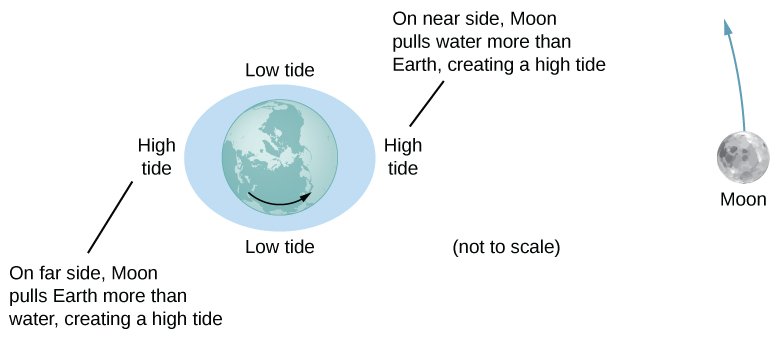
And just as here on earth we have two tides, one rising as the Moon is high in the sky and the other 12 hours later, the tides of the galaxy will pull the stars in an open cluster in a forward direction, relative to its motion around the galactic center, and in a backward direction.

We all know that the tides are caused by the gravity of the Moon and a bit by the Sun but actually every object in the Universe has a gravity that causes a tidal force. (Credit: Time and Date)

Now Newton’s laws predict that the two tides will be of equal strength, with an equal number of stars leaving in each direction. Certain versions of MOND however predict that the forward tide should be just about twice as strong as the backward so that twice as many stars should drift away in that direction.

Newton would predict that the stars leaving an open cluster would do so equally from the front and back but the astrophysicists at the University of Bonn are seeing twice as many leave by the front. Could Newton be wrong? (Credit: Phys.org)

Needless to say trying to determine just which stars that are near an open cluster were actually once members of that cluster is no easy chore but the team from the University of Bonn succeeded with five open clusters and their results, published in the Monthly Notices of the Royal Astronomical Society strongly indicate that some variety of MOND is at work here.

So astronomy and astrophysics today have a couple of really big problems to be solved. Wouldn’t it be interesting if the solution to one problem is also the solution to the other? I mean, what if MOND is that extra factor effecting Dark Energy? We’ll just have to wait and see.

Geology News for December 2022: The Surface of our Planet is made up of a series of jigsaw puzzle pieces called Tectonic Plates. Two new studies show how Geologists are learning more about how those Plates behave over time.

In was during the 1970s that the science of geology was revolutionized by the theory of Plate Tectonics, the idea that the surface of the Earth was cut up into a number of plates that moved relative to each other. As those plates slide past, or butt up against each other mountains rise, volcanoes erupt and earthquakes are generated. There are even places where one plate slides over another causing a ‘subduction zone’ where the deepest parts of the oceans occur. The theory of plate tectonics explains so much of what we see in the rocks around us that it is central to the entire study of geology.

The surface of the Earth is very much like a jigsaw puzzle except that some pieces are getting bigger while others are getting smaller and they’re all pushing and shoving against each other. (Credit: Google Play)

Central perhaps but like most theories plate tectonics is incomplete, there are still some details to be worked out and geologists around the world have been kept busy trying to understand exactly how plate tectonics works. This week’s post is about two such studies.

The major pieces of Earth’s puzzle, the tectonic plates on which the continents ride. (Credit: Earth How)

The first study deals with those subduction zones and how they are generated. The study comes from the Instituto Dom Luiz at the University of Lisbon Portugal along with the supercomputer at the Johannes Gutenberg University in Germany. And, like many scientific studies nowadays, this one uses a computer model to analyze more data than any human being could ever manage to do. In fact the study would not have been possible even with the supercomputer had it not been for the recent development of a much more efficient computational code by the programmers at Johannes Gutenberg.

Modern supercomputers are revolutionizing the way that large scale studies of natural processes are carried out. (Credit: IEEE Spectrum)

Combining the geological expertise of the University of Lisbon with the computing power of Johannes Gutenberg the program was applied to the problem of the development and evolution of subduction zones. For the first time all of the various forces at play at the interface of two plates were taken into account in order to calculate a 3D model of a of how one plate pushes another beneath it down into the Earth’s mantel.

Subduction zones, where one plate is forcing another down into the Earth’s mantel, are regions of great geological activity with earthquakes and volcanoes. (Credit: www.columbia.edu)

Beginning with the many trenches that make up part of the Pacific’s ‘Ring of Fire’ the researchers found that subduction zones follow a rhythmic ebb and flow, with existing trenches slowing in their growth and then being followed by new ones near the same locations. Having used their new model to study the trenches in the Pacific the geologists now hope to apply it to other areas of the Earth like the Caribbean, the Antarctic and even the Atlantic Ocean off of Lisbon. In fact there is evidence that a new subduction zone has started in the waters just off of Portugal, one that may be the beginning of a new ‘Ring of Fire’ that could someday encircle the entire Atlantic Ocean!

The ‘Ring of Fire’ surrounding the Pacific Ocean is formed by all of the plates around the Pacific squeezing in on it! (Credit: National Geographic Society)

Even as one group of geologists learns more about one facet of tectonic activity another, led by scientists at Trinity College in Dublin, Ireland is investigating how plate tectonics contributed to one of the most destructive volcanic events in the history of Earth. Known as the Toarcian period the event happened about 183 million years ago during the Jurassic period. At that time massive volcanic eruptions poured enormous amounts of carbon dioxide into the atmosphere and we all know what that means, global warming and environmental destruction leading to a mass extinction event.

Millions of years after the breakup of the single continent Pangaea, the Toarcian period was marked by a huge increase in volcanic activity releasing enormous amounts of harmful gasses into the atmosphere. (Credit: Nature)

Performing a chemical analysis of samples of mudstone obtained from a 1.5 km deep borehole in Whales researchers were surprised to find that the massive upwelling of magma that triggered the Toarcian event occurred at a time when the movement of the tectonic plates had slowed almost to a stop. That evidence seemed to run counter to common sense, wouldn’t magma pushing up from the Earth’s interior lead to increased tectonic activity?

The recent eruption of the Mauna Loa volcano on Hawaii’s big island is a reminder of the power of molten rock forcing its way up to the Earth’s surface. (Credit: BBC)

But perhaps this is one of those occasions where common sense is simply wrong. Perhaps significant tectonic activity acts as a pressure relief valve releasing energy from beneath so that the magma remains deep below the surface. If that were the case then it would be when the movement of the tectonic plates slows that the magma underneath can build up the pressure to upwell and cause destructive geological events like the Toarcian.

By opening up when the pressure at their intake becomes to high Pressure Relief Valves prevent greater damage from occurring. (Credit: North Ridge Pumps)

The study itself will have to be considered by other geologists but one thing is certain, our planet is a complex, very dynamic place and we still have a great deal to learn from it.

Space news for November 2022: Finally, finally after years of setbacks and delays the Artemis 1 mission is launched and so far everything is a total success.

On November 16th, after more than six years of problems, delays and cost overruns, to say nothing of two last minute hurricanes, NASA’s massive Space Launch System (SLS) with it’s Orion man capable capsule was finally launched from Cape Kennedy’s pad 39B. The Artemis 1 mission as the combination is officially designated is an unmanned test of the equipment that will in just a few years take human beings back to the Moon after a more than 50 year absence. In many ways Artemis 1, and its manned successor Artemis 2, are a reboot of the Apollo 8 mission that first took humans to orbit the Moon.

On the Apollo 8 mission Borman (l), Lovell (r) and Anders (c) became the first humans to go to, although they did not land upon, another celestial body as they orbited the Moon. (Credit: National Air and space Museum)

All of this was supposed to happen back in 2016, the huge SLS rocket that serves as the lunch vehicle was going to be easy to design and build. After all the main engines were the same RS25 engines that powered the space shuttle and the solid fuel boosters on each side of the rocket’s core stage were just longer versions of the shuttle’s solid fuel boosters. The problems just kept multiplying however and the delays, and cost overruns caused the program to take twice as long and cost nearly three times what was originally allocated.

The Artemis Program is a scaled back version of the Constellation Program the NASA developed backs in the early 2000s. (Credit: SlidePlayer)

Even once the SLS got to Cape Kennedy the problems continued to pile up with hydrogen fuel leaks alternating with the threat of hurricane winds to cause a series of small delays. Even on the day of launch itself a small hydrogen leak was detected after the SLS had been fueled that required a team of engineers to go out to the pad and tighten some valves on the rocket before liftoff.

As if the engineering problems weren’t enough even the weather caused problems for Artemis 1 as two hurricanes delayed the launch. (Credit: Space Channel)

Still when the countdown went to zero and the engines ignited the SLS, the most powerful rocket ever built, that’s in terms of initial thrust, performed flawlessly, lifting the Orion capsule, its European Service Module (ESM) along with an Interim Cryogenic Propulsion Stage into Earth orbit. So powerful was the takeoff that the mobile launch pad, which had carried Artemis back and forth to the Vehicle Assembly Building several times, was damaged.

Some of the damage sustained by the mobile launch pad used by Artemis 1. (Credit: Florida Today)

Once Orion was in orbit the SLS had completed its task, ten years of costly development for a mere eight minutes of performance. Now the engineers will have to go over the data thoroughly but the big rocket certainly proved that it could do the job it was designed for. Approximately forty minutes after achieving orbit the Interim Cryogenic Propulsion Sage fired its engine for an eight minute burn that sent the Orion capsule and the ESM on an Earth escape trajectory to the Moon.

Years behind schedule and billions over budget at least the Space Launch System (SLS) worked perfectly when it finally did launch. (Credit: Geek Wire)

The rest of the mission is up to the Orion capsule and it’s service module, which was designed and built by the European Space Agency (ESA) as their contribution to the Artemis program. According to the mission plan the spacecraft was to pass behind the Moon and there perform a four minute burn of the ESM’s engine to place Orion in a lopsided retrograde orbit around the Moon that would bring the spacecraft closer than 100 kilometers to the Lunar surface and take it further than 60,000 kilometers. This burn was successfully carried out on the 21st of November.

Currently (3 December) the Orion Spacecraft is in a distant retrograde orbit around the Moon. This orbit was chosen in order to more fully test the capabilities of the Orion capsule and its European built Service Module. (Credit: The Coalition for Deep Space Exploration)

O’k, so what’s a retrograde orbit and why it that important for Artemis? Well if you take your right hand, point your thump up while wrapping your fingers around, see image, and imagine that your thumb is the Sun’s north pole then virtually everything in our Solar System orbits, rotates, spins around the Sun in the direction your fingers point, their angular momentum is counter-clockwise.

Spin can occur in two directions, like your right hand, seen above, or left hand. Because most people are right handed that direction has been defined as positive while left handed is negative. It just so happens that our Solar System as a whole is righted handed. (Credit: Rolling Motion)

Only a few objects, like the spin of Venus on its axis and several of Jupiter’s smallest, and farthest moons rotate in the opposite direction, clockwise and are said to have a retrograde motion. Now the engineers at NASA wanted Orion to be put into this unusual orbit in order to push it a bit, to see if the spacecraft and the ground systems tracking it, could handle the extra strain. This mission is intended to test the equipment after all.

At the farthest point in its orbit from Earth the Orion capsule takes a selfie with the Earth and Moon in the background. (Credit: Friends of NASA)

So the plan was for Orion, with its ESM to orbit the Moon until the 1st of December when a final burn of the ESM’s engine set the spacecraft on a return path back to Earth. Reentry and splashdown are scheduled for December eleventh off the California coast in the Pacific Ocean.

The splashdown of Apollo 11. It’s been a long time since a man capable capsule has returned from the Moon but hopefully that’s about to change. (Credit: DesignNews.com)

If the mission ends as successfully as its gone so far then the Artemis 2 mission is scheduled for sometime in 2024. That mission will be manned and for the first time in fifty humans will return to Lunar Orbit although not actually land on the Lunar surface. That event is going to have to wait for Artemis 3 and the development of a landing module.

While changes could still be made it is expected that the Artemis lander will look something like this. How long its development will take is the big question. (Credit: Space.com)

It’s been along time since humans last walked on the Moon but the Apollo program that put men on the Moon had no plan for a follow up, no intention of staying on the Moon. Artemis may be slower but it is designed as a step-by-step program leading to a permanent base on the Moon. This time we plan on staying.  

Paleontology News for November 2022:

Paleontology is the science that’s all about origins. Whether it be the origin of life itself or the beginnings of a certain aspect of some living creatures, let’s say warm bloodiness, paleontology seeks to understand when and how the different characteristics that living creatures possess came to be. In this post I’ll be discussing three such important characteristics and as usual I’ll begin in the distant past and work my way forward in time.

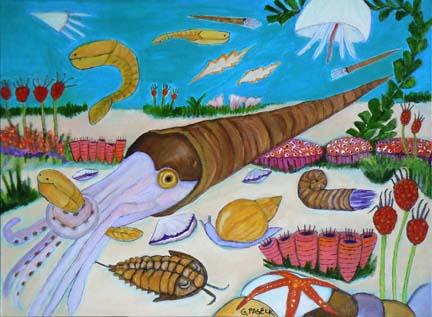
O’k ‘The Cambrian Explosion’ is really just a metaphor but the sudden appearance of so many different life forms at the same time was a unique event in the history of life. (Credit: Think Big)

I have mentioned the Cambrian period several times in these posts, see posts of 16 June 2018 and 2 December 2020. The Cambrian is unique in the history of life because that is the time when a large diversity of living creatures first appears in the fossil record, a phenomenon known as the Cambrian explosion. In the fossils from the Cambrian however we can already recognize animals that are clearly molluscs, or echinoderms, or worms, or arthropods. In other words the major groups of animals known as phyla are already distinct, which means a lot of evolution has already happened. If we want to study the relationships between those major groups, say that between the segmented worms and arthropods, we need fossils that are either from before the Cambrian or from a creature in the Cambrian that contains features unique to two or more distinct phyla.

In order to understand how the various phyla of animals are related to each other we either need evidence from before the Cambrian or ‘missing links’ that share characteristics of two or more phyla. (Credit: ResearchGate)

A recent fossil from China falls into that latter category. The creature is a one centimeter long worm like animal covered with both armoured plates and hair like bristles that has been given the name Wufengella. This creature packs a lot of anatomy into its tiny frame linking three different phyla, the brachiopods (bivalved animals that are not related to clams), bryozoans (known as moss animals) and phoronids (horseshoe worms).

Wufengella, from the late Cambrian, appears to be one of those Missing Links, having features of several very different types of creatures. (Credit: Wikipedia)
Brachiopods (l) may superficially look like clams (r) but the animal inside the bivalve shell is completely different, from a different phyla. (Credit: Wikipedia)

The fossil has been dated to 518 million years ago, near the end of the Cambrian period and so therefore it is not a ‘missing link’ ancestor to those three phyla but rather a now extinct cousin of the brachiopods, bryozoans and phoronids who possessed features of them all. The paper describing Wufengella was published in the journal Current Biology and was written by a large group of paleontologists from a number of universities in both China and the United Kingdom illustrating once again the value to science of cooperation between nations no matter what the quarrels created by their governments.

The original fossil of Wufengella (l) and an artists rendering (r). (Credit: Sci.ners)

One anatomical structure that is of critical importance to many animals is the one with which they eat, their jaw. Different types of animals built their jaws in different ways, arthropods for example built their jaws from modified legs, that’s why close ups of insects eating look so creepy to us. Humans and other vertebrates however developed our jaws from bones that originally held our gills in place, that’s why human fetuses still develop gills about five weeks after fertilization, if we didn’t we wouldn’t have either a jaw or an inner ear.

Human Embryos do in fact develop gills and gill slits. That’s where our jawbones came from and where they first appear. (Credit: Vedantu)

In a previous post I discussed how the early jaws of vertebrates evolved and diversified in the Devonian period, some 400 million years ago, see my post of 30 April 2022, but how the very first vertebrate jaw evolved is still a subject of debate among paleontologists. The one thing that was agreed upon was that, since there were so many different vertebrates with so many different sizes and shapes of jaws during the Devonian, the first jaw must have developed before that time, perhaps during the preceding Silurian period, around 440 million years ago.

By the Devonian period many species of fish possessed jaws. This guy’s are quite impressive. In order to find the first fish with a jaw paleontologists have had to go further back, into the Silurian period. (Credit: The applied Ecologist)

Now a series of four papers in the journal Nature have described a series of early species of jawed fish from the Silurian that are so diverse that they may force paleontologists to look even further back for the first jaw, perhaps as far as the Ordovician period some 480 million years ago. The Silurian fossils were unearthed in a pair of fossil beds outside of Chongqing in southern China and contain both cartilaginous fish, like modern sharks and rays, along with bony fish.

The species discovered represent not only a variety of different types of jaws but different body types, from the wide flat bottom dwelling shape of Xiushanosteus mirabilis and Tujiaspis vividus to the sleek, fast swimming shark like shape of Shenacanthus vermiformis and Fanjingshania renovata. With so much diversity it is obvious that the fish unearthed in China have a lot of evolution behind them, meaning that paleontologists will have to look even further back in time, to the Ordovician period in order to understand how the earliest members of our own phyla came into being.

With a life style that probably resembled a founder’s Xiushanosteus mirabilis already had a well developed jaw when it lived during the Silurian. (Credit: The New York Times)
Shenacanthus vermiformis was a very different kind of fish but, like X mirabilis it too had a well developed jaw. So the common ancestor of this two species, the first jawed vertebrate, must have lived even earlier. In the Ordovician perhaps? (Credit: The New York Times)

Moving forward in time another important innovation in vertebrate animals is the wing, which has allowed thousands of different species to fly. Nowadays when we think of wings we think of birds or bats but they weren’t the first vertebrates to fly, that honour belongs to the family of lizard-like contemporaries of the dinosaurs known as the Pterosaurs.

The Pterosaurs were a large and diverse group of flying reptiles during the age of the dinosaurs but they were not themselves dinosaurs. (Credit:Wikipedia)

Now a reexamination of fossils discovered a hundred years ago in Scotland may have identified the pre-flying ancestors of the pterosaurs. Known as Scleromochlus taylori the small reptile went unappreciated in part because of the incredibly hard 237 million year old limestone blocks in which it was encased.

Not a very impressive creature the small 237 million year old reptile Scleromochlus may have been the common ancestor of the pterosaurs. (Credit: The Indian Express)

The question of how the pterosaurs evolved to fly has been debated as long as how the birds first flew and with pretty much the same arguments. Most paleontologists thought that tree climbing reptiles who began gliding from branch to branch eventually developed leathery wings which they starting flapping for powered flight. The fossils of S taylori however tell the story of a small, fast running ground runner.

Fossils in Limestone can be almost perfectly preserved, but are a bitch to get out of the rock. No wonder it took a long time to discover just exactly what S taylori was. (Credit: Wikimedia Commons)

The researchers at Edinburgh University discovered the connection between S taylori and pterosaurs only when they performed CT scans of the limestone encased fossils revealing for the first time some of more delicate details of the animal’s anatomy. Details like a head too large for its body and a femur with a hook to it that fits into a slot in the hip so that the animal’s legs go straight downward instead of sidewards like a lizard’s or crocodile’s.

Nowadays paleontologists use advanced technology in order to learn everything they can about their fossils. (Credit: Rapid City Journal)

S taylori was a runner, catching insects near the ground and maybe it started using flaps on its forearms to help it catch its prey. Flaps that got larger and larger until the creature took off like…well, like a pterosaur!

The pterosaurs were the largest animals to ever fly. The sight of one of these babies soaring overhead would have put an eagle to shame! (Credit: Biosphere Magazine)

By studying the anatomy of ancient life paleontologists not only learn about the lives of creatures of the past but of how different species relate, the family tree of life on Earth.

Astronomy New for November 2022: Saturn’s Rings and the end of planet Earth. Don’t worry it’s not for a while yet.

Nowadays we’re all used to seeing beautiful images of astronomical objects, whether from Hubble or now James Webb or from some other observatory. To my mind however, nothing beats seeing the planet Saturn with your own eyes through even a small telescope. Somehow looking through a telescope is different; maybe it’s the movement of the air causing a little shimmer that makes it seem different from an image.

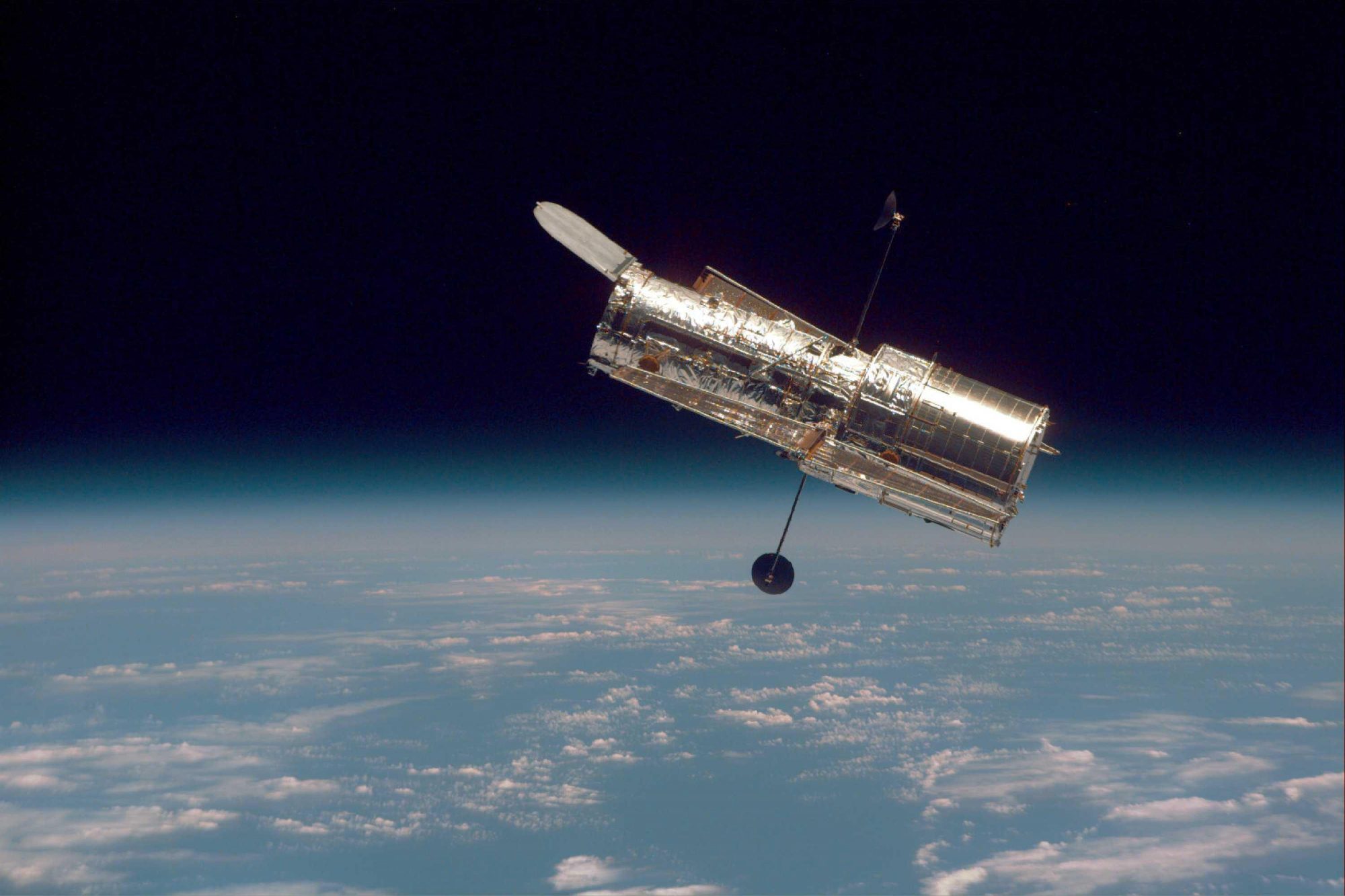
A beautiful image of the planet Saturn even showing a ring of Aurora around the south pole. (Credit: Hubble Space Telescope)

 Of course it’s the rings that make Saturn the most beautiful planet to see. They just seem so unreal, fairy like in a sense. And in a telescope they seem to be as solid as the planet they circle, even though in your mind you know that they are actually made up of trillions, hey millions of trillions of small snowballs. Each snowball a separate moon with its own orbit around Saturn.

From here on Earth it looks like Saturn only has a few rings but up close it’s easy to see hundreds if not thousands of small ringlets in this enhanced image taken by Voyager 2. (Credit: NASA Space Place)

Back before the space age it was thought that only Saturn had rings, you couldn’t see any around any other planet using the telescopes of the 1950s or earlier. Some astronomers claimed to see faint rings around Uranus but it wasn’t until 1977 that observations by James Elliot, Jessica Mink and Edward Dunham convinced the astronomical community that Uranus did indeed have rings. Then in 1979 as the Voyager 1 space probe was flying by Jupiter a couple of its images of the giant planet showed a faint ring system, a discovery that Voyager 2 would confirm a few months later. Finally in 1989 Voyager 2 found that the last of the solar systems gas giants, Neptune also had a set of rings. Since all of the solar systems giant planets are now known to have rings astronomers have begun to wonder if there is some connection, do all gas planets, even those in other solar systems, have rings.

After Saturn the planet Uranus has the best set of rings as seen in this Hubble image. (Credit: Universe Today)

Which of course begs the questions, why do any planets have rings? How do rings form, and how long do they last. Since we’ve never actually seen a ring system forming we really only have theories and educated guesses and astronomers have argued for decades over the details.

One thing we do know about planetary rings is that they are not solid but made up of billions and billions of small moonlets. (Credit: Shutterstock)

For a big ring system like Saturn’s the leading theory has always been that one of the planet’s moons got too close and was disintegrated by tidal forces generating the trillions of particles making up the rings. As I said that theory has been around for nearly a hundred years but now a new analysis by a team of astrophysicists at MIT is using data collected by the Cassini spacecraft that studied the Saturn system between 200 and 2017.

Two major models for how Saturn’s rings formed. Either a moon got to close to Saturn and was pulled apart by tidal forces or an object from the Kuiper belt got to close. (Credit: Science)

As you may remember, NASA ended the Cassini mission by taking the space probe closer and closer to the giant planet until it finally burned up in Saturn’s atmosphere. By tracking Cassini’s path as it got closer and closer the researchers were able to actually measure the distribution of Saturn’s mass within its body, in other words how much of Saturn’s mass was deep in the planet’s core, how much near the surface etc.

The Cassini spacecraft studied Saturn and its moons for thirteen before plunging itself into the giant planet’s atmosphere and burning up! (Credit: Jet Propulsion Labouratory)

That distribution, technically known as the ‘moment of inertia’ was the missing piece of the puzzle to carry out hundreds of computer simulations of an ancient moon of Saturn, which has been given the name of ‘Chrysalis’ being torn apart by the planet’s gravity to form the rings. According to the simulations Chrysalis was about the size and mass of Saturn’s remaining moon Iapetus, about 700 km in diameter. What happened to Chrysalis is that roughly 160 million years ago the gravity of Saturn’s big moon Titan sent Chrysalis too close to the planet where it broke up. So our best estimate now is that Saturn’s big, beautiful ring system probably formed during the age of the dinosaurs!

The beginning of the end for Chrysalis? That’s the leading model for where Saturn’s rings came from. (Credit: PBS Learning Media)

The same thing may happen before too long, cosmically speaking with another moon around planet in our solar system. Phobos, the larger, closer moon of Mars is getting ever closer because of tidal forces drawing it towards the planet. It has been estimated that in about 50 million years Phobos will start to break apart giving Mars a ring system of its own.

Phobos, the bigger, and closer moon of Mars. Are those lines stretched across the moon’s surface signs that Phobos is being pulled apart? Astronomers think that may be so! (Credit: NASA)

Before I go I would like to mention several news stories that have been circulating about the eventual fate of our own planet Earth. According to the stories, based on a paper published in the Astrophysical Journal, as the Sun uses up its hydrogen fuel its core will shrink and grow hotter until it begins to burn helium as a fuel. As the core gets hotter the outer surface of the Sun will expand turning the Sun into a red giant star like Betelgeuse or Antares. As the Sun’s atmosphere expands it will engulf the planets Mercury and Venus and perhaps even our Earth. the news stories hasten to assure their readers that these events will not occur for another 4-5 billion years.

When a star runs out of its hydrogen fuel it begins to burn helium. That causes the star to puff up and become a red giant star. The familiar stars Betelgeuse and Antares are both red giants. (Credit: Forbes)

Well actually that’s all been known since about the 1950s when astrophysicists combined the data from the Hertzprung-Russell diagram with nuclear research to determine the life cycle of stars. That was when the idea that our Sun was a ‘main sequence’ star with a life span of about 10 billion years and was about half way through that span was developed. After the main sequence our Sun will have just about one billion years as a red giant. The question of whether or not the Sun will expand enough to devour the Earth has been debated now for more than 60 years.

The Hertzprung-Russell diagram of star absolute brightness versus surface temperature. This diagram was instrumental in understanding the life cycle of stars. (Credit: Center for Astrophysics and Supercomputing)

What the new study was actually about was what would happen to those planets, Mercury and Venus and maybe Earth, that are engulfed by the Sun as it grows. Once again computer simulations were carried out giving a range of possible fates for those planets but anyway you look at it the planets will certainly be destroyed.

Astronomers think that about 5 billion years from now, as the Sun becomes a red giant, there’s about a 50-50 chance that our Earth will be devoured. In either case our planet won’t be a pleasant place to live anymore! (Credit: Forbes)

But then nothing lasts forever, even planets.

Education in the United States has been suffering for decades and now we are beginning to see how much further damage the Covid-19 epidemic has done.

In several previous posts I have argued that the United States became the world’s richest and most powerful country not because of our many freedoms, nor thanks to our heroic military. No, in my opinion the US owes it’s status as the world’s superpower because of its educational system, because of our nation’s determination that all of its citizens should have free access to primary and secondary schools while at the same time taking an active role in helping its brightest young people to attend college, whatever their families financial situation. For over a hundred years, from about the 1880s into the 2000s the US graduated more high school students and more college and university students than any nation on Earth. See my posts of 23 June 2021 and 12 July 2017.

Dozens of Colleges and Universities here in the US were initially funded by land grants from the Federal Government. This active promotion of education at all levels of government is the primary reason we now enjoy our status as the world’s richest nation. (Credit: Urban to Ag – WordPress.com)

The benefits of having the world’s largest and best public educational system should be obvious but because so many people nowadays are blind to the obvious I’ll take a moment to mention just a few. By educating its large population the US possessed the trained workforce needed to build the wealthiest economy in history. With the largest number of scientists and engineers that economy grew ever more productive as new inventions were developed and old problems were solved. To put it simply the United States of America had the well-educated, well-trained people it needed to get things done and that, more than any other reason, is why the 20th century was the American century. America’s dominance in science and industry was only made possible by America’s dominance in education.

We used to honor education and our educators in this country. Maybe we’d better get back to doing that. (Credit: ebay)

All that began to change about forty years ago during the Reagan administration. Reagan’s emphasis on lower taxes and smaller government did not immediately effect education, at least it wasn’t supposed to. As time went on however and lowering taxes became the only “proper” way to boost the economy shrinking government budgets meant less money for education leading to lower teacher salaries, larger classroom size and poorly maintained, crumbling schools and school facilities.

Reaganomics does not work. All it has done is caused ever growing deficits and debt while causing an enormous decline in education and infrastructure. (Credit: Mar Martinez Blog)

Public schools faced another threat as well as the “private sector” of the economy came to be preferred over the “public sector”. Private, charter schools grew in number as some parents sought to insulate their children from the growing problems at public schools. Charter schools possessed several advantages over taxpayer funded schools. For one thing since they were not legally obliged to accept all students so that any child who became a disciplinary problem was simply expelled and sent back to the public schools. Because of this, over time discipline in many public schools, especially inner city public schools grew worse and worse when compared to their private school rivals. And because of that those parents who cared about their children’s education more and more sent their kids to charter schools, a vicious feedback mechanism that continues to increase the gap between private and public schools even today. 

Charter Schools are ‘For Profit’ institutions. Hence they exist to make money not educate students. When a charter school fails it simply closes its doors leaving its students without a school to attend. (Credit: Weapons of Mass Deception)

Recently even higher education has begun to feel the strain. College enrollment, which reached a peak of 70% of recent high school graduates in 2016, had dropped a full 7% to 63% by just 2020. The causes for this are many but the increasing cost of a college degree along with stories of the crushing debt of student loans on people with bachelor’s degrees has made a growing number of young people question the value of higher education, whether or not a four year degree is really worth the time and money. In fact the state of higher education has declined so much that while back in 2000 the US was second in the world for the proportion of its population between the ages of 25 and 34 with a college degree by 2020 it had fallen to 16th.

The growth in numbers of high school graduates going on to college that occurred during the last half of the 20th century has ended in the 21st, and may even be going down! And that was before Covid! (Credit: Admissionly.com)

So all in all the state of education in this country was pretty bad and getting worse BEFORE the pandemic set in. For the past two years students have been in and out of classrooms, either trying to learn remotely at home on a computer, or at school while social distancing and wearing a mask. The confusion and uncertainty must have surely combined to make learning all that much more difficult.

I don’t know about you but I’m tired of talking about Covid. Unfortunately it’s still out there effected nearly every part of our lives, even education. (Credit: CDC)

Now the results of standardized testing for 9 year olds has shown the effect that Covid-19 has had on education in this country. The National Assessment of Educational Progress tests have been conducted since the 1970s as a means of quantifying the basic ability in math and reading of third graders throughout the country. This year the tests were given to 14,900 nine year old third graders and the results compared to those taken in 2020 immediately before the pandemic.

The worst part of the decline in students test scores is that the students that needed the most help saw the biggest decline. (Credit: John Locke Foundation)

The comparison showed a dramatic difference. For the first time ever math scores declined while reading scores saw their largest drop in over thirty years. Worse, the declines were not evenly spread across all ability levels. In math the top 10% of students saw a decline of only 3 points while the lowest 10% saw a 12 point drop, four times as great. And the decrease had a racial component to it as well. Black and Hispanic students on average saw a full 13 point drop compared to only a 5 point drop for the White counterparts. The declines in reading were similar and together they indicate that two decades of progress in education had been wiped out a little over a year.

Minority students had been making considerable progress, catching up to their white counterparts between the years 1970 and 2017. At least some of that progress has been lost due to the pandemic. (Credit: Education Next)

And for children falling behind in first, second or third grade can lead to continuing problems throughout their school careers. So it is that our nation’s educational system, which has been suffering from neglect for decades, has now been further damaged by the pandemic.

Students who fall behind in elementary school rarely catch up. All to often a human brain is already wasted before they are 10 years old! (Credit: Vox)

I’d like to end this post on a somewhat more hopeful note. On the 24 of August President Biden issued an executive order eliminating $10,000 dollars in student loans for millions of Americans and up to $20,000 dollars for Pell grant recipients. Only time will tell if this is the beginning of renewed emphasis on education in this country, but at least it’s something.

P.S. Just a few days after publishing this post another report was released that details the math and reading abilities of 4th and 8th graders here in the US. The National Assessment of Educational Progress, often referred to as the nation’s report card, has been tracking the advancement of our country’s children since the 1990s and this year’s report showed the biggest decline in math and reading scores ever measured.

According to the report math scores for eighth graders fell in every state, every state, with only 26 percent of students showing proficiency in math, down from 2019’s 34 percent. Fourth graders did little better with 36 percent showing proficiency, down from 41 percent, while there were declines in 41 states. The results for reading were little better with 33 percent of fourth graders and only 31 percent of eighth graders being proficient. Once again the scores for the most vulnerable students saw the biggest drops clearly showing that we are in danger of producing an entire generation of the uneducated at just the time when our nation needs all the brains it can get.   

The Nobel Prizes for 2022 are Announced. This year it’s the award for Physiology that’s the most interesting and unusual.

It’s early October and that means it’s Nobel Prize time, the one time of the year when the media pays at least some attention to science.

TV doesn’t completely ignore Science, there are a few good Science programs like PBS’s Nova. However compared to all of the cop and doctor shows finding anything about Science is like looking for a needle in a haystack. (Credit: PBS)

The prize for physiology or medicine came first this year on the 3rd of October and the award went to arguably the most interesting of all of this year’s recipents. The winner was the Swedish geneticist Svante Paabo who was honoured for his work in sequencing the entire genome of our ancient cousins the Neanderthals and comparing it and the DNA of another extinct close relative the Denisovans to that of modern humans. 

Nobel laureate Svante Paabo with one of his research subjects. (Credit: ABC News)

Dr. Paabo spent more than 20 years assembling bits and pieces of Neanderthal DNA from the best preserved teeth and bones of that extinct species. The task was made more difficult because the minute amounts of ancient DNA that are preserved in fossilized samples can easily be swamped by modern DNA from bacteria or even the paleontologists who unearthed it. In order to carry out his work Paabo first had to develop the clean room facilities and policies that would minimize contamination and even then he had to learn how to separate the ancient DNA from whatever modern DNA that still remained.

Finding ancient DNA is no easy task. Much of it is lost and what little remains can be swamped by the DNA of the scientists unearthing it. (Credit: Nobel Prize)

When Dr. Paabo finally succeeded in assembling the entire Neanderthal genome what he discovered was that the Neanderthals haven’t quite gone extinct. In fact around 50,000 years ago there was a good deal of mixing going on between our ancestors and both the Neanderthals and Denisovans so that today most Europeans and Central Asians have as much as 5% of their genes coming from those ancient relatives.

It’s not quite this straightforward but all of us have inside us the remains of our ancient past. (Credit: Goodreads)

The next day the Physics award was announced and this year’s Nobel went to John Clauser for work carried out in the 1970s at the Lawrence Berkeley Labouratories in California, Alain Aspect, who extended Dr. Clauser’s work during the 1980s at the University of Paris along with Anton Zeilinger of Austria who continued the work of Clauser and Aspect. What the three men studied that won them their Nobel was the strange, almost eerie phenomenon called quantum entanglement, a concept that Einstein rejected as ‘spooky action at a distance’.

This year’s winners of the Nobel Prize in Physics. From left to right Alain Aspect, John Clauser and Anton Zeilinger who all contributed to our knowledge of quantum entanglement. (Credit: Nobel Prize)

Quantum entanglement occurs when two or more particles are placed into a system whose characteristics are measured; let’s say a system of two particles with one spin up and the other spin down. If the two particles are then carefully separated, careful being why Clauser, Aspect and Zeilinger received a Nobel prize, the particles remain entangled so that if one is measured to be spin up then the other, no matter how far away it may now be, has to be spin down.

Einstein didn’t like the concept but thanks to the work of Clauser, Aspect and Zeilinger we now know that quantum entanglement is a real part of our Universe. (Credit: NASA)

Besides being an interesting phenomenon in its own right quantum entanglement also has practical applications in the fields of quantum information and quantum computing. So the work of Doctors Clauser, Aspect and Zeilinger may become even more important in the next few decades.

The next revolution in computers may be quantum computers, which operate on principles related to quantum entanglement. (Credit: DUG Technology)

The Nobel prize for Chemistry came next and was announced on the 5th of October. This year’s award went to Carolyn R. Bertozzi of Stanford University in California, Morten Meldal of the University of Copenhagen in Denmark along with K. Barry Sharpless of the Scripps Research Institute in the USA. The three chemists were awarded the prize for their research into ‘click chemistry’ different techniques that allow molecules to be clicked together like lego blocks in order to build larger molecules.

This year’s winners of the Nobel Prize in Chemistry are, left to right, Carolyn Bertozzi, Morten Meldal and K. Barry Sharpless. This is Dr. Sharpless’ second Nobel a feat only accomplished by five scientists. (Credit: The Washington Post)

It was Doctor Sharpless who coined the term click chemistry in the year 2000 when he and Doctor Meldal independently discovered a chemical reaction called copper-catalyzed azide-alkyne cycloaddition that has allowed a tremendous number of different large molecules to be assembled. Doctor Bertozzi then extended the concept to chemistry performed on biomolecules, often molecules on the outer surface of living cells. These developments have led to new medicines for the treatment of cancer and the sequencing of DNA.

Alkyne-Azide was the original click developed independently by Sharpless and Meldal but in the years since other such techniques have been discovered. (Credit: Research Gate)

The chemistry prize was notable for two other reasons because Dr. Bertozzi is the only woman to be awarded a science Nobel this year, becoming only the eighth woman to do so. Also, Dr. Sharpless’ award makes him the fifth person to receive two Nobels, his first came in 2001 for his work on chirally catalyzed oxidation reactions.

The element Copper is very toxic to living cells so Dr Bertozzi developed a copper free form of click chemistry. (Credit: GeneLink)

Finally on the 10th of October the economics prize given ‘in memory of Alfred Nobel’ was awarded to Ben Bernanke, the former head of the US Federal Reserve along with Douglas Diamond of the University of the University of Chicago and Philip Dybvig of Washington University in St. Louis. The three men were honoured for their work on the role of banks in financial crises.

And the Nobel Prize for economics goes to, left to right, Ben Bernanke, Douglas Diamond and Philip Dybvig for their work on Banks during financial crises. (Credit: Kyodo News)

While the studies carried out by Bernanke, Diamond and Dybvig were conducted back in the 1980s the results became very important during the financial crisis that shook the world’s economy in 2008. Ben Bernanke was of course Federal Reserve Chief at that time and so he had the opportunity to put his own research into action.

Ben Bernanke’s position as Chief of the US Federal Reserve during the financial crisis of 2008 gave him the chance to put his theories to good use. (GAO)

Bernanke’s work demonstrated how bank failures during the great depression of the 1930s were not caused by the initial recession but instead drove the recession into a deep depression. Bernanke showed how the loss of information about lenders that occurred when banks failed made it difficult for the economy to recover, lengthening the time of the depression. Diamond and Dybvig meanwhile investigated the role of banks in linking lenders and borrowers in ways that are mutually beneficial to both.

The man and his prize. Alfred Nobel funded the prizes in his honour in his will. (Credit: Famous Scientists)

Alfred Nobel’s intend in establishing his prizes was to encourage new and innovative discoveries that would be valuable to all humanity. The work of this year’s recipients demonstrate how well he succeeded.  

Space News Special: NASA’s Double Asteroid Redirection Test (DART) is a successful first demonstration of a Planetary Defense Shield.

One of Hollywood’s favourite science fiction plots is that of a massive asteroid or comet headed straight for our planet, a threat to our civilization if not to all life on Earth. The recent movie ‘Don’t Look Up’ (See my Post of 5 January 2022) is just one of many such productions. Of course one reason that the plot is popular is that the threat is actually very real; 66 million years ago the dinosaurs were driven to extinction by a space rock some 10 kilometers in diameter colliding with the Earth.

A somewhat more serious take on the end of the world by asteroid was the 1998 film ‘Armageddon’. (Credit: Rotten Tomatoes)

While 66 million years may seem like a long time scientists are now coming to realize that collisions with smaller asteroids are fairly common, and can still be quite destructive. Archaeologists now have evidence that it may have been an asteroid strike that gave birth to the legend of Sodom and Gomorrah (see my post of 6 October 2021) while the demise of the mound builder culture here in North America has also be linked to an asteroid. So the possibility of a large space rock coming down in the middle of a densely populated area and causing a tremendous amount of destruction is very real.

In 1908 a meteor crashed in the Tunguska region of Siberia. Fortunately few people were hurt because the region was so remote but few such unpopulated areas exist anymore so the next such event could cause enormous destruction. (The Conversation)

Before the space age there was really very little that humanity, or indeed any of Earth’s species, could do to protect themselves from an asteroid strike. The dinosaurs certainly had no idea an asteroid was taking aim at them and they surely all died having no idea what it was that was killing them.

They surely had no idea! (Credit: Space.com)

We can do something to protect ourselves however, we have the technology. Our successes in space have given us the ability to not only see a potentially dangerous asteroid before it strikes, hopefully years before it strikes, but we can even send a spacecraft to that asteroid in a effort to prevent that strike from ever happening.

There are literally thousands of Near Earth Objects, space rocks whose orbit around the Sun comes close to our Planet’s. Fortunately space is awfully big so we don’t get hit very often! (Credit: Astronomy Magazine)

So the question becomes, what is the best way to stop an asteroid that’s headed straight at our planet. Well Hollywood producers certainly knows how they’d do it, nuke the bloody thing. Trouble is that blowing up an asteroid doesn’t completely solve the problem, it could even make the things worse. After all when you blow up something there are still a lot of pieces of it left. So blowing up an asteroid headed for Earth just means you now have a lot of smaller asteroids headed for Earth.

We may like to blow things up but that’s probably not the best way to avoid getting hit by an asteroid. (Credit: YouTube)

NASA’s plan for dealing with a potentially dangerous asteroid is far more gentle. For one thing the space agency has organized and funded dozens of astronomers to search for any ‘Earth Crossing Asteroids’ that could become a danger in the years to come. They have found several thousand but so far fortunately none of them will strike our planet within the next fifty or so years. What NASA hopes is that, when a dangerous asteroid is finally found we will have years if not decades of warning. That will be enough time to deal with any dangerous asteroid more efficiently, more effectively and even more cheaply.

NASA’s DART Mission to test a possible technique for protecting Earth from dangerous asteroids. The idea is to crash a small spacecraft into an asteroid to see how much we can alter its trajectory. (Credit: Applied Physics Labouratory, Johns Hopkins University)

The idea is to simply nudge the asteroid, not much, just a little. Given enough time, let’s say exactly one year, a change of just one meter per second in the velocity of an asteroid that is headed straight for Earth is all that is needed to cause that asteroid to miss our planet by more than 30,000 kilometers, a fair safety margin. That’s all, just one meter per second to save the Earth, if done early enough.

We all know the old story. Slow but steady wins the Race. (Credit: VirilityUnemployed)

But can an asteroid be nudged? Are they solid enough bodies to be gently pushed, or are they just piles of rubble that might break up from even a nudge? Will slamming a projectile into the asteroid work or will we have to spread our push out in order to keep the asteroid in one piece?

Those are some of the questions that NASA’s Double Asteroid Redirection Test (DART) was designed to find out. Launched on the 23 of November in 2021 the Dart spacecraft was targeted at a system of two asteroids, the larger asteroid is named Didymos and is about 780 meters in diameter. Didymos is orbited by a smaller asteroid named Dimorphos, which is roughly 160 meters in diameter.

The DART Spacecraft isn’t going to study Dimorphos but crash into it. Therefore it only carries the instruments it needs to steer it at its target. (Credit: DART)

The plan was for the DART spacecraft to slam into the smaller asteroid Dimorphos at approximately 6 kilometers per second (kps) after which astronomers will measure the change in Dimorphos’ orbit around Didymos. You see the reason for choosing the smaller in a two asteroid system as a target is that it has always been easier for astronomers to measure the time an astronomical event takes compared to the distance to an astronomical object.

Human beings learned how to measure time by watching the rhythm of the objects in the sky and even today it is easier to measure time in astronomy than distances. (Credit: www.astronomy.ohio-state.edu)

Think about it, how would you, all by yourself measure the distance to the Moon? But, with only a little effort you could measure the time it takes to go from full Moon to full Moon, at least approximately. Ancient astronomers actually knew pretty accurately the time it took the various planets to orbit the Sun before they knew that the planets really orbited the Sun not the Earth.
Measuring the distance to the Moon requires two different observers plotting the Moon’s position against the stars at the same time from a great distance apart. (Credit: Medium)

Before DART reached Dimorphos astronomers had measured the orbital period of that asteroid around Didymos at 11 hours and 55 minutes. It is expected that the collision with DART will reduce that orbital period to about 11 hours and 45 minutes but again astronomers can take their time and get a very precise measurement of that change. Then, using the well-known laws of orbital dynamics, they’ll be able to calculate exactly how much they’ve succeeded in changing the velocity of Dimorphos.

Kepler’s three laws of Planetary motion are still the basis for any study of astronomy. (Credit: Teachers Pay Teachers)

The DART spacecraft got only one chance at hitting Dimorphos however, if it missed the probe and the asteroid would fly past each other at 6 kps never to meet again. So as you can imagine the atmosphere at the Applied Physics Labouratory of Johns Hopkins University was pretty tense as DART drew ever closer to its target. All the apprehension was unnecessary however for the spacecraft’s autonomous control computer behaved flawlessly. At 07:14 PM on the night of the 26th of September DART smashed into Dimorphos less than 17 meters from the asteroid’s center, a bull’s eye at 10 million kilometers.

Just seconds before the crash DART sent back this picture of Dimorphos. Like many asteroids Dimorphos appears to be nothing more than a pile of rubble. (Credit: CNN)

And DART was taking pictures the whole way in, sending back dramatic images of Dimorphos as the asteroid appeared to grow larger and larger. Not only that but the day before the collision DART had released an smaller Italian cube satellite whose job it was to take pictures of the collision from a few kilometers away. Finally there were several telescopes back here on Earth that also got in the act, taking images of the collision from 10 million kilometers distance.

DART crashing into Dimorphos (top center) as seen by the Italian LICIA cubesat. The larger asteroid Didymos is lower left. (Credit: New Scientist)

So all of the hardware worked, DART smashed right into Dimorphos exactly as planned and NASA got plenty of pictures. In the weeks to come astronomers here on Earth will determine exactly how much the asteroid’s trajectory has changed. Then we’ll know whether or not humanity has at least the beginnings, a breadboard model of a technology that could save us from going extinct the way the dinosaurs did.